Racing Against Time: Chinese Automakers Take Over European Factories
 06/17 2026
 505
505
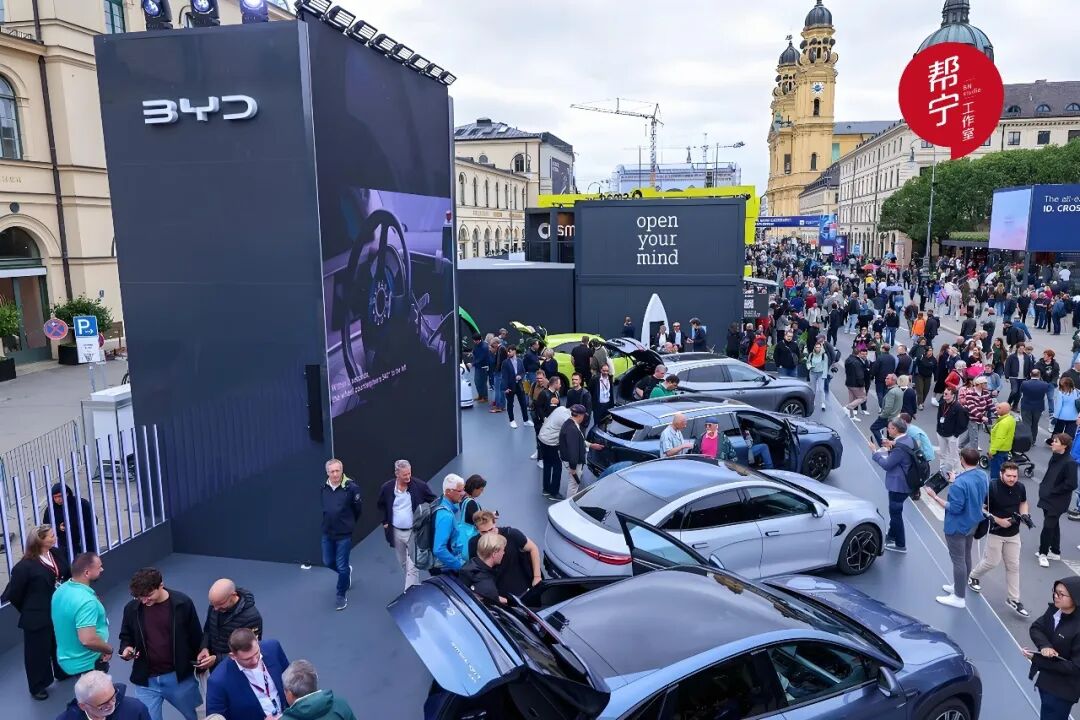
"EU New Regulations Loom: No Time to Build New"
Chinese automakers are racing against time to secure European factories.
Experts and executives believe this sudden wave of Chinese deals is partly linked to the EU's proposed Industrial Accelerator Act (IAA). The IAA is an EU measure designed to protect Europe's industrial base by imposing conditions on foreign direct investment and "Made in Europe" local content requirements.
These measures could reshape the EU industrial landscape, consolidate local brands' positions in Europe, and make it more difficult for Chinese automakers to invest to a certain extent.
However, if Chinese automakers build factories in Europe, they can avoid EU tariffs on imported vehicles. The EU imposes tariffs on Chinese-brand electric vehicles ranging from 10% to a maximum of 45%.
Under the proposed EU bill, foreign investments exceeding €100 million from countries with over 40% global manufacturing capacity in key sectors would require regulatory approval. Relevant to the automotive industry are the electric vehicle and battery supply chains. While the proposal does not specify which countries, it will clearly affect Chinese electric vehicle and battery production.
For an investment to be approved, it must meet most of the following conditions: foreign ownership in joint ventures not exceeding 49%; intellectual property licensed to EU entities; at least 50% EU employees; and local procurement of manufactured goods. According to the proposal, the threshold for EU employees is non-negotiable.
In the EU, the automotive industrial base and employment are being impacted by Chinese automakers. Over the past five years, Chinese automakers' sales in the European market have surged.
Chinese automakers' overall market share in Europe has risen from 0.5% in 2021 to nearly 10% by spring 2026. Almost all these sales come from exports, which are restricted by electric vehicle tariffs.
Local production in Europe would reduce tariff burdens, although it may increase labor and component costs.
"Chinese automakers have always wanted to localize in Europe, but now they see the European (IAA proposal) door closing bit by bit," said Philippe Houchois, an analyst at Jefferies, at the Automotive News Europe Congress on June 10. "They're acting before the situation changes."
Experts estimate the IAA could be launched as early as mid-2027.
A May report by Jefferies estimated that based on announced and reported deals, these automakers could eventually produce over 2 million vehicles annually in Europe.
Alfredo Altavilla, BYD's European special advisor, told Reuters that time pressure is real. Before the IAA takes effect, "there's no time to start building a new factory. All you can do is find a brownfield site, take it over, and refurbish it."
BYD is the first Chinese brand to open a large-scale factory in Europe. Its new factory in Szeged, Hungary, aims for an annual production capacity of 300,000 vehicles and will begin mass production in the fourth quarter of this year, a year behind schedule.
Currently, BYD has suspended plans to open a second regional factory in Turkey. It is exploring opportunities at existing factories in Southern Europe, with Spain as the main candidate.
European automakers are seeking to improve utilization rates and retain jobs—a key goal of the Industrial Accelerator Act. As of December 2024, Jefferies statistics (Note: ' statistics ' is kept as a Chinese term here for context, but translated in surrounding text) that Stellantis had about 1.6 million units of unused capacity compared to 2019 production levels, while Volkswagen Group had 800,000 more units than Stellantis in the same period.
Recently closed European factories include Audi's Brussels plant, Nissan's Barcelona plant, and Ford's Saarlouis plant in Germany. Stellantis' Poissy plant in France will stop producing vehicles after 2028 and shift to recycling operations. Previously, Renault's Flins plant in France took similar action in 2024.
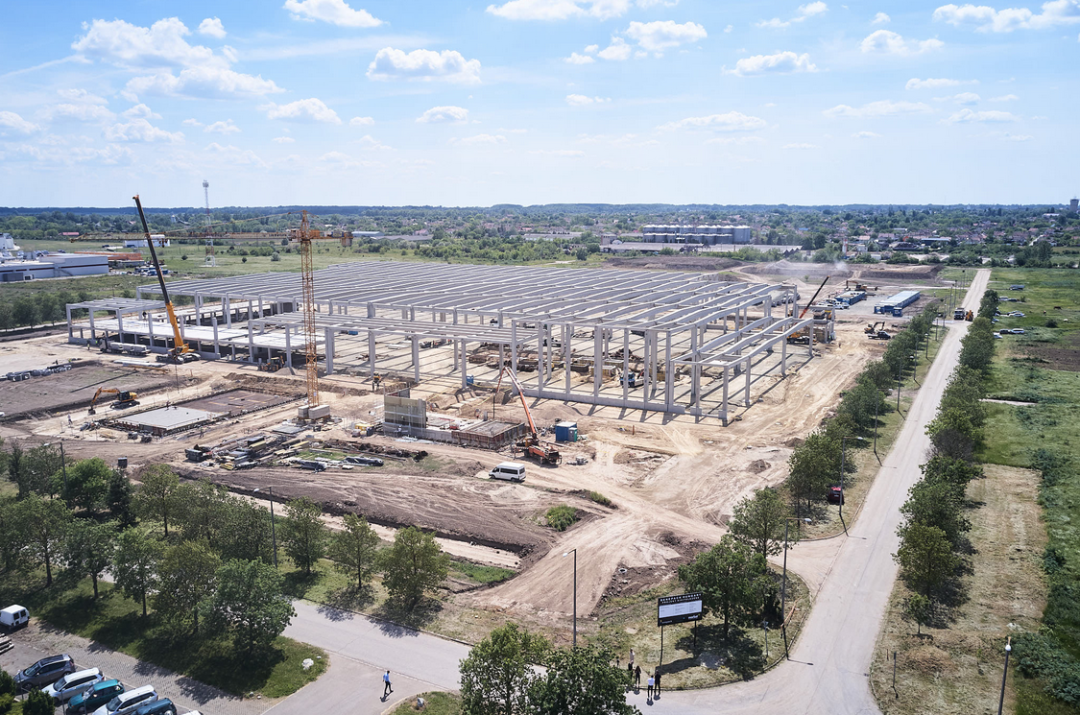
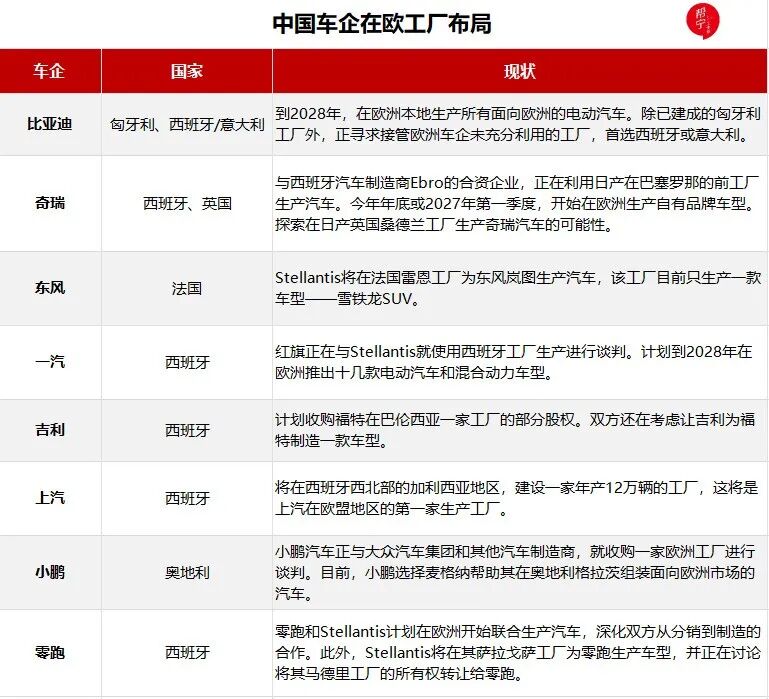
A recently confirmed and reported list of Chinese automakers' layout (Note: ' layout ' is kept as a Chinese term here for context, but translated in surrounding text) in Europe is as follows:
BYD ranks second in sales among Chinese brands in Europe. Its goal is to locally produce all electric vehicles sold in Europe by 2028. In addition to its Hungarian factory, it is negotiating with Stellantis Group and other European automakers to take over underutilized factories.
Two sources familiar with the matter revealed that BYD is actively scouting locations in Spain and Italy.
Chery operates in Europe through its namesake brand and subsidiaries and is currently China's third-largest automaker. It holds a 40% stake in a joint venture with Spanish automaker Ebro, which uses the former Nissan Barcelona plant to produce vehicles.
In May, Ebro Chairman Rafael Ruiz stated that Chery plans to begin producing its own brand models in Europe by the end of this year or the first quarter of 2027. This year's target production volume is expected to reach 30,000 units, which may include Chery models.
In addition to the Barcelona plant, Chery is exploring another possibility. In June 2026, Chery and Nissan signed a non-binding memorandum of understanding to explore the potential for Nissan to produce Chery vehicles at its Sunderland plant in the UK.
Dongfeng Motor plans to enter Europe through Stellantis Group, intending to produce VOYAH vehicles at Stellantis' Rennes plant in France. The Rennes plant currently produces only one model—a Citroën SUV.
FAW Group's approach, according to Reuters in April this year citing sources familiar with the matter, is that its Hongqi brand is negotiating with Stellantis to use a Spanish factory for production. It plans to launch more than a dozen electric and hybrid models in Europe by 2028.
Geely Auto, which owns brands such as Volvo, Polestar, Lotus, and Zeekr, launched its namesake brand in Europe in 2025. Additionally, it owns a 50% stake in Smart, with the Mercedes-Benz Group owning the other half.
Spanish trade publication Automóvil Forum reported in May this year that Geely plans to acquire a partial stake in Ford's plant in Valencia, and the two automakers are also considering having Geely manufacture a model for Ford.
SAIC Motor announced in June that it will establish a factory with an annual production capacity of 120,000 vehicles in the Galicia region of northwestern Spain, its first production plant in the EU.
The Financial Times reported in May that XPENG Motors is negotiating with Volkswagen Group and other automakers to acquire a European factory. Volkswagen Group owns a 4.99% stake (worth approximately $700 million) in XPENG. Supplier Magna stated in September 2025 that XPENG had chosen Magna to assemble vehicles for the European market in Graz, Austria.
Stellantis Group said in May that Leapmotor and Stellantis plan to jointly produce vehicles in Europe, deepening cooperation from distribution to manufacturing. Stellantis acquired a 21% stake in Leapmotor in 2023, establishing Leapmotor International. This is a business-focused joint venture that sells Leapmotor vehicles outside China through Stellantis Group, with Stellantis holding a 51% stake and Leapmotor holding a 49% stake.
Additionally, Stellantis Group will produce models for Leapmotor and Opel at its Zaragoza plant and is discussing transferring ownership of its Madrid plant to its Chinese partner.
(This article partially synthesizes reports from Automotive News, with some images sourced from the internet.)
-
![]()
Who’s Sounding the Alarm on ‘Rushed Vehicles’?
-
![]()
Over 5.3 Billion Yuan in Losses Over Three and a Half Years! Can Yonyou Reverse Its Fortunes Through Streamlining and AI Transformation?
-
![]()
Baidu AI Adopts Free Model: A Strategic Maneuver in Traffic and Monetization
-
![]()
Silicon-Based OLED Pioneer Unveils Financial Results: H1 Shipments Outpace Entire 2025 Volume
-
![]()
AI's First "Lost Summer"
-
![]()
Zeiss Makes Another €2.2 Million Bet: Will Eye Tracking Be the Next Big Thing in the Smart Glasses Industry?
-
![]()
RUNTO Ranking | Global Top TV ODM Factories' Shipment Figures for July 2026
-
![]()
Dealer Service Operational Prowess | How After-Sales Managers Can Harness Efficiency and Expertise to Secure Trust in the New Energy Era