Precocious Ideals, Rebuilding A New Ideal
 06/17 2026
 618
618
From "Daddy Car" to "AI Grandmaster"
"
Author|Qin Zhangyong, Wang Lei
In the realm of new energy vehicle startups, Li Auto stands out for its unwavering strategic focus.
While competitors were still burning cash in a trial-and-error phase, Li Auto had already validated its extended-range technology, established a viable business model, achieved stable profitability, and entered a mature stage ahead of others.
The phrase "fridge, TV, and sofa" represents more than just product features; it symbolizes the era-defining dividends Li Auto created by crafting a family-centric product logic. This approach solidified its position in the high-end home-use new energy vehicle sector and provided peers with a blueprint for differentiated breakthroughs.
Yet the industry's ability to emulate success knows no bounds.
Within a few short years, Li Auto's exclusive selling points became industry standards. While everyone tried to replicate Li Auto's success, few paused to consider where the next era should lead.
As others keep copying yesterday's Li Auto, the company now shifts its full focus toward embodied AI—a frontier still being explored within the industry.
On June 15th, during Livis Day, the event broke free from traffic-driven logic. There were no new car debuts or feature pile-ons. The entire event revolved around one theme: Li Auto aims to restart a decade-long new cycle for intelligent vehicles through embodied AI.
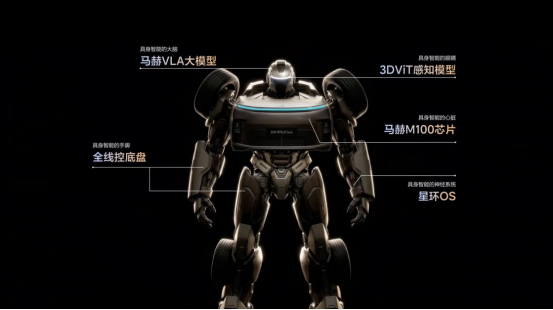
With innovations like the Mach M100 chip, Mach VLA model, and Xinghuan OS, Li Auto reconstructed the smart vehicle concept along the lines of "building silicon-based beings." After this launch, the outside world's strongest impression was that technological innovation had become Li Auto's formidable—and deep—moat.
From its early bet on extended-range technology to its current wholehearted investment in embodied AI, Li Auto hasn't rested on past laurels or imitated others. Instead, it forged its own path in embodied AI based on its understanding of user needs and full-stack technological capabilities.
As Li Xiang stated: Li Auto insists on being the best version of itself and doesn't aspire to become someone else.
01 Exposing the "Emperor's New Clothes"
What should intelligent vehicles look like in the era of physical AI?
Or let's rephrase the question: Are today's smart vehicles truly intelligent?
The answer is harsh. The "intelligence" found in most vehicles resembles pseudo-intelligence. Essentially, it's a patchwork of four functional blocks—cabin, intelligent driving, body control, and interaction—separated by invisible walls. Data remains siloed, logic operates independently, and decisions conflict. When systemic problems arise, functions cannot be fully utilized or may even crash.
Take traditional intelligent driving: when encountering complex environments, it often disengages and hands control back to the driver. It can only move forward and steer, not reverse or park by the roadside. When we're in a hurry, we might not even want to use it.
This is the current reality—so-called intelligence is merely a machine passively responding to commands, not an active problem-solving partner. Not only are its capabilities limited, but its efficiency is also extremely low.
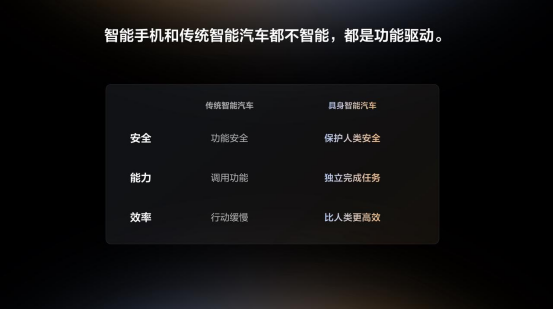
In Li Xiang's view, despite being labeled "smart," today's smartphones and smart vehicles are not truly intelligent.
Li Auto's solution: "embodied intelligent vehicles."
An embodied intelligent vehicle is an electric vehicle, a professional driver, an AI computer, and a lifestyle assistant—not four separate products, but one unified entity. The electric vehicle and AI computer form the "embodiment," while the professional driver and lifestyle assistant represent the "intelligence."
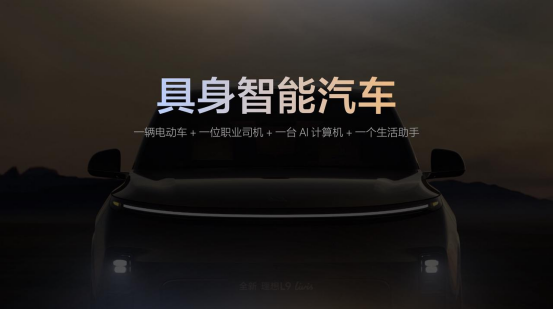
This isn't just semantic rebranding. It means the vehicle is no longer a patchwork toy but a complete, unified, and closed-loop organism.
In Li Xiang's vision, embodied intelligent vehicles must prioritize human safety, comprehensively learn human skills, complete tasks independently, and operate more efficiently than humans.
Achieving this requires rethinking what a vehicle truly is.
It needs eyes to perceive road conditions outside and interpret passengers' micro-expressions inside. It needs a brain to understand implicit intentions and predict needs five minutes ahead. It needs hands and feet to autonomously handle everything from departure, passing, parking, to recharging—without requiring constant human oversight.
Over the past few years of intense competition, everyone focused on reshaping vehicles' exteriors, upgrading interiors, and comparing who looked shinier or offered more scenarios.
What Li Auto does now is reshape the vehicle's nervous system and musculoskeletal structure—betting on the future form of the entire industry. With this clear top-level vision, all subsequent chip, model, system, and chassis development by Li Auto now has a singular, firm foundation.
02 Rebuilding the Computational Backbone
Every grand narrative must eventually confront the challenge of chip development.
In recent years, an awkward situation has emerged in the automotive computational power market—TOPS ratings keep climbing, yet effective computational power grows increasingly hollow. New models from automakers routinely boast thousands of TOPS, appearing formidable, but when running actual models, effective utilization often hovers between 30% and 50%.
On one hand, general-purpose chips, designed for broad compatibility to sell to more manufacturers, inevitably compromise on architecture. This leads to significant computational waste when running specific algorithms, resulting in high inference latency, severe effective computational power loss, and inability to support real-time automotive-grade multimodal embodied computing.
As Li Auto's CTO Xie Yan previously put it: "General-purpose chips are like off-the-rack clothing, while self-developed chips are tailored suits. Only extreme customization can create asymmetric competitive advantages."
On the other hand, the computer industry once enjoyed dual dividends from Moore's Law and Dennard scaling, expecting automatic performance doubling every two years. That logic now falters. Incremental upgrades can no longer meet explosively growing computational demands.
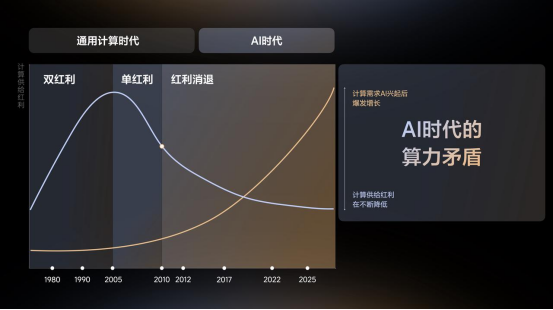
Additionally, traditional cache architectures require constant data reading and writing, shuttling massive visual, radar, and vehicle data. Substantial computational power is wasted on ineffective data circulation (circulation). To mask architectural flaws, automakers pile on more chips, reduce precision, and cut sensing capabilities—compromising for temporary usability.
Li Auto took a far bolder approach than "just add another chip": it completely replaced the chip's underlying architectural logic.
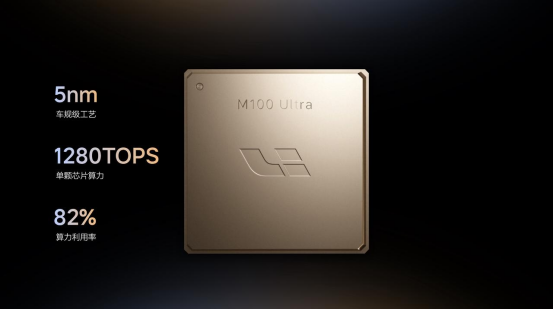
The Mach M100, the world's first mass-produced dynamic dataflow AI chip, uses 5nm automotive-grade technology. A single chip delivers 1,280 TOPS, with dual chips providing 2,560 TOPS in total.
But specifications aren't the focus. The key innovation is abandoning the decades-old "store-then-compute" cache architecture in favor of a dataflow architecture that "drives computation through data movement."
Xie Yan illustrated this vividly: "It's like building a completely different house with a completely different philosophy. The von Neumann architecture drove 70 years of general-purpose computing glory. Today, with the Mach M100, we aim to pass this baton to dataflow architecture and propel AI computing into another 70 years of brilliance."
This confidence stems from the Mach M100's actual computational utilization exceeding 82%—a figure nearly unattainable for mainstream general-purpose architectures.
Beyond intelligent driving, the Mach M100 can run other large models, such as deploying the Qwen3.5-35B-A3B general-purpose large model. During the launch event, Xie Yan showcased testing results for general model deployment. NVIDIA's desktop supercomputer DGX-Spark, priced at 40,000 yuan, showed the Mach M100 achieving 2.7x faster prefill speeds and 1.5x faster decode speeds.
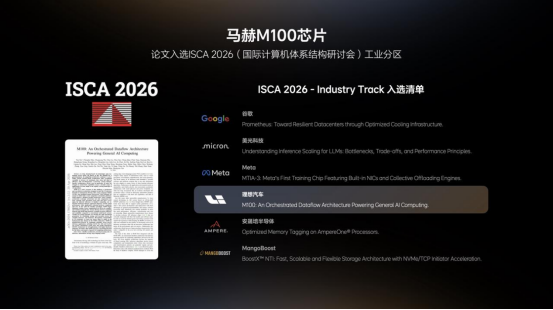
This architectural innovation led ISCA to make an exception by admitting an automaker. The paper was selected for the International Symposium on Computer Architecture (ISCA) 2026 Industrial Session—the first global automaker ever included, alongside Silicon Valley heavyweights like Google, Meta, and Micron.
Beyond hardware architecture innovation, Li Auto developed proprietary compilers, low-level drivers, and AI runtime toolchains. These enable native synergy between chips, compilation scheduling, and VLA models, eliminating the industry-wide issue of software-hardware mismatch in off-the-shelf chips.
For the industry, the Mach M100's true value lies in ending the era of general-purpose chips dominating automotive AI. It establishes a new computational paradigm for intelligent vehicles in the physical AI era and serves as Li Auto's most stable hardware foundation for embodied AI.
03 Evolution of the Embodied Brain
The chip is the heart, but even the strongest heart needs a brain to function. Without cerebral command, it's just high-performance muscle.
The biggest issue with traditional automotive AI is its "fragmented brain." As mentioned earlier, the cabin and intelligent driving systems operate independently, with siloed data and disjointed cognition. For a vehicle to complete a long journey safely and comfortably, traditional smart cars must break it down into fragmented operations requiring constant human intervention.
To achieve "safer, more efficient, and more powerful" capabilities, Li Auto's embodied AI brain splits into "left" and "right" hemispheres. Language intelligence is handled by Mach Mind-Pro and Mind-Edge, while machine intelligence is managed by Mach VLA. In the view of Li Auto's base model leader Zhan Kun, neither hemisphere alone can form complete embodied intelligence.
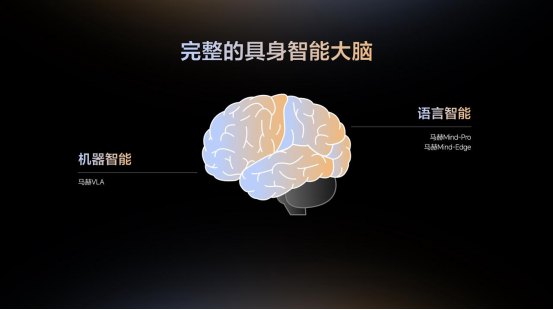
Language intelligence handles linguistic and logical thinking—understanding commands and devising action plans. Machine intelligence manages 3D visual perception and bodily motion control—seeing the physical world and executing precise actions.
Mach Mind-Pro covers all high-frequency in-vehicle scenarios: vehicle control, smart travel, office work, Q&A, and entertainment. Using Token compression technology, it reduces overall Token consumption by 38% and tool call redundancy by 47% without compromising task completion rates, achieving a peak model TPS of 208 tokens/s.
For in-vehicle agents, these numbers mean completing the same task with fewer Tokens, fewer calls, and lower latency.
Mach Mind-Edge is an edge-native intelligent agent model. Its multimodal streaming temporal modeling allows continuous understanding of the dynamic physical world while enabling causal reasoning and autonomous decision-making—breaking free from traditional AI's "answer-only" mode to handle real-time cabin interactions.
Together, they enable the vehicle to understand complex commands and answer questions like "Where did I drop my earphones?" in real time, becoming a truly perceptive assistant.
"Safer" operations fall to the machine intelligence side with Mach VLA. Traditional driver assistance systems handle perception, prediction, and planning separately, often leading to inefficiency and errors. Li Auto upgraded this to a native multimodal Mixture-of-Experts (MoE) model, aligning perception, understanding, thinking, and action within a single framework.
It also introduced the first 3D ViT (Vision Transformer) global visual model, enabling the system to construct pixel-level 3D spatial maps from 2D camera feeds in real time. This allows machine intelligence to perceive and understand the real world like humans.
The capabilities are tangible: while average human reaction time for emergency braking is 0.45 seconds, the new Mach VLA system responds in just 0.28 seconds—approaching the 0.25-second physiological limit of top F1 drivers.
At 120km/h, this 0.17-second difference means braking 6 meters sooner—potentially avoiding a major accident.
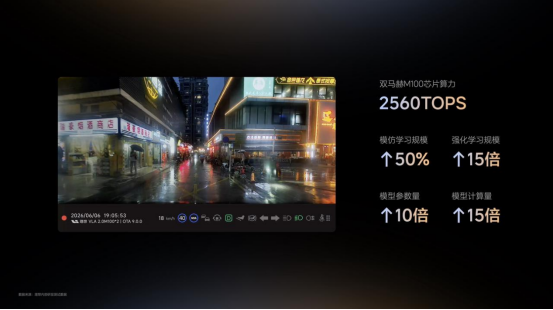
Computational power and training scale expanded concurrently. Dual Mach M100 chips deliver 2,560 TOPS of in-vehicle computational power. Imitation learning data volume increased by 50%, reinforcement learning data by 15x, reinforcement learning training computational power by 5x, model parameters by 10x, and Tokens processed per second by 15x.
But the most striking aspect isn't the numbers—it's the emergent capabilities: reversing to yield, recognizing traffic police gestures, and navigating narrow rain-soaked village roads without lane markings.
Later this year, users will experience these changes in the real world:
In July, overall intelligent driving efficiency will improve by 30%, helping users navigate complex scenarios like width-restricted gates and height-restricted bars. By September, users will experience human-driver-level capabilities, including narrow-road reversing, yielding during head-on encounters, traversing complex surfaces, and controlling smart locks and garage doors.
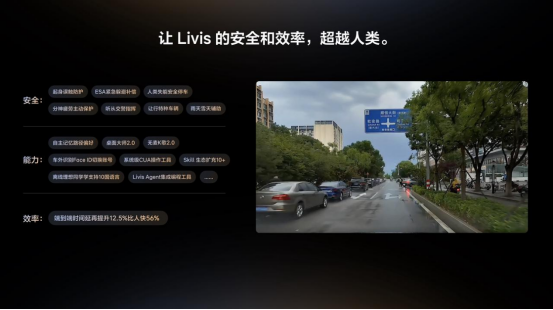
In the OTA update of December, Li Auto takes its most ambitious step yet, enabling Livis to surpass human capabilities in terms of safety and efficiency. It actively protects against accidental steering wheel touches by users, the system can urgently evade and compensate, and it can even follow traffic police instructions.
Most critically, Li Auto officially announced its plan to match Tesla's FSD V14 capabilities in the fourth quarter.
04. The Uncopyable Homework
For other automakers, chips can be self-developed, and models can be iterated. However, what truly creates a generational gap is never a single parameter but whether these elements are integrated into a unified system.
Currently, most automakers follow an assembly-line R&D approach. For instance, they purchase chips externally, outsource systems, subcontract intelligent driving algorithms to suppliers, find another company for the cockpit, and then adapt software after hardware finalization. As a result, when software needs optimization, the hardware cannot be changed; when next-gen hardware is released, software must be re-integrated, leaving a perpetual adaptation gap between software and hardware.
This fragmented model cannot support traditional intelligence, let alone the integrated logic of embodied intelligence. Li Auto's greatest advantage lies in its willingness to start from scratch and overturn outdated logic.
In 2021, Li Auto initiated the self-developed operating system Xinghuan OS. By 2022, chip and 800V active suspension projects were launched, followed by the foundational large model in 2023. These are not “parallel projects” but interconnected roots of a single organism, defined and co-developed synchronously from day one. For example, algorithm requirements define hardware architecture, while hardware iterations feed back into algorithm upgrades, creating not an “adaptation relationship” but a symbiotic one between software and hardware.
At the organizational level, this “symbiosis” is more than just talk.
Based on its positioning as an embodied intelligence enterprise, Li Auto reconstructed its R&D system along the lines of “building silicon-based beings,” reorganizing into Infra, foundational model, software/hardware ontology, and evaluation teams—analogous to a heart, brain, limbs, etc. The benefit is that model, chip, and actuator teams sit at the same table from the start.
Xinghuan OS serves as the neural center of this system, breaking down old multi-domain isolation architectures and using a unified underlying kernel to connect compute pools, sensing devices, smart terminals, and vehicle actuation mechanisms, achieving deep integration across the “perception-decision-execution” chain.
The full-line control chassis acts as the ultimate execution trunk, with purely electronic control signals (no mechanical hard connections) capable of millisecond-level response to VLA decision commands, ensuring every brain-generated thought is precisely translated into tire movements.
As Li Auto CTO Xie Yan stated, the competition in intelligence is never about parameter races but about the systemic efficiency and experience advantages brought by deep vertical integration of chips, OS, and models.
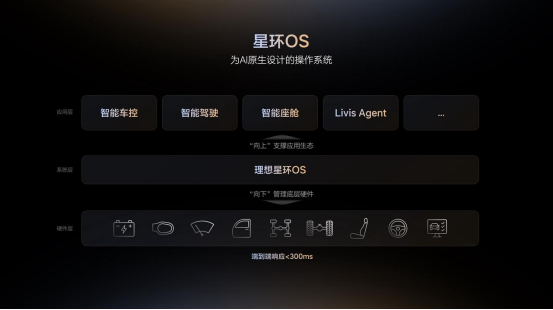
Single technologies may be catchable, and flashy features may be replicable, but no company can replicate in the short term an entire engineering system honed over years, self-iterating and self-closing.
Thus, the stratification of the intelligent vehicle era is now crystal clear.
Short-term competition hinges on superficial hardware like interiors, big screens, and refrigerators, with extremely low barriers. Mid-term competition revolves around purchased intelligent driving solutions and general-purpose large models, with gaps expected to close within two to three years. Long-term competition, however, centers on the position Li Auto has already secured: self-developed chips, native large models, a software-hardware integrated engineering system, and a full-domain data loop—barriers for the next decade.
From winning by product definition to standing firm on foundational technology, Li Auto has completed a total identity transformation.
Continuous self-developed investments enable full-system technology reuse and cost dilution, while massive real-world data loops drive continuous intelligence evolution, creating an irreversible Matthew effect.
Thus, the true significance of Livis Day was never about releasing a few new technologies. It was about announcing Li Auto's official exit from the red ocean, starting from the foundation and using innovations like chips, models, OS, and chassis to carve out a track no one else can chase.
-
![]()
Who’s Sounding the Alarm on ‘Rushed Vehicles’?
-
![]()
Over 5.3 Billion Yuan in Losses Over Three and a Half Years! Can Yonyou Reverse Its Fortunes Through Streamlining and AI Transformation?
-
![]()
Baidu AI Adopts Free Model: A Strategic Maneuver in Traffic and Monetization
-
![]()
Silicon-Based OLED Pioneer Unveils Financial Results: H1 Shipments Outpace Entire 2025 Volume
-
![]()
AI's First "Lost Summer"
-
![]()
Zeiss Makes Another €2.2 Million Bet: Will Eye Tracking Be the Next Big Thing in the Smart Glasses Industry?
-
![]()
RUNTO Ranking | Global Top TV ODM Factories' Shipment Figures for July 2026
-
![]()
Dealer Service Operational Prowess | How After-Sales Managers Can Harness Efficiency and Expertise to Secure Trust in the New Energy Era