Why Is This Precision Optical Film Leader Worth Reevaluating with a Tens of Millions Procurement?
 06/24 2026
 562
562
An announcement of a related-party transaction worth nearly RMB 10 million may seem unremarkable at first glance, but it reflects the strategic resolve of a precision optical film leader on the eve of industry transformation.
On June 24, Crystal-Optech announced that it plans to purchase coating equipment from Optorun in Japan, its equity-invested company, with a total transaction amount of JPY 233 million, approximately RMB 9.8058 million at the exchange rate on that day, accounting for 0.10% of the company's audited net assets in 2025.
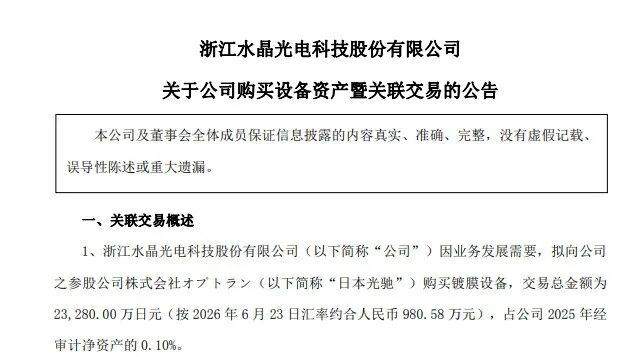
Since Crystal-Optech holds a 15.76% stake in Optorun, making it the largest shareholder, and company director Lin Min serves as a director of Optorun, this transaction constitutes a related-party transaction. In terms of amount, the financial impact of this transaction on the company is negligible—RMB 9.8 million accounts for only one-thousandth of its net assets. However, when viewed over a longer time horizon, the signaling significance far outweighs the numerical value itself.
Optorun is a global leader in the precision coating equipment sector, with a market share ranking among the highest worldwide. As its largest shareholder, Crystal-Optech naturally enjoys a first-mover advantage in equipment procurement and technological synergy.
Notably, from the beginning of the year to the date of this announcement, the cumulative total of various related-party transactions between the company, its controlled subsidiaries, and Optorun has reached RMB 216.334 million. This indicates that a normalized and large-scale cooperation mechanism for equipment procurement and technological synergy has been established between Crystal-Optech and Optorun. The additional equipment procurement comes at a critical juncture when the company is simultaneously advancing multiple business curves.
To understand the strategic weight of this procurement, one must first examine Crystal-Optech's performance. In 2025, the company achieved revenue of RMB 6.928 billion, a year-on-year increase of 10.37%; net profit attributable to shareholders was RMB 1.172 billion, a year-on-year increase of 13.84%, both reaching new highs. The gross margin was 31.29%, and the net profit margin was 16.89%, both showing year-on-year improvements.
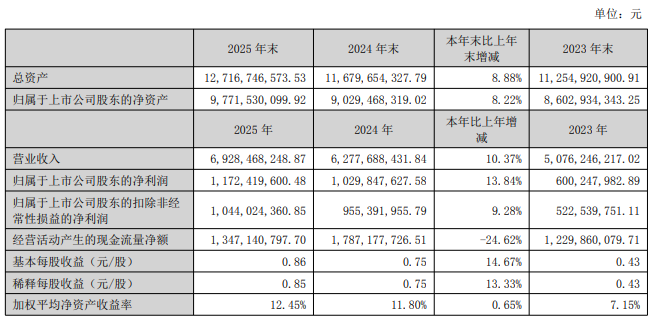
Behind the performance growth lies the company's formally established 'Three Growth Curves' strategic framework—consumer electronics and automotive optics as the first curve, AR optics as the second curve, and AI optics as the third curve.
The first curve is advancing steadily. In 2025, revenue from consumer electronics-related products was RMB 5.892 billion, a year-on-year increase of 7.41%. Micro-prism modules and Android-coated filters maintained high market shares. In 2025, coated filters for a major North American client achieved initial mass production and entered a phase of increasing market share; the automotive optics business experienced explosive growth—revenue from automotive electronics (AR+) business was RMB 586 million, a year-on-year increase of 95.24%, with the gross margin improving by 13.30 percentage points year-on-year.
The second curve is poised for takeoff. AR optics has been positioned by the company as the second growth curve, with proactive strategic positioning. Key process nodes for reflective waveguides have been breakthrough (Note: ' breakthrough ' is kept as is for now, but in a real scenario, it should be translated to 'broken through' or similar if context allows), and a preliminary mass production trial line has been established.
The third curve represents the future. AI optics is the company's medium- to long-term forward-looking layout (Note: ' layout ' is kept as is; a proper translation would be 'layout'). It focuses on three key directions: AI vision, optical interconnects, and optical storage, covering core scenarios such as data centers, optical communications, and 3D visual perception.
The value of the coating equipment procurement lies in its 'infrastructure' attribute that runs through all three curves. Precision coating is one of Crystal-Optech's most core underlying technologies. The company has clearly stated in investor communications that optical components such as filters, silicon lenses, and prisms adapted for the optical communications field are the products with the fastest pace of commercialization and the highest potential to generate revenue first in the AI optics business. These products are highly compatible with the company's mature precision coating and ultra-precision cold processing technologies, featuring strong technological reusability and high maturity in mass production processes.
In the direction of AI optics, the company is actively advancing optical communication-related projects, all of which rely on the support of high-precision coating equipment. In the consumer electronics base, the increasing market share and category expansion of core products such as micro-prism modules and coated filters also depend on continuous upgrades in coating processes. In the AR optics field, the mass production breakthrough of waveguides places extremely high demands on coating precision and consistency. In other words, the arrival of each coating equipment unit may simultaneously serve the capacity expansion and technological iteration of multiple business lines.
This RMB 9.8 million equipment procurement coincides with a critical juncture where Crystal-Optech is advancing the 'Three Growth Curves' strategy in depth, and both AI optics and AR optics are on the verge of industrialization. Its significance far exceeds the numerical value on the books.
It is reminding the market: In the industry transformation where the optical industry is shifting from single-pole growth driven by consumer electronics to multi-polar growth driven by automotive optics, AR, and AI, whoever can first complete the strategic reserve of core process capabilities is likely to gain an early advantage in the next cycle.
Crystal-Optech's strategic stake in Optorun and continuous equipment procurement are precisely the microcosmic footnotes of this forward-looking layout (Note: ' layout ' again kept as is; proper translation would be 'layout'). The future holds great promise.
-
![]()
Raking in Big Profits Overseas! Chery’s Overseas Revenue Makes Up 70% in H1, with Gross Margin Climbing to 16.1%
-
![]()
Alibaba’s New Fiscal Quarter: 45% Revenue Surge in Alibaba Cloud, Enhanced Profitability in AI Cloud, but Widening Losses in the Application Layer
-
![]()
The AI Version of 'PayPal Mafia' Has Arrived: 20 AI Startups Raise Over $4.6 Billion in Funding
-
![]()
Wang Jian's Vision: Paving a Pathway for Alibaba Through AI
-
![]()
Hyundai Motor Workers Strike Today, Fearing Job Losses to Robots
-
![]()
Embracing 'Light': O-film Unveils Its 'Illuminating the Future' Strategy
-
![]()
SenseTime’s SenseNova U1.5 Lite Goes Open Source: Ushering in a New Era of Predictable AI Image Generation
-
![]()
Collaboration Initiated! Tesla Officially Welcomes Doubao Onboard