Shenzhen’s Longgang District Unveils New Rules for Autonomous Vehicles: Initial Deployment of 30 Vehicles, 5% Inspection Rate, and Nationwide Cross-Regional Recognition
 07/09 2026
 555
555
Introduction
On July 8th, Longgang District in Shenzhen took a groundbreaking stride by officially releasing the “Shenzhen Longgang District Management Measures for Road Testing and Application Pilot of Functional Autonomous Vehicles (Trial),” which comprises 23 articles. These articles comprehensively cover various aspects, including the definition, management mechanisms, and technical specifications of functional autonomous vehicles, as well as application prerequisites, traffic regulations, and safety protocols.
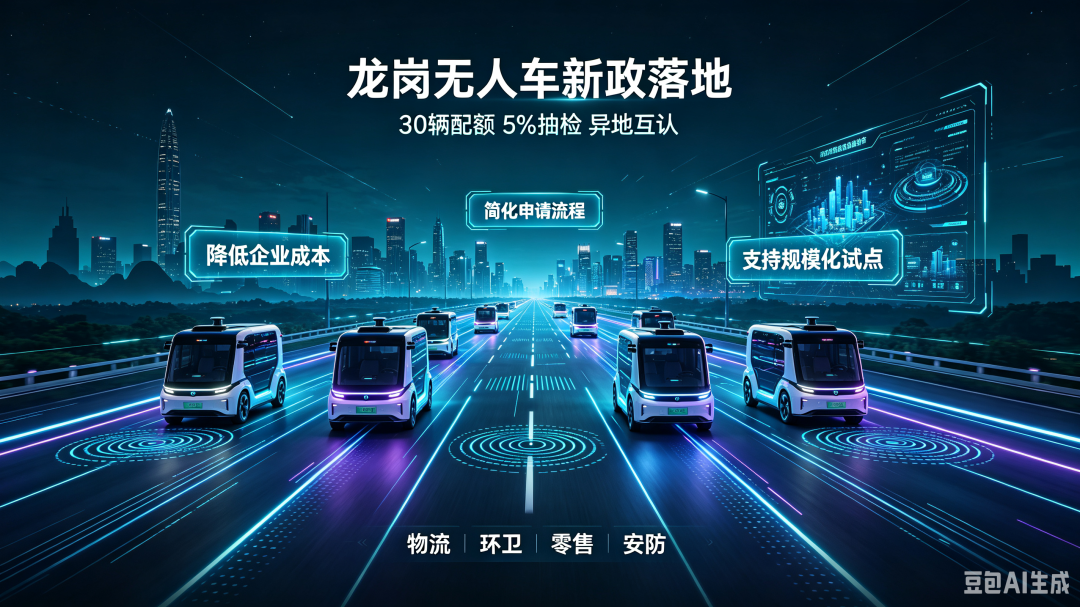
However, the true game-changer for the industry lies in the specifics embedded within these regulations: an initial deployment quota of 30 vehicles, a 5% inspection rate, and cross-regional recognition.
The WeChat official account “Autonomous Vehicles Are Coming” posits that Longgang’s measures effectively tackle the three most pressing challenges that have impeded the widespread adoption of autonomous vehicles.
(For further details, please refer to: “Shenzhen Longgang: Nuenchi and Jimu Xingyuan’s Autonomous Sweeping Vehicles Forge AI Capabilities for Urban Governance Through ‘Scenario-Based’ Development.”)
I. Why 30 Vehicles for Initial Deployment?
What was the primary concern for companies seeking to deploy autonomous vehicles in a new city previously?
It was not technological prowess but rather the limited number of approvals granted.
Typically, companies were only permitted to test three to five vehicles at a time, necessitating repeated applications after data collection. Deploying a few dozen vehicles in a single city could take up to six months. With over 300 cities across the nation, this process could become endless.
Longgang has now set a clear benchmark: the initial deployment quota has been raised to 30 vehicles. Thirty vehicles are sufficient to support a district-level autonomous delivery network pilot, encompassing dozens of stations and routes.
(For more information, please click: “Shenzhen Longgang District: The First ‘Smart Logistics + Medical Logistics’ Autonomous Delivery Vehicle Launched.”)
Even more revolutionary is the 5% inspection rate for the autonomous driving capabilities of these vehicles.
Out of 30 vehicles, only 1.5 (rounded up to 2 in practice) require inspection. The remaining vehicles can utilize the inspection report of the same model, eliminating the need for redundant testing.
This marks a shift from “mandatory inspection for each vehicle” to “random inspection for the same model,” reducing the time cost from “months” to “days.”
II. Cross-Regional Recognition: No More Redundant Testing
One of the autonomous vehicle industry’s greatest fears is “retesting in a new city.”
A vehicle that has operated in City A for a year must still undergo testing, accumulate mileage, and await approval from scratch in City B. This process can take at least two months or extend up to half a year.
The hindrance for companies is not technological immaturity but the burden of redundant approvals.
Longgang’s solution: Vehicles with the same architecture that have already undergone equivalent or similar functional testing in other regions are exempt from repeated autonomous driving function testing and can follow simplified procedures.
The power of this regulation lies in the phrase “same architecture”: As long as the vehicle architecture remains consistent, Longgang will recognize testing data from other regions. There is no need to re-accumulate hundreds of kilometers of road testing to demonstrate “I can drive.” Companies can simply present their out-of-state license and testing report.
For autonomous vehicles already operational in other districts of Shenzhen, Dongguan, or Huizhou, the barrier to entering Longgang has been significantly lowered.
This effectively establishes an “autonomous vehicle circulation zone” within the Guangdong-Hong Kong-Macao Greater Bay Area, where success in one location can radiate across the entire region.
III. Stringent Regulations Behind Relaxed Policies: Speed Limit of 45 km/h, Safety Officers, and Traceable Data
Relaxing entry requirements does not equate to lax oversight. Longgang has eased restrictions at the entry point while tightening safety protocols.
There are stringent technical requirements for vehicle dimensions, mass, maximum speed, minimum turning radius, climbing ability, insurance coverage, remote control, and data accessibility.
Speed limit of 45 km/h: Vehicles must travel on the rightmost lane of open roads at speeds not exceeding 45 km/h.
Mandatory safety officers: Each vehicle must be equipped with a remote or on-site safety officer. Operators must establish internal safety management systems and conduct regular training and assessments.
Clear list of prohibited items: Vehicles are prohibited from carrying items that violate the law, endanger national security, weapons, ammunition, or flammable and explosive hazardous materials.
Timely accident reporting: In the event of a traffic accident, the safety officer must immediately protect the scene, call the police, and report as required.
The rationale is clear: Relax entry requirements while tightening operational oversight. This allows capable companies to enter swiftly while preventing unreliable players from exploiting loopholes.
IV. Why Is Longgang Bold Enough to Implement These Measures?
Longgang did not enact these policies on a whim. This path has been nearly two years in the making.
In August 2024, when Neolix submitted its application to deploy autonomous logistics vehicles in Longgang, company executives were apprehensive.
At the time, the autonomous logistics industry nationwide grappled with challenges such as “missing regulations, unclear responsibilities, and ambiguous departmental authority.” The primary concern for companies was not technological immaturity but whether vehicles could legally operate on roads, which largely determined the success or failure of innovation.
Longgang’s response was unexpected.
No precedent? Then study cutting-edge explorations domestically and abroad. Lack of detailed upper-level regulations? Then innovate boldly within the legal framework.
In just over two months, the groundbreaking “Shenzhen Longgang District Guidelines for the Pilot Management of Commercial Operation of Functional Autonomous Vehicles (Trial)” was officially issued.
From an initial 11.89 kilometers of intelligent connected vehicle public roads to nearly 900 kilometers of open roads today;
From the rigid constraint of “no action without legal authorization” to a cautious and inclusive approach of “trial where not prohibited by law.”
Longgang has utilized reformative courage to pave the first pathway for autonomous vehicles to “hit the road.”
As of early 2026, the operational scale of autonomous vehicles in Shenzhen has surpassed 1,100 units, with open routes exceeding 6,000 kilometers.
Longgang has deployed nearly 200 autonomous logistics vehicles, opened approximately 600 routes, and accumulated over 170,000 kilometers of operational mileage.
Automakers such as Neolix, Jiushi, Meituan, JD.com, Minieye, and Cainiao have established a presence, while logistics giants like SF Express, JD.com, China Post, and “Shentong, Yuantong, Zhongtong, and Yunda” have made significant investments.
The most intriguing aspect of Longgang’s “Management Measures” is not what it includes but what it omits.
It avoids empty rhetoric like “encouraging innovation.” Instead, it specifies concrete figures such as an initial deployment quota of 30 vehicles, a 5% inspection rate, and cross-regional recognition. It eschews clichés like “cautious and inclusive.” Instead, it sets stringent standards like a 45 km/h speed limit, mandatory safety officers, and timely accident reporting.
From “no action without legal authorization” to “trial where not prohibited by law,” Longgang has utilized a 23-article document to transition autonomous vehicles from “pilot exploration” to a “regulated” new phase.
Summary
In summary, the WeChat official account “Autonomous Vehicles Are Coming” believes:
Previously, the autonomous vehicle industry faced the widespread issue of “different rules for different regions,” leading to cumbersome cross-regional operations and high costs for companies. Longgang’s replicable district-level management model provides a reference for industrial powerhouses nationwide: It simplifies entry, mutually recognizes qualifications to reduce corporate burdens, while maintaining stringent safety standards for traffic, accidents, and data, achieving a dual balance between industrial development and urban governance.
What are your thoughts?
References: Media reports from Longgang Government Online, Yangcheng Evening News Jin Yang Network, Shenzhen Government Online, Shenzhen Qiaobao, Shenzhen Evening News, China News Video, etc.
#AutonomousVehiclesAreComing #AutonomousDriving #SelfDriving #AutonomousVehicles
-
![]()
Model Giant Jieyue Xingchen Steps into Smartphone Arena: A Strategic Alliance with Huaqin Technology
-
![]()
Big Model Firm Dives into Phone Market: StepFun and Wingtech Forge a ‘Dynamic Duo’
-
![]()
Zhongrun Optics Makes a Bold Move with 1 Billion Yuan Investment: Is a Turning Point on the Horizon for the Precision Optics Industry?
-
![]()
Deploy CLBO Crystals and YIG Single Crystals! Erythritol Leader Invests 30 Million in Youwei Optoelectronics
-
CXMT’s July 16 Subscription: Leading Domestic Memory Manufacturer—What’s the Earning Potential per Lot?
-
![]()
Rhythm Discrepancy and Premium Value Erosion: Foreign Luxury Brands Must Re-evaluate Their China Strategy
-
![]()
Half-Year, 1 Billion Yuan Financing, 7 Billion Yuan Valuation: A New Dark Horse Emerges in the Embodied AI Sector
-
![]()
Strong Rebound for Tech Stocks in Hong Kong Stock Market: Is It Time to Bottom-Fish?