Chongqing Public Transport Group Set to Initiate High-Level Assisted Driving Bus Demonstration This Year
 07/10 2026
 370
370
Based on insights from industry insiders and the latest tender documentation, Chongqing Public Transport Group is poised to officially commence a demonstration project for high-level assisted driving buses this year. This strategic move is driven by the company's pressing need to bolster safety and efficiency, as well as the broader governmental push to foster the growth of the intelligent connected new energy vehicle sector. Earlier this month, representatives from Chongqing Public Transport Group visited Shenzhen to gain firsthand experience of the ongoing implementation of high-level assisted driving in Shenzhen's public transportation network. They explicitly announced that a dedicated budget would be earmarked for these advanced buses, signaling the project's progression from the preliminary planning (demonstration) phase to the concrete procurement and deployment stage.
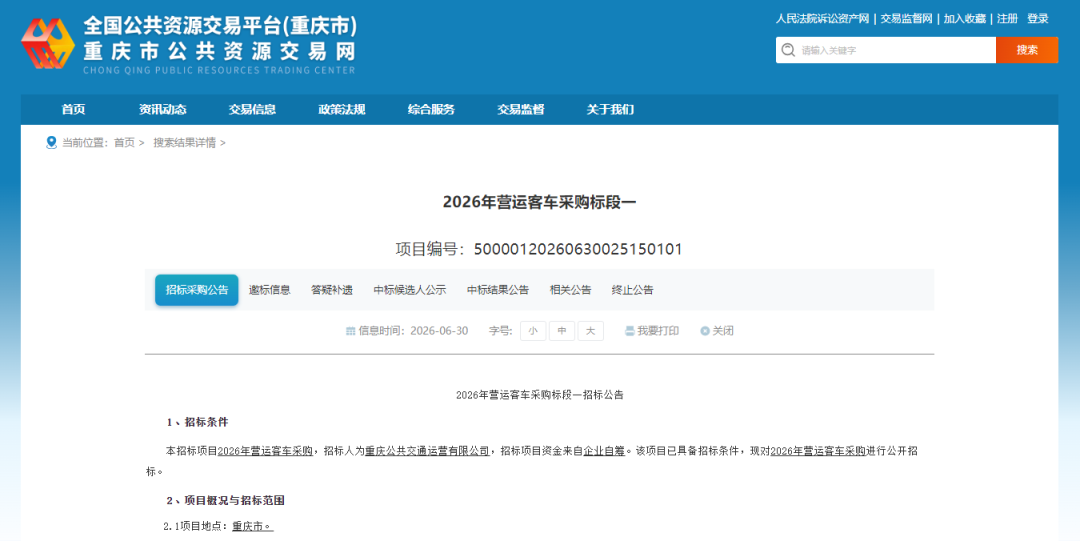
The batch tender notice for the operation of new energy buses in 2026, issued on June 30, provides a solid foundation for this demonstration initiative. This tender document has drawn considerable attention within the industry as it stipulates a "comprehensive integrated high-level ADAS" as a mandatory disqualification criterion for all series of pure electric models. This implies that out of the 542 pure electric buses to be procured, any vehicle lacking any of the ADAS, DSM, or BSD hardware, or failing to comply with the pre-installed wiring harness, computational power, and imaging warning requirements, will be immediately disqualified. This marks a significant departure from previous years when ADAS was merely considered an optional bonus feature or when only basic DMS fatigue monitoring was mandated, underscoring Chongqing Public Transport's pragmatic approach and stringent technological standards.
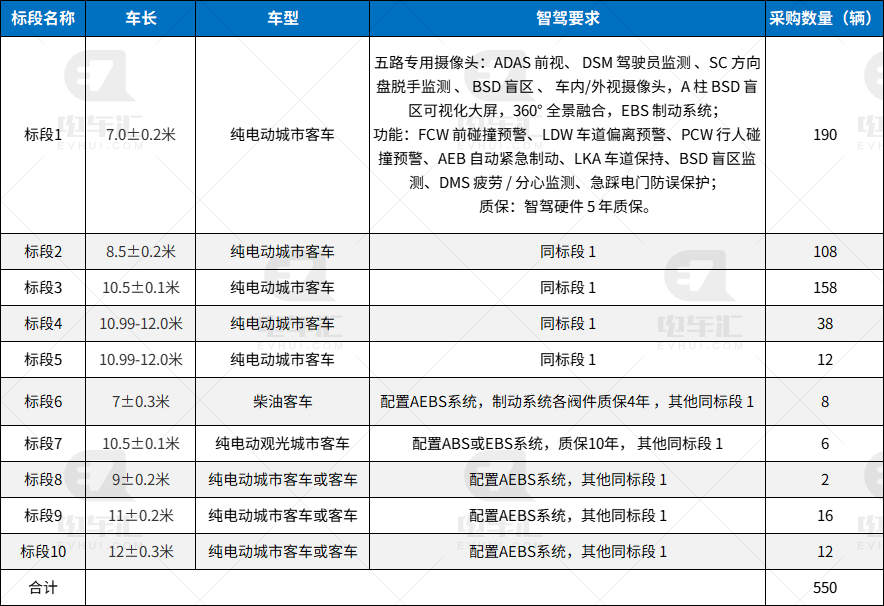
According to the detailed technical specifications outlined in the tender documents, these new buses are explicitly required to be outfitted with AEBS/AEB/EBS emergency braking systems capable of detecting pedestrians, non-motorized vehicles, and other vehicles. Furthermore, functions such as LDW lane departure warning, LKA lane keeping assistance, FCW forward collision warning, BSD blind spot monitoring, and DMS driver fatigue monitoring are mandatory. The system must also support 360-degree panoramic integrated perception, enabling the identification of obstacles at intersections and non-motorized vehicles at long distances, and uploading all ADAS warning data in real-time to the public transport group's intelligent operation platform via vehicle-cloud connectivity. Additionally, for the vehicle's "three electric systems" (battery, motor, and electronic control) and key components, the bidder has specified a warranty period of up to 13 years, reflecting the operator's emphasis on long-term stable operation and total lifecycle costs.
What is particularly noteworthy is that the tender documents hint at the exploration of future technological advancements in the "optional bonus points" section. The documents explicitly state that vehicles equipped with a fused perception system combining millimeter-wave radar and LiDAR, along with fixed-point automatic station entry assistance functionality, will receive bonus points in the evaluation. This configuration of "high-level bus-exclusive functions" suggests that Chongqing Public Transport is not content with basic L2-level safety assistance but aims to validate multi-sensor fusion solutions, including LiDAR, as well as automated precision docking capabilities in complex station environments during the demonstration operation.
With Shenzhen and Chongqing successively launching demonstration operations for high-level assisted driving buses, the new energy public transportation sector is witnessing an accelerated trend towards intelligent upgrades. This tender by Chongqing Public Transport is not merely a straightforward vehicle procurement but a profound validation of high-level assisted driving technologies in complex mountainous urban settings. For the commercial vehicle industry chain, this not only signifies new market growth opportunities but also indicates a shift in product definition rights from mere vehicle manufacturing to comprehensive solutions encompassing algorithms, data operations, and infrastructure collaboration.
In fact, the trend of "standardizing high-level intelligent driving" is no longer limited to a few pioneering cities but is rapidly spreading across the country. According to the latest industry tender trends, in addition to Shenzhen and Chongqing, first-tier and emerging first-tier cities such as Guangzhou, Shanghai, Hangzhou, and Beijing have also listed a comprehensive integrated ADAS, DMS driver monitoring, and BSD blind spot monitoring as mandatory disqualification criteria for new vehicle procurements. Key second-tier cities like Changsha are also fully implementing front-end high-level intelligent driving and V2X vehicle-road coordination technologies in regular bus updates. This series of intensive tender actions clearly indicates that high-level intelligent driving is swiftly shedding its experimental "demonstration operation" label, transforming from past "optional bonus features" into a "mandatory requirement" for bus vehicle access. In the future, intelligent systems with multi-sensor fusion perception, vehicle-cloud connectivity, and data closed-loop capabilities will become "standard configurations" for every bus leaving the factory, propelling the entire public transportation industry into a new era of proactive safety and digital operations.
-
![]()
Strategic Shift in Photoelectric Sensing: Maxvision Secures Controlling Stake in CAS Optotech
-
![]()
Optical Communication and Robot Vision: OFILM’s Bold Transformation Amid a 460 Million Yuan Loss
-
![]()
From 100,000-GPU Computing Might to Industrial Efficiency: The Logic Behind AI4S-Driven Intelligence
-
![]()
OpenAI, Grok, and Meta Release Three Major Models: Who is the King of Cost-Effectiveness?
-
![]()
Momenta’s Backers in the Auto Industry Crave Blockbusters More Than Stock Dividends
-
![]()
China’s AI Computing Power: Embracing a New Organizational Paradigm
-
Same Bloodline, Two Fates: How Two AI Giants Took Divergent Paths?
-
![]()
Combined Market Value Plummets by Nearly One Trillion Yuan: What’s Behind the Decline of Two AI Powerhouses?