From 100,000-GPU Computing Might to Industrial Efficiency: The Logic Behind AI4S-Driven Intelligence
 07/10 2026
 355
355
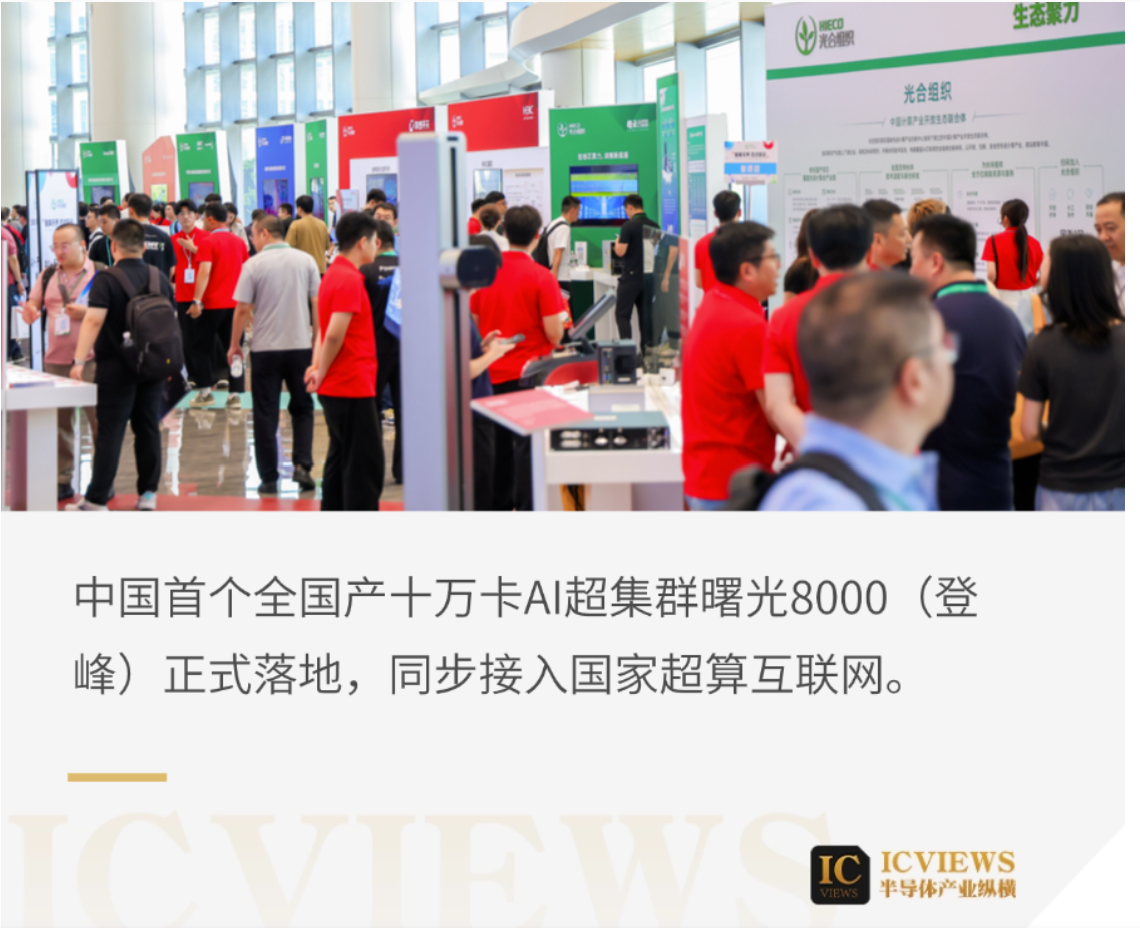
From July 9 to 11, the 2026 Intelligent Computing Applications Conference, hosted by the HIPPO Organization, took place in Zhengzhou. China's first fully indigenous 100,000-GPU AI supercomputing cluster, the Sugon 8000 (Dengfeng), was officially launched and seamlessly integrated into the National Supercomputing Internet. This milestone marks a significant leap for China's homegrown computing infrastructure, advancing from the 10,000-GPU tier to the 100,000-GPU level, and is now accessible to AI users across all scenarios.
"This achievement is not only the culmination of the HIPPO Organization's relentless efforts in fostering an open computing ecosystem but also establishes a solid computing foundation for the widespread adoption of 'application-driven intelligence,'" remarked an industry expert. The expansion in computing capacity is merely the starting point; the true challenge for the 100,000-GPU cluster lies in converting its vast computational power into tangible industrial efficiency within cutting-edge AI applications.
At the conference, the HIPPO Organization unveiled its 'Open Computing Token Spectrum' strategy—centered on token-based productivity, it encompasses the entire production, scheduling, and transformation chain, facilitating a shift from large-scale to high-performance computing, and from merely stacking performance to delivering concrete outcomes.
01
Breakthrough in Domestic Large-Scale Computing: The Next Leap in AI Productivity
In recent years, AI applications have deepened, spanning from large-scale model training and inference to intelligent agent deployment, leading to an exponential surge in demand for cluster computing power. Last month, the State Council Executive Meeting explicitly called for "accelerating key technological breakthroughs and the construction of ultra-large-scale intelligent computing clusters," propelling domestic large-scale computing infrastructure from technological validation to rapid engineering implementation.
Li Guojie, an academician at the Chinese Academy of Engineering, highlighted that AI for Science is propelling rapid advancements in fundamental research and technological innovation, generating immense demand for computing power. This demand extends beyond single-precision computing to encompass simultaneous support for high-precision scientific computing and low-precision AI training. Such integration necessitates systemic innovation in computing system architecture, scale, energy efficiency, and reliability.
The introduction of the fully indigenous 100,000-GPU cluster at this conference is a robust response to the era of large-scale AI computing. The cluster adopts a 'hyper-intelligent integration' technological approach, meeting the composite needs of high-precision scientific computing and low-precision intelligent computing. It supports full-precision computing from FP64 to INT8, catering to diverse scientific research and industrial applications, including scientific computing, AI training and inference, and industrial simulation.
Previously, cluster construction in the pursuit of scaled computing power faced numerous challenges, including system architecture, network interconnection, memory access efficiency, energy efficiency management, and ecological capabilities. Any deficiency in these areas could compromise computing efficiency. To efficiently harness peak computing power and provide users with a stable and user-friendly intelligent computing experience, the Sugon 8000 leverages its full-chain, self-developed AI infrastructure, offering robust solutions in chip design, computing, storage, networking, cooling, applications, and services.
Among these, domestic chips like Hygon provide the foundational support for system construction; the scaleFabric IB-native RDMA high-speed network ensures highly reliable connections for the 100,000-GPU cluster; ParaStor distributed storage facilitates massive data read and write operations in large model training and scientific computing, ranking first in both full-node production and 10-node performance on the 2026 global IO500 list; and the world-leading immersed phase-change liquid cooling technology enables MW-level high-power density deployment while enhancing cluster energy efficiency.
Furthermore, leveraging an open computing ecosystem and computing service capabilities, the cluster offers comprehensive support from underlying computing power to application adaptation for research institutions, industry users, and application developers, bridging the gap between cluster computing power and AI industrial productivity.
The Beijing Academy of Artificial Intelligence also signed a strategic cooperation agreement with Sugon at the conference, initiating research and construction of a second fully indigenous 100,000-GPU hyper-intelligent integrated computing power system. This signifies the cluster's transition from a demonstration project to large-scale replication, potentially becoming a standard configuration for next-generation AI infrastructure.
02
Resonance of the Token Spectrum: Overcoming AI Efficiency Bottlenecks Across All Scenarios
With the deployment of a large-scale computing foundation, the HIPPO Organization is advancing towards a broader landscape of 'application-driven intelligence.' The 100,000-GPU cluster aims not only to win the computing power race but also to support cutting-edge AI scenarios and deliver industrial efficiency. As computing power supply and demand sides collaborate closely within an open ecosystem, the focus of industrial competition is shifting from 'stacking hardware' to 'unlocking business value.'
"In the banking and broader financial sector, general-purpose computing, intelligent computing, supercomputing, and edge computing each have their suitable applications. Building a hybrid, heterogeneous, distributed computing power platform is an inevitable choice," said Xu Zhaohui, Chief Engineer of China Postal Savings Bank. He emphasized that this requires not only advanced parallel computing technology in computing cards but also good ecological openness and compatibility to facilitate the adoption and implementation of financial AI applications.
This is precisely the strategic rationale behind the HIPPO Organization's 'Open Computing Token Spectrum.' Official information indicates that the spectrum uses token-based productivity as its core metric, integrating three levels—foundational computing power production, scheduling-layer resource circulation, and application-layer value transformation—to form a new, highly efficient AI production relationship. This can deeply activate computing power efficiency and overcome full-scenario token productivity bottlenecks.
It is evident that in the foundational computing power production phase, the Sugon 8000's computing power output system, built on full-chain technological collaborative innovation, addresses efficiency shortcomings in multi-core heterogeneous environments from the source, overcoming the issue of idle computing resources due to ecological barriers.
Moreover, at the scheduling layer, relying on the supercomputing internet platform, the HIPPO Organization achieves secure and efficient unified orchestration of multi-core, multi-cloud, and multi-domain resources, breaking the past closed pattern of 'computing power silos.' The application layer embeds computing power and model capabilities into real business processes, transforming them from computing resources into productivity that can directly generate business results.
This approach has already yielded tangible benefits among HIPPO ecosystem partners. Zhao Kang, Chairman and CEO of Megvii, noted that thanks to the compatibility support from the HIPPO Organization's chip layer (Hygon DCU), Megvii's visual small model adaptation costs were significantly reduced by 70%, with inference performance improved by 15%. Through end-to-end optimization from foundational models to engineering applications, the performance improvement of the joint solution reached 150%.
As of now, the HIPPO Organization has attracted over 6,000 ecological partners, established 28 ecological adaptation centers and 25 regional and industry branches, forming an industrial collaboration network covering chips, systems, basic software, industry applications, and security and trustworthiness. Partners across the industrial value chain are resonating with the 'Open Computing Token Spectrum,' jointly driving efficiency upgrades at the forefront of the AI industry.
03
AI4S Scenario Validation: Making Intelligence Effective on the Frontlines of Scientific Research and Industry
Enabling computing power to efficiently empower AI productivity is the core value of the Token Spectrum. Especially in cutting-edge scenario applications like AI4S, the HIPPO Organization's full-stack ecosystem is being tested in real scientific research and industrial settings.
Taking the Sugon 8000 as an example, the cluster has completed adaptation for over 300 key hyper-intelligent integrated applications, covering more than twenty fields such as large models, robotics, automotive, innovative drugs, new materials, quantum computing, and astronomical meteorology. In AI4S scenarios, it has achieved application results including protein folding simulation, trillion-atom-level water molecule dynamics simulation, and hundred-trillion-grid turbulence simulation.
Zhang Jun, an AI biology expert, introduced that in the field of digital biology, his laboratory has developed the dawn OneScience (Sugon OneScience) platform for AGI+Science, efficiently integrating scattered computing power, data, models, and applications to achieve resource intensification, platform unification, and value transformation. He revealed that in the Protein-OCR AI server, a single indigenous DCU can achieve an inference window of >8K, with a compression rate reaching 10-100 times or more while maintaining decoding accuracy above 97%.
Clearly, when computing power infrastructure and the Token ecosystem collaborate openly, AI productivity undergoes a new round of value reshaping. At the conference, the HIPPO Organization also simultaneously released the 'Token Spectrum Partner Recruitment Plan.' During the event, nearly a hundred companies officially joined the plan. Sugon, Hygon Information, the Beijing Academy of Artificial Intelligence, Sochen Technology, Paoding Technology, and Xugu Weiye reached multiple strategic cooperations, aiming to inject advanced productivity momentum into fields such as energy, communications, and internet infrastructure in the future.
Additionally, with the 100,000-GPU computing power connected to the core nodes of the National Supercomputing Internet, the HIPPO Organization is promoting the transition of computing power supply from single-node construction to networked scheduling and platform-based services. Leveraging the supercomputing internet platform, relevant computing resources will be opened to universities, research institutes, and industrial users, comprehensively serving AI4S, complex engineering simulations, large model training and inference, and industry intelligence applications.
From the expansion of computing power scale to the leap in AI productivity, a clear industrial logic has emerged: Domestic computing power is accelerating from scale and parameter competitions to an AI industrial effectiveness competition, with open collaboration as its foundation. This stage may well be the decisive round in the global computing power competition.
-
![]()
Li Bin Claims, 'Denying the Pure EV Trend is Like Ostrichism.' What's Li Xiang's Take?
-
Lenovo: Liu Jun Turns Left, Yang Yuanqing Turns Right
-
Lenovo: Liu Jun Goes Left, Yang Yuanqing Goes Right
-
![]()
MiniMax Shares Unlock: Cornerstone Shareholders Show Long-Term Optimism, Yet Stock Plummets Nearly 30% in Two Days; Zhipu Also Sees Nearly 20% Drop Today
-
![]()
Single-Day Plunge of 40%: The 'First AGI Stock' Faces More Than Just Share Price Concerns
-
![]()
Ricoh and Fuji Hike Prices on Legacy Edge; Insta360 Poised to Disrupt Mirrorless Camera Market
-
![]()
Ricoh and Fujifilm Raise Prices in Tandem, Relying on Established Reputations; Insta360 Poised to Disrupt Mirrorless Camera Market
-
![]()
Strategic Shift in Photoelectric Sensing: Maxvision Secures Controlling Stake in CAS Optotech