Ricoh and Fuji Hike Prices on Legacy Edge; Insta360 Poised to Disrupt Mirrorless Camera Market
 07/10 2026
 549
549

Source | YuanSight
Are Japanese brands' days of dominating the mirrorless camera market numbered, with domestic contenders ready to take center stage?
Recently, Liu Jingkang, the founder of Insta360, confirmed in a media interview that the company is intensively developing a mirrorless camera. While citing information disclosure requirements for listed companies, Liu refrained from divulging too many specifics. Nevertheless, he emphasized that Insta360's strategic ambitions extend beyond smartphones to encompass all imaging-related sectors and equipment.
Following this announcement, many netizens are hopeful that domestic manufacturers will "leapfrog" the competition with large-sensor portable cameras, especially as Japanese brands have, in recent years, used their market dominance to slow product innovation and frequently hike prices under the guise of rising costs. From a consumer standpoint, the entry of domestic brands is seen as a potential "game-changer" for the camera market.
Source: Internet
However, some skeptics argue that domestic manufacturers still face significant technical hurdles in breaking into this specialized camera segment.
Notably, Japanese media reports indicate that Insta360's first handheld gimbal camera, the Luna Ultra, recently made a splash in the Japanese market, quickly becoming a bestseller. This counterattack by domestic imaging brands into Japan has sparked industry discussions about the future of imaging creation. Some Japanese photography bloggers predict that traditional video cameras will eventually be supplanted by new generations of intelligent, portable imaging devices.

Source: Internet
Liu Jingkang believes that by leveraging its strengths in optical systems, AI algorithms, cross-device technology integration, and the creation of a community platform for creators, Insta360 is solidifying its brand ecosystem. This strategy also opens up new possibilities for domestic manufacturers entering the mirrorless camera space, enabling them to redefine professional cameras through intelligent creation and sharing experiences.
01 Imaging Ecosystem Strategy
The fact that Insta360 is developing mirrorless cameras is hardly a secret.
Liu Jingkang previously hinted in a media interview that at a 2021 strategic meeting, the company decided not only to launch a "surround-style differentiated offensive" in the action camera market but also to explore new imaging markets, ultimately aiming to cover all focal lengths and scenarios.
When asked if this meant Insta360 would venture into mirrorless and DSLR cameras, Liu did not explicitly rule it out. Fast forward to 2026, and rumors about Insta360's mirrorless cameras have intensified.
In January, Liu teased a mysterious new camera on Weibo with the caption "Heading towards new focal lengths," sparking excitement in the photography community.

Source: Weibo
Based on the photos, the new camera features a flip screen and multiple physical buttons. The display suggests it can adjust parameters such as shooting mode, shutter speed, aperture, exposure compensation, focus mode, metering mode, and ISO.
Photography communities speculate that this could be an M43-specification mirrorless camera or a large-sensor portable digital camera akin to the Ricoh GR or Fuji X100 series.
In April, a foreign camera blogger leaked spy shots of Insta360's first interchangeable-lens digital camera. The design and color scheme matched Liu's January reveal, and the prototype appeared to be fitted with an Olympus 14-42mm zoom lens.

Source: Internet
In June, during an interview with Japanese media, Liu confirmed the mirrorless camera project and compared it to Fuji's consumer and mirrorless cameras, acknowledging their distinctive designs and color schemes that have earned market acclaim.
From a product strategy perspective, Insta360's foray into professional mirrorless cameras aligns with its next phase of expansion. Its current lineup includes panoramic cameras, modular action cameras, handheld gimbal cameras, and aerial photography equipment, essentially covering all handheld intelligent camera categories.
However, Insta360 faces stiff competition in this arena.
IDC data shows that global shipments of handheld intelligent cameras rose by 33% year-on-year in the first quarter of this year, with a five-year CAGR of nearly 18%. Insta360 held a 22% market share, ranking second. In the action camera market, it captured 24%, while in panoramic cameras, it maintained a leading 68% share.
In the long term, Insta360's product matrix focuses on innovative portable imaging devices. As competition intensifies and the industry approaches its ceiling, mirrorless cameras have become an essential category for Insta360 to expand its market reach and complete its brand imaging ecosystem.
To this end, Insta360 is ramping up R&D investment. In the first quarter of this year, its revenue reached 2.481 billion yuan, up 83.11% year-on-year. Over the past seven years, cumulative R&D spending has exceeded 3 billion yuan, with 2025 alone seeing a 1.53 billion yuan investment—a nearly 100% year-on-year increase that outpaces revenue growth.
02 The Market is Warming Up
Insta360's entry into the mirrorless camera market comes at a pivotal moment.
The global mirrorless camera market, particularly the compact digital camera segment, is experiencing a robust rebound.
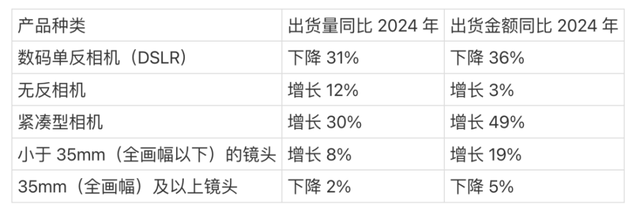
According to Zhiyan Consulting, global mirrorless camera shipments surged from 2.933 million units in 2020 to 5.612 million units in 2024, achieving a CAGR of 17.6%. Shipment value also climbed from 15.96 billion yuan to 31.90 billion yuan. CIPA data reveals that global compact camera sales hit 2.44 million units in 2025, up 29.6% year-on-year.
Source: CIPA Data
Global Market Insights forecasts that the digital camera market will grow from $24.8 billion in 2026 to $41.8 billion in 2035.
As traditional DSLR cameras fade from the mainstream, mirrorless cameras—with their lightweight design and superior optical performance—are taking center stage. China, the world's largest mirrorless camera market, accounted for 29.2% of global shipments in 2024.
Yet, domestic camera brands have yet to achieve significant product or market breakthroughs in the mirrorless segment.
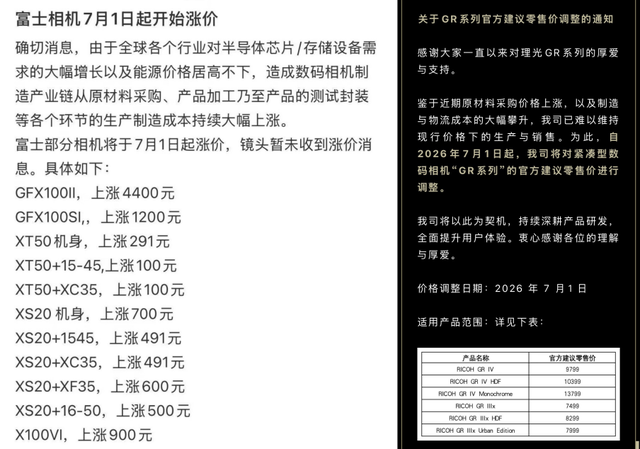
Meanwhile, Japanese brands have repeatedly raised prices, citing production constraints and rising costs. Since June, Ricoh and Fuji have announced hikes, effective July 1st, with increases ranging from several hundred to over a thousand yuan. This has fueled social media discussions about Japanese manufacturers "resting on their laurels" and domestic brands "shaking up the mirrorless market."

Source: Online Comment Section
Liu previously stated that Insta360's decision to enter a category hinges not on trends but on factors like genuine user demand, commercial viability, and capability enhancement.
Given the current market rebound, Insta360 sees an opportunity to explore new categories. The M43 Alliance, which promotes interchangeability and compatibility across brands, offers a mature ecosystem for domestic manufacturers to enter the mirrorless arena.
Launched in 2008 by Olympus and Panasonic, the M43 Alliance provides a standardized platform for mirrorless interchangeable-lens cameras. For domestic players, joining means leveraging an existing technological framework rather than building one from scratch. The Alliance's open nature makes it an ideal launchpad for newcomers.
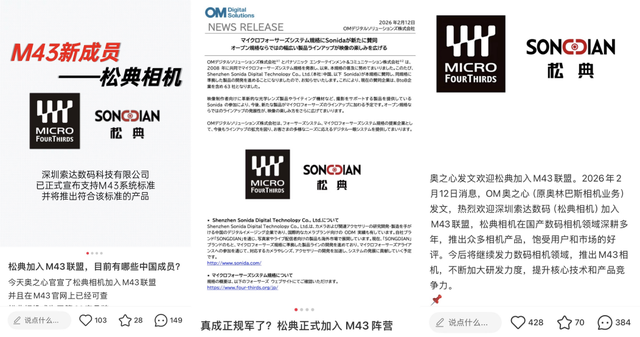
The announcement by domestic brand Songdian to join the M43 Alliance earlier this year sparked heated discussions | Source: Internet
However, the M43 system, while offering compact size, a diverse lens lineup, and lower R&D costs, still lags behind Japanese manufacturers in sensor technology, optical design, and underlying algorithms.
Additionally, brands like Sony, Nikon, and Canon have entrenched technological expertise, brand recognition, channel networks, and user loyalty in the mirrorless field—formidable barriers for new entrants.
Liu acknowledged that mirrorless camera R&D is progressing slower than expected, but Insta360 is pushing forward.
In recent years, domestic imaging manufacturers have honed their skills in areas like image stabilization, high-definition transmission, and manual-auto lens control. Their "hardware + algorithms + ecosystem" approach, validated in pan-action and handheld gimbal cameras, bodes well for their mirrorless ambitions.
Some images are sourced from the internet. Please inform us for removal if there is any infringement.
-
![]()
Li Bin Claims, 'Denying the Pure EV Trend is Like Ostrichism.' What's Li Xiang's Take?
-
Lenovo: Liu Jun Turns Left, Yang Yuanqing Turns Right
-
Lenovo: Liu Jun Goes Left, Yang Yuanqing Goes Right
-
![]()
MiniMax Shares Unlock: Cornerstone Shareholders Show Long-Term Optimism, Yet Stock Plummets Nearly 30% in Two Days; Zhipu Also Sees Nearly 20% Drop Today
-
![]()
Single-Day Plunge of 40%: The 'First AGI Stock' Faces More Than Just Share Price Concerns
-
![]()
Ricoh and Fuji Hike Prices on Legacy Edge; Insta360 Poised to Disrupt Mirrorless Camera Market
-
![]()
Ricoh and Fujifilm Raise Prices in Tandem, Relying on Established Reputations; Insta360 Poised to Disrupt Mirrorless Camera Market
-
![]()
Strategic Shift in Photoelectric Sensing: Maxvision Secures Controlling Stake in CAS Optotech