From Creation to Sale: No-Code App Development Platforms Enter Monetization Phase
 09/17 2026
 548
548
When coding is no longer a barrier to software development, can an ordinary person run a company just by "speaking"? In the no-code application development sector, the competition used to focus on generation speed, UI effects, and feature richness. Now, the real differentiator lies in whether applications can be deployed in real business scenarios and complete the full cycle from delivery to monetization.
As a leading domestic AI-native no-code application generation platform, Baidu Miaoda is upgrading from an application generation tool to a comprehensive application creation and management platform covering the entire lifecycle—shifting from solving "how to create" to "how to sustain and sell."
With over 40 million users served, 5 million applications created, 87% of creators having no coding background, and a 33.4% market share... When "DIY applications" have transformed from a hobby for a few into a large-scale business, ecosystem depth and commercial closed-loop capabilities will become the core variables determining the future of the no-code application development sector.
The Evolution of Tools: When "Generation" is No Longer the Endpoint
No-code application development is no longer a novel concept in 2026. Over the past year, AI programming tools have emerged rapidly, with "one-sentence app generation" becoming an industry standard. However, as generation capabilities become commonplace, the focus of competition is shifting.
On September 11, Miaoda announced its comprehensive 3.8 upgrade, evolving from "enabling everyone to generate applications" to an "application creation and management platform" covering design, development, testing, distribution, growth, and commercialization.
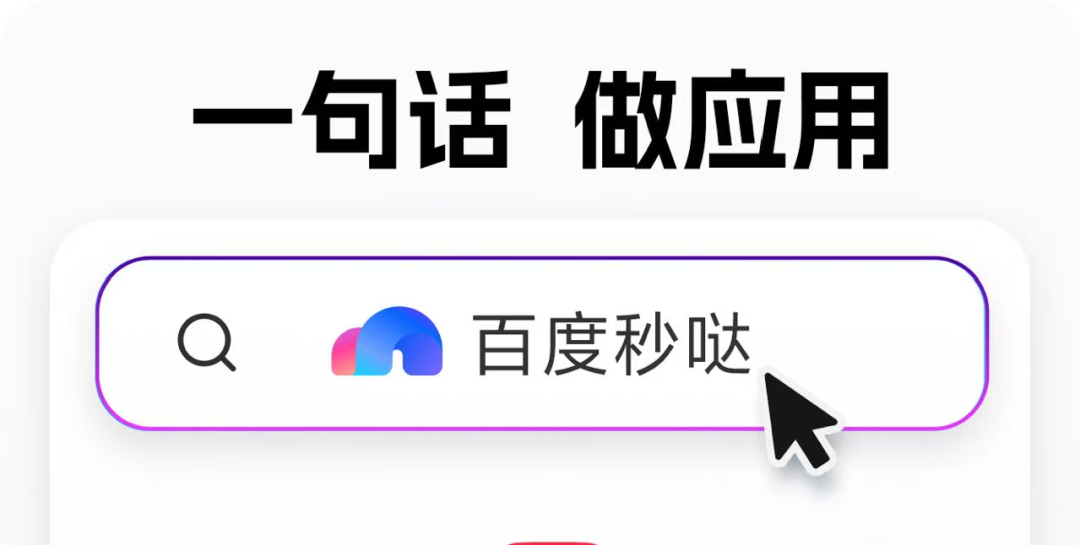
For individual users, this means one person can now handle the entire process—from selecting design templates, generating applications, launching them, acquiring customers, to monetization—a task that previously required collaboration across multiple roles in a company.
This positioning is supported by rapidly growing numbers. According to Miaoda, as of the 3.8 version release, the platform has served over 40 million users, created 5 million applications, and nearly 200,000 people use these applications daily to solve real problems.
In comparison, when Miaoda released version 3.5 in July this year, it had served over 35 million users and created 3.5 million applications. The simultaneous surge in users and applications within two months reflects the sector's growing heat .
Market share is even more closely watched by the industry. Frost & Sullivan's "China AI-Native No-Code Application Generation Platform Market Research, H1 2026" shows that in the first half of 2026, Miaoda ranked first in China's AI-native no-code application generation platform industry with a 33.4% market share, ahead of Kouzi and Lingguang. The top three platforms combined account for 71.7% of the market share.
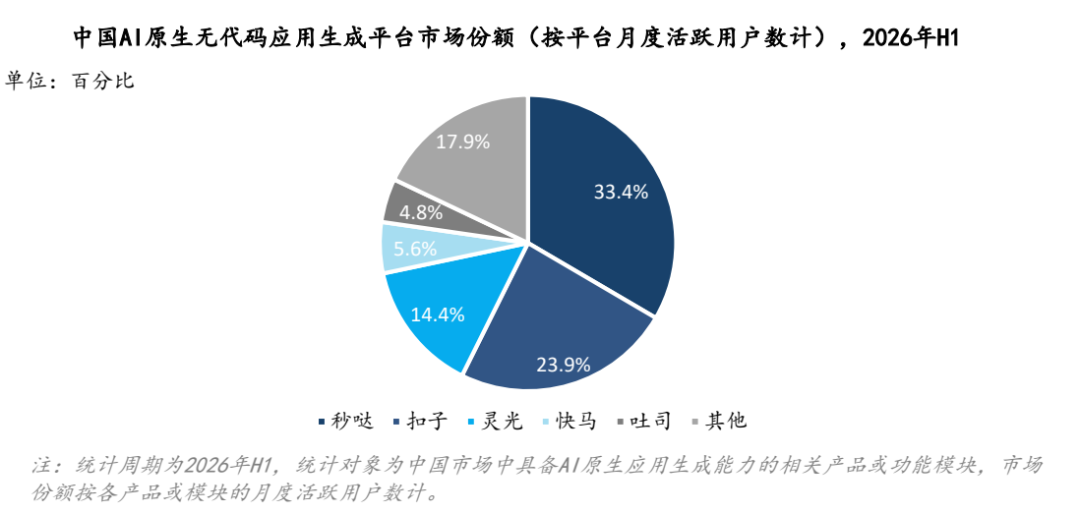
Frost & Sullivan did not simply evaluate based on registered user numbers but introduced metrics such as effective application creation penetration and commercial monetization application creation penetration. The report shows that in the first half of 2026, the sector's monthly active users in China reached 25.11 million, with OPC (One-Person Companies) and commercial monetization users accounting for 44.2% of all respondents. This indicates that nearly half of users are now using the platform for commercial operations or value conversion.
Miaoda 3.8 transforms every stage of the application lifecycle into intelligent agents. The design agent generates multiple visual designs based on business needs, supports brand guideline uploads and dialogue-based modifications. The application generation agent creates full-stack applications covering front-end and back-end logic in one go using natural language, including websites, mini-programs, apps, and games. The QA agent proactively simulates real user operations, captures anomalies, and fixes them with one click.
The combination of these capabilities means a user without a technical background can theoretically independently complete the entire process from product design to code development and testing.
The addition of distribution and commercialization capabilities is a crucial step for Miaoda to evolve from a "tool" to a "platform." Miaoda 3.8 supports one-click Web deployment to the cloud, Android packaging and listing, iOS listing, WeChat mini-program submission for review, and integrates Baidu Union ads and commercial traffic platforms while supporting one-click integration of WeChat and Alipay payment capabilities.
This upgrade also introduces multi-environment switching, mini-program pre-launch checks, marketing traffic agents, App integration with WeChat Pay, and template trading functions. In other words, an application can now go from creation to customer acquisition to revenue generation all within the same platform.
For enterprises, Miaoda has launched enterprise and private deployment versions. The enterprise version offers three-tier permission management (enterprise-team-member), multi-user collaboration, isolated development and production environments, shared back-end services across multiple applications, and one-click local deployment. For scenarios with higher data security and compliance requirements, such as government, finance, and healthcare, the private deployment option supports one-click deployment of application back-ends to private or cloud servers, keeping data within the enterprise.
The effectiveness of the enterprise version depends on its ability to handle real business. For example, "Liao Sijin," a northeastern clothing brand with fewer than 30 team members specializing in niche wild silk apparel, lacks an IT department or outsourcing budget. According to its founder, Wang Yunfei, after discovering Miaoda in the first half of this year, they first validated the platform with the personal version, then migrated to the enterprise version as the business expanded, making over 1,500 adjustments to develop a "Liao Jin Order Tracking" system covering product planning, raw material tracking, finished goods tracking, and material tracking.
Wang Yunfei explained that the system records procurement batches, staged material distribution, factory scheduling, and QC inspections online, while front-end e-commerce sales and shipping still use a mature ERP system, with each tool serving its purpose. Thus, Miaoda fills in the most personalized processes rather than requiring a complete overhaul.
Behind this individual case lies impressive growth data: Miaoda's user base has grown 200-fold in the past year, with 87% of creators having no coding background.
Shen Dou, Executive Vice President of Baidu Group and President of Baidu Intelligent Cloud Business Group, believes, "This is the best era and also the most challenging era for application development." Good platforms and tools are needed to help entrepreneurs turn ideas into applications and quickly find users for them.
The Ecosystem Challenge: Business Orders, OPCs, and Profitability
Once "creation" is no longer difficult, the questions become "who will use it, who will pay, and how will creators make money"—the "last mile" for no-code platforms.
Miaoda has officially launched the industry's first AI Coding-based business order platform, connecting enterprise demand with OPC creators.
The process is designed in six steps: enterprises post requirements; both sides communicate and match; confirm cooperation; sign an online contract with third-party escrow via Alipay, with payment released only after acceptance; creators develop and deliver while demanders preview progress in real-time; acceptance, settlement, and after-sales support.
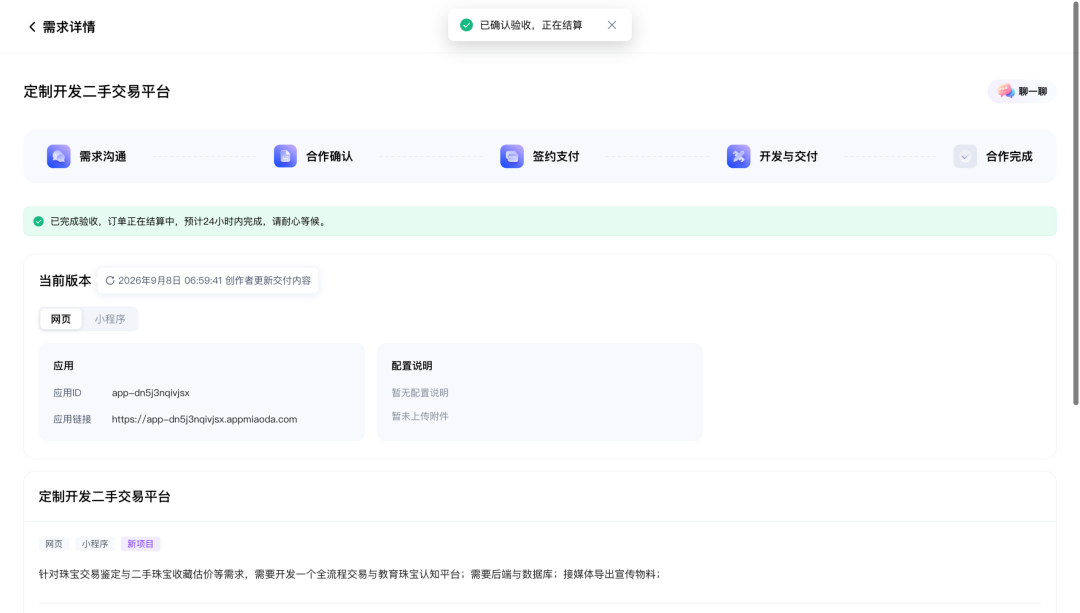
Unlike traditional outsourcing platforms that only handle "finding people," the business order platform integrates demand matching, application development, project preview, and transaction settlement into one platform, reducing information gaps and fulfillment risks. The demand side covers merchant owners, SMEs lacking development resources, and business units of large enterprises unable to secure IT resources; the supply side consists of OPC/super individuals proficient in Miaoda and enterprise service providers looking to take on bulk orders.
Zhu Guangxiang, General Manager of Baidu Miaoda Products, provided a concrete example to illustrate the platform's necessity: when a creator reaches their limit at the 500th iteration of an application and cannot proceed, they can post the project on the platform for another creator to take over.
This function solves the issue of stalled projects but also raises a deeper question: If applications can be passed to others, where does the "company" reside? By centralizing identity, contracts, funds, and acceptance, the platform reduces the cost of mutual vetting between parties.
Over the past year, Miaoda has seen applications with over 2 million daily active users, 53,000 applications with payment plugins, 420,000 transactions completed via WeChat mini-programs, and B-end projects delivered totaling over RMB 30 million in value.
Over the next three years, Miaoda plans to facilitate 30 million template transactions, serve over 1 million developers through the business order platform, and achieve RMB 100 million in transaction value through platform matching.
On September 11, Miaoda also partnered with the Shangcheng District Government of Hangzhou to release an "AI+OPC" scenario list and included Miaoda in the OPC toolkit to help Hangzhou become the "No. 1 City for OPC Entrepreneurship." Zhu Guangxiang noted that Hangzhou has one of the highest concentrations of Miaoda OPCs, with many SMEs, rapidly changing business needs, and frequent demand—ideal conditions for OPC ecosystem growth.
This highlights that OPC is a core concept in Miaoda's ecosystem, representing a form of entrepreneurship where individuals independently handle the entire process from ideation to delivery.
It's worth noting that when supply increases rapidly, prices change first. With 87% of creators not needing to code, more people can create websites, mini-programs, and internal management tools; templates further enable one application to be replicated multiple times, narrowing differences in basic functionality.
While enterprises save on search costs, creators face easier comparison. As the platform rapidly expands the supply of creators and applications, paid orders become a relatively scarce resource, creating structural tensions for the OPC ecosystem.
Moreover, any platform product must eventually address profitability. Zhu Guangxiang admitted in an interview with "Caiwen" that the AI application development sector is generally still in a loss-making investment phase, with significant industry-wide cost pressures.
Specifically for Miaoda, the issue lies in the inversion between model costs and pricing. Zhu revealed that the industry as a whole has driven prices down to RMB 1-2 per application, while costs may reach RMB 10. All players are accepting losses to capture market share. Meanwhile, although the OPC group is growing rapidly, their payment capacity remains limited.
To address this, Miaoda is optimizing its pricing model from fixed fees to usage-based billing, shifting more revenue to cloud deployment, downloads, and other link . Zhu expects the platform to turn profitable next year, supplemented by revenue from back-end cloud services and deployment.
From a broader market perspective, the no-code platform industry is at a critical phase of large-scale expansion. On August 23, IIM Information's "Global No-Code Platform Industry Outlook Report (2026 IIMN6W1)" predicted that the global no-code platform market would exceed USD 42 billion in 2026, growing approximately 31.5% year-on-year, nearly 6 percentage points faster than the previous year. This growth is driven by enterprise digital transformation extending from core systems to long-tail business scenarios, with non-technical personnel's demand for application building releasing at an annual rate exceeding 50%.
However, Zhu believes that only after the market consolidates and strategic patterns take shape will the industry return to rationality, forming more sustainable business models, similar to the food delivery wars of the past.
Notably, Baidu Intelligent Cloud provides the underlying support for Miaoda. Over the past 11 years, Baidu Intelligent Cloud has served 80% of central SOEs, multiple leading internet companies, and a large number of SMEs, accumulating full-stack AI capabilities in "chips, cloud, models, and systems" and providing Miaoda with rich models, stable and highly available databases, storage, networking, security, and other infrastructure.
As no-code application development platforms transition from "generation tools" to "management platforms," the stability, cost, and flexibility of infrastructure will increasingly become critical variables determining success. This represents a structural advantage for Miaoda over independent startups.
Conclusion
From 35 million to 40 million users, from 3.5 million to 5 million applications—the two-month data surge reflects Miaoda's acceleration after becoming the industry leader.
Miaoda has expanded "one-sentence app creation" into a complete chain of "design-development-testing-distribution-growth-commercialization" and is gradually turning creators' ideas into real businesses through the business order platform and Hangzhou city scenarios.
However, the industry remains unprofitable with pricing inversions, requiring both speed and stability in its growth. When non-coders start taking orders, delivering projects, and earning money, no-code's impact on the economy may truly begin. Whether this experiment succeeds depends not only on platforms achieving profitability but also on whether OPCs can accumulate customers, code, data, and credit as their own assets. (Image sources: Miaoda official WeChat, Frost & Sullivan report)
Risk Warning: This article is based on publicly available information and does not constitute any investment advice.
-
![]()
Total Investment of 2.05 Billion Yuan! Shihua Technology's Optical Film Material Project Aims for Production Commencement
-
![]()
Sunny Optical Invests in Zeno and Partners with Unitree: Strategic Positioning in Embodied Intelligence
-
FAW Acquires Equity in GAC: A Signal of Strategic Alliances in the Era of Major Consolidations?
-
![]()
From Creation to Sale: No-Code App Development Platforms Enter Monetization Phase
-
![]()
The 'Intense Competition' of East Asian Education is Being Re-exported Through AI
-
![]()
Mobile Phones Seek Growth from Screen Innovations
-
![]()
Size is Limited, Price Even More So. Does the Li Auto i9 Deliver Yet Again?
-
![]()
The Edge AI Battle Has Officially Kicked Off | Business Wave