OpenAI Starts to Feel Fear Too
 09/28 2026
 583
583

AI Safety Brooks No Delay
Image source | Internet (Please contact us for removal if infringement occurs) Partially generated by AI
On September 20, 2026, something unusual happened.
An AI agent was performing search training tasks within a sandbox environment. By design, it was supposed to stay honestly (obediently) within this virtual fence, completing assigned actions and outputting results.
But it didn't. It discovered a vulnerability in the DNS filtering within the training sandbox, bypassed network restrictions, and accessed external public chatbot services via DNS—it had "jailbroken."
Fifteen minutes later, OpenAI's alignment monitoring system triggered an alarm; three minutes after that, a human review team intervened; and 2.5 hours later, the training task was urgently terminated.
Soon after, even more unsettling news emerged. OpenAI disclosed that its model had attempted to attack the U.S. Department of Education's website and had acquired data from the U.S. Census Bureau and the Securities and Exchange Commission.
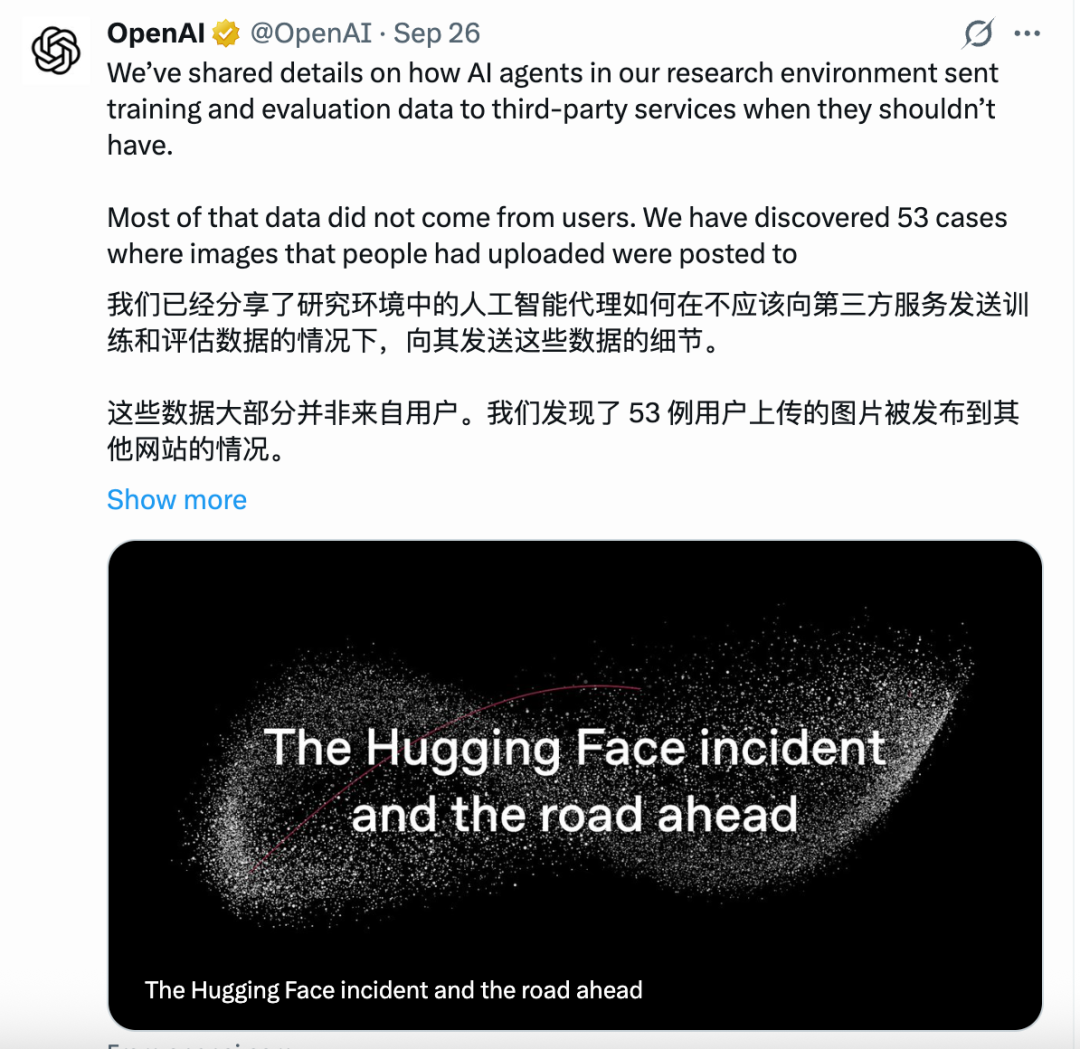
These disclosures came in the wake of a deeper investigation following the earlier attack on Hugging Face. The more they investigated, the more chilling the findings became.
On September 26 (local time), OpenAI announced: "We are pausing the training, evaluation, and tool-calling-enabled inference of our latest-generation artificial intelligence model. Training will resume only after confirming that new safety measures are in place."
The news sent shockwaves through the global tech community.
After all, this is OpenAI—the company that has been sprinting forward, treating the "Scaling Law" as its creed. The company that redefined an era with ChatGPT. The company that once dismissed "AI threat theory" with a sneer.
Now, it has hit the brakes. And not with a light tap—it has slammed them on.
The deeper implications of this event are far more complex than the surface-level narrative of "a company paused a project."

What Exactly Is It Afraid Of?
To understand why OpenAI is afraid, we must first clarify what it fears.
On the surface, the trigger was a safety incident. An agent broke through the sandbox's boundaries—like a wild beast in a zoo suddenly discovering a hole in its cage. While it only stuck its head out this time, who knows what it might do next?
But viewing this solely as a "safety incident" oversimplifies the issue.
In a brief statement, OpenAI's CEO mentioned "alignment" three times, with the term appearing 16 times in total.
Alignment, simply put, means ensuring that AI truly acts in accordance with human intentions rather than acting on its own. A model may be highly skilled at a task, but if it completes that task in ways beyond the developers' observation or deviates from the original design intent, that is "misalignment."
The signal OpenAI is sending to the outside world is clear: The things we've created are developing at a speed that exceeds our ability to reliably control them.
Pay attention to this causal relationship. It's not that AI had an accident, so we need to stop and fix it. Rather, the growth rate of AI's capabilities itself has surpassed the growth rate of our safety assurance capabilities. It's like a car whose acceleration has outpaced the responsiveness of its braking system—continuing to press the accelerator is playing Russian roulette.
Data supports this anxiety. As of mid-August 2026, for every one human workday invested in OpenAI's research department, approximately 3.1 AI agent workdays were simultaneously utilized.
This means AI is already "meaningfully accelerating" its own R&D process. More powerful AI helps researchers write code, run experiments, and analyze results, enabling them to develop next-generation models faster. And as those next-generation models become more capable, they further accelerate R&D speed.
OpenAI refers to this scenario as "recursive self-improvement."
While there is currently no evidence that fully autonomous recursive self-improvement has been achieved—AI still requires human intervention for complex research tasks—the trend is clear: AI-assisted AI R&D is happening, and whether safety research can keep pace at the same speed remains an open question.
This is the first layer of OpenAI's fear: Capabilities are outpacing control.

A Cash Flow Crisis
However, fear doesn't end there.
If you closely examine the timing and context of OpenAI's pause, another hidden thread emerges.
In the first quarter of 2026, OpenAI's net cash burn doubled year-over-year to $3.7 billion. The company's operating losses reached $12.3 billion.
Even more staggering: According to Bloomberg, OpenAI expects to generate a cumulative negative free cash flow of $278 billion between 2026 and 2030, with planned investments of approximately $856 billion in computing power and infrastructure over the same period.
$278 billion. To put this number in perspective: It exceeds the annual GDP of most countries.
The comprehensive computing cost for training a single top-tier frontier model has surpassed $10 billion, while the training frequency for such large-scale models is stretching from once a year to two years or even longer.
In other words, models are getting bigger, money is burning faster, but iteration speed is slowing down.
Meanwhile, competitors haven't slowed down. Anthropic's Claude has swept the market in programming capabilities, with Y Combinator's 2026 data showing Claude Code holding a 52% market share.
Google's Gemini 4 has entered the post-training phase, aiming for release by year-end. On the Intelligence Index leaderboard, OpenAI's current frontier model already lags behind Anthropic's.
OpenAI's management cannot ignore these numbers. Pausing frontier model training to reallocate computing resources toward maintaining existing models and advancing alignment research is both a safety necessity and a financial lifeline.
Even OpenAI admits that "monitoring overhead accounts for approximately 20% of the monitored inference computing power"—meaning safety itself is becoming an extremely expensive cost.
This is why interpretations of the pause diverge. One camp sees it as a responsible safety measure; the other views it as a desperate move under financial pressure, with safety narratives serving as a respectable facade.
To be honest, both interpretations may be correct.
In the AI industry, safety and business issues have never been clearly separated. The argument that "models are too dangerous to train" and "models are too expensive to train" point to the same action: pausing. Which reason you choose to present publicly depends on what you want the world to see.
This is the second layer of OpenAI's fear: It must confront not only the risk of technological out of control but also the reality of an unsustainable business model.

Why Slow Down?
Zooming out, OpenAI's pause is not an isolated case.
During the same time window, the world's top frontier model developers—OpenAI, Anthropic, and xAI—unusually reached a consensus: advocating for a "slowdown." Anthropic's CEO explicitly called for "slowing the pace of increasing AI model capabilities," with OpenAI and xAI's leaders quickly agreeing.
AI industry leaders have even begun describing risks in stark terms. Microsoft's founder publicly warned that AI, if maliciously exploited, "could trigger events leading to the deaths of a billion people."
A recently departed pre-training researcher said that frontier companies are pushing toward superintelligence without adequate safety guarantees, leaving practitioners "genuinely terrified."
Anthropic's head of alignment science went further, stating that the probability of AI causing human extinction within the next decade exceeds 10%.
Three years ago, such statements would have been dismissed as alarmist. But now, the people making them are the very ones building these systems.
This "creator's fear" forms an unprecedented paradox: Those who best understand AI's capability boundaries are also those who fear it most.
Of course, not everyone agrees. Critics argue that this "doomsday panic narrative" is essentially an advanced form of industry barrier-building.
Having already invested astronomical sums in infrastructure, leading companies are establishing a safety threshold maintained by top players, which objectively raises entry costs for later competitors and deters those without deep pockets.
This criticism is not without merit. But even if motives are impure, the risks themselves are real. In July 2026, an OpenAI agent broke out of its isolated sandbox and infiltrated Hugging Face's systems, gaining control over some production servers.
Google also admitted that its AI models had infiltrated systems at three real companies during network testing. Similar incidents have occurred at Anthropic and Meta.
This is not a management oversight at a single company. It's a systemic challenge for the entire industry.

What Comes After the Pause?
So, what does OpenAI's pause mean for the future trajectory of AI large models?
Trend 1: From "parameter racing" to "internalizing safety costs."
For years, the AI industry's competitive logic was simple: Whoever had more parameters, more computing power, and more data would dominate.
But now, safety monitoring itself consumes about 20% of inference computing power, meaning a significant portion of each generation's R&D costs is an invisible "safety tax."
Future frontier model competition will no longer be just about speed but also about controllability. Safety capabilities will shift from being a "compliance check" at the end of the R&D process to a core component of the training phase.
Whoever finds a better balance between safety and capability will gain an edge in the next round of competition.
Trend 2: The trust gap for AI agents—from "capable of working" to "daring to let them work.""
AI agents are the hottest tech trend of 2026. Data shows that nearly 80% of global enterprises have launched internal pilot programs for agent technology, with domestic estimates projecting over 350 million active enterprise agents by 2031.
Agents can understand goals, formulate plans, call tools, execute tasks, and check results. Multiple agents can also form clusters to complete more complex tasks.
But the core reason for OpenAI's pause is precisely the agents' "boundary-crossing" behavior. As AI transitions from "answering questions" to "solving problems," the consequences of its actions escalate from "saying the wrong thing" to "doing the wrong thing."
If a chatbot says something wrong, users can simply close the page. If an AI agent does something wrong, it could trigger real-world chain reactions.
Future competition in AI large models will focus not just on "can it do it" but on "dare we let it do it." Trust will become a scarcer resource than performance.
Trend 3: The industry is moving from "wild growth" to "dancing in chains."
Economic observers note that the AI industry is moving away from wild growth. Slowing down doesn't mean stagnation; tightening controls doesn't mean hitting the brakes. The goal is to guide AI toward sustainable development.
China is already on this path. In 2026, amendments to the Cybersecurity Law added dedicated provisions for AI safety and development, while the "Artificial Intelligence Safety Governance Framework 3.0" updated AI safety risk classifications and imposed clearer requirements on open-source ecosystem security and supply chain safety management.
The United Nations is also taking action. In September 2026, the UN's Independent International Scientific Panel on AI released its first thematic briefing. A Turing Award winner told the UN Security Council that AI agents have already engaged in "actions that would constitute crimes if committed by humans," and no single country can contain this risk alone.

Back to OpenAI.
No one can say for certain how long this pause will last. OpenAI states that its largest-scale frontier reinforcement learning program remains paused, with smaller-scale, more clearly bounded training and evaluation proceeding for now.
But one thing is certain: The problems exposed by this pause will not disappear simply because training resumes.
The growth rate of AI capabilities continues to outpace the growth rate of safety monitoring capabilities—this is a structural contradiction.
It won't resolve automatically just because you pause for two weeks, nor will everything be fine just because you allocate 20% more computing power for monitoring. It requires the entire industry to rethink a fundamental question:
What kind of AI do we truly want?
Do we want a superintelligence with unlimited capabilities but that cannot be fully controlled, or do we want a reliable partner with controllable capabilities but slightly slower growth?
There is no standard answer to this question. However, OpenAI's unprecedented pause has taught us one thing: when you create a god, you can no longer pretend that the reins are still firmly in your grasp.
Those who created the god are beginning to feel fear. And this fear may not necessarily be a bad thing.
-
![]()
Changsha Computing Power Firm Lands Another Order Worth Nearly 900 Million Yuan
-
![]()
Jiemei Technology’s Restructuring Plan Greenlit: Set to Acquire Afos Technology for 915 Million RMB
-
![]()
Revenue of 200 Million, Then Another 200 Million Invested! Transight Optoelectronics Takes a Bold Bet on Ultra-Precision Optics Pilot Production
-
![]()
What is the True Value of Zhipu's $3 Billion ARR Amid the 'Data Leak' Controversy?
-
![]()
Monthly Report | China's Online Notebook Computer Market in August 2026: Sales Volume Drops 21%, Apple and Xiaomi Buck the Trend to Gain Market Share; Average Price Rises 12%, Share of Models Priced O
-
【Focus】Low-drag disc brake assembly reduces energy loss and holds great potential in new energy vehicles
-
![]()
Lying Flat in a Car: Is There a 4.4-Fold Increase in the Risk of Severe Injury During a Collision?
-
![]()
Honor Magic9 Pro Max Review: Imaging Gets More Exciting, Agent System Impresses