Better Not Expect Too Much from the Domestic Muse
 10/09 2026
 495
495
Everyone was talking about launching personal AI agents before the holidays, but none have been officially released yet. What's going on?
On September 28, reports emerged that Doubao's product team received an urgent task during the Mid-Autumn Festival: complete joint debugging by September 27 and deliver an experience version by September 30 for internal testing. The total timeline was about six days. The next day, sources revealed that ByteDance is accelerating the external release of its personal assistant product, planning to further integrate Project Spell with Doubao. The Spell and Doubao conversation teams will jointly oversee the project.
Alibaba has also publicly announced its direction. Zheng Sishou, head of the Qianwen App, declared at the Cloud Town Conference the acceleration of Personal Agent development. On September 30, media sources learned from insiders that Tencent Yuanbao plans to launch a personal AI agent, though the specific form and timeline remain undetermined.
These developments have sparked expectations that Muse is already developed and that once domestic tech giants catch up, users will have an assistant that understands them and can complete tasks across applications. In the future, delegating tasks might not require opening multiple apps individually.
However, these expectations have already been disappointed once. The first-generation Doubao phone a year ago generated significant buzz, but the current personal AI agents may not even match its popularity. The second-generation Doubao phone, released this year, faced rejections from numerous third-party apps.
Even Muse in the United States encountered blockades from Amazon, and its cloud browser did not provide unrestricted access.
Developing a domestic Muse is not a technological challenge. The ability to operate long-term (chángqí - persistently) within other companies' services depends on the attitudes of third-party platforms. User expectations may not be realized soon.
The development of application-layer services faces far greater restrictions than model-layer advancements.
01 After User Authorization, Platform Approval Remains a Hurdle
Muse's most compelling feature is its ability to perform tasks continuously and across platforms.
In Meta's official September demonstration, Muse identified a school event form due that day from the user's emails, filled it out, and then, based on the schedule, asked if the user would like to sign up to accompany someone. After confirmation, it sent the email. What the user saw was a conversation, but behind the scenes, email, calendar, and spreadsheet services were utilized. Muse operates in the cloud, allowing tasks to progress even after the user closes the app.
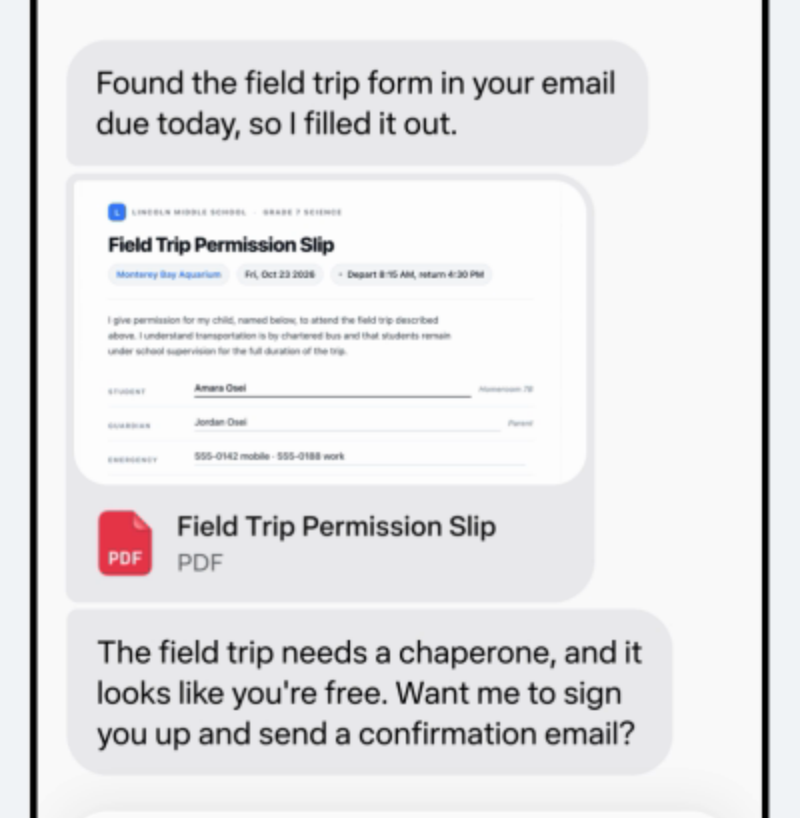
Muse fills out a school event form and requests user confirmation for the next step.
This experience makes personal AI agents attractive. Users don't need to remember each software's different functions or transfer information between interfaces. All services are completed by a cloud-based agent.
Soon after, foreign media reported that Amazon had blocked Muse from accessing and shopping on behalf of users. Amazon stated that Meta did not inform them in advance about Muse's access to its store, that the agent did not identify itself, and that there were privacy and security concerns regarding credential handling. Amazon had previously requested that Meta proactively exclude Amazon from Muse's usage scope.
After users allow the assistant to use their accounts, whether the service platform accepts this access remains a B-side decision. Muse can submit purchase requests on behalf of users, but Amazon still controls the website's access rules. Whether the computer is on the user's desk or in Meta's cloud does not automatically resolve this disagreement.
Platforms must manage risks. If an agent makes an error, users will seek help from the actual service provider. How account credentials are stored and how sensitive operations are confirmed must also be regulated by the service provider. Moreover, after resolving these issues, cooperation must address revenue distribution.
If product comparisons are completed within the assistant, users may already have made purchase decisions when entering the store. The store still receives orders but misses out on the opportunity to showcase other products to users, potentially reducing recommended placements and ad exposures. For platforms, integrating personal AI agents may add a channel or cultivate a new competitor with the power to choose platforms on behalf of users.
Domestic companies face more specific business boundaries. Life services are distributed across different apps, with accounts, data, and transaction processes operating independently. A phone assistant seeing the screen or a personal AI agent accessing a few services represents only part of the entire task.
Zheng Sishou, head of the Qianwen App, previously described computing power, models, and offline ecosystems as "relatively good entry conditions" in interviews. He also admitted that different scenarios within Qianwen are not fully interconnected, let alone data across Alibaba's entire ecosystem. The team is working with partners to define the capabilities agents can invoke and how they provide feedback.
Alibaba can start by integrating its services. Taobao can open its product and transaction capabilities to Qianwen, a process that can be driven by the group without needing to first persuade a competing platform to accept its assistant. Qianwen still needs to complete data authorization and technical modifications, but the challenges it faces differ from those Doubao encounters when seeking Taobao's approval for integration. The more comprehensive the in-house services, the fewer external collaborations the personal AI agent needs to pursue.
Thus, these tech giants simultaneously wear two hats. When developing personal AI agents, they hope external services will open up more. When managing their core businesses, they must consider whether others' assistants will alter their user relationships. All these giants aim to be the primary gateway, yet their partners also have their gateways.
02 AI in Phones Also Needs App Cooperation
Does integrating assistants into phone systems reduce restrictions?
On September 16, the Nubia NaviX Ultra, equipped with the consumer version of the Doubao phone assistant, officially launched. Zhao Ganlin, head of Doubao's product experience, introduced its cross-app operation and error-correction capabilities at the launch event. Tasks demonstrated in live reports included identifying time and location from an invitation in the photo gallery and adding them to the schedule, as well as summarizing Feishu group messages, forwarding documents, and scheduling meetings.
However, before the new phone's release, Doubao introduced the Screen Automation Operation Statement Protocol (SAEP). Third-party apps can decide whether to allow automatic operations and can separately restrict screenshots, simulated inputs, and content modifications. To date, no service provider has explicitly made a similar statement or accepted this scheduling model.
This is clearly an ecosystem battle. Media tests revealed that when asked to order a hot latte, Taobao Flash Sales and JD.com did not support agent operations, so Doubao suggested using Douyin instead. After authorization, it selected a Luckin Coffee store on Douyin and left the final payment to the user. In the same test, WeChat messages could not be sent via Doubao.
In these tests, whether the assistant could complete the task depended on which platform the task landed on. Douyin's products, merchants, and transaction systems are already available to ByteDance. Feishu's messages, documents, and meetings can also serve as Doubao's tools. Like Alibaba, ByteDance has convenient conditions for using its services. Expanding to Taobao, JD.com, and WeChat requires securing their cooperation.
ByteDance is working to supplement its missing services externally. Before the National Day holiday, Cao Cao Mobility announced its initial integration with the Doubao phone assistant. By September 30, the Doubao App launched a centralized "Travel with Doubao" portal, with mapping capabilities from Baidu Maps, ride-hailing from Cao Cao Mobility, and flight and train ticket services from Flight Manager and High-Speed Rail Manager, respectively.
The specific open scopes for the phone assistant and Doubao App are arranged separately, but these collaborations indicate that ByteDance is integrating services provided by external companies into its assistant.
The model understands tasks, partners provide usable services, and both must adapt authorization, order placement, and result return processes. Expanding each type of usage involves work beyond the model.
This issue persists with a domestic version of Muse. Cloud browsers and phone screen reading represent different execution methods, but both require interacting with other companies' services. As long as tasks pass through external platforms, assistants must handle their access rules.
Honor's collaboration with Qianwen demonstrates a route starting with division of labor.
At the Cloud Town Conference on September 22, Xu Zhuhong, vice president of Alibaba's ATH Business Group and head of Qianwen's phone intelligence, announced Qwen Intelligence. The solution offers capabilities like task planning and cross-app execution. Phone manufacturers can adopt the entire solution or select modules to integrate into their systems. Honor became the first partner, and the Magic9 series, released on September 28, already incorporates their collaborative intelligent agent capabilities.
Alibaba provides the model and agent solution, which Honor integrates into MagicOS. Users continue to initiate tasks through YOYO, allowing Alibaba to enter the phone ecosystem while Honor retains its assistant brand and system gateway.
Before announcing its collaboration with Qianwen, Honor had already introduced a batch of YOYO features on September 15: after users purchase tickets or register for appointments, YOYO extracts the time and location to create a schedule; after calls end, it generates to-dos or adds new contacts. It can also organize pickup codes and provide reminders based on item types. These functions utilize information already generated on the phone, reducing users' subsequent organization efforts.
Honor is also collaborating directly with service providers. At the Bund Conference, Honor demonstrated YOYO working with Alipay's Abao to collect Ant Forest energy and redeem membership points within Alipay. When querying social security or housing provident fund information, YOYO first activates service cards, then users click to enter the corresponding pages.
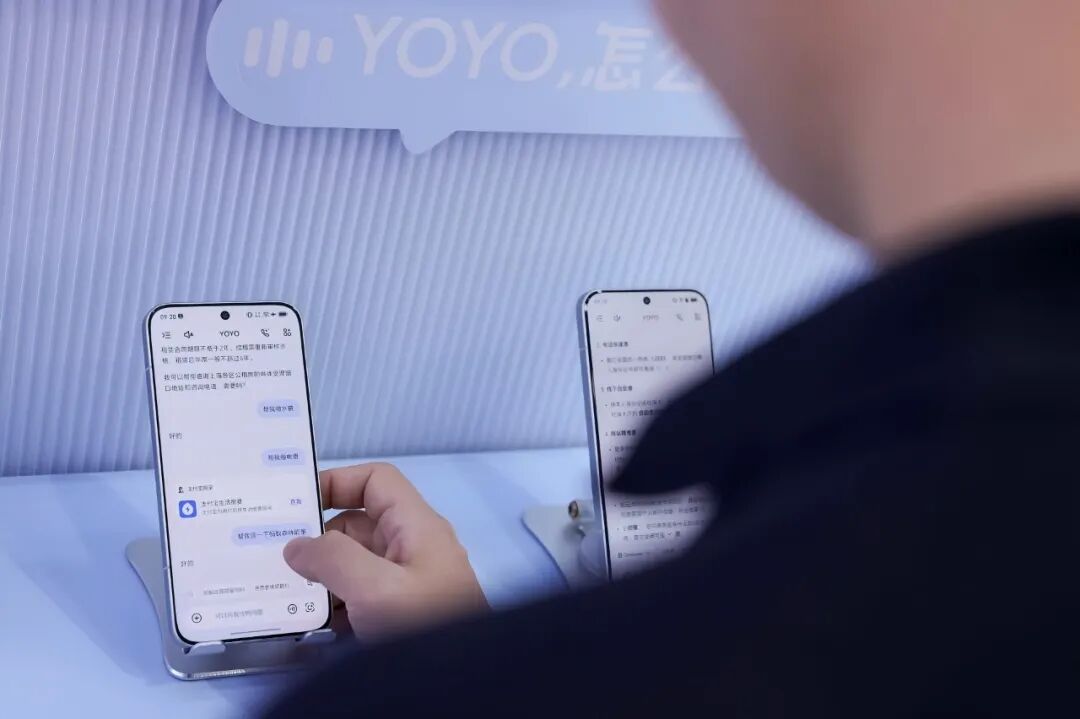
At Honor's booth, YOYO brings up Alipay's utility payment service card.
These collaborations have distinct divisions of labor. Qianwen provides the model and execution solution for phones, Alipay decides which services to open and which steps remain user-completed. Phone manufacturers must advance collaborations on both sides to expand their assistants' capabilities.
Qianwen's cross-app execution solution also retains two approaches: prioritizing API calls and supplementing with interface operations when necessary. It does not abandon scenarios without suitable APIs or delegate all operations to screen reading. Using clearer invocation methods for partner services allows both sides to agree on how tasks are initiated and results are returned.
Doubao is also pursuing app collaborations. Both routes expand the scope of tasks assistants can handle, differing only in partners and organizational methods. Honor's integration with Qianwen reduces the phone manufacturer's workload in building from the model up; Doubao's collaboration with Nubia allows an assistant with an independent user base to enter the phone system. Both must continue securing service providers.
Integrating assistants into phone systems also incurs new investments. According to Jiemian News on September 16, ByteDance covers some AI phone development costs and model invocation expenses in its collaboration with ZTE, prioritizing getting Doubao into the system before exploring subsequent business models.
Limited openness suffices to create useful functions. The issue is that users do not arrange their lives based on collaboration lists. A task may complete smoothly within a partnered app, but the next task, involving a different service provider, may require user intervention. The more a personal assistant aims to cover complete daily life, the more it must address these discontinuities.
03 The Cost of Building an Ecosystem
As previously discussed, technologically, developing personal AI agents poses minimal challenges for tech giants. The difficulties lie in ecosystem integration, which involves Equity (quányì - rights and benefits) alignment and cost considerations.
Integrating shopping, food delivery, and transportation into personal AI agents faces varying resistances and challenges across companies.
Douyin E-commerce, Taobao, and Tmall already have products and merchants, allowing Doubao and Qianwen to initially leverage their respective e-commerce platforms. Alibaba's additional assets include Taobao Flash Sales' instant retail system and platforms like Gaode Maps and Fliggy. Doubao has integrated maps and ticketing through external collaborations; Alibaba can reuse Gaode Maps and Fliggy's existing service providers, order systems, and fulfillment relationships.
These are assets Qianwen can leverage. Alibaba's latest quarterly results confirm that the Qianwen App continues deepening integration with Taobao, Tmall, and Taobao Flash Sales; subsequent reports mention Qianwen connecting to life services like food delivery and ride-hailing. Alibaba's task is to enable its platforms' capabilities for agent invocation while continuing to streamline fragmented tasks.
Negotiating collaborations with external platforms involves first securing their willingness to accept this new gateway, then agreeing on which capabilities to open and how to settle transactions. In-house platforms can be directly driven by the group for transformation, with their revenues managed internally. Alibaba saves on reintroducing a service platform and rebuilding partnerships from scratch; past investments in merchant recruitment, transactions, and delivery can continue serving the new assistant. ByteDance enjoys similar conditions within Douyin E-commerce and Feishu, but Alibaba's advantage lies in having more life services covered by internally coordinated businesses.
According to Alibaba, less than 2% of the Qianwen product team's manpower is dedicated to App docking (duìjiē - integration) and construction, with more resources allocated to execution frameworks, memory, tools, and services. After establishing platform connections, the team must invest in helping the assistant understand tasks, correctly invoke services, and handle errors.
Alipay warrants separate consideration. Alibaba's annual report discloses that the company pays Alipay processing and custody service fees under commercial agreements. Companies often included in the same "Alibaba ecosystem diagram" cannot all be directly mobilized by the same management.
ByteDance also has existing businesses Doubao can leverage. Douyin E-commerce provides products and transaction systems, while its life services business has organized Catering (cānyǐn - catering), accommodation, and other merchants. Connecting these capabilities to Doubao allows ByteDance to save on re-recruiting merchants and building transaction systems.
According to previous Caijing reports, Doubao proactively requested supply from Douyin's travel business, with both business units operating independently. NBD tests before the National Day holiday revealed that users binding their Douyin accounts could directly purchase hotel group-buying vouchers within Doubao. Doubao borrowed Douyin's existing merchant and transaction capabilities.
In its recently released Mid-Autumn and National Day consumption report, Douyin's life services division highlighted "Doubao booking hotels" as a standalone achievement: order volume increased by over 56% month-on-month. Doubao's inclusion in Douyin's consumption performance statistics signals ByteDance's intention to operate it as a service gateway.
36 krypton revealed that Douyin's travel business generated nearly 200 billion yuan in GMV in 2025, covering hotels and other travel products with a redemption rate of about 31%. LatePost estimated Douyin's share of the online hotel booking market GMV at around 3%, with Fliggy at 5-7%. While Douyin's travel sales are substantial, its hotel booking share remains lower than Fliggy's.
For Doubao to reuse these products, it must also connect booking and fulfillment services. When users place an order, they may need to schedule appointments later. Tasks delegated to personal assistants often require confirming specific dates, room types, and prices together. LatePost also mentioned that some of Douyin's hotel rooms come from Ctrip and Tongcheng. If Doubao invokes this supply, inventory, pricing, and after-sales still require coordination with external platforms.
After internal connections are established, pricing structures also change. Doubao-generated accommodation orders, previously merged into Douyin's organic traffic and settled at an 8% comprehensive rate, were later designated as a standalone transaction channel with a 12% rate. Merchants pay these fees. While ByteDance reuses Douyin's supply, merchants must decide whether Doubao can drive additional orders to justify accepting the new channel's fees.
Outside of the existing offerings on Douyin, ByteDance still needs to seek external partners. The aforementioned map services, ride-hailing, and ticketing are supplemented by Doubao through external companies. Each collaboration requires defining the scope of access, completing interface adaptations, and ongoing maintenance. Alibaba already has AutoNavi and Fliggy, enabling more work to be driven within the group. ByteDance can leverage its own e-commerce and lifestyle services, but to cover a similarly broad range of daily needs, it must also expand external services.
WeChat is also a significant player in personal AI agents.
Tencent has publicly confirmed that Xiaowei, currently in small-scale testing, can operate native WeChat functions, including sending messages, making audio and video calls, and searching Moments. It can also launch Mini Programs to complete services like hospital registration and coffee purchases. Actions restricted for Doubao within WeChat can be directly initiated by Xiaowei from inside WeChat.
Tencent already possesses user relationships, a payment environment, and Mini Program access points. Placing the assistant within WeChat allows it to utilize existing business positions of merchants, reducing the effort of relocating users and services into another app. However, the hospitals, dining brands, and service platforms behind Mini Programs each have their own operators. While WeChat can set access rules, specific business operations still require developer cooperation.
WeChat's current development examples vividly demonstrate this collaborative approach: Xiaowei returns text and Mini Program cards. After users click, they enter the business page provided by the developer to continue selecting products, placing orders, and making payments. Developers must prepare corresponding interfaces and landing pages and obtain beta access permissions. The existing Mini Program network makes it easier for Tencent to find services, but transforming them into capabilities callable by the assistant still requires a round of modifications. This is the compound interest from the Mini Program era, likely to explode at the personal AI agent level. After all, services and interfaces are nearly ready-made; running them through is not difficult—only profit distribution poses a challenge.
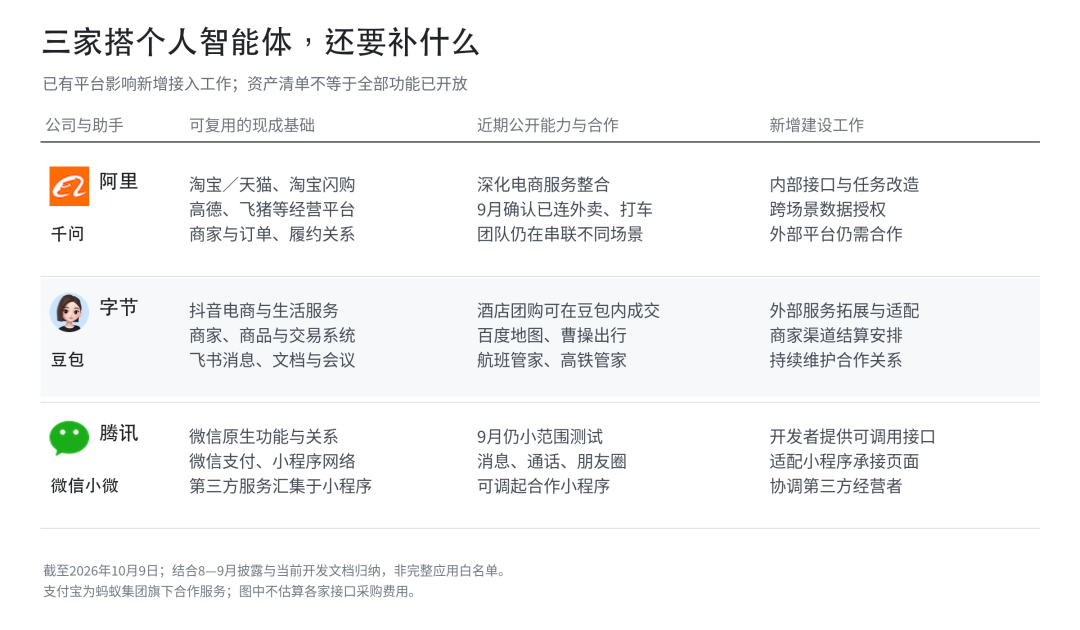
Services Reusable by Three Personal AI Agents and New Access Work Required.
If all three companies aim to cover shopping, home delivery, and transportation, Alibaba can minimize external platform expansion: more of the platforms needed for these scenarios are already within the group and can be driven by group-level transformations. This is Alibaba's condition for reducing the cost of new ecosystem construction. ByteDance needs to continue expanding external services, while WeChat must drive transformations among Mini Program operators. Alibaba can avoid one round of expansion costs, and Tencent has its own advantages in native social networking and existing user relationships. Ranking the three based on total group expenditures would obscure these differences entirely.
The major companies have already invested heavily in models and computing power. Alibaba's quarterly capital expenditures reached RMB 67.678 billion by the end of June this year, while Tencent's hit RMB 52.784 billion in the second quarter. These group investments serve multiple businesses. Expanding the use of personal AI agents on this basis also entails costs for accessing services and executing tasks.
The product library and order systems can continue to be used, but model inference, task state preservation, and failure handling still require ongoing resource investment. Alibaba's existing platforms allow it to avoid building part of the service system, freeing up capital and development resources to continue improving the assistant itself.
The new transactions generated by QianWen also have the opportunity to feed back into the group's original businesses. The more external services there are, the more the assistant company must allocate revenue with other operators: the other party provides order and fulfillment capabilities and must retain profits for continued operation. How much computing power the major companies are willing to invest cannot replace this decision by service providers.
Of course, moving internal services to AI must also generate practical incremental value. During Tencent's Q2 earnings call, UBS analyst Kenneth Fong asked whether Xiaowei would merely transfer existing Mini Program transactions into AI, increasing computing costs while reducing ad impressions. Tencent President Martin Lau responded that improving the experience, expanding the WeChat ecosystem, and then leveraging existing monetization methods to generate revenue while controlling service costs would be the approach. The existing ecosystem reduces construction difficulty, but income returns still depend on achieving more transactions or higher efficiency.
An internal beta version can be delivered in six days. Ultimately, which assistant users entrust with their tasks will depend on whether it can handle the apps they use daily.
Alibaba can more easily integrate its own services into QianWen, Doubao can start with Douyin and Feishu, and WeChat Xiaowei can begin with its own relationships and Mini Programs. The more each company leverages its existing ecosystem, the easier it is to create useful personal AI agents first. However, a user's day involves more than one company's business. To complete these tasks, the major companies must still invite other platforms in and accept the conditions proposed by partners. The challenges already faced by Doubao Mobile will still confront domestic Muse.
-
![]()
Case Amount Hits 201.085 Million Yuan! Optical Enterprise Faces Charges for Smuggling State-Prohibited Goods
-
![]()
Optical Giant Changes Leadership: Transition and Challenges During a Period of Performance Pressure
-
![]()
Better Not Expect Too Much from the Domestic Muse
-
The Race to Become the ‘First Video Large Model Stock’: Kling AI Eyes Hong Kong IPO, Targeting Launch as Soon as Next Year
-
![]()
Holiday Sales of Communication Devices Soar by 119.8%: Is It Volume or Pricing Driving Growth?
-
![]()
OpenAI Annual Revenue Disappoints, AI Sector Tumbles, Nvidia’s Market Value Plunges $168.4 Billion Overnight
-
Can an AI Smartphone That 'Automates Tasks' Go Too Far?
-
![]()
4G Intelligent Lighting Module Selection, Deployment, and Common Issues