AWS and NVIDIA Open Source Robotics Toolchain: Heavy Lifting for Physical AI Taken Over
 10/13 2026
 515
515
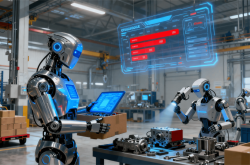
On October 8, AWS unveiled an open-source toolkit called Physical AI Toolchain. It’s not a model, not a chip—it’s a complete engineering pipeline that helps take robots from 'trainable' to 'deployable.'
Uwem Ukpong, VP of AWS Industries, put it bluntly: 'Customers tell us too much engineering effort goes into infrastructure, not innovation. We want to flip that ratio.'
Translated plainly: Stop building your own assembly line—I’ll set it up for you. You focus on tuning your robot.
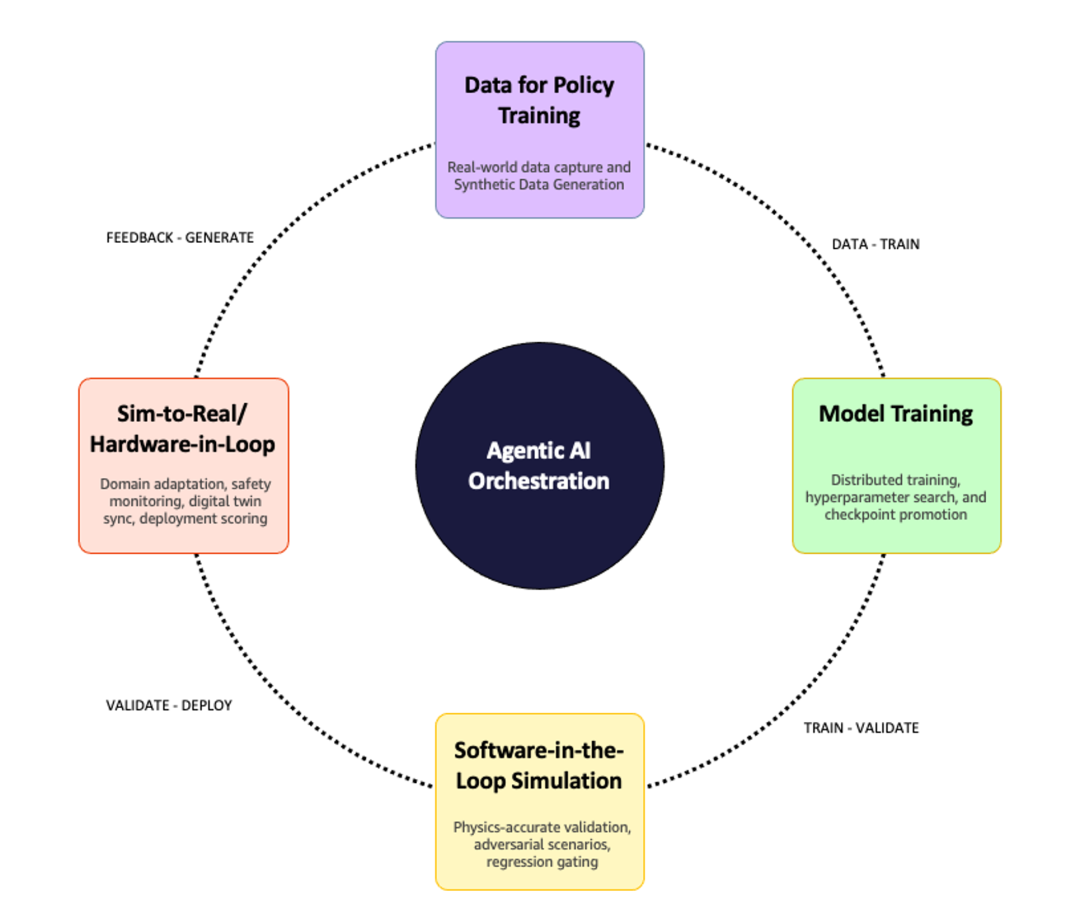
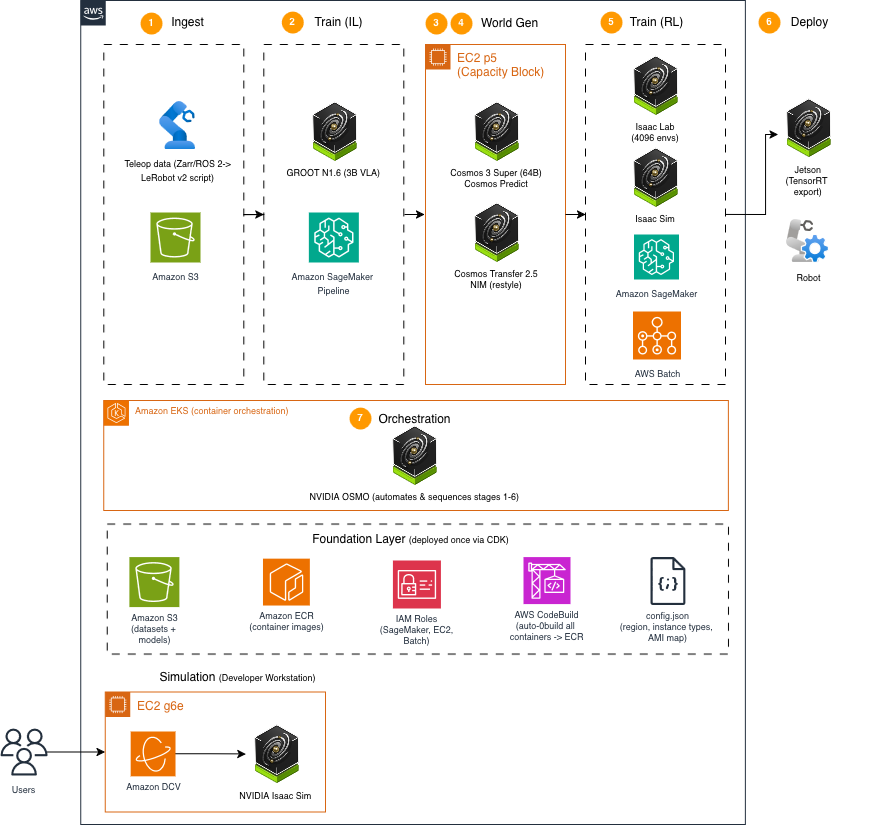
The toolchain was co-built by AWS and NVIDIA. AWS provides cloud services (SageMaker, EC2 GPU, IoT Greengrass, S3), while NVIDIA contributes its Physical AI stack (Isaac Sim, Isaac Lab, GR00T, Cosmos). Five stages are linked: synthetic data generation, model training, simulation validation, edge deployment, and continuous improvement.
aws.amazon.com/cn/blogs/physical-ai/introducing-aws-physical-ai-toolchain/
Official public examples are provided: a UR3 robotic arm with Robotiq 2F-85 gripper, featuring 27 real teleoperation episodes. Teams can first run through the complete pipeline of 'data ingestion—fine-tuning—simulation evaluation—weight transfer' using this small dataset, then replace it with their own robot URDF and sensor configurations.
Costs are also listed. GR00T smoke testing costs ~$2, full training ~$79; Cosmos 3 Predict costs ~$37/hour. The significance of this price list? It turns 'Should we try Physical AI?' from a vague budget decision into a calculable one.
Unique Insight: Cloud-based closed loop (closed loop) is complete, but the 'last mile' remains unconnected
I combed through the component status table in the GitHub repository. Most modules are marked 'Available,' but two key statuses stand out: Arena evaluation is 'Preview,' and Edge Deployment is 'Planned.'
What does this mean? The cloud-based data, training, and simulation pipelines now have relatively complete examples, but the final step of stably deploying models to Jetson or on-site devices remains unclosed.
This is precisely the segment manufacturing cares about most. A factory won’t pay just because you’ve trained a shiny model—it wants that model to run error-free for 8 hours straight on an industrial PC beside the production line. Cloud validation is technical proof; edge stability is commercial delivery.
AWS acknowledges this gap. Hence, the toolchain is positioned as a 'reference starting point,' not a 'turnkey solution.' Steve Blackwell put it candidly: 'Some clients will deploy it directly; others will adapt it to their environments.'
The focus isn’t on the toolchain itself
For the past two years, Physical AI infrastructure has been 'built in-house.' Figure has its data pipeline, Tesla has Optimus Academy, and leading Chinese firms are building their own training grounds. Every company solves the same problem, but solutions are incompatible.
What AWS and NVIDIA did here is turn 'infrastructure' into a public good.
Consider the timeline. In July, NVIDIA integrated GR00T and Isaac into Hugging Face’s LeRobot framework. In October, AWS connected NVIDIA’s full Physical AI stack to its cloud infrastructure and open-sourced reference architectures and deployment automation. With these two steps, the 'cloud-chip-open source' triangle for Physical AI is complete.
Who is impacted most? Small-to-medium robotics companies and manufacturing clients. Previously, doing Physical AI meant building data pipelines, configuring simulation environments, and solving Sim-to-Real engineering issues alone. Now, AWS has released reference architectures, IaC code, and deployment automation—cutting startup costs from 'months for an engineering team' to 'days for a single engineer.'
This shift will disrupt valuation logic in the primary market. For the past two years, embodied AI companies were valued on 'technical barriers'—who had more efficient data pipelines, more realistic simulations, or richer deployment experience. When these capabilities are partially commoditized by open-source toolchains, barriers will shift upstream and downstream: upstream to the performance of foundational models, downstream to real-world deployment experience and customer relationships.
The most memorable part of AWS’s toolchain isn’t 'open source'—it’s the honest labeling of what works and what’s still in progress. Edge Deployment being 'Planned' shows cloud vendors are clear about which problems they solve. A complete cloud-based closed loop (closed loop) doesn’t mean the physical world’s loop is closed. Manufacturing clients don’t want a model that scores high in simulation—they want a machine that works nonstop in the workshop without crashing. The journey from 'Planned' to 'Available' is where Physical AI’s true watershed lies.
#PhysicalAI #AWSNVIDIA #EmbodiedAIOpenSource
Note: This article is based on public sources available as of October 10, 2026. Industry forecasts and profitability judgments involve uncertainties and do not constitute investment advice.
Follow 'Zhicaishe' for updates on embodied AI tech evolution and capital trends.
-
![]()
Who is Taking Away the Profits of Car Companies: Battery or Intelligent Driving?
-
![]()
Tencent Successively Discontinues Two AI Agents
-
![]()
Has the Brake Pedal of JAC Motors Really Broken? The Market Will Teach Every Automaker with 'Fatal Flaws' a Lesson
-
![]()
Changsha’s Emerging Powerhouse in Computing: Cancels RMB 3 Billion Contract!
-
![]()
Production Capacity Can’t Keep Up with Orders! This Optical Enterprise Soars 449% on Debut
-
![]()
Q3 Report | Yuanjie Technology's Net Profit Expected to Surge Fivefold, Transitioning from 'Shortage Dividends' to 'Delivery Challenges'
-
![]()
The Computing Power Price War Hits Silicon Valley
-
![]()
The AI Office Sector is Forming a 'Three-Pillar' Landscape