AI Bubble in US Stocks with a $2 Trillion Valuation
 10/13 2026
 580
580
After the highest-level meeting between China and the United States, the U.S. side stated that the two sides decided to change AI to SI, with artificial intelligence renamed superintelligence.
Subsequently, on September 29, Trump convened tech executives at the White House, including Google CEO Pichai, Anthropic CEO Amodei, Meta CEO Zuckerberg, OpenAI President Brockman, xAI founder Musk, and others, to discuss AI development and sign a joint statement on “Superintelligence” (SI).
Absurdly, the statement misspelled the name of the United States as “Unites States.”

Sure enough, it's a shambolic operation.
1
A $2 Trillion IPO
Among them, Anthropic is going public.

CEO Amodei is a drama queen who once worked at Baidu—it’s unclear what he learned there. He publicly calls for slowing AI development and strengthening government oversight. Yet his actions speak louder: seeking a ~$2 trillion valuation, aiming to raise capital faster than any company in history.

What does $2 trillion even mean? It surpasses SpaceX’s ~$1.77 trillion valuation. If issued at this price, it would be the largest IPO in history.
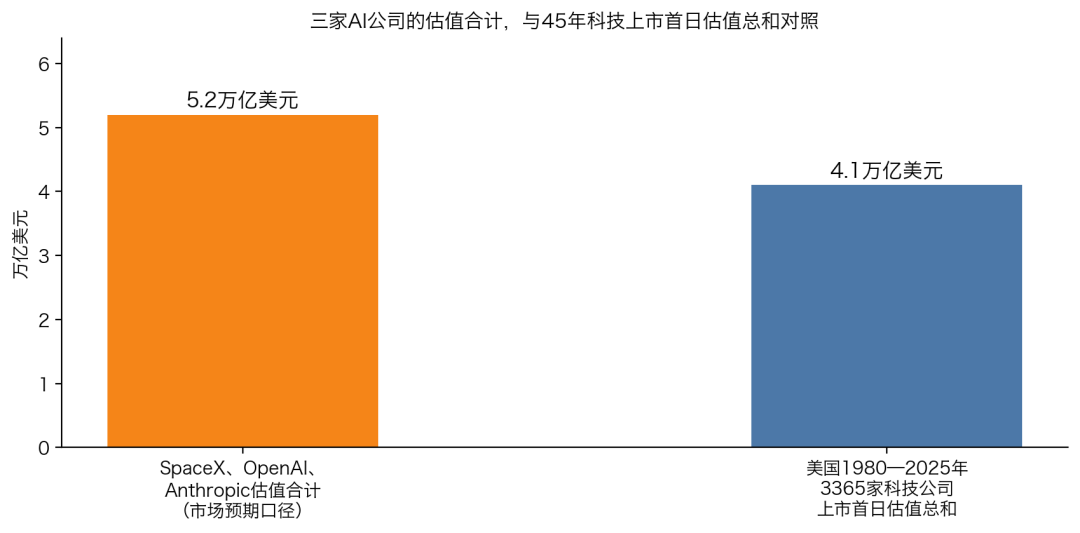
The combined valuations of SpaceX, OpenAI, and Anthropic reach ~$5.2 trillion. By this metric, they exceed the total first-day valuations of all 3,365 U.S. tech companies that went public from 1980 to 2025 (~$4.1 trillion).
What revenue supports this valuation?
Anthropic’s annualized revenue was ~$65 billion in August (unofficial figure). Even if fully credible, the $2 trillion pricing implies a price-to-sales ratio over 30x.
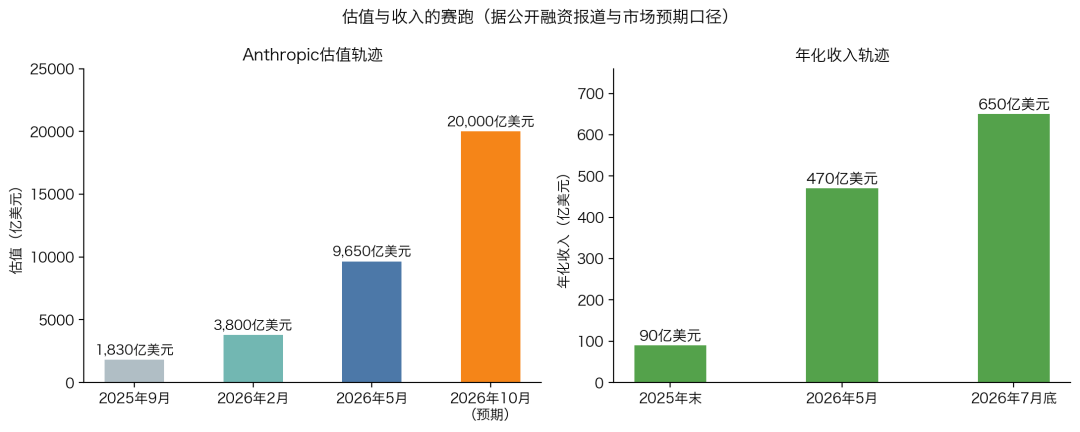
The timing is impeccable: the Nasdaq is at all-time highs, and U.S. business output is expanding at its fastest pace in five years (S&P Global’s September flash composite PMI hit 58.4, the highest since July 2021).
But the IPO market itself is cooling. OpenAI delayed its listing to next year; since Labor Day, only three IPOs have occurred in the U.S. (excluding SPACs, counting only operating companies), bringing the year-to-date total to 238–248. Nearly 49% of 2024’s IPOs trade below their offer prices, with 38 of 76 non-SPAC debuts breaking issue.
Moreover, Anthropic’s valuation defies traditional investment banking methods.
Discounted cash flow? In an industry where annual revenue grows 10x+, cash flow projections are nearly impossible.
Comparable companies? No sufficiently similar public peers exist.
Even more fatal is the denominator: the 10-year U.S. Treasury yield has risen to 5.23% (peaking at 5.27% in late September), the highest since the 2007 financial crisis. The 30-year yield also breached 5.5% for the first time since 2004.
Rising rates deliver a double blow: they reduce the present value of future profits while increasing borrowing costs for data center construction.
This reminds me of someone. After the 2002 dot-com bust, Sun Microsystems co-founder Scott McNealy calculated that investors had valued his company at 10x sales. What did that imply?
It meant paying out 100% of revenue as dividends for a decade. Assuming zero cost of sales, zero expenses for 39,000 employees, zero taxes, zero R&D for ten years, and maintaining revenue.
Realize how absurd these assumptions are?
And that’s before accounting for the time value of money.
If Anthropic is priced at $2 trillion, its price-to-sales ratio is ~31x—triple Sun’s.
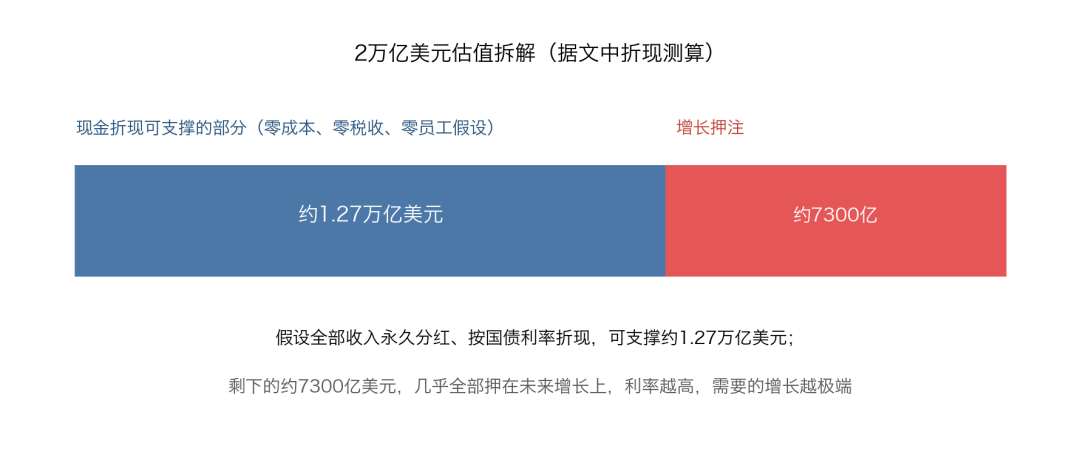
Assume the company has no costs, no employees, no taxes, no electricity bills, and distributes all revenue permanently to shareholders. Discounted at Treasury rates, it’s worth ~$1.27 trillion today.
That’s $730 billion short of $2 trillion. Always $730 billion short.
So the $2 trillion valuation is almost entirely a bet on growth. The higher rates climb, the crazier that growth must be.
How crazy? Eighteen months ago, Anthropic itself projected $12 billion in revenue for 2027. In this story of optimistic forecasts, that’s the only figure proven wildly pessimistic.
Public reports suggest that seven weeks ago, valuation researchers suspected Anthropic’s target might slide from $1 trillion to $800 billion. Seven weeks later, the market discusses $2 trillion. Predictions here are hard in both directions.
2
Addressable Market Inflation: From $22T to $60T
When conventional math fails to reach $2 trillion, new math emerges: the total addressable market (TAM)—the total potential revenue for a product or service across all possible customers.
This metric was popularized by internet analyst Henry Blodget in the late 1990s. He used it to justify Amazon’s $240 stock price as worth $400. Amazon hit that within weeks, making Blodget famous—and later infamous when he was banned for life from the securities industry for analysis manipulation.
History repeats.
In May, SpaceX told investors in IPO materials that its TAM was ~$28.5 trillion, with AI enterprise applications alone accounting for $22.7 trillion—roughly three-quarters of the U.S. economy.
Then the inflation began. Anthropic reportedly emphasizes a market opportunity exceeding $30 trillion to investors. Last week, an investment bank calculated generative AI’s addressable market at ~$60 trillion—about half of global annual output.
In four months, TAM expanded by $37 trillion, faster than Anthropic’s revenue growth.
Morgan Stanley is likely one of this IPO’s underwriters. Bankers are famously conservative when estimating their cut of a deal’s value.
Companies don’t always capture their claimed markets. Uber’s IPO prospectus cited a $6 trillion TAM (covering private vehicle miles and public transit; another version exceeding $12 trillion included food delivery and freight). Annual revenue now tops $60 billion, with most of the market still untapped. WeWork once claimed a $3 trillion TAM—then went bankrupt.
If $60 trillion isn’t enough, there’s a bigger number. Anthropic’s internal research modeled an extreme scenario where AI adds over $10 trillion to U.S. GDP by 2030, roughly translating to $100 trillion in equity value today. Beyond that lies recursive self-improvement: AI designing better AI, rendering monetary value meaningless.
That’s one way to hit a target price: redefine the denominator.
Yet Xingkongjun argues that Anthropic’s large models might be slain by free, open-source Chinese alternatives before 2030.
3
Data Centers That Don’t Exist Yet
The AI boom also invented a new game: valuing buildings that don’t exist.
SoftBank’s SB Energy aims to go public at a ~$50 billion valuation—a monumental achievement for any company, especially considering it hasn’t activated any data centers yet.
The $50 billion valuation is ~400x its annual EBITDA.
Prospectus data shows completing committed projects will require $174 billion. Last week, its new bond issuance priced at ~$4.9 billion with a ~10% yield, with reports of weak demand. Lenders won’t permit dividends until 2029. The IPO is now delayed, pending improved investor sentiment toward data centers.
Traditional investors might view unoperational buildings as flaws, but accounting treats them as massive advantages.
Projects under construction don’t depreciate. Unbuilt data centers have no electricity bills, no maintenance, no delayed complaints—because the product doesn’t exist. Unbuilt data centers might be the ultimate high-margin business. The only issue is that someone will eventually force you to build them.
And construction is where problems arise. The iron law of megaprojects: they exceed budgets and deadlines. Some states may take a decade to grant grid connections. A Gallup poll found 71% of Americans oppose data centers near their homes.
Even more twisted is duration mismatch: lenders finance these projects as long-lived infrastructure, like commercial real estate. Yet the chips inside will be obsolete in one to two years. One fund manager likened it to taking a 30-year mortgage on an iPhone.
SB Energy’s primary customer is OpenAI.
Even better is the circular structure: SoftBank borrows money via bonds to lend to OpenAI. OpenAI leases SoftBank’s data center campus for 20 years, filled with NVIDIA-guaranteed chips—and NVIDIA is a campus shareholder.
NVIDIA invested $1.5 billion at a 10% discount to IPO price, committed to buy another $1.5 billion, and agreed to guarantee up to $105 billion for the campus. In exchange, the two are deeply bound in compute supply, with the campus adopting NVIDIA chips long-term.
Why does OpenAI need this money? It expects to burn nearly $280 billion by the end of 2030. Leasing SB Energy’s Ohio campus provides SoftBank’s data center firm with the revenue needed to justify its valuation. OpenAI also holds warrants that trigger payment if SB Energy’s valuation hits $80 billion.
They buy each other’s products, guarantee each other’s debts, and inflate each other’s valuations. In this chain, every link’s revenue is the next link’s expense.
Amazon’s latest results show 85% of net profit comes from unrealized gains in equity holdings, primarily Anthropic. Google’s figure is ~88% ($112.1 billion net profit, ~$99 billion in unrealized equity gains) from Anthropic and SpaceX.
To value Microsoft, you must first value OpenAI. Valuation authority Aswath Damodaran says he once hated valuing Asian family conglomerates—now, to value one company, you must value four others.
4
The AI Price Bubble Question
Research firms estimate that since 2023, the cost to achieve equivalent AI performance has dropped ~13x annually—possibly faster than any technology in history.
This week, Anthropic and OpenAI released cheaper models on the same day, priced 40% and 50% below their predecessors.
A startup launched a programming model 440x cheaper than cutting-edge alternatives, built on $40 million in seed funding—about 0.002% of a $2 trillion valuation.
Some companies use routers to distribute tasks across different models, cutting AI bills by 40%. This approach is called: You don’t need a Ferrari to pick up groceries.
AI might ultimately resemble traffic or email—something everyone uses daily, but no one profits from selling.
So is Anthropic still worth $2 trillion?
-
![]()
Who is Taking Away the Profits of Car Companies: Battery or Intelligent Driving?
-
![]()
Tencent Successively Discontinues Two AI Agents
-
![]()
Has the Brake Pedal of JAC Motors Really Broken? The Market Will Teach Every Automaker with 'Fatal Flaws' a Lesson
-
![]()
Changsha’s Emerging Powerhouse in Computing: Cancels RMB 3 Billion Contract!
-
![]()
Production Capacity Can’t Keep Up with Orders! This Optical Enterprise Soars 449% on Debut
-
![]()
Q3 Report | Yuanjie Technology's Net Profit Expected to Surge Fivefold, Transitioning from 'Shortage Dividends' to 'Delivery Challenges'
-
![]()
The Computing Power Price War Hits Silicon Valley
-
![]()
The AI Office Sector is Forming a 'Three-Pillar' Landscape