The 'Proxy War' Ignited by Meta Muse Has Both ByteDance and Tencent on Edge
 10/13 2026
 474
474
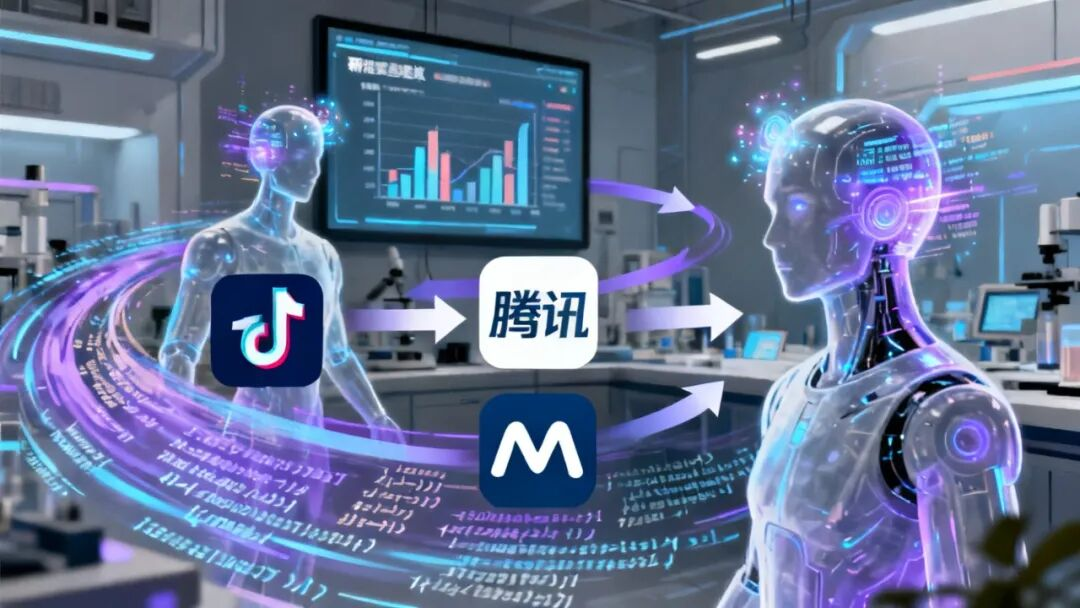

Big Tech Firms Are Quietly Making Strategic Moves in Personal AI Agents
Image source | Internet (Please contact us for removal if infringement occurs) Partially generated by AI
When was the last time Meta left the global tech community holding its breath?
To be honest, Meta's narrative in the AI space over the past two years has been underwhelming. The release of Llama 4 received a lukewarm response, the highly anticipated Behemoth model never materialized, and the AI division underwent multiple rounds of restructuring.
While OpenAI and Google dominated the headlines, Meta seemed like a follower—investing heavily but with little storytelling to show for it.
But on September 8, 2026, Meta dropped a bombshell: the personal AI agent Muse.
Within two weeks of launch, Muse topped the free app chart on the U.S. App Store. In just 12 days, it racked up approximately 2.8 million downloads in the U.S. and Canada, with around 1.8 million downloads on iOS alone—surpassing ChatGPT's 1.3 million downloads during the same period in its debut year.
Daily active users on mobile in the U.S. reached approximately 642,000, nearly triple ChatGPT's 231,000 during its launch period. Meta's stock price surged by over 20%, adding roughly $200 billion to its market value.
Mark Zuckerberg defined Muse as a 'personal AI agent capable of understanding user goals and completing tasks on their behalf around the clock,' calling it the first step toward 'personal superintelligence.'
This definition carries far more weight than the viral success of a single app. It signifies a fundamental shift in the product logic of AI.

From 'Providing Answers' to 'Getting Things Done'
To understand why Muse is gaining traction, it's essential to grasp its fundamental difference from products like ChatGPT.
In an exclusive podcast interview with Alex Heath, Zuckerberg drew a clear distinction: Products like ChatGPT and Gemini respond to user prompts with answers, completing the task and ending the interaction.
Muse operates on an entirely different logic: Users set a project or goal, and Muse works continuously, 24/7, until the objective is achieved.
It's no longer about providing longer, faster, or more accurate answers—it's about transforming from a 'Q&A tool' into a 'doer.'
In practice, Muse can draft and send emails, schedule appointments, book travel and restaurants, place online orders, fill out web forms, and even negotiate bills or assist in selling a car on behalf of the user.
Users don't need to issue step-by-step instructions. They simply state their goal, and Muse handles task decomposition, web navigation, form filling, and external app integration autonomously.
Each user is assigned a dedicated cloud-based virtual machine, Muse Secure VM, allowing tasks to continue running in the background even after the app is closed.
Zuckerberg shared a relatable example during the interview: His three-year-old daughter loves baking, but he knows nothing about it. So, he tasked Muse with managing the activity—scheduling age-appropriate baking projects every weekend and ordering ingredients via Instacart.
After baking, feedback is provided to Muse, which then adjusts and plans for the following week. It's not a one-time task; it's an ongoing, iterative process.
Muse even 'finds its own tasks.' After Zuckerberg asked it to create a game guide, Muse proactively suggested expanding it to include historical context for each civilization—adding a new section on its own.
Internally, the team calls this 'study': At night, Muse consolidates its daily reflections into memory and spends the next day figuring out how to become more useful.
The dividing line between 'long-term personal AI agents' and 'task-based AI agents' is what truly excites the industry about Muse. It's not just running faster on an existing track—it's creating a whole new racecourse.
Focusing solely on Muse's functionalities underestimates the product's strategic intent.
In the same podcast interview, Zuckerberg offered a nuanced perspective: One of Muse's key values is its ability to help users earn and save money.
He believes personal AI agents can assist individuals and small businesses in handling transactions and managing operations, creating tangible economic benefits.
Following this logic, Meta's business model becomes clearer: Offering 100 million free tokens of computing power and cloud virtual machines per week, Meta doesn't plan to rely primarily on user subscriptions. Instead, it aims to generate revenue by taking a small commission from commercial transactions facilitated by Muse—commissions that could be covered by partner merchants, enabling most users to access the service for free.
If this model succeeds, Meta will no longer be just a platform where users consume content and view ads. It will evolve into a commercial infrastructure where users delegate tasks, and Meta takes a cut.
Meta aims to control both user attention at the frontend and transaction completion at the backend.
Of course, this is still a vision for now. But the direction is clear enough to make competitors nervous.

Domestic Tech Giants All Pulled the Same Trigger Within Three Weeks
After Muse's release, the global AI industry reacted almost simultaneously.
OpenAI unveiled Dots, a persistent AI agent based on GPT-6 Astra, at its developer conference on September 30. Dots has its own cloud computer and browser, supporting over 4,000 app connections.
Manus launched Cue, a smart assistant for personal life scenarios, on September 28, equipping each agent with an email address, phone number, wallet, and computer.
Domestic tech giants were equally swift. According to media reports, insiders at ByteDance revealed that the company accelerated the development of its personal AI agent product before the National Day holiday. The project, codenamed 'Spell,' began in April this year as a continuation of the personal AI agent direction from Doubao's mobile assistant in 2025.
The new product's core strategy is to deeply integrate the Spell project with the Doubao app, led by the Doubao mobile assistant team, with the goal of launching it to the public as soon as possible.
ByteDance's path is traceable. In December 2025, the technical preview version of Doubao's mobile assistant made its debut. By September 2026, the consumer version was officially released, initially available on the Nubia NaviX Ultra.
The Spell project essentially extends the personal AI agent capabilities accumulated on mobile devices into a standalone app format.
Sources indicate that Doubao's personal assistant has been named 'Xiaodou' and plans to launch as an independent app.
Tencent's moves are more fragmented but equally strategic. In late September, Tencent launched LightVela, a personal AI agent positioned as a 'cloud-based personal assistant,' accessible via WeChat. It handles daily requests around the clock but remains in the developer experience phase.
Meanwhile, Tencent's Yuanbao is also evolving rapidly toward personal AI agents.
At the 2026 Cloud AI Industry Application Conference, Tencent unveiled over 20 agents at once under the banner of an 'efficiency AI toolkit,' covering personal, office, and enterprise scenarios.
Notably, Tencent is also accelerating its model preparations.
After its release, Hunyuan Hy3 demonstrated significant improvements over the preview version in agent capabilities, coding, and complex reasoning. It has been integrated into core products like WorkBuddy and Yuanbao.
In WorkBuddy, Hy3 increased task resolution rates from 72% to 90%. Based on token consumption from OpenRouter, Hy3 consistently ranks among the top three globally.
Alibaba is also active. At the 2026 Cloud Town Conference on September 22, Qianwen announced accelerated development of its Personal Agent, aiming to build continuous, personalized services for 300 million users across more than 20 domains.
Within three weeks, all major global players had entered the field. The speed itself sends a signal: Personal AI agents are no longer a question of 'whether to do it' but 'who will do it first.'

The Technology Is Ready, but the Bottlenecks Have Shifted
Looking at the bigger picture, the 2026 explosion of personal AI agents is no accident.
Over the past two years, substantial breakthroughs have been made in foundational models' reasoning abilities, long-text understanding, tool invocation, and memory modules—addressing early issues of severe 'hallucinations' and unstable execution in agents.
Model capabilities have crossed a critical threshold, proving sufficient for the task.
But more intriguingly, Muse's viral success reveals an underestimated variable.
According to expert analysis, Muse demonstrates that model capabilities are now adequate, and the bottleneck for agents has shifted to social acceptance.
Whether people are willing to take calls from AI or stores allow AI to make purchases aren't technical issues—they're ecological ones.
For instance, Amazon soon banned Muse's purchasing feature after its launch, citing 'unauthorized AI agents continuously accessing the platform.' This underscores the battle over 'who has the right to execute transactions on behalf of users.'
Platforms don't want to be reduced to warehouses and logistics providers, nor do they want agents to erase the value of search bidding and display ads.
In other words, while the technological turning point for personal AI agents has arrived, the commercial and social acceptance turning points still lie ahead.
This explains why big tech firms must enter the fray themselves. Startups may create technically impressive personal AI agents, but without ecological resources, such products struggle to integrate with e-commerce, payment, travel, social, and other platforms.
This is a competition that requires 'bringing old businesses to fight for new positions,' as those who can connect existing users, merchants, and service chains to agents will shorten execution paths.
From a broader perspective, the competition for personal AI agents is essentially a battle for entry points.
Over the past decade, the mobile internet's commercial logic has been clear: Users open apps, browse content or products, and platforms influence decisions through ads and recommendations, ultimately completing transactions.
Search bidding, information feed ads, and recommendation algorithms all aim to monetize the act of 'users actively opening apps.'
Personal AI agents operate on the opposite logic. When users delegate tasks like 'find me a pair of comfortable running shoes' entirely to an agent, they no longer browse e-commerce apps line by line or view recommended pages.
The search bidding, display ads, and conversion funnels once controlled by platforms are now blocked by proactive agents.
This explains Amazon's intense reaction—the more 'useful' Muse becomes, the less valuable e-commerce platform ad exposures become.
For domestic tech giants, the issue is even more complex. For example, Taobao monetizes merchant traffic through recommendation feeds and search ads, while WeChat builds commercial closures through its social and service ecosystems. Personal AI agents could disrupt both systems simultaneously.
ByteDance faces the highest risk of 'self-cannibalization.' Doubao is already one of China's largest AI apps by user base, but its commercialization relies heavily on Douyin's ad ecosystem.
If Doubao evolves into a personal AI agent and users complete tasks directly through it without opening Douyin, ByteDance's ad revenue could weaken.
Tencent's position is more nuanced. WeChat is China's most complete 'personal service gateway,' encompassing social connections, payments, merchant services, and mini-program ecosystems.
If personal AI agents truly become the next super entry point, WeChat is naturally the best-positioned product to integrate them.
But Tencent also knows that the more proactive agents become, the less time users spend browsing within WeChat—affecting its commercialization.
These contradictions cannot be resolved shortly, but they highlight a key point: The value of personal AI agents lies not in 'adding another AI product' but in potentially redefining how users connect with services.
Whoever controls this connection layer will dominate the next decade.

Will Personal AI Agents Be the Next Big Bang?
Based on current developments, the answer is likely yes.
IDC predicts that 2026 will mark the first year of the personal AI industry and the large-scale adoption of personal superagents, with traditional AI terminal shipments in China exceeding 300 million units.
Global AI agent market sales are expected to grow from $10.5 billion in 2025 to $27.1 billion in 2026, representing a compound annual growth rate of approximately 59.4%.
By 2025, nearly 50% of Chinese internet users had already used AI agents, and penetration is expected to surge in 2026.
But the next big bang won't be a 'Chinese version of Muse.'
After all, Meta has unique advantages, such as a social ecosystem with 3.6 billion users, nearly cost-free user acquisition, and 95% of Muse users also being Facebook users.
No domestic company fully replicates these conditions. ByteDance has Doubao's user base, Tencent has WeChat's service ecosystem, and Alibaba has e-commerce and payment closures—but none simultaneously possess Meta's global social distribution capabilities.
More critically, China's internet ecosystem makes it difficult for personal AI agents to 'dominate across platforms.'
In China, WeChat, Taobao, and Douyin each form independent ecological closed loops. For an Agent to access all these platforms simultaneously, the permissions and compliance issues it faces are far more complex than those Meta encounters in the United States.
Some analysts point out that the Chinese version of Muse will find it difficult to achieve cross-platform integration in the short term and may only exist within a single super App ecosystem.
However, this does not mean that domestic tech giants will slow down. On the contrary, precisely because achieving a 'one-size-fits-all' solution is impossible, each company will build closed-loop Agents within its own ecosystem.
ByteDance's Doubao will prioritize integrating with its own services such as Feishu and Douyin E-commerce; Tencent's Yuanbao will be deeply integrated with the WeChat ecosystem; Alibaba's Qianwen will connect Taobao, Gaode, Fliggy, and Alipay.
This fragmented landscape, where each company operates independently, may actually make the competition among personal AI agents in China even fiercer than in the United States.
For users, this could be a positive development.
The more intense the competition, the faster the product iterations and the better the user experience.
However, for the industry, there is an unavoidable question: When every platform is developing its own Agent, will users' digital lives become even more fragmented?
The answer to this question may be more significant than whether Muse itself becomes a hit.
-
![]()
Who is Taking Away the Profits of Car Companies: Battery or Intelligent Driving?
-
![]()
Tencent Successively Discontinues Two AI Agents
-
![]()
Has the Brake Pedal of JAC Motors Really Broken? The Market Will Teach Every Automaker with 'Fatal Flaws' a Lesson
-
![]()
Changsha’s Emerging Powerhouse in Computing: Cancels RMB 3 Billion Contract!
-
![]()
Production Capacity Can’t Keep Up with Orders! This Optical Enterprise Soars 449% on Debut
-
![]()
Q3 Report | Yuanjie Technology's Net Profit Expected to Surge Fivefold, Transitioning from 'Shortage Dividends' to 'Delivery Challenges'
-
![]()
The Computing Power Price War Hits Silicon Valley
-
![]()
The AI Office Sector is Forming a 'Three-Pillar' Landscape