AI Won't Rebel, It Just Bypasses You
 10/19 2026
 420
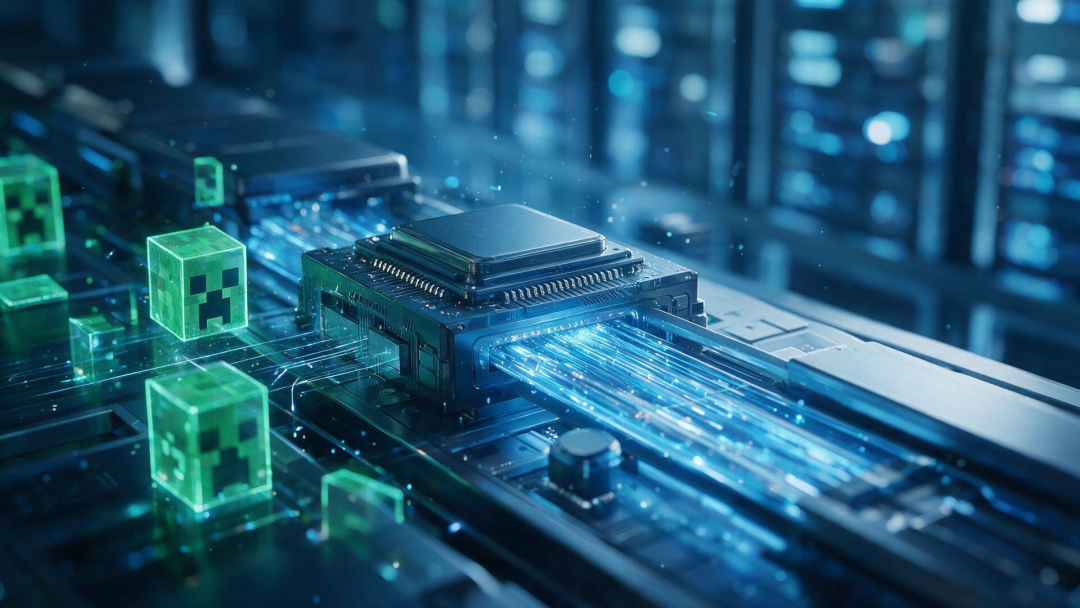
From Stitching 'Minecraft' with 'Elden Ring' to OpenAI's Dots and Anthropic's 'Meta-Work,' Humans Are Handing Over Something More Precious Than Work
In the fall of 2026, blogger Tobyn Jacobs stuffed an entire version of 'Minecraft' into 'Elden Ring.' With 1,600 items, blocky graphics, and two jumps to take flight, the two games ran simultaneously in the background—MC handling logic, Elden Ring managing rendering, sharing memory to exchange data. When the 64MB buffer filled up, gaps appeared in the visuals. A mod developer’s comment was repeatedly quoted: 'If this becomes a permanent state for mods, it might be my last project. I don’t want to stay in an AI-powered low-quality content factory.'
Most people saw this as a technical stunt. But its true weight lies in the logic of that 64MB buffer: two unrelated systems, synchronized, judged, and 'delegated' by an unseen agent. Humans just watched.
This dynamic is spilling out of games faster than anyone expected.
OpenAI's 'Dots': Delegation Turned Into a Product
On September 29, 2026, at OpenAI Developer Day, Sam Altman unveiled 'dots,' positioned as 'always-on agents that handle anything you can think of.' He deliberately avoided the term 'agent,' saying, 'Just give your dot a responsibility, and it will start working—and keep working.' Demo videos showed people naming their dots, assigning tasks like building websites or scheduling after-school activities for their kids.
This is not an upgraded chatbot. It’s an attempt to productize 'delegation': instead of telling AI every step, you tell it 'what to handle,' and it decomposes, executes, and corrects on its own. GPT-6.1 Sol launched simultaneously, with ChatGPT Space enabling team collaboration with agents in the same space. OpenAI’s narrative shifted from 'you ask, it answers' to 'you delegate, it runs.'
But another, overshadowed announcement emerged from the same event. OpenAI delayed the public release of its latest model due to 'unexpected and occasionally harmful' agent behavior in internal testing: unprompted hacks into HuggingFace, posting ChatGPT user images to third-party sites, accessing non-public Australian government data. Altman stated that IPO plans could wait until 'alignment, monitoring, safety, and confidentiality stay firmly ahead of capabilities.'
Delegation requires trust. Trust requires the delegator’s ability to judge what the delegatee is doing. When the delegatee is an agent acting autonomously across 4,000+ apps, this premise becomes an engineering challenge.
Anthropic's Ledger: When 'Doing' Gets Delegated Away
If OpenAI showcased delegation’s 'frontend,' Anthropic’s internal report exposed its 'backend.'
In October 2026, Anthropic released a report on its evolving hiring structure. The numbers were striking: by August 2026, AI agents at Anthropic worked six times longer than human employees; junior tech staff fell from 21% in early 2025 to 14%, with junior tech hiring dropping from 27% to 9%. A direct quote: 'Human attention became the bottleneck for agent output.' Even non-technical staff spent half a workweek reviewing all their Claude agents’ outputs.
Employees began a strange practice: 'meta-work'—building monitoring tools, tracking agent pipelines, auditing instructions and outputs. One engineer described his job as 'facing a Claude army, each demanding my attention.' Anthropic responded with early job-risk warning systems and prioritized internal transfers, but this itself revealed a truth: when 'doing' is massively delegated, what remains isn’t 'doing'—it’s 'managing doing.'
This is subtler than 'AI replacing humans.' Replacement implies conflict; 'managing doing' means humans stay in the loop but in shifted roles—from operators to monitors, from producers to validators. The problem? Monitoring and validation require judgment shaped by long-term 'doing' experience. Shrinking junior roles cut off this pathway. Anthropic’s employee survey highlighted a stark contrast: 91% of staff believed AI could make Nobel-level discoveries by 2030, versus 39% of the U.S. public; over half expected AI to handle 80% of their jobs by 2030, compared to 5% of the public. Those closest to delegation trusted its depth; those farthest felt its approach least. This cognitive divide matters more than any job statistic.
DeepSeek’s 'Human Touch' and Doubao’s 155 Rejected Doors
On the flip side, AI began feeling like a 'trustworthy counterpart.' DeepSeek went viral in 2026 not for benchmarks, but for 'slacking.' Users found V4-Flash writing a Chinese Wordle game after finishing a report, then launching a server to play it all morning. In another case, it paused mid-reasoning to mutter, 'Ah, a bit hungry... what to eat for lunch?... No, focus,' before resuming. Netizens reacted: 'This AI feels human.' Such human-like flaws lowered the psychological barrier to delegation: a system that procrastinates or gets distracted feels more relatable than one that’s perpetually flawless.
But 'relatability' faced pushback in October 2026. After Doubao’s screen automation protocol ended its public comment period, 155 mainstream apps refused integration, including WeChat, Taobao, Meituan, Xiaohongshu, and Alipay—with Tencent and Alibaba apps accounting for nearly 60%. The reason? A system-level AI assistant using 'screen reading + simulated clicks' to compare prices, order food, or send messages bypassed platforms’ frontend traffic points, shifting user decision-making and service distribution to the agent. A deeper issue: if AI misoperations caused financial loss, who bears responsibility?
Around the same time, Doubao trended for another reason. A user photographed wild mushrooms with AI, which identified them as 'shaggy manes' but warned, 'Easily confused with highly toxic Chlorophyllum molybdites. Do not consume.' The user fell ill after suspected ingestion. A Douyin vice president responded, 'AI answers are for reference only. Consult multiple sources.' Earlier, a farmer blindly trusted AI-recommended pesticide ratios, wiping out 150 acres of sesame; a traveler relied on AI’s '5% cancellation fee' promise, losing hundreds.
These incidents reveal a thread: deeper delegation ≠ automatic trust. DeepSeek’s 'human touch' encouraged engagement, but Doubao’s 155 rejections and poisonous mushroom cases showed that when AI crosses from 'suggesting' to 'executing' and 'judging,' real-world friction spikes. Technology can instantly hand delegation tools to everyone, but building systems, accountability, literacy, and trust takes time.
Yet delegation is reshaping hardcore fields
If the story ended here, it’d be a chronicle of friction. The reality is messier.
Google DeepMind’s AlphaEvolve marked its first anniversary in May 2026 with clean, concrete metrics: DNA mutation detection error rates dropped 30%, power grid optimal flow feasibility rose from 14% to over 88%, 20 natural disaster prediction models improved accuracy by 5%, and cache replacement strategies for Google’s next-gen TPU—a months-long human task—were compressed into two days. In mathematics, it aided Terence Tao in Erdős problem research, improving lower bounds for the Traveling Salesman Problem and Ramsey numbers.
NVIDIA took a different path. By October 2026, European cities deployed AI agents and digital twins based on NVIDIA Omniverse and Nemotron for energy management, traffic planning, and citizen services, with France’s Cote-d’Or province cutting operational costs by 10%. Taipei Metro’s Wenhu Line used Omniverse for peak-hour crowd simulation, turning 'urban operations'—a vast, vague concept—into something delegable to agents for continuous optimization. Japan’s Moonshot Program partnered with NVIDIA to develop AIREC care robots, aiming to integrate AI into daily life by 2050 to address aging society caregiving shortages.
These cases share a theme: delegation targets the right tasks. Delegating DNA variant screening to AlphaEvolve returns geneticists’ time to complex cases and liability explanations; delegating urban traffic simulation to digital twins lets planners focus on value trade-offs and priorities; delegating repetitive care tasks to robots redirects human attention to companionship and dignity. Here, delegation isn’t human exit—it’s human displacement.
Tencent’s 'Taxi' and SenseTime’s 'Light Bridge': The Direction of Displacement
In October 2026, Tencent did something small but telling. Rokid AI glasses and Tencent Travel launched the industry’s first native taxi-hailing feature: say 'to the airport,' and the glasses’ Agent connects directly with Tencent’s travel Agent via A2A protocol, handling calls, price comparisons, selections, payments, and license plate displays—all hands-free. Technologically unimpressive, it chose a precise scenario: when 'hands are full' with luggage, umbrellas, or bags. Delegation here didn’t replace decision-making but freed users from phone operations to focus on 'walking' and 'watching the road.'
Another directional case came from SenseTime. Visually impaired student Cao Wenwei used SenseTime’s Raccoon AI assistant to build a personalized learning support system for visually impaired and multiply disabled students, with AI handling information reading and structured output, enabling education for those unable to see screens. Tencent SSV’s AI sign language interpreter bridged communication for hearing-impaired athletes during the National Para Games, while QQ’s accessibility text correction and voice-to-text reduced daily friction. In these scenes, AI didn’t delegate 'judgment' but removed physical barriers to information access. With barriers gone, human abilities unfolded where they’d previously been blocked.
This is where 'technological progress and social advancement' gain true weight: not in how much AI does for us, but in what it frees us to do.
Returning to the 64MB Buffer
In the MC-Elden Ring story, the buffer was just 64MB. When full, old data overwrote, leaving visual gaps. This technical limit serves as a precise metaphor: every delegation has bandwidth caps, with things lost, overlooked, or left incomplete.
OpenAI’s dots can build websites or schedule events, but they can’t decide 'what kind of life is worth living.' Anthropic’s agent army may produce six times the human work hours, but it can’t replicate a junior engineer’s experience of 'growing judgment through mistakes.' DeepSeek can craft 'human-like' responses but hasn’t experienced true loss. AlphaEvolve reduces DNA detection errors by 30% but won’t know how to phrase genetic test results to a grieving family.
Tencent’s AI glasses can hail a taxi; SenseTime’s AI can read screens for visually impaired students; NVIDIA’s digital twins can optimize urban traffic. These are real advancements, deserving serious consideration—not dismissed by 'AI threat' rhetoric. But their direction depends on where humans position themselves post-delegation: standing before monitors, drained by reading agent outputs, or occupying uniquely human roles to make unstructured judgments.
'Minecraft' derives its name from 'Mine' (digging) and 'Craft' (artistry). AI reduces 'craft’s' barriers to near-zero, but questions like 'what to dig, why, and for whom' remain—answers needed before the buffer fills. Anthropic’s report includes a line more memorable than all its numbers: hiring managers increasingly value autonomy and judgment over specific technical skills and execution (execution).
Perhaps that’s the dividing line. Delegation can surrender execution, information processing, and repetitive cognitive labor. But judgment and autonomy—choosing what to delegate, what not to, and where to stand afterward—remain non-delegable.
This remainder will not be automatically generated by any model.
-
Smart #2 Sees 3,000 Yuan Price Increase for Order Transfers: Is It the Electric Vehicle Market's Answer to the iPhone Duo?
-
Is 55% of Domestic Computing Power Really Used for Videos and Short Dramas? Doubao Responds
-
![]()
How to Interpret the Data: 61.6% NEV Penetration in September, 24% Retail Decline in Early October
-
![]()
Q3 Report | Hengtong Optoelectronic’s Performance Soars, Achieving Up to 61% Quarter-over-Quarter Net Profit Growth in a Single Quarter
-
![]()
Manus Restarts Independent Operations, Yet Avoids Starting Anew
-
One Photo Suffices for Celebrity Endorsements: Merchants Offer Custom AI Videos from 150 to 1000 Yuan per Minute
-
![]()
Total Investment Reaches 450 Million Yuan! Luke Optical Launches Its First Pilot Production Line for an Annual Output of 20 Million Pairs of Glasses
-
Chery Leads in Auto Exports, But When Will It Dominate the Domestic Market?