How to Interpret the Data: 61.6% NEV Penetration in September, 24% Retail Decline in Early October
 10/19 2026
 544
On October 12, 2026, the China Association of Automobile Manufacturers (CAAM) released automobile production and sales data for September and the first three quarters. In September, NEV sales reached 1.823 million units, accounting for 61.6% of total new automobile sales. This proportion set a new historical record, with the monthly share exceeding 60% for three consecutive months.
Just two days later, on October 14, the China Passenger Car Association (CPCA) released weekly data for early October. From October 1 to 11, retail sales of passenger vehicles nationwide reached 459,000 units, down 24% year-on-year, including 281,000 NEV units, down 13% year-on-year. While the market shows a new high in penetration rate on one hand, it also exhibits a double-digit decline in retail sales on the other. These two sets of data, seemingly contradictory, actually record different aspects of the same market.
▍Behind the New High in Penetration Rate: A Shrinking Denominator
Let's first examine the total data for September: In September, China's automobile production and sales reached 2.99 million and 2.956 million units, respectively, down 8.7% and 8.4% year-on-year. This indicates an overall market contraction. NEVs were the only segment maintaining growth within the broader market, with production and sales reaching 1.814 million and 1.823 million units, respectively, up 12.2% and 13.6% year-on-year.
Extending the timeframe to the first three quarters, the situation becomes clearer. From January to September, automobile production and sales reached 23.246 million and 23.271 million units, respectively, both down 4.5% year-on-year. NEV production and sales reached 12.483 million and 12.472 million units, respectively, up 11% and 11.1% year-on-year.
An often-overlooked detail is that penetration rate is a ratio, equal to NEV sales divided by total new automobile sales. A new high in this ratio typically has two possibilities: an increase in the numerator or a decrease in the denominator. In September, both forces were at play, but the shrinking denominator had a more pronounced effect.
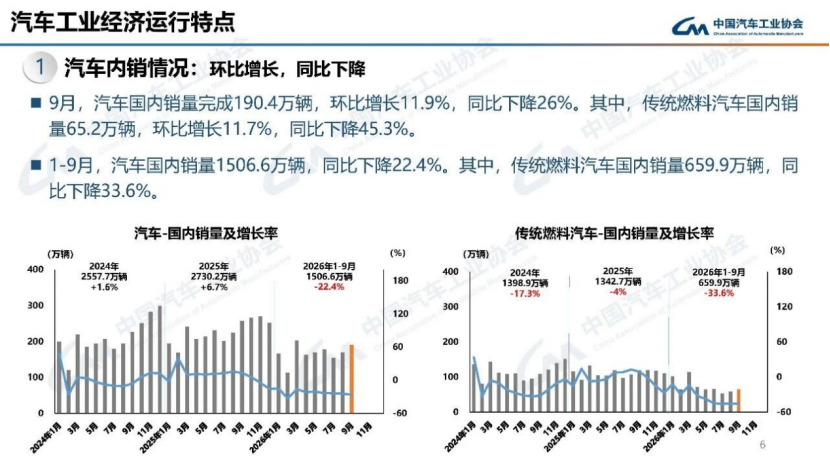
CAAM data shows that domestic automobile sales in the first three quarters reached 15.066 million units, down 22.4% year-on-year. Domestic sales of traditional fuel vehicles reached only 6.599 million units, down 33.6% year-on-year. Monthly trends show that domestic sales of traditional fuel vehicles have been nearly halved for four consecutive months starting in June, with a 45.3% year-on-year decline in September. At such a rapid contraction rate for fuel vehicles, the penetration rate is naturally pushed higher. In other words, the new record of 61.6% includes both NEVs outperforming on their own and fuel vehicles ceding market share, with the latter playing a significant role.
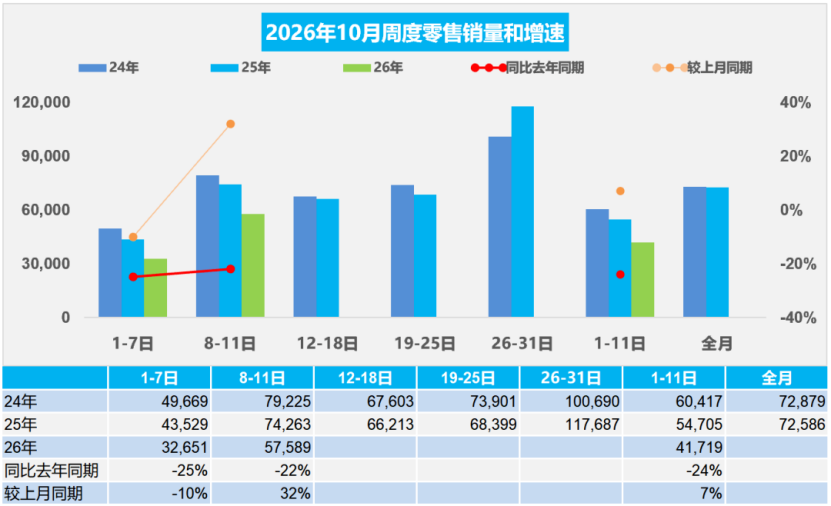
The retail data for early October reflects the continuation of this sluggish domestic market. CPCA data shows that from October 1 to 11, retail sales of passenger vehicles nationwide reached 459,000 units, down 24% year-on-year, including 281,000 NEV units, down 13% year-on-year, with a retail penetration rate of 61.2%.
Notably, NEVs were not spared this time, with their retail sales also declining year-on-year, albeit at a smaller rate than the overall market. By week, the first week saw average daily retail sales of 33,000 units, down 25% year-on-year. The second week saw some recovery in foot traffic, with average daily retail sales rising to 58,000 units, narrowing the year-on-year decline to 22%.
Why did October start this way? There is no definitive conclusion yet, but the market mainly offers three analyses. The first is the high base effect. Last year's trade-in policies were in full swing during the same period, with the 2025 policy offering a fixed subsidy of RMB 20,000 for scrapping old vehicles to purchase NEVs, significantly boosting terminal sales. This year's comparison is against a high base.
The second is the change in policy pace. The 2026 subsidy method shifted from a fixed amount to a proportional subsidy, offering 12% of the vehicle price (up to RMB 20,000) for purchasing NEVs. For lower-priced models, the actual subsidy received is less than last year, causing some price-sensitive first-time buyers to hesitate.
The third is the holiday factor. This year's Mid-Autumn Festival fell in late September, and during the first half of the National Day Golden Week, consumer travel reduced in-store foot traffic, delaying sales. The CPCA also mentioned that persistently high international oil prices continue to drive up vehicle usage costs, with fuel vehicle consumption unexpectedly sluggish, temporarily hindering first-time purchases and making trade-in demand the main support for stable growth.
Chen Shihua, Deputy Secretary-General of CAAM, believes that the current automotive market downturn is a temporary phenomenon caused by short-term policy disruptions and a high base effect, not a sign that the market has peaked. He also admitted that domestic automobile sales in September were relatively sluggish and expects this trend to continue in the coming months.
▍Exports Take the Baton for Growth, Automaker Differentiation Determines Annual Outlook
If the domestic market is 'ice,' then exports are 'fire.' In September, automobile exports reached 1.053 million units, up 61.4% year-on-year, including 571,000 NEV units, up 157.2% year-on-year. This marks the fourth consecutive month that China's automobile exports have exceeded 1 million units. More notably, NEV exports accounted for more than half of total automobile exports in September, a proportion that has also exceeded 50% for four consecutive months.
Chen Shihua stated that NEV exports have become the main driver of China's automobile exports. In the first three quarters, cumulative automobile exports reached 8.205 million units, up 65.8% year-on-year, including 4.006 million NEV units, up 127.9% year-on-year.
From a technology perspective, in the first three quarters, exports of battery electric vehicles (BEVs) reached 2.449 million units, up 1.2 times year-on-year, while exports of plug-in hybrid electric vehicles (PHEVs) reached 1.557 million units, up 1.5 times year-on-year. In September alone, PHEV exports reached 219,000 units, up 2.2 times year-on-year. PHEVs are becoming the fastest-growing segment in exports, which is also why they are most sensitive to changes in EU trade arrangements.
Breaking down September's NEV sales, domestic NEV sales reached 1.252 million units, down 9.4% year-on-year, while exports reached 571,000 units, up 157.2% year-on-year. The sum of domestic and export sales approximately equals the total sales of 1.823 million units. This means that nearly all of the year-on-year growth in September's NEV sales came from exports. In recent years, the industry has been accustomed to the narrative of 'domestic NEVs driving the overall market,' but September's data, for the first time, highlights the shift in growth engines.
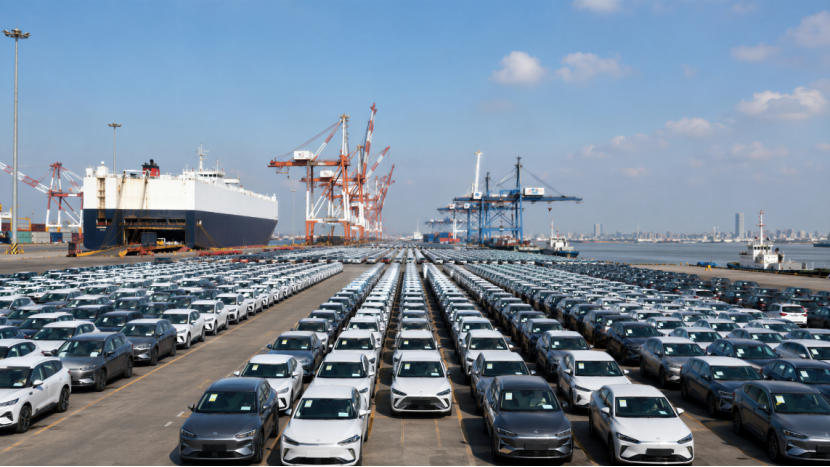
This shift in growth engines has left a clear dividing line in the performance of different automakers. On October 15, Geely Holding announced its first three quarters' data, with cumulative group sales reaching 3.0026 million units, a historical high, including 1.7926 million NEV units, up 12.6% year-on-year, with an NEV penetration rate of 59.7%. Automakers that transformed quickly and established early overseas presence have managed to maintain growth amid this 'cold domestic, hot overseas' scenario.
On the other hand, on October 13, BMW Group announced that its global deliveries in the third quarter reached 551,000 units, down 6.3% year-on-year, with cumulative global deliveries in the first three quarters reaching 1.708 million units, down 4.9% year-on-year. In the third quarter, BMW delivered 114,000 units in the Chinese market, down 24.8% year-on-year. While BMW achieved growth in Europe and the U.S. markets in the third quarter, its Chinese market saw a significant decline, dragging down its global performance. The competitive logic in the Chinese market has fundamentally changed, and multinational brands that are slow to electrify risk being quickly marginalized in their largest single market.
Looking ahead to the fourth quarter and the full year, official forecasts remain relatively cautious. Chen Shihua stated that the automotive industry is expected to maintain stable operation in the fourth quarter, with exports likely to continue growing and potentially exceeding 10 million units for the full year. He also mentioned that the RMB 250 billion Trade in of consumer goods (consumer goods trade-in) funds have been fully allocated, and existing policies will further enhance implementation effects. Combined with local and corporate promotional activities, the decline in domestic market sales is expected to narrow.
Cui Dongshu, Secretary-General of the CPCA, is more optimistic, projecting that China's automobile exports could reach 11.5 million to 12 million units in 2026. However, exports are not without concerns. Cui also pointed out that domestic PHEV exports to the EU are expected to reach nearly 800,000 units this year, but due to new trade arrangements, this volume may decline next year, with PHEV exports to Europe facing short-term pressure. Chinese automakers need to accelerate their localized production capacity Layout (layout) in the EU.
Layout 丨 Yang Shuo Image Sources: CAAM, CPCA, Qianku Network
-
Smart #2 Sees 3,000 Yuan Price Increase for Order Transfers: Is It the Electric Vehicle Market's Answer to the iPhone Duo?
-
Is 55% of Domestic Computing Power Really Used for Videos and Short Dramas? Doubao Responds
-
![]()
How to Interpret the Data: 61.6% NEV Penetration in September, 24% Retail Decline in Early October
-
![]()
Q3 Report | Hengtong Optoelectronic’s Performance Soars, Achieving Up to 61% Quarter-over-Quarter Net Profit Growth in a Single Quarter
-
![]()
Manus Restarts Independent Operations, Yet Avoids Starting Anew
-
One Photo Suffices for Celebrity Endorsements: Merchants Offer Custom AI Videos from 150 to 1000 Yuan per Minute
-
![]()
Total Investment Reaches 450 Million Yuan! Luke Optical Launches Its First Pilot Production Line for an Annual Output of 20 Million Pairs of Glasses
-
Chery Leads in Auto Exports, But When Will It Dominate the Domestic Market?