Q3 Report | Hengtong Optoelectronic’s Performance Soars, Achieving Up to 61% Quarter-over-Quarter Net Profit Growth in a Single Quarter
 10/19 2026
 432
Author|Zhang Qiming
Editor|Chen Xiaoran
AI Data Centers Propel Optical Communication Boom, Though Long-Term Growth Potential Awaits Validation
The race for AI computing power fundamentally depends on data transmission. With more servers and larger clusters, the demand for optical fibers and high-speed connectivity intensifies.
Hengtong Optoelectronic’s (600487.SH) latest performance forecast reveals that the ongoing optical communication boom has transitioned from increased orders and pricing to tangible profit growth.
Q3 Profit Sustains Upward Momentum
Hengtong Optoelectronic projects net profit attributable to the parent company for the first three quarters of 2026 to reach RMB 5.970 billion to RMB 6.370 billion, marking a year-on-year surge of 151.27% to 168.10%. Non-recurring net profit attributable to the parent company is anticipated to be RMB 5.940 billion to RMB 6.340 billion, up 153.88% to 170.98% year-on-year.
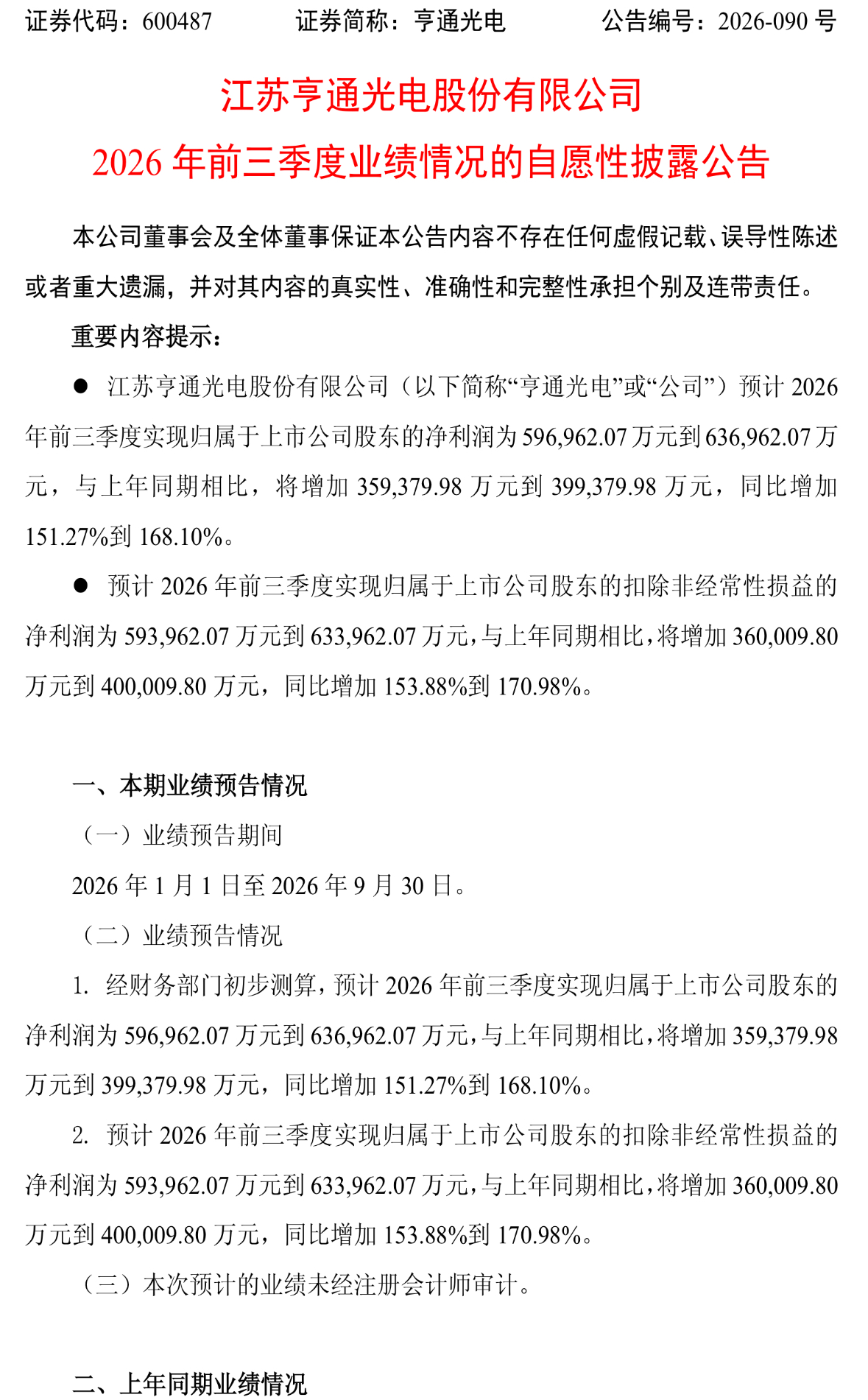
Image Source: Hengtong Optoelectronic Announcement
The narrow gap of approximately RMB 30 million between recurring and non-recurring net profit attributable to the parent company indicates that while factors like government subsidies and asset disposals have played a role, the primary driver of this profit surge stems from core business operations.
In the first half of 2026, Hengtong Optoelectronic reported a net profit attributable to the parent company of RMB 3.120 billion. Extrapolating from this, third-quarter net profit alone is estimated at RMB 2.850 billion to RMB 3.250 billion, representing a quarter-over-quarter increase of approximately 41% to 61%. This demonstrates that performance not only sustained its peak from the first half but accelerated further, fueled by rising optical communication demand and price hikes.
Hengtong Optoelectronic attributes this growth to the rapid expansion of artificial intelligence and sustained capital expenditures in data centers, which have driven up both market demand and product prices in the optical communication sector.
However, these figures are derived from an unaudited performance forecast. Final revenue, gross margin, and segment-specific contributions will be confirmed in the official Q3 report.
Full Industry Chain Advantages
Hengtong Optoelectronic is not merely an optical module provider; it operates across both communications and energy sectors. Its communications industry chain spans “optical preforms-optical fibers-optical cables-optical devices,” while also extending into marine communications, marine energy, smart grids, and new energy cables.
This diversified business portfolio means its AI-driven growth is less concentrated than that of pure-play optical module companies, yet it offers greater resilience against market volatility in any single segment.
In the first half of 2026, Hengtong Optoelectronic achieved revenue of RMB 42.026 billion, up 31.13% year-on-year; net profit attributable to the parent company reached RMB 3.120 billion, up 88.75% year-on-year; and gross margin stood at 16.77%.
Profit growth significantly outpaced revenue growth, reflecting improved profitability driven by product price increases, a higher proportion of high-end offerings, and economies of scale.
Tangible product advancements are also evident.
The 2026 interim report highlights that Hengtong Optoelectronic’s G.654.E ultra-low-loss large effective area optical fiber achieved a minimum attenuation of 0.144 dB/km and has been deployed at the million-core-kilometer scale, suitable for 800G trunk lines and data center interconnects. OM4 and OM5 multimode fibers support high-speed data center connections, with products compatible with 400G, 800G, and 1.6T networks.
The company is also advancing CPO polarization-maintaining fibers, multi-core fibers, and hollow-core fibers, with the latter achieving a minimum attenuation of 0.04 dB/km and entering operator trial commercial projects.
The value of these innovations lies not merely in selling more optical fibers but in upgrading from standard communication consumables to low-loss, low-latency, high-density connection materials.
As data rates climb, customer demands for attenuation, reliability, and bulk delivery capabilities become increasingly stringent. Companies with integrated capabilities across preforms, fibers, cables, and devices are better positioned to convert technical certifications into sustained orders.
Post-Boom Considerations
Global AI infrastructure investment remains the primary growth engine for the optical communication industry.
LightCounting projects the global Ethernet optical module market to reach USD 26.084 billion in 2026, with 800G and 1.6T modules expected to account for USD 14.6 billion, or roughly 64%.
CRU estimates global optical fiber demand will reach approximately 577 million core-kilometers in 2026, up 5% year-on-year, with the North American market potentially seeing 17% growth driven by AI data center construction.
Technological advancements are also accelerating. Internal data center connections are upgrading from 400G to 800G and 1.6T, while inter-rack, campus, and cross-regional computing node transmission is driving demand for ultra-low-loss fibers, high-density cables, and data center interconnects.
Once CPO, hollow-core fibers, and multi-core fibers achieve large-scale adoption, industry value may further concentrate in high-performance materials and precision connection segments.
However, sustained prosperity cannot be judged by price increases alone. Optical fiber price hikes may spur industry expansion, but cloud provider capital expenditures are cyclical. New technologies require time for validation and bulk procurement, and premature capacity expansion could lead to depreciation pressures.
In the first half of 2026, Hengtong Optoelectronic’s net cash flow from operating activities was -RMB 865 million, lagging behind its profit performance. This underscores the need to monitor accounts receivable, inventory levels, and project capital occupancy amid order growth.
Thus, while the performance forecast confirms Hengtong Optoelectronic’s gains from the AI-driven optical communication boom, the next phase hinges on three critical factors: the sustainability of optical fiber prices, the scalability of 800G and 1.6T-related products, and whether operating cash flow can keep pace with profit growth.
In essence, the boom has delivered results, and the focus now shifts to the quality of growth in the next reporting period.
-
Smart #2 Sees 3,000 Yuan Price Increase for Order Transfers: Is It the Electric Vehicle Market's Answer to the iPhone Duo?
-
Is 55% of Domestic Computing Power Really Used for Videos and Short Dramas? Doubao Responds
-
![]()
How to Interpret the Data: 61.6% NEV Penetration in September, 24% Retail Decline in Early October
-
![]()
Q3 Report | Hengtong Optoelectronic’s Performance Soars, Achieving Up to 61% Quarter-over-Quarter Net Profit Growth in a Single Quarter
-
![]()
Manus Restarts Independent Operations, Yet Avoids Starting Anew
-
One Photo Suffices for Celebrity Endorsements: Merchants Offer Custom AI Videos from 150 to 1000 Yuan per Minute
-
![]()
Total Investment Reaches 450 Million Yuan! Luke Optical Launches Its First Pilot Production Line for an Annual Output of 20 Million Pairs of Glasses
-
Chery Leads in Auto Exports, But When Will It Dominate the Domestic Market?