Tencent Refuses to Settle for Mediocrity
 11/19 2026
 403
On November 18, Tencent released its latest quarterly financial report.
In the third quarter of this year, Tencent reported revenue of 207.336 billion yuan, up 8% year-over-year; operating profit of 59.147 billion yuan, down 7% year-over-year; profit attributable to equity holders of the company of 63.612 billion yuan, up 0.8% year-over-year; and non-IFRS net profit attributable to parent of 66.519 billion yuan, down 6% year-over-year.
By business segment, value-added services revenue came in at 98.326 billion yuan, up 3% year-over-year; marketing services revenue reached 43 billion yuan, up 19% year-over-year; and fintech and business services revenue totaled 63.655 billion yuan, up 9% year-over-year.
AI is "devouring" Tencent's profits. In the third quarter, Tencent's capital expenditure reached 81.433 billion yuan, surging 527% year-over-year; operating capital expenditure was 63.6 billion yuan, up 257% year-over-year. Under such massive capital expenditure, Tencent's free cash flow in Q3 saw a net outflow of 69.1 billion yuan—the worst on record since its listing. Excluding prepayments for computing power procurement, however, free cash flow was a net inflow of 16.9 billion yuan.
This is a "contradictory" report card. The core business is still growing steadily, yet non-GAAP profit declined year-over-year; free cash flow saw a massive outflow, but the money was mainly invested in computing power—and excluding this portion, it would still have been a net inflow.
White Horse Observation: Quite a few investors are dissatisfied with the report card Tencent delivered. The disagreement lies in this: does Tencent want the present or the future? Can the future the company envisions actually be realized?
AI: Tencent Goes All In
Over the past year, the narrative that "Tencent is falling behind in AI" has continued to ferment, with outsiders worried that Tencent's moat will be "breached" by AI. Pony Ma admitted at Tencent's annual general meeting in May this year that a year earlier he thought they had boarded the ship, only to find later that "the ship was leaking."
For a period of time, Tencent's investment in AI was relatively moderate. In the second and third quarters of last year, for example, Tencent's capital expenditure was once less than half of Alibaba's.
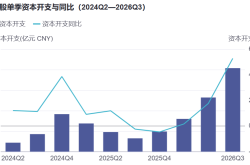
But since the start of this year, Tencent's capital expenditure growth rate has traced a steep curve. In the first three quarters of this year, cumulative capital expenditure exceeded 160 billion yuan, nearly 2.8 times that of the same period last year.
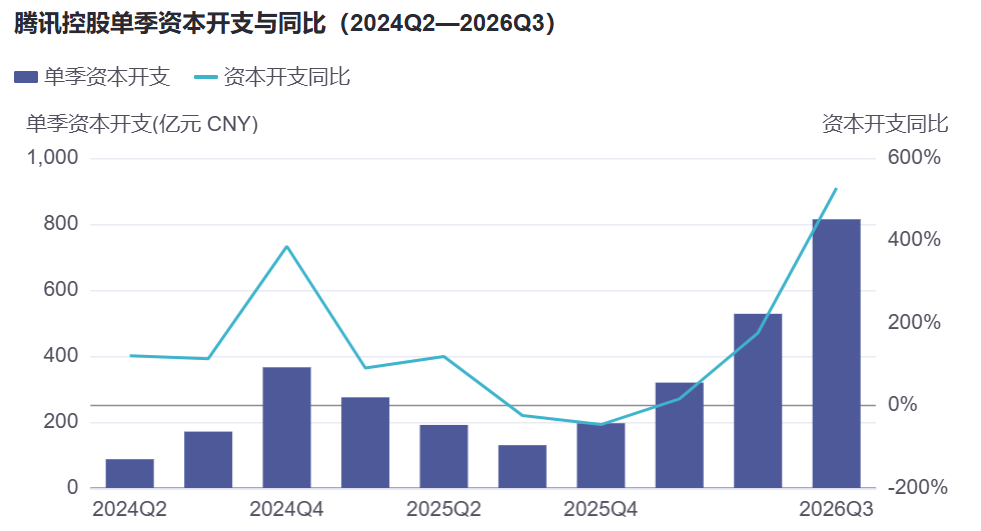
Currently, capital expenditure is mainly directed toward the procurement of AI computing power resources, and the results are already evident.
In the third quarter, Tencent Cloud services revenue growth accelerated to 35% year-over-year from 21% in the previous quarter, mainly driven by AI-related demand, including WorkBuddy, model-as-a-service, and the GPU rental business.
The performance announcement stated that Hy4 ranked first among Chinese models on the AgentArena leaderboard at launch. The lightweight model Hy4Flash is priced at only one-twentieth of Hy4, setting the highest daily token consumption record on OpenRouter among all models released this year.
WorkBuddy's "results" are even more outstanding. Tencent President Martin Lau disclosed at the earnings call that WorkBuddy's annualized revenue over the past seven days has exceeded $500 million, more than twice that of Tencent Meeting. Third-quarter standalone revenue grew more than 5 times quarter-over-quarter.
WorkBuddy's daily active users surpassed 10 million, with daily token consumption exceeding 100 trillion, making it the most-used AI product in China. Since the enterprise version was launched in June this year, 60% of China's top 100 enterprises have become WorkBuddy customers.
Martin Lau was also "painting a picture": in the internet era, doubling a business was already a remarkable achievement; but in the AI era, truly successful products or models typically achieve tenfold growth. WorkBuddy is precisely the product he described as achieving tenfold growth.
Investors' Expectations and Pony Ma's Ambition
Of course, compared with the "peace and prosperity" at the earnings call, Tencent executives' anxiety about AI is also real.
Not long ago, rumors circulating online about "Tencent laying off 50% of staff" were debunked, but during a livestreamed communication event during Tencent's 28th anniversary celebration, Pony Ma did use "harsh words."
According to an article published by Tencent officially, in the Age of Discovery, those who do not advance fall behind; in the Industrial Revolution, those who fall behind get beaten. If you do not invest in and embrace the ongoing intelligence revolution, you will be disrupted. This is a matter of survival.
Pony Ma stated, "The wave is already crashing over us. Some core businesses appear to have solid positions, but AI is progressing rapidly, and the distant wave is already swallowing hill after hill. You cannot just sit there and admire the view. Everyone must feel the urgency, stand up quickly and prepare new strategies, and find new high ground. Land warfare is becoming sea warfare, the army is becoming the navy; everyone must move supplies, transform skills, and quickly board the ship to meet the challenge."
Regarding AI, "if you don't invest now, you may not even have the chance to participate later." This statement directly explains Tencent's sense of urgency in AI investment and also explains the reason for the substantial increase in capital expenditure this year.
Tencent once obtained its "ticket" early in the mobile internet era and even sat in the best seat; now Pony Ma urgently hopes to "board the ship" and obtain a "ticket" in the AI era, even though this "ticket" is a bit expensive and requires paying a great price.
Not all investors approve of Tencent's approach—this is also the common "gap" between investors and entrepreneurs. For investors, they want profits, cash flow, dividends, buybacks...
If investment must be made, it is best to see profits immediately, or at least see explosive revenue growth; the reality is that none of these will materialize immediately. Many investors worry that Tencent's AI investment will be difficult to translate into numbers on the financial statements.
At this point, some people have begun to miss Pinduoduo, which has not made large-scale investments in AI, and even Sohu, jokingly called "lying flat," has started to look rather pleasing.
By comparison, defending the existing "territory" may be simpler, but Tencent has clearly chosen the harder path.
Tencent management stated that current investment is mainly used for reusable AI infrastructure. As infrastructure built in 2026 and 2027 continues to play a role in subsequent years, operating pressure is expected to gradually ease by 2028; the combination of infrastructure reuse, declining hardware costs, and improved computing efficiency will jointly improve the input-output efficiency of the AI business, and the company holds a more optimistic judgment for 2028.
This means Tencent may maintain high-intensity AI investment through 2027. During this period, performance may continue to come under pressure, which is the price Tencent must pay for refusing to settle for mediocrity.
The content and views in this article are for reference only and do not constitute investment advice. Investment involves risks, and decisions should be made cautiously.
-
![]()
AI Hasn't Produced Fully Automated Ransomware—but It Has Lowered the Barrier to a Single Person
-
![]()
Pony.ai's Q3 Net Loss Doubles, but the Loss Isn't the Real Problem
-
![]()
Tencent Refuses to Settle for Mediocrity
-
![]()
Rumors of Shangjie Leaving HIMA Resurface—Is "Going Solo" Really Necessary for Shangjie? | Mingjing Pro
-
Foxconn Said to Win OpenAI Phone Assembly Order, Mass Production Could Start as Early as First Half of 2027
-
![]()
Three Gates for AI Automated Testing: Verifying Code Correctness
-
![]()
XPeng's Q3 2026: Service-Fee Tide Recedes as Cars and Overseas Sales Take Over
-
![]()
Waymo Suspended from California Highways: Why Halt Operations Without Any Casualties, and Where Is Tesla's Cybercab?