Pony.ai's Q3 Net Loss Doubles, but the Loss Isn't the Real Problem
 11/19 2026
 492

This is the 173rd original article from Siwei AI Society
The full text is about 1,379 words, with an estimated reading time of 4 minutes
On November 18, Pony.ai released its Q3 2026 financial report.
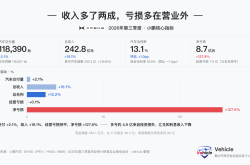
Let's start with two numbers: total revenue reached 299 million yuan, up 75.2% year-on-year and a new single-quarter high; net loss came in at 914 million yuan, compared with 440 million yuan in the same period last year—more than doubling.
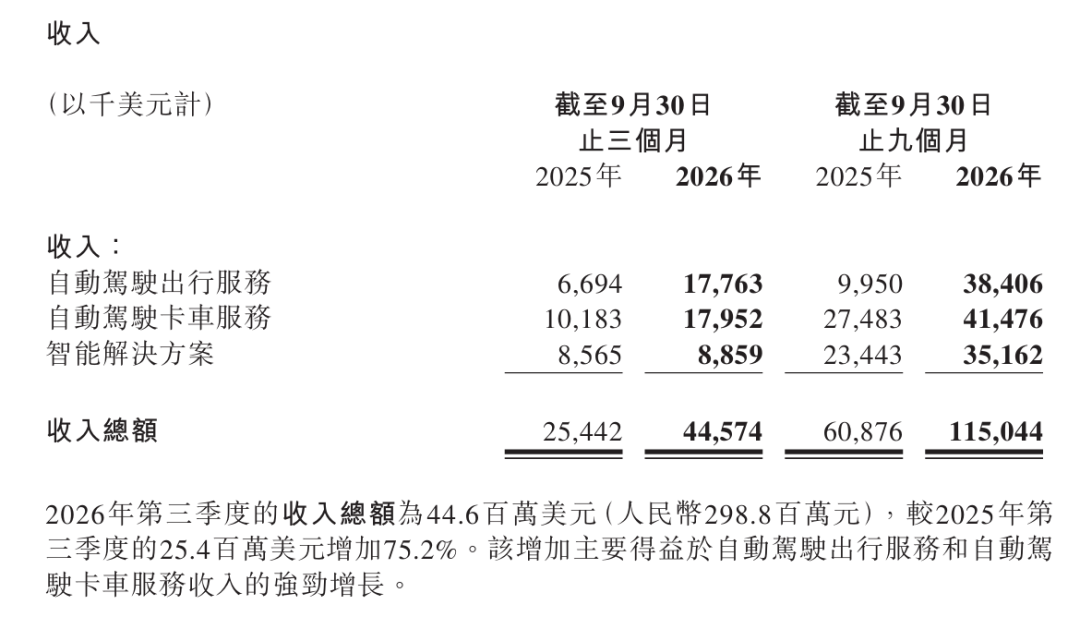
Revenue rose, and losses rose too—a textbook case of revenue growth without profit growth.
But if you stop here, you'll miss the most interesting part of this financial report.
Of the 914 million yuan loss, more than half is an accounting figure
The net loss was 136.3 million US dollars, compared with 61.6 million in the same period last year. Of the increase, the largest part was a 77 million US dollar fair value loss on trading financial assets.
This money is non-cash and unrelated to the core business. It is a book loss from revaluing held financial assets at market prices.
Excluding this item and share-based compensation, the non-GAAP net loss was 48.9 million US dollars, compared with 56.8 million in the same period last year, narrowing by 13.9% year-on-year.
Now look at the operating level. The GAAP operating loss was 68.7 million US dollars, compared with 69.7 million in the same period last year—basically flat; the non-GAAP operating loss was 58.3 million, down 7.6% year-on-year.
So the accurate takeaway is this: operations did not get worse, and the doubling of the net loss was caused by accounting items.
What really deserves attention is the revenue structure
The Robotaxi segment is indeed impressive. Revenue was 17.8 million US dollars (119 million yuan), up 165.4% year-on-year and up 47.1% quarter-on-quarter, accounting for 39.9% of total revenue—compared with only 26.3% in the same period last year, a historical high. Passenger fare revenue rose nearly 400% year-on-year.
But there is another line in the financial report that is easy to skip: by nature, product revenue was 19.4 million US dollars, up 90.9% year-on-year, accounting for 43.5% of total revenue; service revenue was 25.2 million, up 64.8%.
What is product revenue? It is delivering vehicles to partners under the co-built fleet model.
To put it plainly, part of Robotaxi's 165% growth came from selling vehicles, and the pace depends on signing and delivery schedules, not on the density of orders on the road.
The nearly 400% rise in fares reflects real demand, but the base was only 6.7 million US dollars, so quadrupling adds only a bit more than 20 million.
What is more noteworthy is the cost side. Q3 costs were 36.7 million US dollars, up 76.5% year-on-year, faster than the 75.2% revenue growth. As a result, the gross margin was 17.8%, down slightly by 0.6 percentage points from 18.4% in the same period last year.
With more vehicles and larger scale, procurement and manufacturing costs have not yet been significantly diluted.
The operating loss margin fell from 273.9% to 154.2%, which looks like a big improvement, but it is mainly because the denominator became larger—revenue rose 75%, while the absolute loss only fell from 69.7 million to 68.7 million.
The real progress is in insurance premiums
The only place in this financial report that made me feel "this direction is right" is insurance.
After renewal of the seventh-generation model, per-vehicle insurance premiums fell 19% year-on-year, about 40% of those for human-driven taxis. In 2025, this ratio was still 50%.

Insurance premiums are one of the most rigid cost items for Robotaxi. Their decline says more about improving per-vehicle economics than rising revenue does.
The company disclosed that fleets in Guangzhou and Shenzhen have achieved positive unit economics, based on fare revenue after discounts and refunds, as well as seven categories of costs including depreciation, charging, personnel, maintenance, and insurance.
Operations are also expanding. Guangzhou's previously separate city center and Nansha are now connected into one area of more than 1,000 square kilometers, nearly nine times the size of San Francisco; Shenzhen Bao'an Airport has shifted from safety drivers to fully driverless operation, the first such case at an airport in a tier-1 city; Shanghai Pudong obtained a new permit, and deployment has begun in Hangzhou, Chongqing, and Hengqin in Zhuhai.
The fleet has 2,768 vehicles, with a year-end target of 3,500 vehicles and 20 cities. In the first three quarters, Robotaxi revenue was 38.4 million US dollars, 3.86 times that of the same period last year, so the full-year target of 3.5 times is not under much pressure.
Overseas, Zagreb produced Europe's first fully driverless passenger-carrying test in September; London and Manchester have been announced, and overseas agreements have a pipeline of more than 4,000 vehicles.
There is still 1.154 billion US dollars on the books, 52.1 million less than at the end of June. Q3 free cash flow outflow was 78.2 million, similar to last year. At this pace, statically calculated, it is enough to burn for 14.8 quarters.
But the Hong Kong stock market is not giving it much support. On November 18, it closed at HK$31.78, hitting a new post-listing low for the second consecutive trading day. It listed on November 6 last year at an issue price of HK$139, broke below the issue price on the first day, and has fallen 77% so far.
What the capital market is calculating is not revenue growth, but the day when refinancing is no longer needed. This question cannot be answered by selling vehicles; it can only be supported by fares from vehicles on the road.
So what really matters next year is not whether the fleet reaches 3,500 vehicles, but whether passenger fares can pick up when delivery revenue from co-built fleets is no longer growing rapidly.
Fares rose nearly 400% in Q3. Whether this momentum can continue matters far more than the net loss figure.
All content in the article is compiled from public information and represents only personal views
If interested, you can click the business card to follow
-
![]()
AI Hasn't Produced Fully Automated Ransomware—but It Has Lowered the Barrier to a Single Person
-
![]()
Pony.ai's Q3 Net Loss Doubles, but the Loss Isn't the Real Problem
-
![]()
Tencent Refuses to Settle for Mediocrity
-
![]()
Rumors of Shangjie Leaving HIMA Resurface—Is "Going Solo" Really Necessary for Shangjie? | Mingjing Pro
-
Foxconn Said to Win OpenAI Phone Assembly Order, Mass Production Could Start as Early as First Half of 2027
-
![]()
Three Gates for AI Automated Testing: Verifying Code Correctness
-
![]()
XPeng's Q3 2026: Service-Fee Tide Recedes as Cars and Overseas Sales Take Over
-
![]()
Waymo Suspended from California Highways: Why Halt Operations Without Any Casualties, and Where Is Tesla's Cybercab?