AI Is Flooding Everywhere! Professors Give Up Judging Right From Wrong—Whose Tragedy Is This?
 11/23 2026
 391
AI is shaking up math assessment and grading systems.
No projector, no laptop—just one blackboard after another filled with handwritten formula derivations. This is the daily routine of the introductory math class taught by Ni Yi, a professor in the Department of Mathematics at Caltech.
This traditional teaching style, relying entirely on chalk, stands in sharp contrast to the AI tools students can summon at their fingertips today.
Recently, this professor changed his grading rules—and behind this lies a common dilemma now facing the entire mathematics assessment system.
According to relevant reports, Professor Ni adjusted the grading criteria for homework: he no longer grades based on the accuracy of answers, but only looks at whether students completed the assignment. The reason is straightforward—he simply cannot accurately determine whether these answers were worked out by the students themselves or generated by AI.
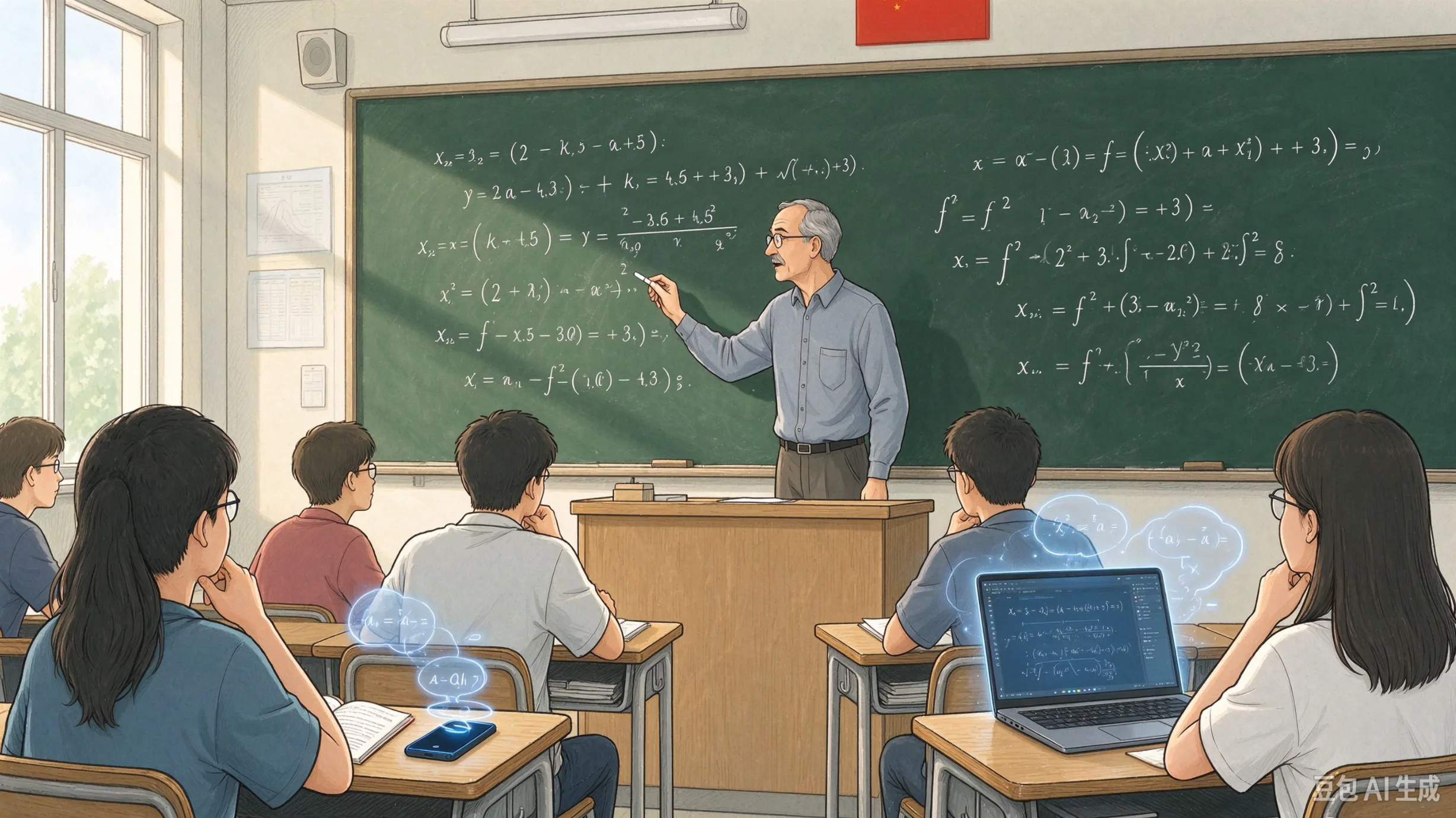
Image source: Generated by Doubao AI
If this adjustment becomes the industry norm, it means the core assessment mechanism of undergraduate mathematics education has already been hit by an unprecedented impact.
Mathematics differs from humanities subjects; the nature of math homework has made it a major disaster area for AI cheating.
An essay can at least reveal traces of the writer's thinking through writing style, argumentative logic, and textual structure; but the final answer to a math problem is often a compact symbolic expression, and behind the dry result there is almost no evidence of the reasoning process left behind.
Whether it is the solution steps for an algebra problem or the derivation process for calculus, the essence is concise symbolic content. If grading only looks at whether the final result is correct, teachers have almost no way to distinguish whether the homework was calculated by a student staying up late or generated by AI in one second.
This is also why mathematics, under the impact of AI, is more passive than other subjects.
The current student population has also shown clear polarization. There is a sophomore named Savic who never uses AI for homework.
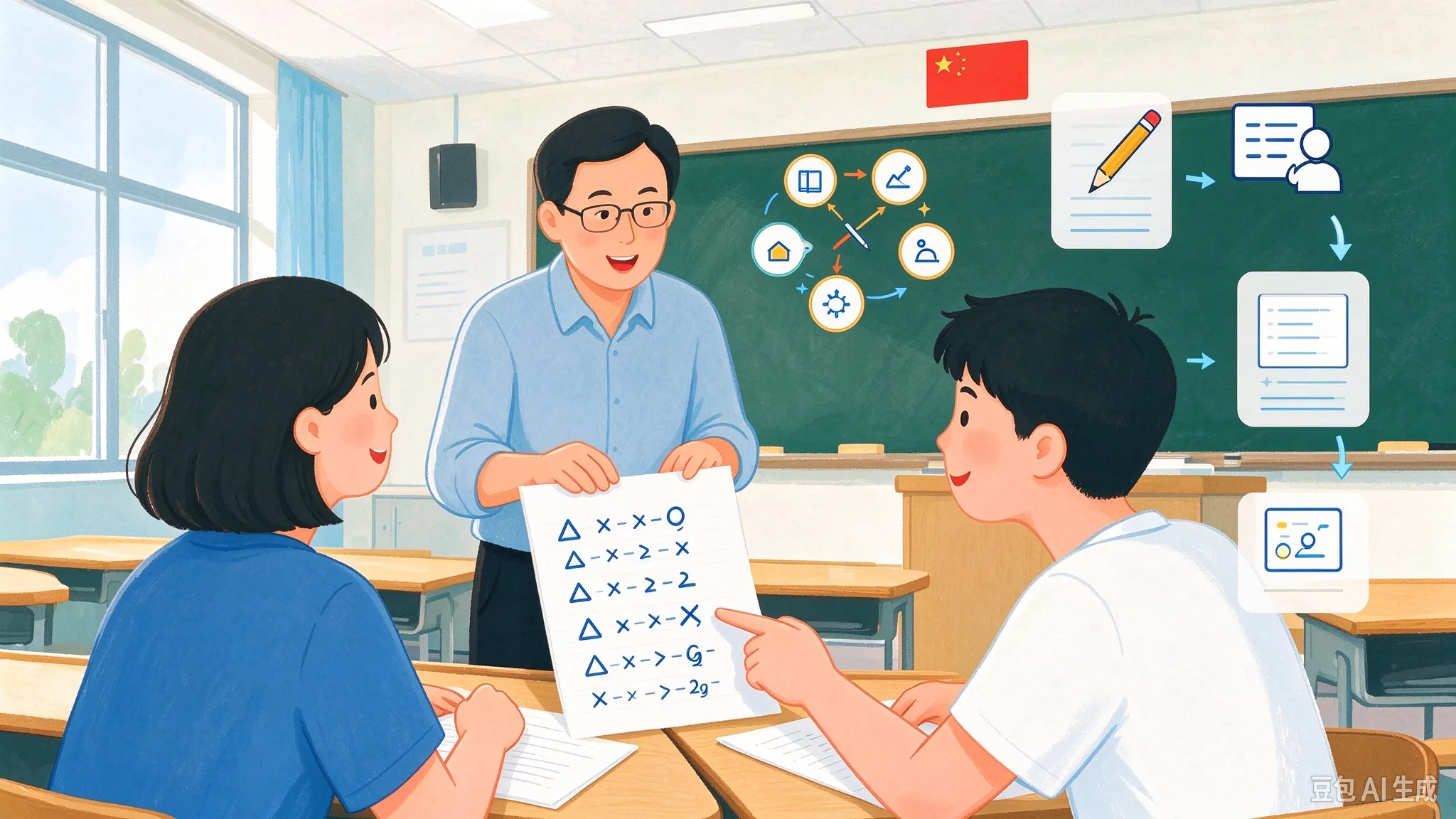
Image source: Generated by Doubao AI
He understands it clearly: if he muddles through homework with AI now, he will not have a solid grasp of the knowledge points, and when the in-person closed-book exam comes, all the knowledge gaps will be exposed.
He would rather spend more time doing the problems himself and build a solid foundation. But many students directly treat AI as a homework ghostwriting tool—as long as they can submit on time and get a grade, that is enough.
Over the long term, the gap between the two choices will grow wider and wider. Students who seriously do the problems themselves will build increasingly solid foundational abilities; students who muddle through homework with AI seem to save effort, but in fact learn nothing and will sooner or later fall behind the course pace.
Facing the impact brought by AI, Caltech has not issued a school-wide unified AI ban, but has delegated decision-making power to each specific course.
The guidance given by the school's Teaching and Learning Center is for each instructor to clearly state AI usage rules in the course syllabus—for example, whether tools such as ChatGPT are fully allowed, restricted in use, or must be reported before use.
According to reports, many course syllabi now include relevant explanations about AI use. This actually also means that the school's attitude has shifted from assuming AI cannot be used to formulating clear, public rules at the level of individual courses.
That said, the root of the problem is not AI, but that the assessment methods used for many years can no longer keep up with the pace of AI development.
Before AI existed, if the homework answer was correct, it basically showed that the student had mastered the knowledge points. Now AI can easily produce complete solutions to routine exercises, so grading only by the final answer can no longer measure students' true level.
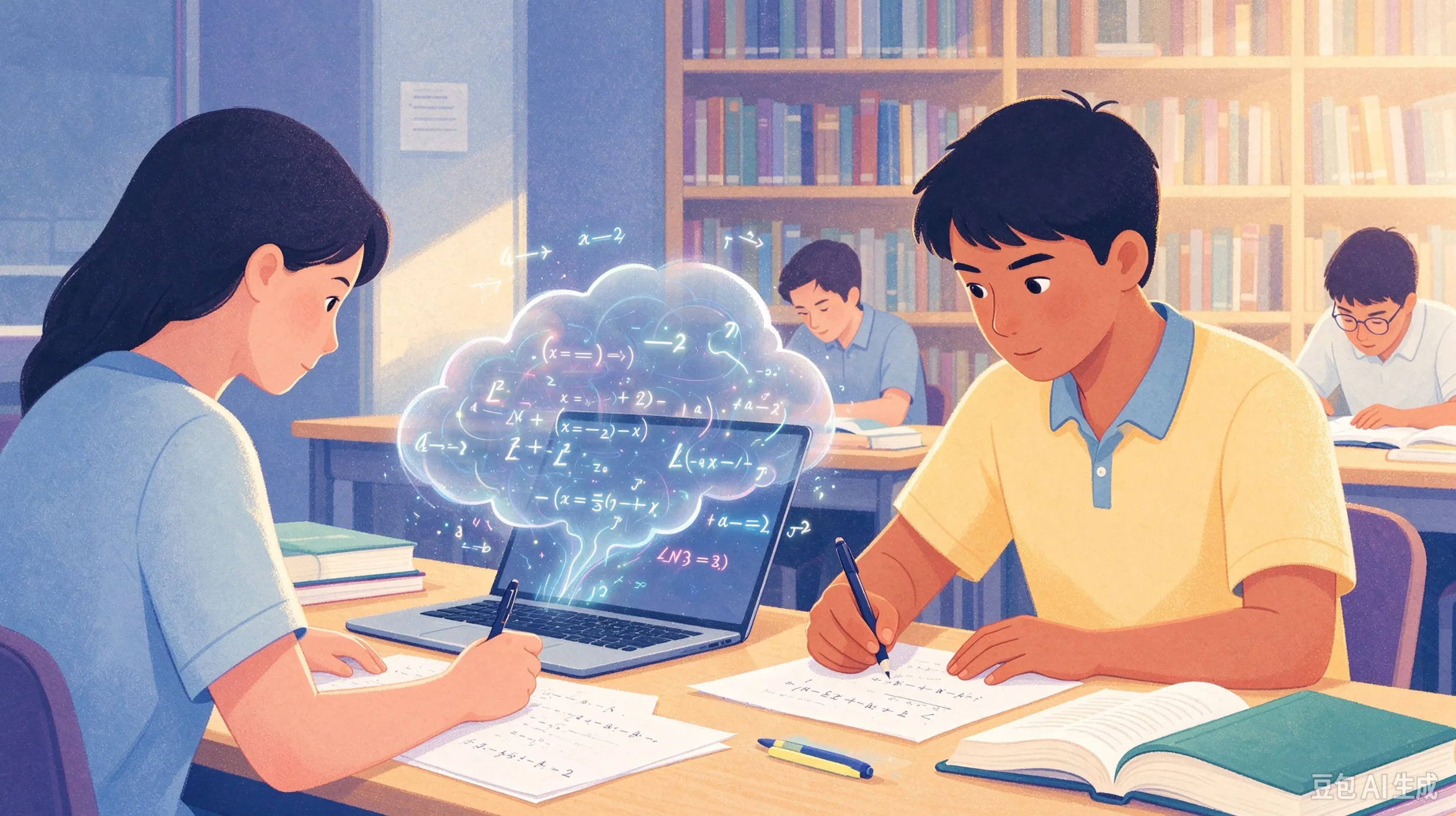
Image source: Generated by Doubao AI
Caltech's own teaching guidelines also mention that generative AI content may contain errors, be incomplete, or even be fabricated out of thin air.
Even if the derivation process looks very correct, it still must be verified by someone who truly understands mathematics. Simply put, the assessment system established before AI existed no longer works today.
In response to this dilemma, the school has also offered some feasible alternatives, with the idea of shifting the evaluation focus from whether the final answer is correct to the student's thinking process.
For example, having students orally explain their problem-solving approaches, submit assignments in stages to show the derivation process, and adding in-class mini-exercises; or, when grading, looking not only at the final result but also at erroneous attempts and error analysis.
But these methods also have practical limitations. They take up more of teachers' time and energy, and they also create new fairness issues. For example, different students have different financial ability to access paid AI tools, which itself creates a gap.
Looking at the bigger picture, mathematics and AI are mutually reinforcing: AI can assist in solving complex mathematical problems, and advances in mathematical research can in turn optimize AI systems.
But the problem now is whether universities' course design and assessment systems can keep up with the iteration speed of AI tools.
The core of education is to ensure that the grades students ultimately show truly correspond to the knowledge and abilities they have actually mastered. If this correspondence is broken by AI, then the meaning of homework, grades, and even degrees will be greatly diminished.
Source: Leitech
Images in this article are from: 123RF licensed image library Source: Leitech
-
Perspective on Pinduoduo's 2026 Q3 Report: Revenue Stalls, Growth Dilemma Emerges?
-
Two Companies Receive Hong Kong IPO Filing Approval
-
Pinduoduo: The Only One Quietly Making Money in China's Internet
-
![]()
399-Yuan Down Jackets Go Viral—and the Biggest Contributor Isn’t Pang Dong Lai, but Large Language Models?
-
Report | Global Computing Power Top 10 Trends Report 2027
-
![]()
100,000 Vulnerabilities in a Single Year: How AI Is Overwhelming the Internet's Security Defenses
-
Anthropic's Trillion-Dollar IPO Set to Shake Up the Semiconductor Industry
-
![]()
AI Is Flooding Everywhere! Professors Give Up Judging Right From Wrong—Whose Tragedy Is This?