399-Yuan Down Jackets Go Viral—and the Biggest Contributor Isn’t Pang Dong Lai, but Large Language Models?
 11/23 2026
 427
By: Xiangshan Finance
The weather is turning colder, and peak season for down jacket sales has arrived once again—except that, unlike previous years’ trend of spending thousands or even tens of thousands of yuan on down jackets,
this year’s down jackets are all about a “frugal living” mode. People no longer buy clothes based on brand names; instead, they have started paying attention to the “ingredient list” of down jackets, flocking to buy Sam’s Club and Pang Dong Lai’s 399-yuan and 299-yuan down jackets.
The matter once topped trending searches, and even the down jackets at Peking University’s cultural and creative store, offered as benefits for students, were dug up. Some netizens even joked that this year’s rising oil prices have been made back on down jackets......
In this regard, mainstream views all agree that this is the “frugal living” trend blowing onto down jackets. After all, these days even hard currency like Moutai is not selling as well as before; some also believe that this is a victory for the supply chain, and that down jackets should indeed be made cheaper and cheaper......
These are all objective facts, but today, Xiangshan Finance wants to talk about something different.
One overlooked reason why down jackets can sell so cheaply and yet be so popular is the information equality brought by AI large models, which broke the chain reaction caused by the original information gap between products and consumers.
//AI turns “professional courses” into “open-book exams”
Surely some friends will say that this view does not hold up. Information equality already existed in the short-video era, and down jackets were not this popular then.
This is indeed a fact.
For example, in 2022, the wave of Xin Jifei’s “technology and ruthless chemicals” going viral made everyone “enlightened” for the first time and pay more attention to the raw materials of goods.
According to a survey by Youthology combined with Dingdong Maicai, 83% of young people have now developed the habit of actively checking ingredient lists. From initially only staring at the keyword “zero additives,” to later learning to read ingredient ordering and understand traps such as high-fructose corn syrup and non-dairy creamer, they completed the first round of consumer enlightenment.
However, the ingredient-conscious consumers of the short-video era essentially “learn first, use later,” and there is still an unavoidable learning cost.
Bloggers break down the knowledge points and spell them out for you, but understanding a yogurt ingredient list does not mean you can understand cat food; mastering snack additives means that when facing a whole new set of terms for down jackets such as down content, fill weight, fill power, and oxygen consumption, you have to take another course.
This is the ceiling of information equality in the short-video era: it completed the popularization of knowledge, but did not eliminate learning costs.
Many people finish scrolling through a bunch of down jacket explainers, but when it actually comes time to place an order, they are still easily led astray by promotional rhetoric without numerical support, such as “large down clusters” and “high-down warmth.”
Besides, you can’t just study everything intensively before buying anything, right? That would be too exhausting.
So when people buy low-frequency essential products like down jackets, they divide them into light short and long styles, thick short and long styles, and fashion styles, and then see which of the major brands such as Bosideng and Uniqlo looks good and buy that one.
This is the “even good wine fears a deep alley” caused by information gaps and learning costs.
Now it is different. AI large models that know astronomy above and geography below have arrived, and they are free to use, so current consumers almost each have a “Jarvis.”
This directly saves consumers the learning cost when purchasing.
For example, if you directly ask a large model, “What indicators should I look at when buying a down jacket? List them for me,” it answers like this:
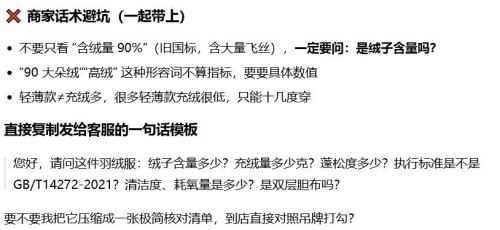
Bad sellers will certainly complain when they see this, but consumers can directly “Ctrl C+V” and throw the indicators to the customer service and staff of relatively cheap brands or white-label brands. As long as the formula fits, the products they buy are very likely not bad.
If you want to save even more effort, just skip the parameter step and directly ask the AI assistant on the shopping platform.
For example, if you want to buy a down jacket with the same indicators as Sam’s Club, the author takes the Taobao platform as an example and directly asks, “Are there down jackets with parameters similar to the recently viral Sam’s Club products?” It answers like this:
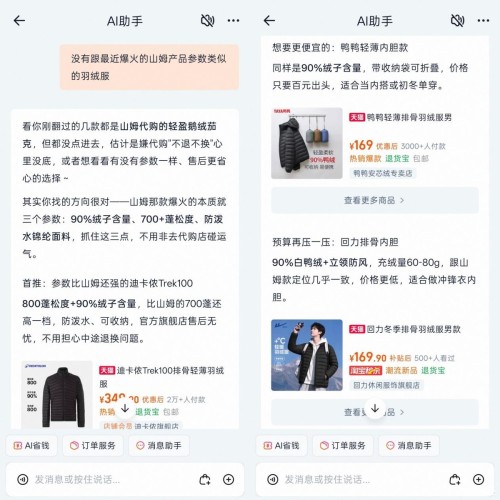
At the same time, in each price range, it gives you the option to “view more products.” Click in, browse and choose, and you can place an order directly.
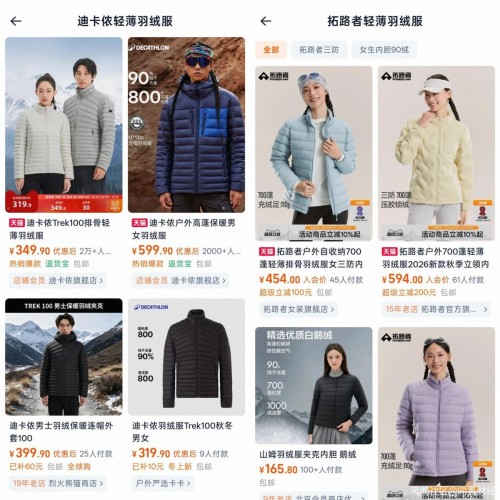
You see, the emergence of AI not only equalizes the information search stage; at the final decision-making stage, you do not even need to ask customer service. Taobao’s built-in AI assistant can directly help consumers shorten the decision-making chain.
What is even more interesting is that today’s AI large models are very much like the apps of the past, all competing for users, traffic, and cultivating user habits. And using AI to shop, buying products like down jackets that are “low-frequency essential needs,” is very suitable as a “grip.”
How to understand that?
Take WeChat Pay back then. It was precisely by uncovering specific scenarios such as sending red envelopes during the Spring Festival that it pulled ahead in the mobile payment field.
So at this time, in the early stage of the AI era, helping users buy essential products with a certain selection threshold will likely form very strong user stickiness.
For example, if within the Taobao app, the experience of using the AI assistant to buy a “low-frequency essential” product like a down jacket is good enough, then the next time I have choice difficulties buying high-frequency essential products like dog food or milk powder, I can just use you directly. It is convenient and effortless, and there is no need to ask other large models at all.
And once high-frequency usage scenarios land, it will likely form extremely strong user mindshare on the consumer side.
So from a competitive perspective, whether it is a specific large model or an existing app, they are all willing to promote the development of information equality on the consumer side.
Overall, the real value of AI large models is to encapsulate scattered professional knowledge into tools that can be directly invoked. In one sentence, you can get a standardized purchasing ruler, allowing consumers to quickly and directly match corresponding products.
It makes rational consumption no longer an exclusive ability of enthusiasts, and the initiative in consumers’ hands has become so solid and concrete for the first time.

Of course, a change in cognition is only the internal cause. If all brands remained consistent, high prices would still be a “truth” consumers have to accept, and reasonable corporate profit.
Cognition is the dry firewood, but someone still needs to ignite it.
//Companies’ playbook has changed, from “talking brands” to “showing bottom cards”
As the information gap gets smaller and smaller, driven by profit, the new playbook evolved by offline formats has acted as the fuse.
On the one hand, many brands are using a “low-profit” approach to cultivate what Buffett calls “economic goodwill.”
Take Pang Dong Lai. Whether it is the current “cost-effective” down jackets or the previous underwear, tea, baijiu, and jade, these are all essential products with opaque prices and information gaps.
Since they are essential needs, consumers can obtain obvious bargains, and if the quality is poor they can also get excess compensation from Pang Dong Lai, so of course people flock in.
So we can see that its 2023 revenue was 10.7 billion yuan, net profit was 140 million yuan, and net profit margin was only 1.31%, significantly lower than the industry average of 5%.
But what followed was a substantial improvement in reputation and visibility.
Tianyancha APP shows that with only more than ten stores and without stepping out of Henan, in the following two years, driven by scale effects (revenue doubled to 23.5 billion), the net profit margin began to rise, at 4.72% and 6.38% respectively.
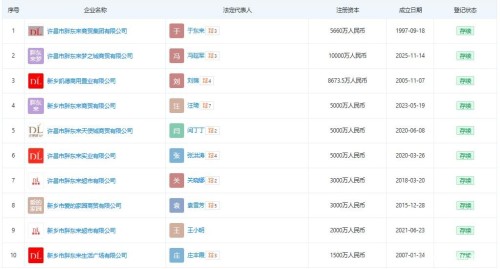
Conversely, if Pang Dong Lai’s net profit margin had always been kept above 5%, it would most likely just be a local supermarket in Xuchang, with revenue perhaps of 10 million or 100 million yuan, and it would not have reached the current 20 billion yuan (with only 14 stores).
To put it plainly, down jackets are like Coca-Cola and Nongfu Spring sold close to cost in volume snack stores. Merchants do not expect to make money from them, but use them as “price anchors” to help consumers build awareness.
Once everyone believes that this store does not make dirty money, when buying snacks, daily necessities, and fresh food, they will prioritize this place, and profits from other categories can naturally make up the overall return.
On the other hand, companies like Sam’s Club use private brands to push product profits down to “cost price.”
Take down jackets. There is not only the Member’s Mark private brand, but also dedicated hit products such as Rokka&Rolla, directly cutting out distributor and brand premiums and advertising and marketing expenses, connecting with upstream factories for large-order customization, compressing all intermediate links, so prices naturally return to their true essence.
Then how does it make money?
Sam’s Club’s underlying logic is not to rely on the purchase-sale price difference of goods to seek high profits, but first to lock in membership fees as stable cash flow.
With that as confidence, it actively lowers the gross margin of all store products. Then the product price difference first covers store operation and warehousing fulfillment costs, and then hook hit products (such as this down jacket) are used to create the perception of “pricing close to cost,” driving members to continuously renew and repeatedly visit the store to consume.
What it has in common with Pang Dong Lai is that both actively use highly influential products like down jackets to “show their bottom cards,” directly laying out the supply chain, raw materials, and pricing in front of users.
Looking at a longer industry cycle, this “showing bottom cards” playbook is essentially reconstructing the relationship between buyers and sellers.
In the past, merchants and consumers were in a game of information asymmetry, with merchants holding the information advantage; now merchants actively give up the dividend of information gaps and exchange short-term thin profits for long-term trust.
Once trust settles into economic goodwill, users’ repeat purchases, spontaneous dissemination, and the supply chain dividends brought by scale will gradually transform into sustained and stable returns.
Of course, some people will define this as a price war and unsustainable.
An ordinary price war means compressing quality, cutting corners, and exchanging low prices by sacrificing the bottom line of goods. In the end, both sides are hurt and no closed loop can be formed.
But the model of Pang Dong Lai and Sam’s Club is to actively tear down information walls, compress intermediate premiums on the premise that quality does not shrink, transfer profits to consumers, and then build a new profit loop with goodwill, membership systems, and scale effects.
Then in the future, driven by such companies, the supply side will likely evolve once again.
Brand rhetoric will no longer lead our choices, and we will not have to pay for invisible premiums. This kind of candid buyer-seller relationship will become mainstream, and more and more brands will proactively put raw material specifications, OEM information, and cost composition on the table.
Ordinary people can both understand the value of goods and gain real good things with peace of mind.
-
Perspective on Pinduoduo's 2026 Q3 Report: Revenue Stalls, Growth Dilemma Emerges?
-
Two Companies Receive Hong Kong IPO Filing Approval
-
Pinduoduo: The Only One Quietly Making Money in China's Internet
-
![]()
399-Yuan Down Jackets Go Viral—and the Biggest Contributor Isn’t Pang Dong Lai, but Large Language Models?
-
Report | Global Computing Power Top 10 Trends Report 2027
-
![]()
100,000 Vulnerabilities in a Single Year: How AI Is Overwhelming the Internet's Security Defenses
-
Anthropic's Trillion-Dollar IPO Set to Shake Up the Semiconductor Industry
-
![]()
AI Is Flooding Everywhere! Professors Give Up Judging Right From Wrong—Whose Tragedy Is This?