AI Can't Understand Emotions, but It Has Spawned Seven New Businesses
 11/23 2026
 527

Author | Cheng Yu
Disclaimer | The cover image is sourced from the internet. This is an original article by Jingzhe Research Institute. For reprints, please leave a message to apply for authorization.
The "Good Life Survey: Report on the Consumption Characteristics and Trends of Chinese Residents (2026)" released by the Research Institute of China Media Group shows that among the 18–35 youth group, 45.89% cite emotional value as the main reason for increased consumption—the highest proportion among all consumption motivations.
As emotional value gradually becomes an important factor in young people's consumption decisions, some emotional needs that once seemed difficult to price explicitly are beginning to turn into new consumption opportunities. And with the continuous development of AI technology, emotional consumption has found new avenues beyond plush toys, blind boxes, aromatherapy, and various companionship products.
1. AI Emotional Diary: Turning Moods into Exclusive Records
For many young people, keeping a diary is a way to record their state of mind and relieve emotions, but not many can truly keep at it every day. Around this demand, some AI diary products have begun trying to combine emotional check-ins, voice recording, and AI analysis, adding more possibilities for automating the recording and organizing work that originally had to be done by oneself.
Take the Mindlo APP as an example. This AI emotional diary application combines daily mood check-ins with AI analysis. Users can rate their mood for the day, choose emotional tags such as joy, calm, anxiety, and sadness, and also supplement specific circumstances through text notes. As records accumulate, AI generates weekly, monthly, and even annual emotional reports, helping users review recent emotional changes and analyze which life events may be related to emotional fluctuations. In terms of charging, Mindlo adopts a free download plus in-app purchase model. According to its official explanation, the PRO version costs 6.99 US dollars per month.
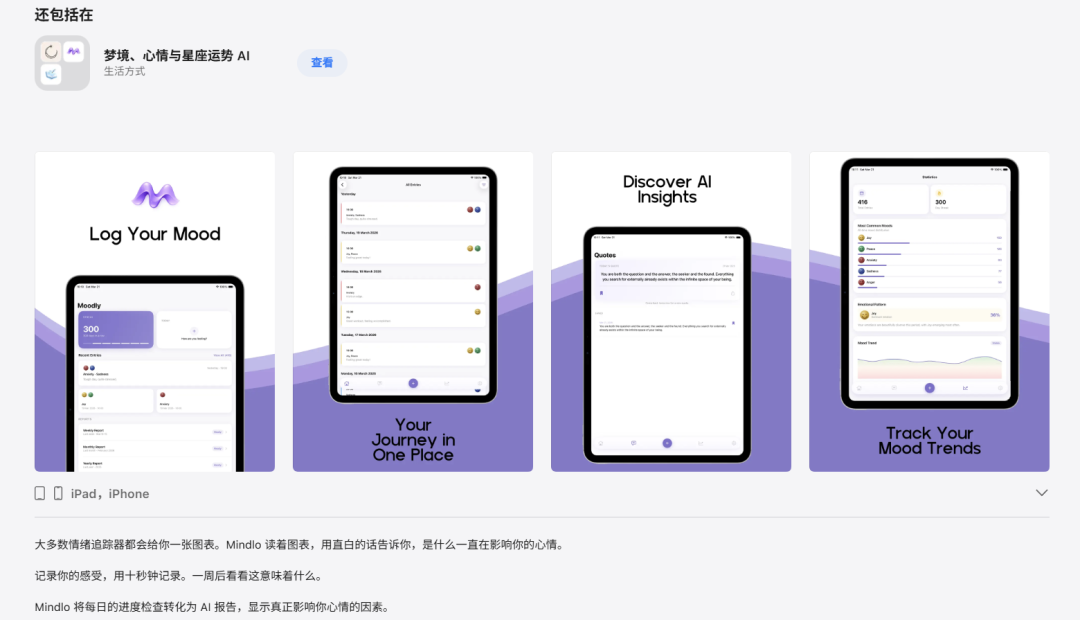
*Mindlo APP
In addition to analyzing emotions, AI has also begun to participate in recording daily life. The Xiaoshu Diary APP combines AI with diary functions, attempting to automatically organize and generate diaries through information such as voice, photos, and health data. The product also connects to an on-device local large model to provide users with AI feedback, and through weekly reports and a growth timeline, helps users review their life state over a period of time.
In addition, dreams have also become a new entry point for AI recording and creation. Some AI dream tools allow users to record dreams through text, after which AI interprets them from psychological and emotional perspectives and generates images and short videos from the descriptions. Some products also support uploading photos of people or pets to create exclusive digital images for them, allowing the same character to maintain a relatively consistent appearance across different dream videos.
For example, users of the Dream Diary APP can record dreams through voice or text. AI can not only generate corresponding illustrations, but also split the dream into multiple scenes, produce four-panel or multi-panel comics, and even generate dynamic videos.
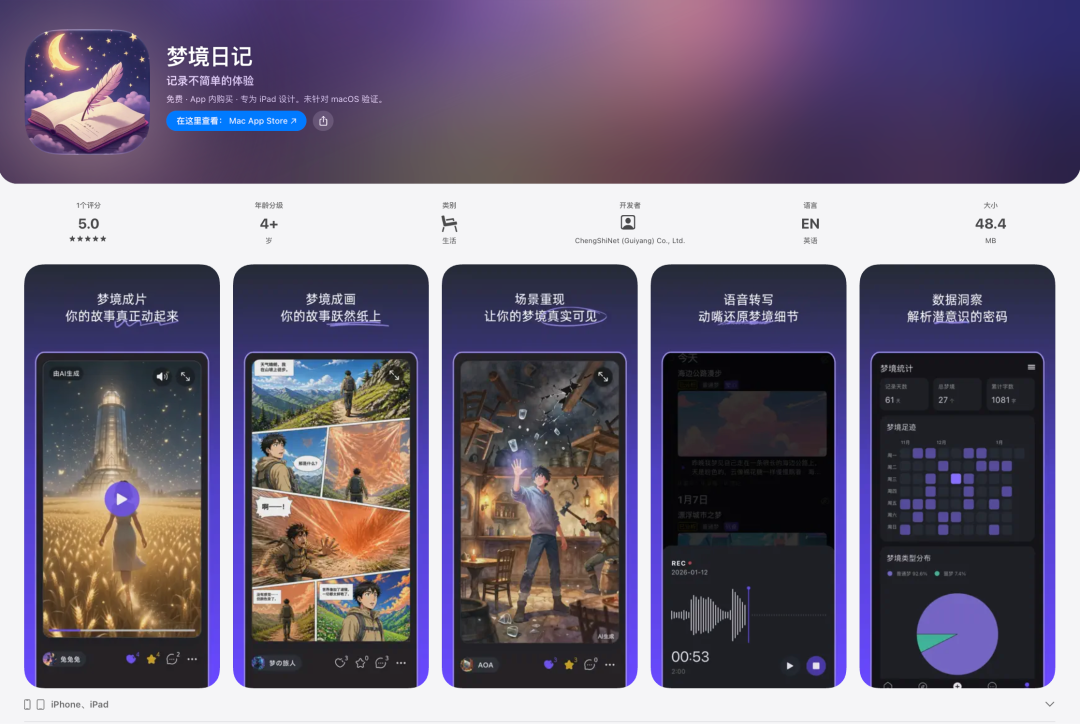
*Dream Diary APP
However, AI emotional diaries involve a large amount of personal life records, and how to handle these data has also become a problem these products need to face. In particular, AI-generated emotional analysis and dream interpretation are not equal to professional psychological assessment, let alone a substitute for psychological counseling. How to protect user privacy while providing personalized feedback, and avoid overinterpreting emotions or even misleading users, remains a problem such products need to solve.
2. AI Pet Holographic Box: Letting the Image of Fur Babies "Come Back to Life"
In the past two years, as pets gradually become members of the family, attention has also grown to pet aging and memorial needs after death. With the addition of AI technology, pet memorials have gained new product forms. For example, the AI pet holographic box, which integrates holographic projection and AI technology, attempts to combine digital pet images with display hardware. Users can upload photos, videos, and sound materials of pets, and AI restores the pet's appearance, voice, and some behavioral characteristics. Then, with holographic equipment, the digital pet can appear in various life scenes in a more concrete way.
Jingzhe Research Institute noted that specific product explorations have already emerged from the combination of AI and pet holographic displays. For example, Shenzhen Fuling Technology's "Fuling Xingchong" AI pet digital life holographic cabin, according to its official website and roadshow introduction, allows users to replicate a pet's appearance, calls, and behavioral habits through photos, videos, and sound materials. The device also supports visual, auditory, and tactile interaction, as well as AI and offline dual-mode voice interaction. It should be noted that this product is still in the internal testing and crowdfunding preparation stage. The above functions are official claims and have not yet been verified through mass production.
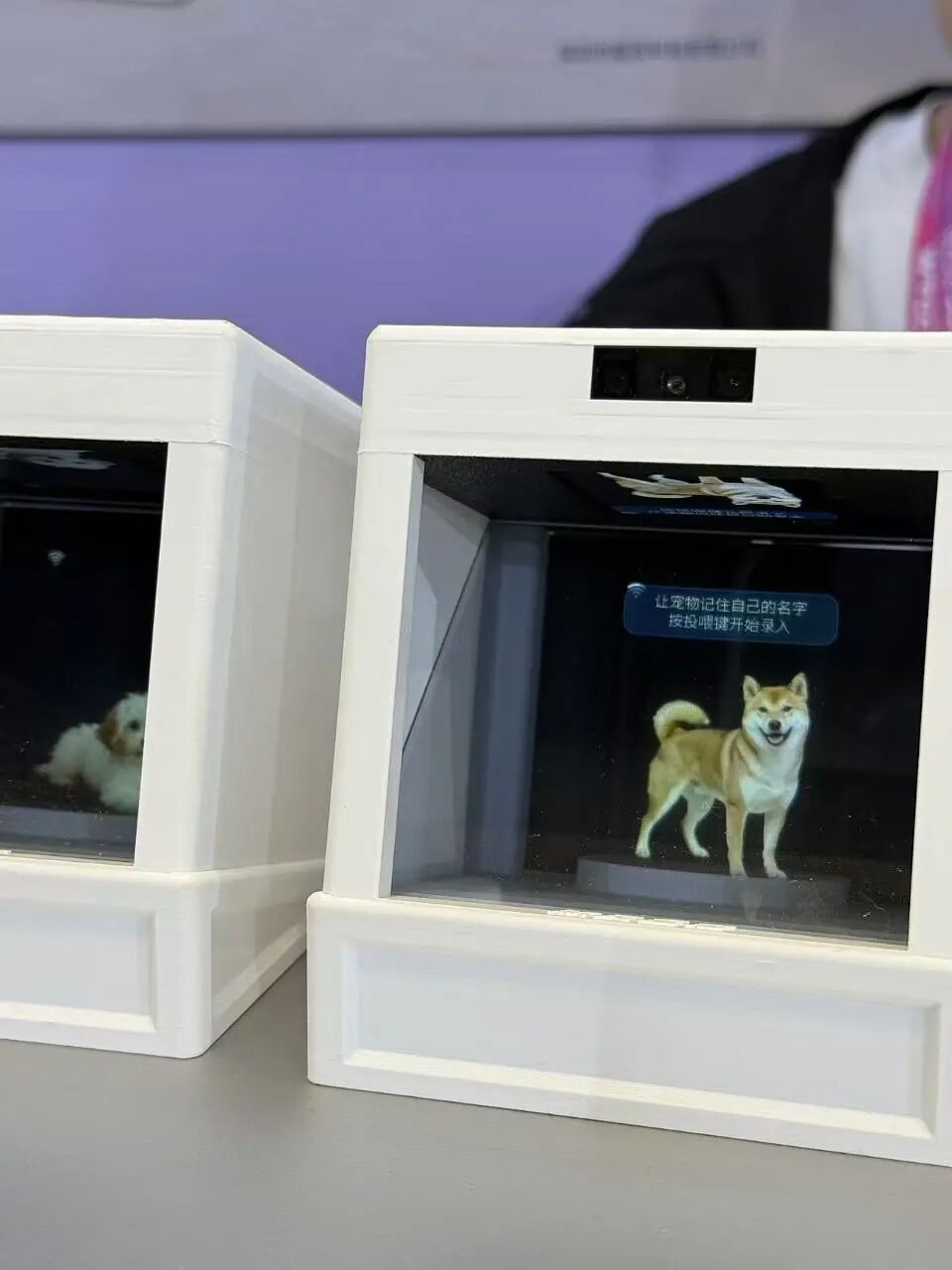
*AI Pet Digital Life Holographic Cabin
From a business model perspective, Fuling Technology plans to base itself on holographic hardware sales and then expand software value-added services around functions such as virtual feeding and personalized action customization. According to public roadshow materials, the team plans to set the first product's domestic price at 399 yuan and overseas price at 299 US dollars, and plans to promote crowdfunding and mass production after internal testing and supply chain preparation are completed. It has not yet been officially released. This means the company hopes to use hardware to establish a user entry point and then use digital image customization and continuous interaction services to extend subsequent consumption space.
However, the AI pet holographic box still faces a relatively realistic problem: to what extent can a digital image restore a real pet? Photos and videos can help AI replicate appearance, and sound materials can also provide some voice reference, but a pet's personality, habits, and the unique interaction formed with its owner are difficult to fully restore based on limited materials alone. If the product overemphasizes replacing real pets, it may instead create higher psychological expectations among consumers.
Therefore, what is truly worth exploring for the AI pet holographic box may not be letting digital pets completely replace real pets, but using technological means to give those precious companionship memories more ways to be preserved, presented, and interacted with.
3. AI Toys: This Time You Can Really Chat with Abebe
The appeal of traditional toys mainly comes from appearance, playability, and IP images. For some toys with mature IPs, the character itself may even be the main reason consumers are willing to pay.
As large models and voice interaction technology enter the toy industry, products have begun to offer more ways to play. Compared with traditional smart toys that can only play fixed voices and perform preset actions, AI toys can understand what users express through technologies such as voice recognition, natural language processing, and large models, and respond according to the context of the conversation. Some products have also added long-term memory and character settings, allowing toys to remember things users previously shared and gradually form relatively stable interactive relationships.
At present, AI toys on the market have already appeared in multiple forms, including plush toys with built-in AI modules, smart accessories that can be attached to traditional figures, and interactive dolls that can be carried around. Different products have different emphases in appearance design and interaction methods, also gradually extending AI toys from fixed desktop devices to daily travel and life companionship scenarios.
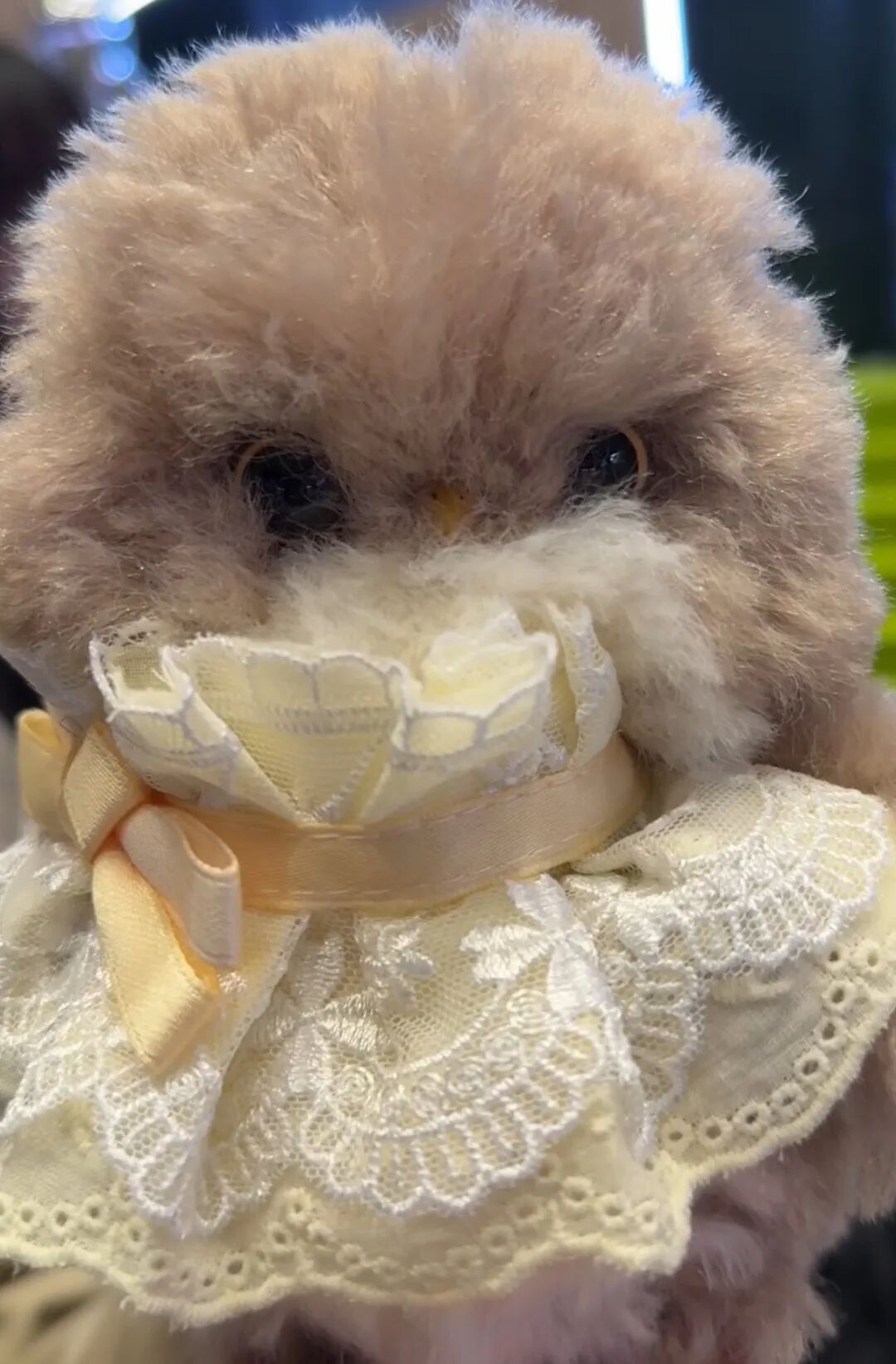
*AI Plush Toy
AI also provides new commercial imagination space for traditional IP toys. When AI enters IP toys, characters can further restore the personality traits in the works through preset personas, tones, and interactive content. The CocoMate series by Yueran Innovation, reported by Xinhuanet in May 2026, cooperated with the classic IP Ultraman. When the AI interaction module is placed into the official doll, users can engage in natural voice conversations, allowing the toy to respond to questions and express emotions in Ultraman's character tone.
In terms of business models, AI toys have also begun to try shifting from one-time hardware sales to "hardware + continuous services." According to media reports, BubblePal under Yueran Innovation is priced at 499 yuan and comes with a 3-year membership service, with a subscription price of 99 yuan/year after expiration; the AI cactus smart toy under FoloToy is priced at 258 yuan and comes with a 6-month membership, charged at 99 yuan/year after expiration. In addition, Fuzai launched by Luobo Intelligence also explores subsequent charging through an "energy value" consumption mechanism and VIP/SVIP annual membership cards (199 yuan and 299 yuan respectively). For companies, hardware sales provide the first revenue stream, while subsequent subscriptions, interactive content, and personalized services have the opportunity to extend the product's consumption cycle.
Overall, the significance of AI toys is to turn one-time purchase items into companion products capable of sustainable interaction. For IP toys, this also opens new space from image consumption to character interaction and continuous services. But whether AI toys can truly gain a firm foothold in the market still depends on whether the interaction experience is natural, whether the content is safe, whether privacy protection is adequate, and whether users are willing to continue paying for subsequent subscriptions.
4. AI Emotional Music: Letting Music Follow Mood
In 2025, a study published in Frontiers in Psychology analyzed the relationship between listening to music and subjective well-being based on data from the Chinese General Social Survey from 2010 to 2023; a separate online supplementary questionnaire conducted in the study (232 valid samples) showed that 79.74% of respondents listed relaxation and stress relief as one of the main reasons for listening to music. This shows that, in addition to entertainment attributes, music also carries a certain demand for emotional regulation.
Around this demand, some AI music products have begun trying to change the traditional way of listening to music. Unlike traditional music platforms, which mainly recommend around songs, playlists, and users' listening preferences, AI emotional music pays more attention to users' current state and usage scenarios.
Take the Jingjing APP as an example. Jingzhe Research Institute learned that this product combines emotional recording with AI music generation. After entering the application, users can choose different needs such as "soothe the feelings of this moment" and "make the state a little better," and then select specific feelings from an emotion dictionary, such as "mental friction" and "like a taut string." The product also features an emotional mandala function, where users can transform their emotions into dynamic visual patterns by selecting bubbles of different colors.
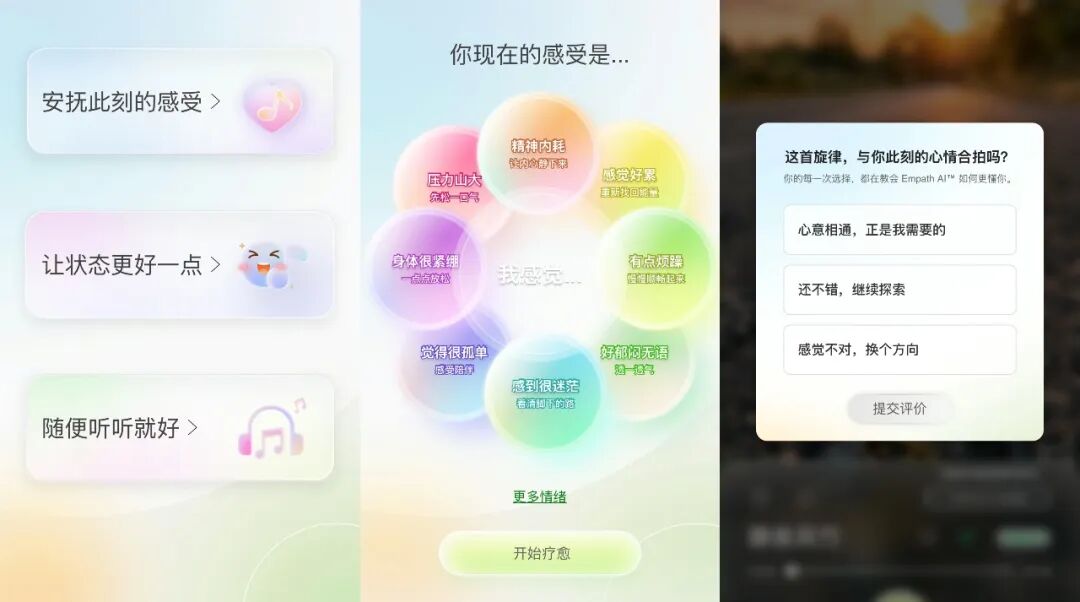
*Jingjing APP
After completing the emotion selection, the product's Empath AI engine reads the information provided by the user, matches corresponding parameters from the sound solution library, and then generates personalized music. In addition to generating music based on personal emotions, it also provides functional scenarios such as sleep, focus, relaxation, and energy boost, as well as preset content such as morning wake-up, commute stress relief, and late-night solitude. The product also integrates the five traditional tones of Gong, Shang, Jue, Zhi, and Yu into music classification, adding an Eastern five-tone series.
Another overseas product, the Endel APP, connects music with users' physical states and external environments, combining different sound layers, rhythms, and sound effects through algorithms to generate continuously changing background soundscapes, and provides modes such as focus, relaxation, sleep, and exercise. According to Endel's product description, with user authorization, the application can read heart rate, natural light, weather, and exercise data, and adjust sound intensity and rhythm in real time based on this information.
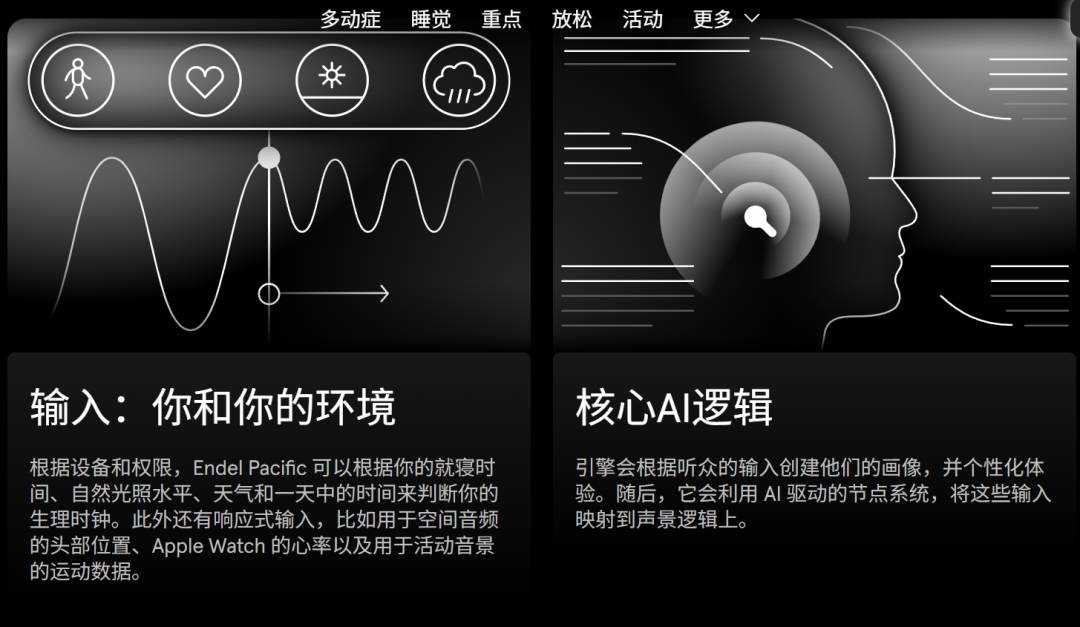
*Endel APP
Judging from current product explorations, AI is trying to turn music from fixed content consumption into a daily service closer to personal states. However, emotions cannot be simply judged through a few tags or physiological indicators, and whether the generated music truly matches user preferences also requires long-term use to verify. For such products, how to provide personalized experiences while helping users form habits of continuous use and payment will determine whether AI emotional music can develop from a novel experience into stable consumer demand.
5. AI Custom Perfume: An Exclusive Perfumer Is Now Online
Perfume is a consumer product highly related to emotions and personal expression. The "2026 China Perfume Industry Research and Consumer Insight Report" by iiMedia Research shows that 59.7% of consumers buy perfume to please themselves and enhance emotional experiences; the "2023 White Paper on Perfume and Fragrance Consumer Insights" shows that 44% of consumers hope to express their personal views through niche fragrances.
But for ordinary consumers, finding a perfume that truly suits their preferences is no easy task. Perfumes on the market are typically sold according to established scent profiles and product positioning. Even customized services require consumers to gradually determine the scent they want by smelling, testing, and choosing among different ingredients. For people who do not understand perfume ingredients or perfumery knowledge, accurately translating a certain feeling in their mind into a scent is itself a threshold to cross.
AI offers another way to accomplish this. Consumers do not necessarily need to start by choosing professional fragrance materials. They can also answer questions, describe personal preferences, or even share an experience, allowing AI to participate in the analysis and generate a preliminary perfume formula.
Jingzhe Research Institute has learned that the Guangzhou Xuelei Fragrance Museum has introduced AI technology into its offline perfumery experiences and launched an AI private perfumery project. Users can experience different scent types in the museum and rate the scents they smell, after which AI calculates the perfume formula based on these preferences. Relying on 150 fragrance materials and AI algorithms, the museum can complete on-site production of a bottle of exclusive perfume in about two minutes. According to a report by People's Daily Overseas Edition on November 5, 2026, the museum has received more than 100,000 visitors in the year since opening, and the conversion rate of AI perfumery has remained at around 30%.
The Algorithmic Perfumery platform launched by the overseas brand EveryHuman allows users to describe their personality, lifestyle, and personal preferences by answering a questionnaire, after which AI participates in generating an exclusive perfume. Users can create for themselves, or describe another person's personality and characteristics from their own perspective to make an exclusive "scent portrait" for that person. According to the current US site pricing on the brand's official website, after completing the questionnaire, users can receive 3 bottles of 5 ml personalized perfume for 65 US dollars (45 pounds on the UK site). If they are not satisfied with the generated scent, they can also modify the formula through subsequent adjustment services and book a fragrance consultant for further communication.

*Image source: EveryHuman official website
However, scent itself is highly subjective. At present, AI mainly assists consumers in sorting out preferences and generating preliminary formulas. The final scent presentation still requires actual smelling and adjustment, and it cannot yet fully replace professional perfumers. Therefore, for brands, what truly needs to be addressed is not just how to generate more unique formulas, but how to translate consumers' personalized needs into a product they are willing to buy and reuse.
6. AI oral memoirs: passing family stories to the next generation
In the film "Hi, Mom," the daughter returns to the era when her mother was young and gets to know the girl who had not yet become a mother. But in real life, many children's understanding of their parents often remains limited to their family roles. Fully recording parents' lives is not an easy task.
For ordinary families, creating a life memoir specifically for parents often requires considerable time and effort. Interviewing, recording, transcribing, editing, and layout all require someone's involvement. AI oral memoirs attempt to lower this threshold, letting the recording begin with a chat or a voice message.
In the Jiayi APP, users can record the life experiences of parents and grandparents through audio or text input. Zhenzhe Research Institute has learned that AI converts the user's oral content into text and organizes it into editable chapters according to different stories. In addition to text records, according to the product introduction, users can also add photos and text descriptions to each story while retaining the original recordings, so that family members can not only see the organized text but also hear the voices of elders telling the stories themselves. As records continue to accumulate, these scattered stories can gradually come together into a family memory book, with support for PDF export and sharing.
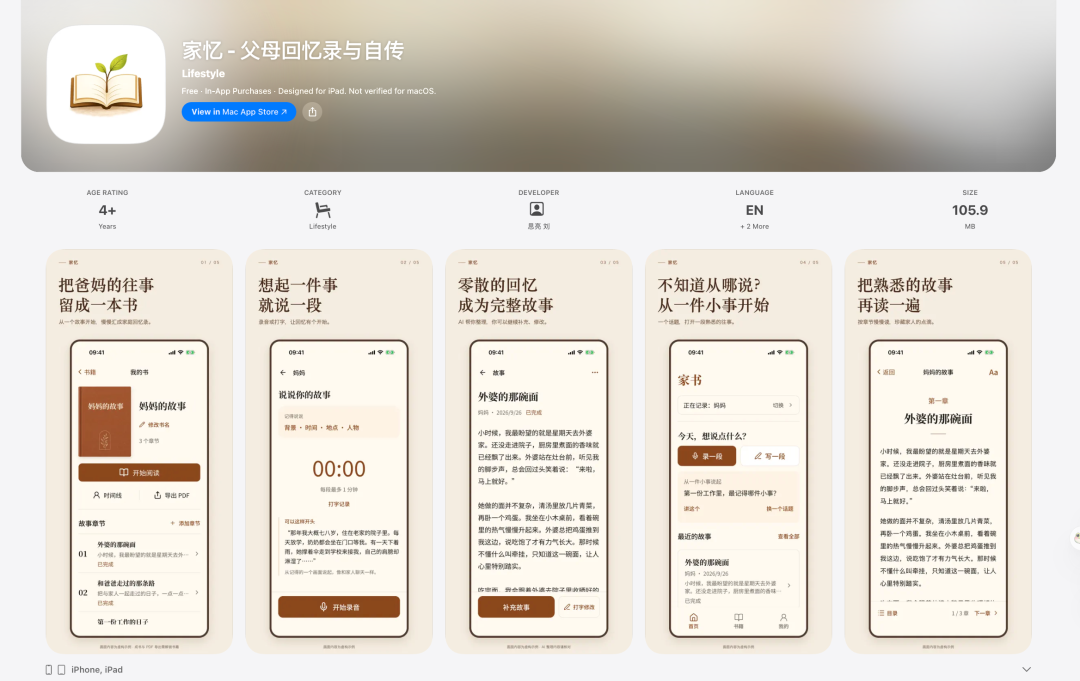
*Image source: Jiayi App
In addition, some products combine AI recording with professional editing and physical publishing. After AI organizes scattered content into a manuscript, professional editors review it, and it is ultimately made into a hardcover physical book and mailed home. Different brands set prices based on binding and page count, ranging from several thousand yuan to tens of thousands of yuan.
Beyond text memoirs, some services have also begun trying to combine family photos, voices, and videos to ultimately create family works that can be read or watched, allowing AI oral memoirs to go beyond a single book and potentially extend into family memory archives containing text, photos, and video.
AI has lowered the threshold for interviewing, transcription, and editing, and has also given related services the opportunity to extend from digital records to richer consumer formats such as physical publishing and family video. However, the value of memoirs lies precisely in authenticity and personal expression. If AI takes it upon itself to add plot details to make the story more complete, it may instead alter the original memory. For such products, how to encourage users to keep telling stories and get family members involved in content verification and joint preservation is the key to determining whether they can create long-term consumer value.
7. AI voice memory: preserving memories that are disappearing
Compared with photos and videos, voice is an easily overlooked yet very special carrier of memory. And voice itself has already formed a considerable consumer market. The "2026 Sound Industry Insight Report" released by Beijing Radio and Television Station together with CTR Market Research shows that in 2025 the scale of China's sound economy industry reached 611.01 billion yuan, with a compound annual growth rate of about 18.6% from 2021 to 2025.
The addition of AI voice technology has also given sound materials new ways to be preserved and used. In addition to organizing, restoring, and preserving original recordings, users can also use existing voice samples to train AI models, allowing the system to learn a person's timbre and speaking habits, and then generate corresponding voice content through text input. Recordings that could originally only be played passively therefore gain new forms of interaction.
For example, the Qinshengji APP provides voice archives and AI voice interaction functions. Users can upload voice messages, audio from old videos, or re-record a segment of voice to build an exclusive voice archive. After that, users can not only repeatedly play the original recordings but also input questions and let AI generate voice replies using the corresponding timbre. The application also supports converting old text messages, greeting cards, and letters into voice content, letting a familiar voice read these texts again, which increases the use scenarios of sound materials in daily life.
Unlike products mainly built around voice archives, the Wanzai APP further combines voice replication with digital avatars and AI conversation. Users can upload voice materials of loved ones and supplement their life experiences, personality traits, and speaking habits to build an exclusive voice model and AI character profile. In addition to communicating through text or voice, the product also supports uploading photos to generate digital avatars and interacting through audio and video calls, attempting to integrate voice, character images, and past experiences into a more complete digital memory archive.
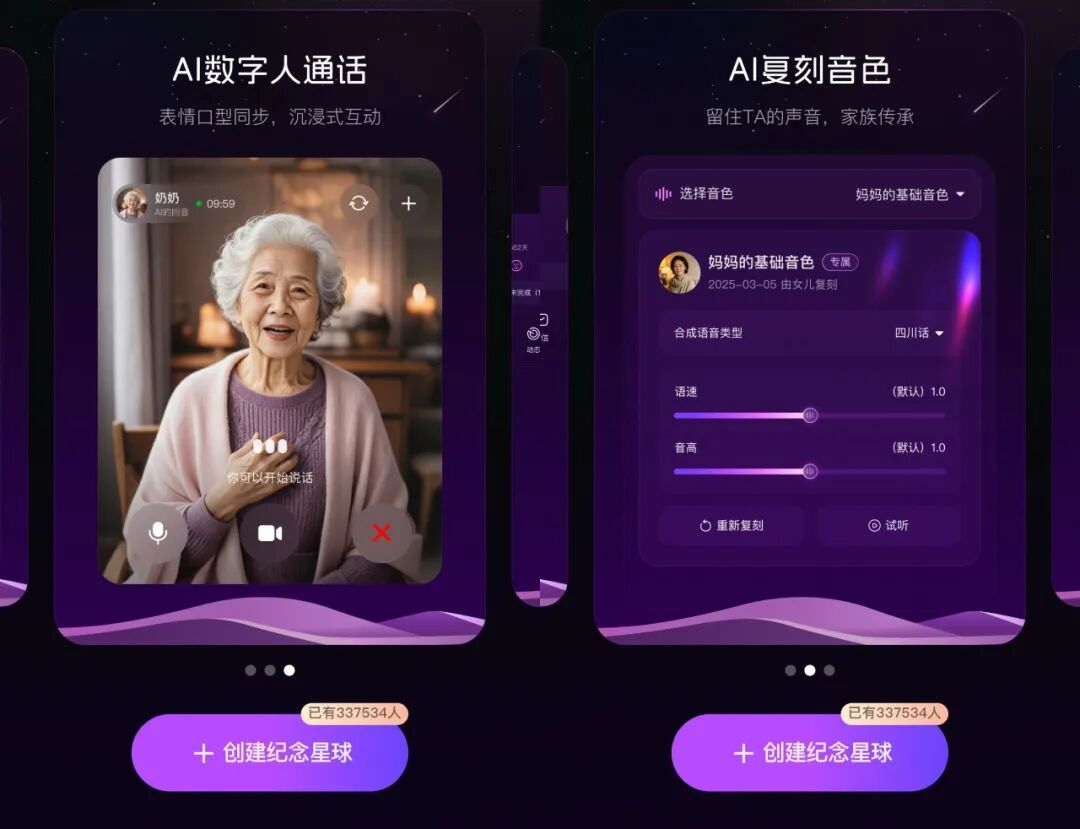
Image source: Wanzai APP
In addition to APP forms, AI voice replication has also appeared in e-commerce customization services. In 2024, Legal Daily reported that a consumer paid more than 200 yuan and provided recordings, photos, and the words the deceased father was hoped to say, ultimately receiving an AI-generated memorial video. The report also mentioned that related services on the market at that time had already taken multiple forms, including using photos and voices to create memorial videos and combining personal experiences and voice materials to create interactive digital avatars. This shows that related consumption is not limited to software subscriptions and can also be completed through one-time customization services.
However, when a person's voice can be preserved, copied, and even used to generate things never said, AI voice memory must face not only technical issues but also the right to use the voice and the authenticity of content. How to let technology continue memory rather than blur the boundary between reality and fiction may be the question such products need to answer next.
Conclusion
Behind emotional consumption, it is not that algorithms have created new demands, but that they have given these feelings, which were originally difficult to express and preserve, more concrete forms of presentation.
As more and more emotional needs begin to be broken down into specific products and services, companies also need to rethink how emotional value should be priced. Rather than simply emphasizing how smart AI is and how rich its functions are, whether it can understand consumers' real needs and provide experiences with sustained value may be the key to whether this business can succeed.
*This article is jointly produced by Zhenzhe Research Institute and 21 Finance · Southern Finance Account
-
Used Chinese Phones: Africa's Enthusiasts Embrace a Transsion Alternative
-
![]()
The Largest IPO in History: 14 Young Chinese Professionals Strike It Rich
-
![]()
AI Can't Understand Emotions, but It Has Spawned Seven New Businesses
-
![]()
Long Lead Times for Imported Rubidium Clocks? The SRS Stanford Research Systems FS725 Benchtop Rubidium Atomic Frequency Standard Is in Stock and Shipping Directly!
-
![]()
The 12th Munich Shanghai Analytica China Exhibition Concludes: Zolix Showcases Cutting-Edge Spectroscopy Solutions
-
![]()
Tengjing Technology Sets 2027 Revenue Target of at Least 1.8 Billion Yuan
-
![]()
Old Factory at Full Capacity, Rushing Orders! Why Does This Optics Company Dare to Invest 200 Million Yuan to Pursue 300 Million Yuan in Output Value?
-
![]()
BMW i3 and Lexus TZ Step Up: Joint Venture Brands Are Not Backing Down at the Guangzhou Auto Show