Long Lead Times for Imported Rubidium Clocks? The SRS Stanford Research Systems FS725 Benchtop Rubidium Atomic Frequency Standard Is in Stock and Shipping Directly!
 11/23 2026
 529
As the year-end approaches, many time-frequency laboratories find themselves needing to spend down remaining budget balances and hoping to receive and accept equipment before the year is out. Multiple test instruments running on inconsistent reference sources can easily produce inconsistent measurement data—and imported reference equipment often comes with long production scheduling and customs clearance cycles. Today we introduce the SRS Stanford Research Systems FS725 benchtop rubidium atomic frequency standard and discuss how to give multiple instruments a common reference.
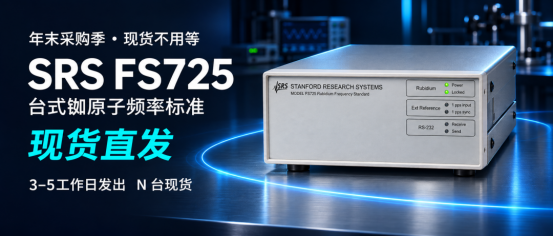
▋The Role of an External 10 MHz Reference and the FS725 Rubidium Atomic Frequency Standard
The vast majority of RF test instruments have built-in crystal oscillators. While these are adequate for basic use, their frequency drifts with temperature and over time—and when multiple instruments drift independently, comparing them is prone to systematic deviations.
Connecting the entire system to a common, highly stable 10 MHz external reference is like giving every instrument the same ruler: spectrum analyzers, vector signal generators, frequency counters, network analyzers, oscilloscopes, and ATE fixtures all lock to the same reference, which is the foundation for measurement repeatability and cross-device data consistency. In applications with more demanding requirements, an external 1 pps signal (from a GPS/GNSS receiver, for example) can be used to discipline the reference to traceable time.
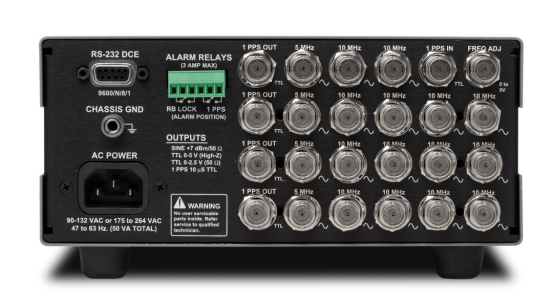
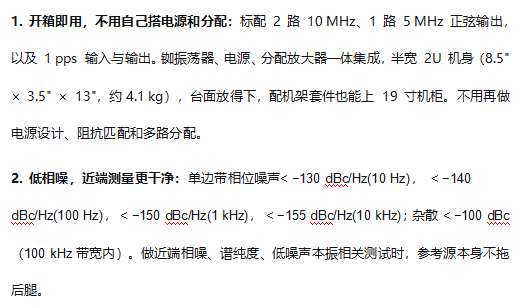
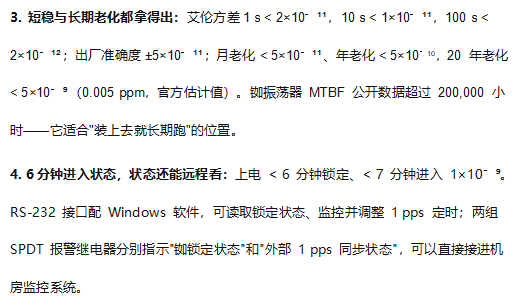
The FS725 benchtop rubidium atomic frequency standard comes from Stanford Research Systems (SRS) in the United States. The unit integrates a PRS10 rubidium oscillator, a low-noise AC power supply, and a distribution amplifier inside a half-width 2U chassis. After power-on, wait about 6 minutes for the Locked indicator on the front panel to light up, and the reference signal is ready.
::
▋Six Core Features of the FS725
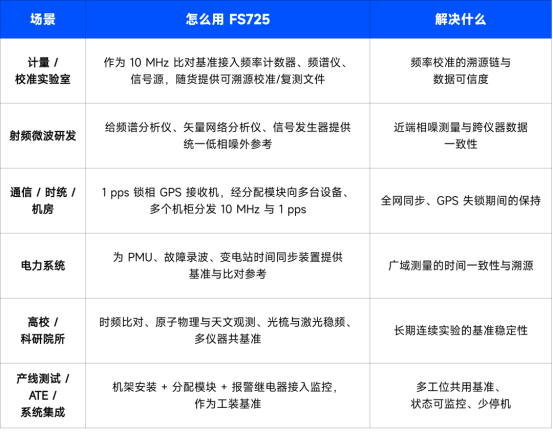
▋Six Typical Application Scenarios
▋Key Parameters at a Glance
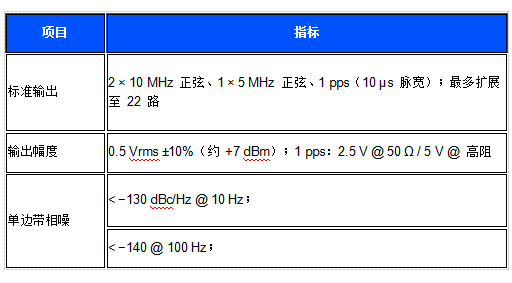
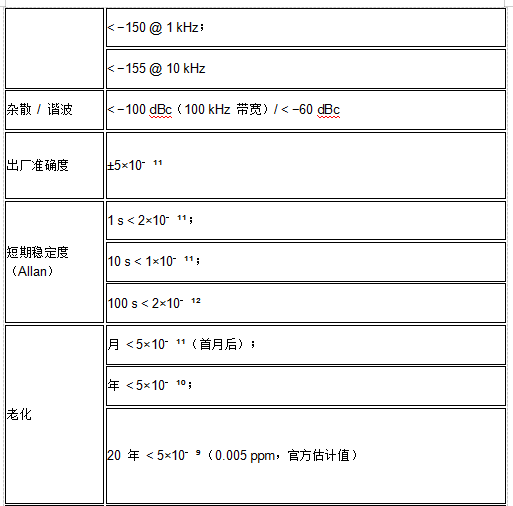
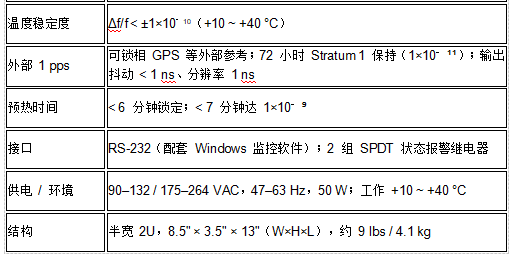
Note: Parameters are quoted from the FS725 product page on the SRS official website and the FS725 Operation and Service Manual; the original manufacturer's official data sheet and the documents delivered with the unit shall be the final basis.
▋Configuration Selection Reference
Usage
Recommended Configuration
1–3 instruments sharing a reference
FS725 standard unit (2×10 MHz + 1×5 MHz + 1 pps)
4–10 output channels required
FS725 + Option 01 (+6 channels) / Option 02 (+12 channels)
Multi-cabinet, whole-floor laboratory distribution
FS725 + Option 03 (+18 channels, 22 channels in total)
19-inch rack mounting required
Add O725RMS single-rack / O725RMD dual-rack kit
GPS/GNSS disciplining and time tagging required
Combine with FS740 / FS752, or connect the 1 pps input to an existing GNSS receiver
If you are unsure about the selection, send us your instrument list and the required number of output channels, and our technical team will help provide a connection plan and configuration list.
▋Year-End In-Stock Notice
As the domestic agent for SRS of the United States, TEO Pioneer Titan currently has N units of the FS725 benchtop rubidium standard main unit in stock. These will be released centrally at year-end, with specific arrangements as follows:
√ In-stock delivery: Place a firm order before December 20, and we promise to ship within [3–5] working days, striving to complete arrival acceptance and invoicing within the year;
√ Quantity tiers: tiered discounts for single units, 3 units, and 5 units or more; multi-unit purchases and channel bulk packages are negotiable separately;
√ Campaign period: from now until December 25, 2026. Quotations will indicate the validity period, and inventory is subject to the real-time ledger.
Regarding "in-stock units": each unit is registered with its serial number, production batch, and warehouse entry time. Before shipment, each unit is powered on and retested (lock time, output level, 1 pps, and 1 s stability spot check); the warranty starts from the date of arrival acceptance, and original manufacturer standard warranty and local technical support are provided. Original genuine products supplied through authorized channels, and relevant supporting documents can be provided upon request.
▋Frequently Asked Questions
Q: How do I choose between this and OCXO or GPSDO solutions?
A: OCXO has low cost and good short-term stability, but it drifts over the long term and requires periodic calibration; GPSDO long-term accuracy depends on satellite signals, and antenna installation and holdover performance after loss of lock must be evaluated together. The FS725 is an independent rubidium reference: it can work stably over the long term without relying on external signals, and it can also be locked to GPS via 1 pps to combine long-term accuracy. If you value independent operation, low phase noise, and multi-channel distribution, it is more suitable.
Q: Can it be used without GPS?
A: Yes. In most scenarios it is used as an independent frequency standard; when traceability to UTC or time synchronization is required, the 1 pps input can be connected to a GNSS receiver.
Q: Will performance degrade if in-stock units are stored for a long time?
A: This is a question that should be asked. Our approach is to power on and retest each unit and issue records. Units are shipped only after passing lock time, output level, 1 pps, and short-term stability spot checks, and the warranty starts from the date of acceptance.
Q: It only has RS-232. How do I connect it to a modern computer?
A: Use a common USB–RS232 adapter cable. The included Windows software can read status, monitor, and adjust 1 pps timing; daily use without connecting to a computer is also completely normal.
Q: Can it be mounted in a 19-inch rack? How many instruments can it support at most?
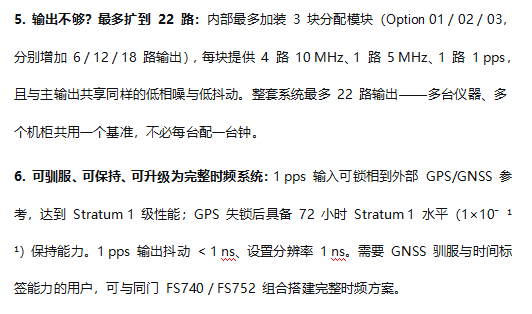
A: It can be rack-mounted using the O725RMS / O725RMD rack kit; when fully equipped with 3 distribution modules, the unit supports up to 22 outputs. Please confirm the specific distribution according to the instrument list.
Q: Can distribution modules be added later?
A: They can be installed according to the configuration. Before ordering, confirm the internal slots and configuration number with sales.
Warm reminder: Campaign details are subject to the formal quotation and purchase contract. Inventory changes in real time and is available while supplies last. The technical parameters in this article are quoted from official SRS materials, and performance specifications are subject to the original manufacturer's data sheet and documents delivered with the equipment. Trademarks mentioned in this article belong to their respective owners.
Different test scenarios have different requirements for time-frequency references, and a suitable configuration is key to ensuring stable and consistent test data. TEO Pioneer Titan is an authorized agent of SRS in the United States and can provide you with original equipment, selection evaluation, and localized technical services. If you have needs related to frequency standard selection or solution evaluation, please contact us. We will customize a suitable technical solution and supporting support based on your actual working conditions!
-
Used Chinese Phones: Africa's Enthusiasts Embrace a Transsion Alternative
-
![]()
The Largest IPO in History: 14 Young Chinese Professionals Strike It Rich
-
![]()
AI Can't Understand Emotions, but It Has Spawned Seven New Businesses
-
![]()
Long Lead Times for Imported Rubidium Clocks? The SRS Stanford Research Systems FS725 Benchtop Rubidium Atomic Frequency Standard Is in Stock and Shipping Directly!
-
![]()
The 12th Munich Shanghai Analytica China Exhibition Concludes: Zolix Showcases Cutting-Edge Spectroscopy Solutions
-
![]()
Tengjing Technology Sets 2027 Revenue Target of at Least 1.8 Billion Yuan
-
![]()
Old Factory at Full Capacity, Rushing Orders! Why Does This Optics Company Dare to Invest 200 Million Yuan to Pursue 300 Million Yuan in Output Value?
-
![]()
BMW i3 and Lexus TZ Step Up: Joint Venture Brands Are Not Backing Down at the Guangzhou Auto Show