The Pressure on Lens Technology Is Not Just About Poor Sales of Mobile Phones
 09/14 2026
 416
416
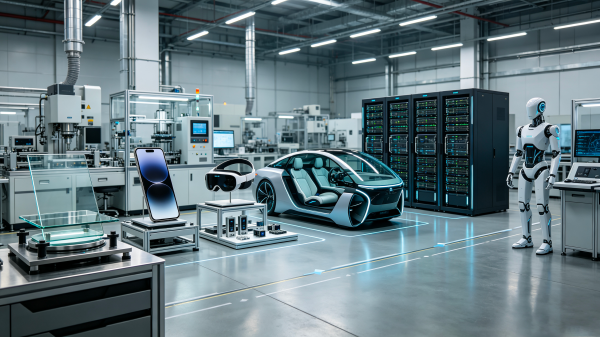
Lens Technology, a company in the Apple supply chain, has delivered a financial report with clear signs of pressure.
In the first half of 2026, Lens Technology achieved revenue of RMB 28.866 billion, a year-on-year decrease of 12.42%. This represents a rare decline in revenue.
Lens Technology is best known as a 'consumer electronics supply chain enterprise.' Starting from mobile phone glass cover lenses and becoming a key supplier in the global smart terminal industry chain, Lens Technology seized the golden era of rapid smartphone development.
Since 2014, among all half-year revenues, only 2016 and 2022 saw declines. In 2022, the decline in the first half was offset by higher growth in the second half, achieving full-year growth.
Given the 12.42% decline in half-year revenue, whether the assessment target of a 15% increase in full-year revenue in the equity incentive plan can be achieved remains questionable.
The profit decline was even more significant. In the first half, Lens Technology's net profit attributable to shareholders was RMB 577 million, a year-on-year decrease of 49.52%; net profit excluding non-recurring items was RMB 278 million, a year-on-year decrease of 70.45%. However, at the same time, Lens Technology's gross profit margin increased by 2.21 percentage points to 16.43%.
How should we interpret these diverging financial indicators? With the smartphone market now in a mature stage, how long can the past growth model relying on mobile phones continue? Can new businesses successfully take over?
I. Why Did Profits Halve?
The significant decline in Lens Technology's profits resulted from the combination of several factors.
Among them, the impact of exchange rate fluctuations on the financial level was the most direct influencing factor. Lens Technology has a substantial overseas business scale, with overseas revenue accounting for more than half in 2025, and some businesses settled in U.S. dollars.
Exchange rates are uncontrollable and can only be managed through hedging operations to reduce risks. Therefore, in the first half of 2026, the phased (temporary) appreciation of the RMB against the USD subjected Lens Technology to significant exchange pressure.
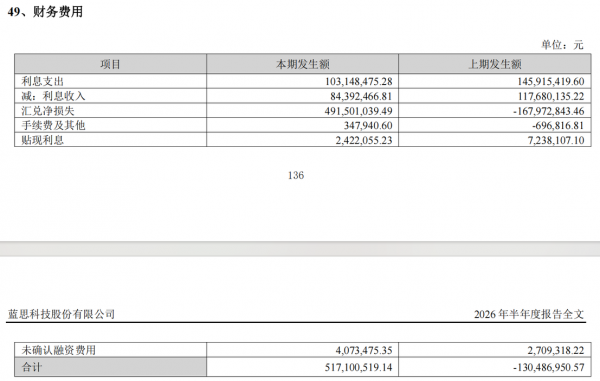
The half-year report showed that financial expenses turned from RMB -130 million in the same period last year to RMB 517 million, a significant year-on-year increase. Among them, exchange losses amounted to approximately RMB 492 million.
Assuming the exchange gains generated in the first half of 2026 were the same as those in the first half of 2025, i.e., RMB 168 million, indicators such as operating profit and net profit would shift from significant declines to growth or stability.
Another layer of pressure came from asset impairments.
In the first half, Lens Technology's asset impairment losses reached RMB 437 million, a year-on-year increase of 21.58%, primarily from inventory write-downs. As of the end of the first half of 2026, inventory scale reached RMB 7.933 billion, a 14.4% increase from the beginning of the year.
However, from a longer-term perspective, the fundamental reason Lens Technology's profits are susceptible to shocks lies in the relatively low profit margins of its manufacturing business.
Over the past decade, Lens Technology's highest gross profit margin was around 30%. As the smartphone industry chain matured and the scale of low-value-added assembly businesses expanded, gross profit margins gradually came under pressure. In the first half of 2026, the company's overall gross profit margin was 16.43%. Even with a year-on-year increase of 2.21 percentage points, it remained at a relatively low level.
If we define 'gross profit minus selling, administrative, research and development, and financial expenses' as core profit to observe operational quality, then in the first half, Lens Technology's core profit margin was only 3.6%. This means that single factors such as exchange rates, inventory, and cost changes can significantly impact profits.
This is also one of the reasons Lens Technology adjusted its business structure in the first half of this year.
Affected by factors such as rising memory chip prices, Lens Technology proactively reduced some low-value-added assembly businesses while introducing higher-value-added assembly businesses such as action cameras. As a result, the revenue side came under pressure, but the gross profit margin of the consumer electronics segment increased by nearly 3 percentage points, contributing to the overall gross profit margin recovery.
In other words, Lens Technology is trading some scale for profitability quality, as reflected in the half-year report's theme of 'reducing quantity and improving quality.'
For Lens Technology, short-term profit fluctuations are not the biggest challenge. The real issue is whether, after the slowdown in consumer electronics growth, the company can find new growth sources while gradually replacing the past manufacturing model reliant on scale with higher-value businesses.
II. Core Consumer Electronics Business: Can Quality Improvements Offset Quantity Reductions?
The consumer electronics business remains Lens Technology's largest revenue source, but this core segment, which once drove the company's rapid growth, is entering a new phase.
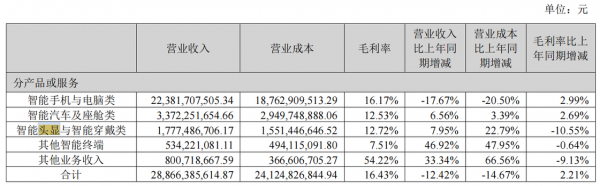
In the first half of 2026, Lens Technology's smartphone and computer business achieved revenue of RMB 22.382 billion, a year-on-year decrease of 17.67%, accounting for 77.54% of total revenue.
This decline primarily stems from overall pressure in the smartphone industry.
In recent years, the smartphone market has transitioned from a high-growth phase to a stock competition (inventory competition) phase, with consumers extending their replacement cycles and terminal brands facing increased growth pressure. IDC data shows that global smartphone shipments in Q1 2026 decreased by 4.1% year-on-year, and by 6.7% in Q2.
A widely recognized factor driving consumer upgrades is AI. Smartphone manufacturers are positioning on-device AI as a key selling point for new products, hoping to stimulate consumer upgrades through features like intelligent interaction and image enhancement.
However, on the other hand, the impact of AI has also spread to the cost side.
As demand for AI servers grows, the global supply-demand relationship in the memory industry has changed, with rising memory prices beginning to affect the consumer electronics industry chain. For smartphone manufacturers, memory chips are a significant component of BOM costs, and cost increases ultimately need to be reallocated between terminal prices and supply chain profits.
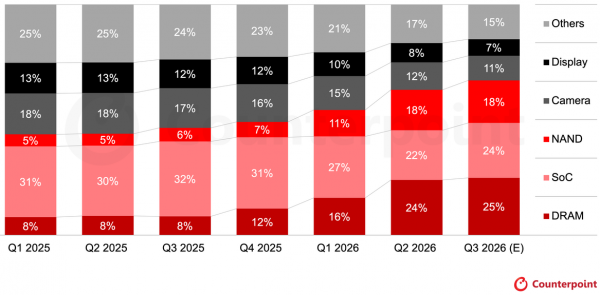
Recently, several smartphone manufacturers have begun adjusting product prices, but whether price increases will be accepted by consumers, or whether AI experiences can justify consumers paying higher prices, remains to be further validated.
For Lens Technology, the issue is that it does not hold the initiative in this price transmission chain.
From window protective glass in the feature phone era to cover glass and structural components in the smartphone era, and then to assembly businesses, Lens Technology gradually entered the supply chains of global leading brands, with Apple being a key supporter.
Apple not only brings stable large-scale orders but also helps suppliers build globally leading manufacturing capabilities. However, at the same time, terminal brands like Apple also wield significant bargaining power.
In the consumer electronics industry chain, brand owners control product definition, terminal pricing, and market channels, while suppliers primarily undertake manufacturing and technical support roles.
When terminal product prices rise, component companies may not necessarily see synchronized revenue increases. However, if rising terminal prices suppress demand, component companies are likely to suffer.
Lens Technology's solution is to diversify its customer base and improve supply dynamics, value proposition, and technological upgrades and process improvements.
In terms of customer structure, the revenue share of the company's largest customer (widely believed to be Apple) has decreased from a relatively high level in the early stages to about 45% as disclosed in the 2025 annual report. Meanwhile, the company continues to expand its customer base in other terminal segments and enters emerging fields such as AI glasses and smart wearables.
Among them, smart head-mounted displays and smart wearables represent an extension of the company's consumer electronics capabilities to new terminals. In 2025, this business generated revenue of RMB 3.978 billion with a gross profit margin of 19.91%, among the highest across business segments. In the first half of 2026, the smart head-mounted display and smart wearable business achieved revenue of RMB 1.777 billion, a year-on-year increase of 7.95%, accounting for 6.16% of total revenue.
Smart head-mounted displays and wearables primarily represent an expansion of consumer electronics categories, while foldable screens enhance per-unit value through form factor upgrades.
Compared to traditional smartphones, foldable screens impose higher requirements on materials and manufacturing processes. Products like UTG ultra-thin flexible glass, glass support plates, PET functional films, and 3D glass cover lenses are more technically challenging and can increase the per-unit value for suppliers.
Lens Technology previously disclosed that it has supplied UTG ultra-thin flexible glass, glass support plates, PET functional films, and 3D glass cover lenses to a major North American customer for foldable models, with mass shipments beginning at the end of Q2.
However, foldable screens also face practical challenges.
On the one hand, Lens Technology has certain technical barriers in specific processes, such as UTG yield rates exceeding 95%, which provide pricing leverage during the introduction of new categories. However, because Apple generally adopts a 'dual-supplier + competitive bidding' strategy for core components, this strategy compresses the time and space for premiums.
On the other hand, rising memory prices equally affect the BOM costs of bar-type, curved, or foldable screens, and higher product value ultimately depends on consumers' willingness to pay. The recent observation window is the sales performance of Apple's first foldable model.
IDC predicts that global foldable smartphone shipments will reach approximately 22.9 million units in 2026, a year-on-year increase of 12.6%. While this growth rate is decent, the overall scale remains small. Counterpoint data shows that foldable screens currently account for only about 2% of the global smartphone market, with cumulative shipments expected to exceed 100 million units by the end of 2026.
In the past, Lens Technology relied on smartphone sales growth for scale. In the future, it will need to rely on high-end products, complex processes, and higher per-unit value for growth. However, even after achieving this, consumer electronics will still not be entirely free from terminal cycles.
III. How Far Along Are the New Growth Curves?
Beyond consumer electronics, Lens Technology continues to expand its business boundaries, including automotive, AI-related businesses, and TGV glass substrates, to outline growth curves for the next stage.
Currently, these new businesses are still at different stages.
Among them, the automotive smart cockpit business is the largest segment outside consumer electronics.
In the first half of 2026, Lens Technology's smart automotive and cockpit business generated revenue of RMB 3.372 billion, a year-on-year increase of 6.56%, accounting for 11.68% of total revenue. Unlike the consistently increasing revenue scale, the gross profit margin of this business has been unstable, around 20% in 2022, dropping to 7.22% in 2025, and reaching 12.53% in the first half of 2026, a year-on-year increase of 2.69 percentage points.
The advantage of the smart automotive and cockpit business lies in its high alignment with Lens Technology's past manufacturing capabilities.
Relying on glass processing, precision structural component manufacturing, and large-scale production capabilities, Lens Technology entered the consumer electronics supply chain. Products like cockpit displays, automotive glass, and structural components similarly require high-precision manufacturing, high reliability, and strong supply chain management.
The automotive industry also has its own characteristics. Automotive component certification cycles are longer, and vehicle development timelines differ, meaning Lens Technology needs to gradually penetrate the market. However, once integrated into the supply system, order stability is typically stronger. Currently, Lens Technology collaborates with several domestic and foreign automakers and is advancing mass production and delivery of products like laminated window glass.
If the automotive business reflects the application of manufacturing capabilities in a mature industry, then AI servers may represent a direction with greater mid-term growth elasticity for Lens Technology.
With the rapid development of the artificial intelligence industry, demand for computing infrastructure continues to rise, creating new market opportunities for AI server structural components, liquid cooling systems, and server storage.
Around AI servers, Lens Technology is deploying directions including cabinet structural components, liquid cooling systems, and server storage. The Dongguan Songshan Lake campus has completed relevant capacity expansions and customer validations, further supplementing capabilities in AI server structural components and liquid cooling through industrial investments; enterprise-grade SSDs have achieved mass shipments, and HDD glass hard drives have entered validation and delivery stages.
AI servers can also leverage capabilities Lens Technology accumulated in its consumer electronics business, but these reused capabilities are only foundational for entry.
The core difference lies in certification barriers. Globally, only a few companies hold NVIDIA RVL supplier certifications, with validation cycles lasting 6 to 18 months, covering quality systems, technical capabilities, and capacity audits. This is not a threshold that can be crossed solely through precision manufacturing capabilities. Therefore, Lens Technology chose to acquire Yuanshi Technology to indirectly obtain NVIDIA RVL certification rather than building it in-house.
In terms of product requirements, AI servers are designed for data centers and must operate stably over the long term. Liquid cooling systems have far higher requirements for sealing, durability, and safety compared to consumer electronics structural components. Product forms also expand from precision small parts in smartphones to cabinet system integration, involving entirely new technical domains.
However, once the certification threshold is crossed, AI servers may offer greater growth elasticity.
Other smart terminals represent Lens Technology's proactive Layout (layout) in the direction of next-generation smart hardware.
The half-year report shows that revenue from other smart terminal businesses was RMB 534 million, a year-on-year increase of 46.92%, with embodied intelligent robots being a key focus. The company is advancing layouts around dexterous hands, joint modules, and complete machine assembly, collaborating with enterprises like Zhiyuan Robotics, and has achieved mass delivery of related products.
The robotics business differs significantly from Lens Technology's consumer electronics manufacturing in terms of business model.
The consumer electronics business serves a small number of major customers, providing large-volume, highly standardized products using mature OEM models. Its characteristics include stable and predictable order scales but relatively weak bargaining power for contract manufacturers.
The humanoid robotics industry is still in its early stages, with undefined product forms, standards, and demand, resulting in fragmented customers, small shipment volumes, and low standardization. In terms of production methods, Lens Technology needs to independently develop core components like joint modules and dexterous hands, potentially requiring deeper involvement in customers' product definition processes. While this offers greater gross profit margin potential, it also entails higher R&D investment and inventory risks.
Additionally, the greater uncertainty comes from timing—the speed of industry explosion—rather than capability.
TGV glass substrates represent Lens Technology's cross-border attempt into the semiconductor materials field.
As AI chips evolve toward multi-chiplet and high-bandwidth directions, traditional organic substrates face challenges in flatness and dimensional stability, making glass substrates a next-generation candidate for advanced packaging. Lens Technology hopes to extend its precision machining capabilities accumulated in glass post-processing from smartphone cover lenses to chip packaging substrates.
In July 2026, Lens Technology signed a cooperation memorandum with Intel, though reports indicate that Intel's own glass substrate packaging solution is not expected to be fully introduced until the latter half of the 2020s; the company has established a pilot line and sent samples to some customers, with partial customers passing initial conceptual validation and entering technical testing stages.
Overall, this business is still some distance away from commercial revenue.
From consumer electronics to automotive and AI servers, and then to embodied intelligent robots and TGV glass substrates, Lens Technology is attempting to migrate manufacturing capabilities accumulated over the past three decades to new industrial directions.
However, during the process of transformation, there will inevitably be a period of shortage. The next thing to watch is which track can be the first to move from verification to continuous mass production. Orders and revenue are the hard indicators of the new curve.
-
![]()
Rescuing Neta Auto: Even Taiyi Zhenren Steps In, and Associated Company’s Value Soars by 2.5 Billion Yuan
-
Why Does 'Taiyi Shenglian' Step In to Save Neta?
-
![]()
Registered Capital Sees Slight Reduction to 110.7291 Million Yuan! Yongxin Optics Finalizes Industrial and Commercial Registration Amendments
-
![]()
Renaming Marks the Start: Conant Optics’ Smart Glasses Business Gets a Full-Throttle Boost
-
Amazon’s Shift to Passkey Compels Home Furnishing Brands to Overhaul Backend Access Controls
-
![]()
Doubao Mobile Phones: Opting for the Path of Maximum Public Discourse
-
![]()
OpenAI Hits Pause on the AI Race: The Hype Around Large Models Cools Down, and Enterprise AI Enters the Era of Results-Based Adoption
-
![]()
Li Feifei's Atlas Opens the Door to a New World for Embodied AI