OPPO at 31: The Time for 'Integrity' to Deliver is Here
 09/21 2026
 395
395
'Integrity' is a Product Methodology
Author|Hua Wen
Editor|Xiaobai
Illustration|AI-Generated
Produced by|Qiangdiao Next
On September 17th, OPPO celebrated its 31st anniversary. Chen Mingyong once again explained 'integrity' in an internal talk, summarizing it in nine words: a calm mindset, focusing on the essence, and thinking long-term.
These nine words have previously helped OPPO navigate through several transitions in feature phones, smartphones, and mobile internet. Today, the competitive landscape of the smartphone industry is undergoing deeper changes.
According to IDC data, in the second quarter of 2026, smartphone shipments in China declined by 4.3% year-on-year, marking the fifth consecutive quarter of decline. Huawei and Apple saw growth of 19.4% and 24.4%, respectively, while OPPO experienced a 9.7% decline. Rising costs for memory and other components have pushed up overall device costs, while AI demands smartphone manufacturers to reinvest in models, operating systems, and on-device computing power. The old market is shrinking, and the bill for new technology has arrived.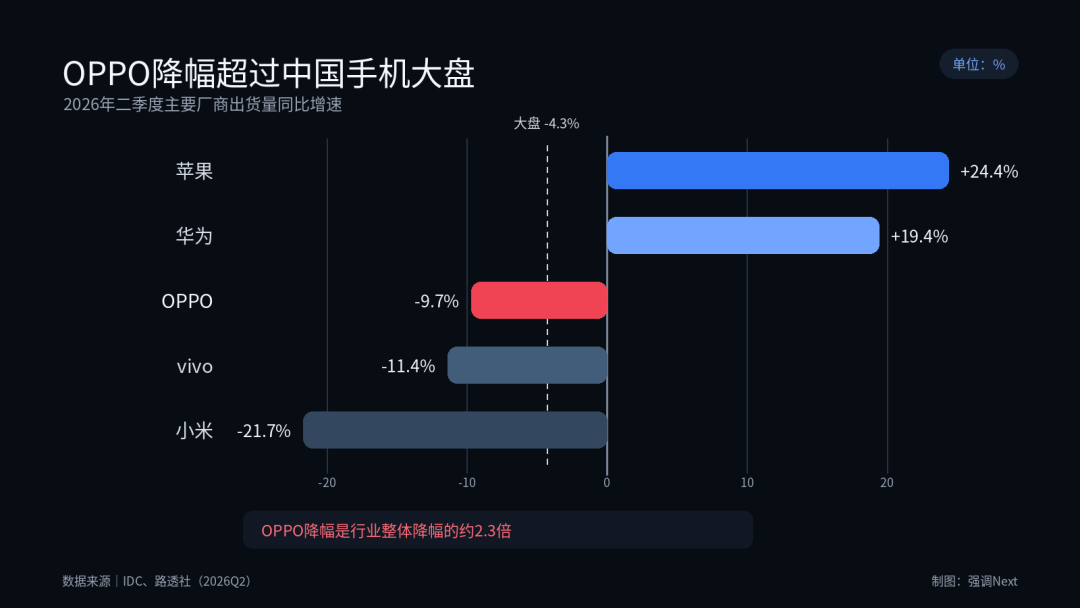
Chen Mingyong's reaffirmation of 'integrity' at this time seems to set the tone for OPPO's next round of choices. It has a longer decision-making cycle than listed companies and must now convert this time advantage into an industrial position.
Maintaining Scale is No Longer Enough
OPPO's growth over the past two decades has been built on a mature consumer electronics approach: accurately judging mainstream demand, rapidly defining products, relying on supply chains and offline channels to reach nationwide markets, and then replicating this system overseas.
This capability remains an important asset for OPPO. The Find, Reno, A/K, and OnePlus series cover different price points, with offline stores and distribution systems reaching a large number of sink markets (lower-tier markets), and business operations in over 90 countries and regions globally. Few Android manufacturers possess such a complete product lineup, supply chain scale, and global operational capabilities simultaneously.
The value of these capabilities has changed in a saturated market. With longer replacement cycles, channels can improve reach and turnover efficiency but cannot create replacement demand out of thin air. Supply chains can quickly follow trends in large-capacity batteries, telephoto lenses, and new materials but also lead to faster convergence of hardware selling points. Differences between flagship models increasingly rely on long-term joint R&D, system optimization, and brand pricing power.
Profits are also concentrating at both ends of the supply chain. Upstream, advanced chips, memory, and core components hold cost leverage, while Apple and Huawei capture more high-end profits through brand and system capabilities. Mainstream Android manufacturers are caught in the middle: bearing higher R&D and material costs while maintaining scale in price-sensitive markets.
This explains the source of OPPO's current pressure.
Declining market share is only the surface issue; the key lies in whether scale advantages can continue to translate into profits and technological investments. The speed at which the Find series breaks into the high-end market and the Reno series maintains its mainstream market position determine whether OPPO can continue to support high-end R&D with mass-market sales. Once these two decouple, scale will shift from an advantage to an expensive organizational burden.
A 'calm mindset' can help OPPO avoid short-term stockpiling and price wars but cannot replace the sustained investments needed in the high-end market. The more mature the market, the more patience requires a clear strategic direction.
ZEKU Left More Than Just Sunk Costs
ZEKU represented OPPO's most significant technological bet in the past decade. In late 2019, Chen Mingyong announced a three-year R&D budget of 50 billion yuan. In 2020, OPPO launched its self-developed chip project; in 2021, the first self-developed imaging chip, MariSilicon X, was released. In May 2023, OPPO terminated ZEKU's operations, disbanding a team of thousands.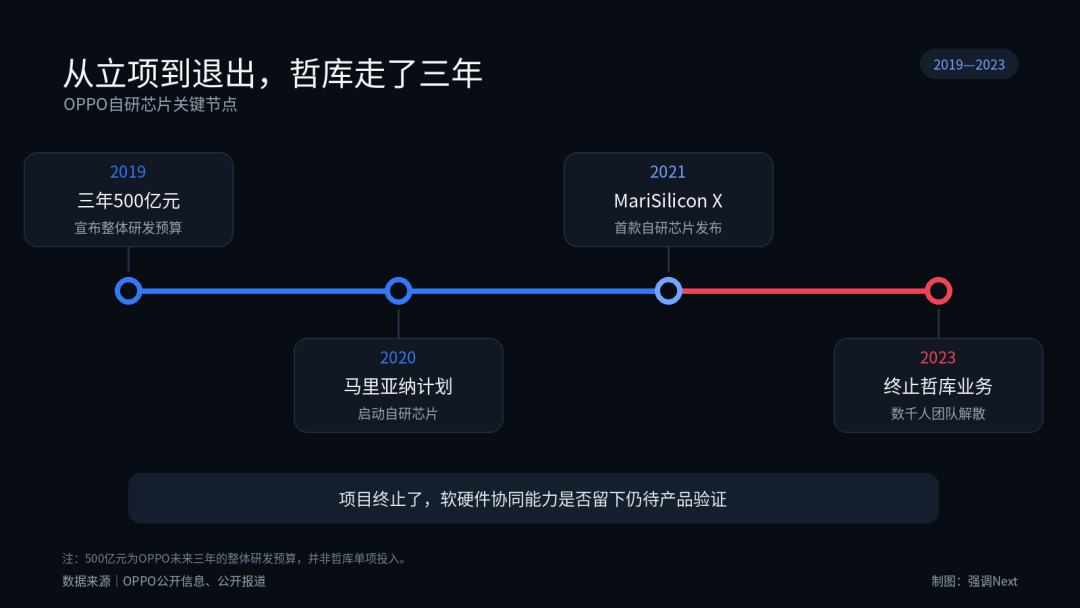
Transitioning from dedicated imaging chips to flagship smartphone SoCs requires filling gaps in CPU, GPU, NPU, baseband, RF, drivers, and development tools, as well as bearing the costs of advanced manufacturing tape-outs and annual iterations. The viability of chip investments depends on the returns formed by shipment scale, R&D efficiency, and product premiums. The shutdown of ZEKU indicates that OPPO judged the costs of this path had exceeded the strategic benefits obtainable at the time.
This exit also redefined OPPO's technological boundaries in the next round of competition.
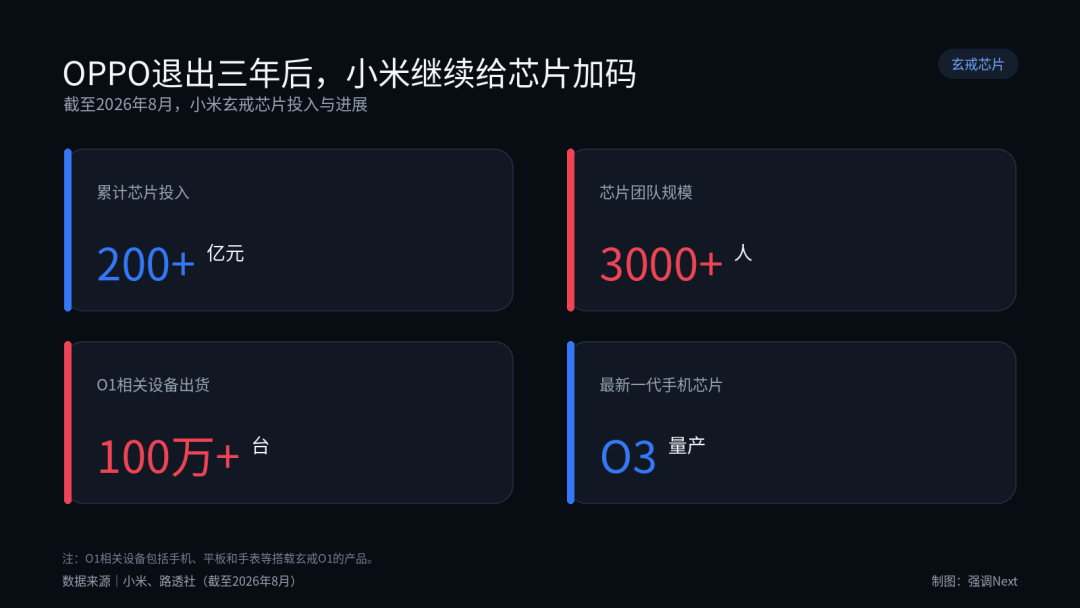
Apple achieves vertical integration through self-developed chips and operating systems; Huawei continues to strengthen its underlying autonomy amid external restrictions; Xiaomi had invested over 20 billion yuan in chip R&D with a team exceeding 3,000 people as of August 2026. OPPO chose a lighter capital route: continuing to procure platforms from Qualcomm and MediaTek while participating in underlying definitions through systems, algorithms, and joint tuning.
On September 15th, OPPO announced that the Find X10 Pro Max would be among the first to feature MediaTek's 2nm flagship chip, the Dimensity 9600 Pro, and utilize a jointly developed underlying rendering and scheduling engine. Such collaborations reduce the capital risks of full self-developed SoCs while allowing OPPO to embed imaging, power efficiency, and system fluidity requirements into the chip platform upfront.
The trade-offs are clear.
AI-driven smartphones increasingly rely on the synergy of NPU, memory, power efficiency, and operating systems, leaving limited room for differentiation on general-purpose platforms. If joint definitions can span multiple product cycles, OPPO can still build software-hardware collaborative capability (synergistic capabilities). If cooperation remains limited to single-generation tuning, the gap in underlying control compared to self-developed chip manufacturers will widen.
Thus, ZEKU's value cannot be summarized merely as 'daring to cut losses.' It represents capital discipline and long-term trade-offs. OPPO saved on the enormous investments required for continued chip development but must now prove that supplier collaborations can also generate unique, reusable technological capabilities.
AIOS Transforms Smartphones into Platform Competition
OPPO has not entered the automotive sector, concentrating resources on smartphones and adjacent personal smart devices. This focus reduces capital and organizational dispersion but places greater growth responsibility on the smartphone business.
AI further expands the boundaries of the 'smartphone core business.' Traditional operating systems primarily managed apps, files, and hardware resources. AIOS needs to continuously understand users, retain long-term memory, invoke different services, and allocate tasks between on-device and cloud computing. Smartphone manufacturers thus enter a coordination layer for models, cloud computing, privacy infrastructure, and application services.
In January, OPPO disclosed its overseas AIOS solution in collaboration with Google Cloud, focusing on user memory, cross-app search, proactive recommendations, and private computing clouds. For OPPO, the strategic value of AIOS exceeds that of individual AI features. ColorOS, with its system privileges and device access points, can extend model capabilities to mass-market products like Find and Reno, while global channels provide real pathways for AI services to reach users.
OPPO also operates within constraints shared by the Android ecosystem.
Basic models, cloud computing, and core chips come from external partners, while cross-app services depend on developers granting account, payment, and data permissions. Apple controls chips, systems, accounts, and app distribution, while Huawei is building its own software-hardware ecosystem. OPPO must strive for an experience close to vertical integration within a collaborative ecosystem.
This makes AI the most concrete test of OPPO's ability to 'think long-term.' Early AI smartphone features are easily replicated; systemic memory, on-device-cloud scheduling, and service connections create lasting differentiation. OPPO's strategic leap requires extending the organizational capabilities of an excellent hardware company into platform operations and developer collaboration.
This step is harder than adding a product line. It demands OPPO maintain hardware scale, undertake long-term software investments, and take responsibility for the final experience without full control over chips and models.
Patience Must Ultimately Translate into Decision Quality
As an unlisted company, OPPO does not need to explain quarterly ROI to secondary markets. This governance structure allows management to maintain longer product cycles, tolerate multi-year unprofitable R&D projects, and swiftly terminate initiatives like ZEKU when judgments change.
This is the foundation for 'integrity' to serve as an operating principle.
A calm mindset reduces interference from short-term rankings in decision-making; focusing on the essence requires the company to identify true returns on technological investments; thinking long-term allows time for accumulation in systems, imaging, and globalization.
However, its boundaries are clear. The absence of stock price pressure does not equate to unlimited resources. Without public financial reports and continuous disclosure, outsiders cannot assess the investment efficiency of different businesses. OPPO's decision quality relies more on internal mechanisms, founder judgment, and organizational consensus. As it enters a period of heavier technological investment, a directional error could consume years of time and significant talent.
The issue of succession also belongs to this structural context. OPPO's 'integrity' has long been interpreted by Duan Yongping and Chen Mingyong. When founders are present, corporate culture can serve as a common language for resource allocation. After generational transitions, stable decision-making procedures must determine which businesses warrant long-term investment and when to exit. Otherwise, the culture may endure, but judgment standards could blur with key figures' departure.
Thirty-one years have proven OPPO's strong ability to survive and adapt. It has evolved from feature phones to smartphones, expanded from China's offline market to the global stage, and accumulated technological expertise in imaging, fast charging, foldable screens, and system experiences. These assets are sufficient to keep OPPO in the game.
The new round of smartphone competition has raised the cost of 'staying in the game.' Scale must translate into high-end pricing power, supplier collaborations into underlying capabilities, and ColorOS must further serve as the user gateway in the AI era. OPPO possesses time and organizational stability, but the industry will not slow down iterations in chips, systems, and models.
'Integrity' is now most in need of delivery. OPPO must use this patience to forge critical technologies and platform capabilities, ensuring its 31 years of accumulation continue to define its position in the next round of industrial competition.
Note: Data in this article comes from public sources and does not constitute investment advice.
- END -
-
![]()
RoboX’s Breakthrough Year: From Hype to Reality
-
![]()
Nitto Denko Pours $160 Million into New Factory to Bolster Global Polarizer Strategy
-
![]()
Collaborating with XIOPM: Unveiling Huawei's Ambitious Optics Strategy
-
![]()
Monthly Report | Online Market Analysis of Dash Cams in July: Hikvision Maintains Leadership, DDPai Stands Out Against the Trend, and Panoramic Security Features Reshape the Market
-
![]()
Six Dishes and One Soup: The Launch of AITO Grand Hotel, How Seres Takes Over AITO Starting from a Meal
-
![]()
"China Speed" from an Overseas Perspective: The Coordination Revolution of Manufacturers and Suppliers
-
![]()
Founders Fund Allocates SpaceX Shares to Investors: Commercial Space Industry Hits Trillion-Dollar Valuation, Unlocks Liquidity Avenue
-
![]()
Revealed: Tesla’s Robot Team Conducts Factory Inspections, with Top Group, Sanhua Intelligent Controls, and Others Securing Major Orders!