Is Apple Exerting Ecological Dominance? Forcing Developers to Comply with iPhone Duo Standards
 10/08 2026
 493
493
Bianews Report
On October 7th, reports surfaced indicating that Apple is seemingly asserting ecological dominance within its ecosystem.
With the imminent release of Apple's inaugural foldable iPhone Duo, the tech giant has mandated a new policy: starting from April 2027, developers must provide exclusive screenshots tailored for the iPhone Duo, or risk their updates failing the review process.

From April 2027 onwards, all new or updated applications and games submitted to the App Store must include exclusive screenshots specifically designed for the iPhone Duo. Failure to comply will result in immediate rejection during the review stage.
At present, a transitional period is in place, allowing older apps that have not yet adapted to continue operating and being listed as usual. However, after April 2027, the absence of the required screenshots will bar any further updates.
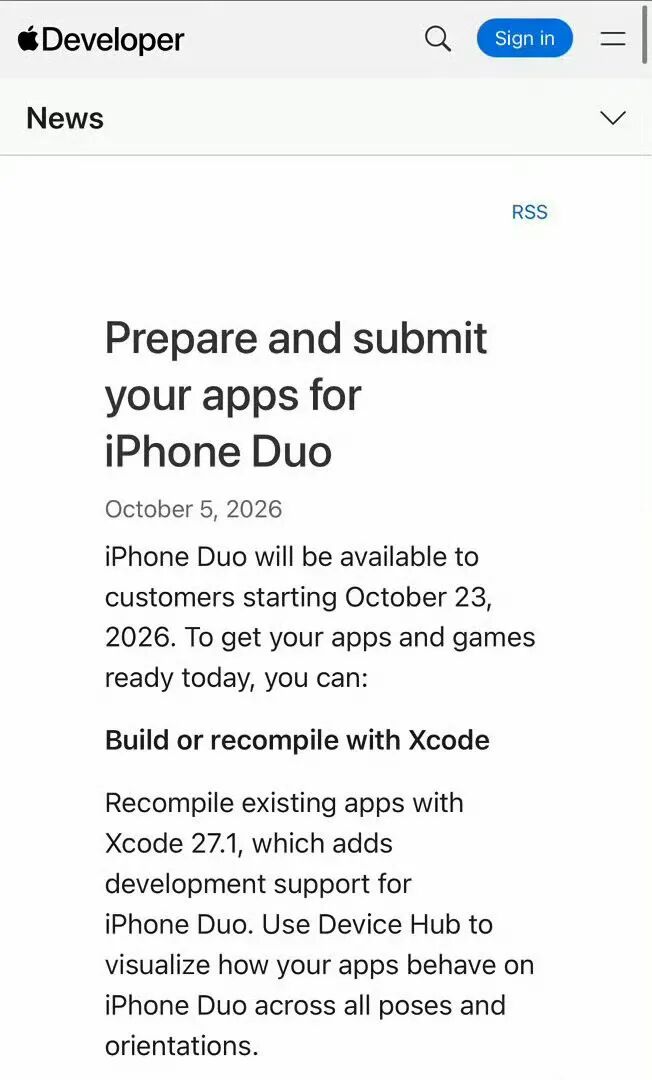
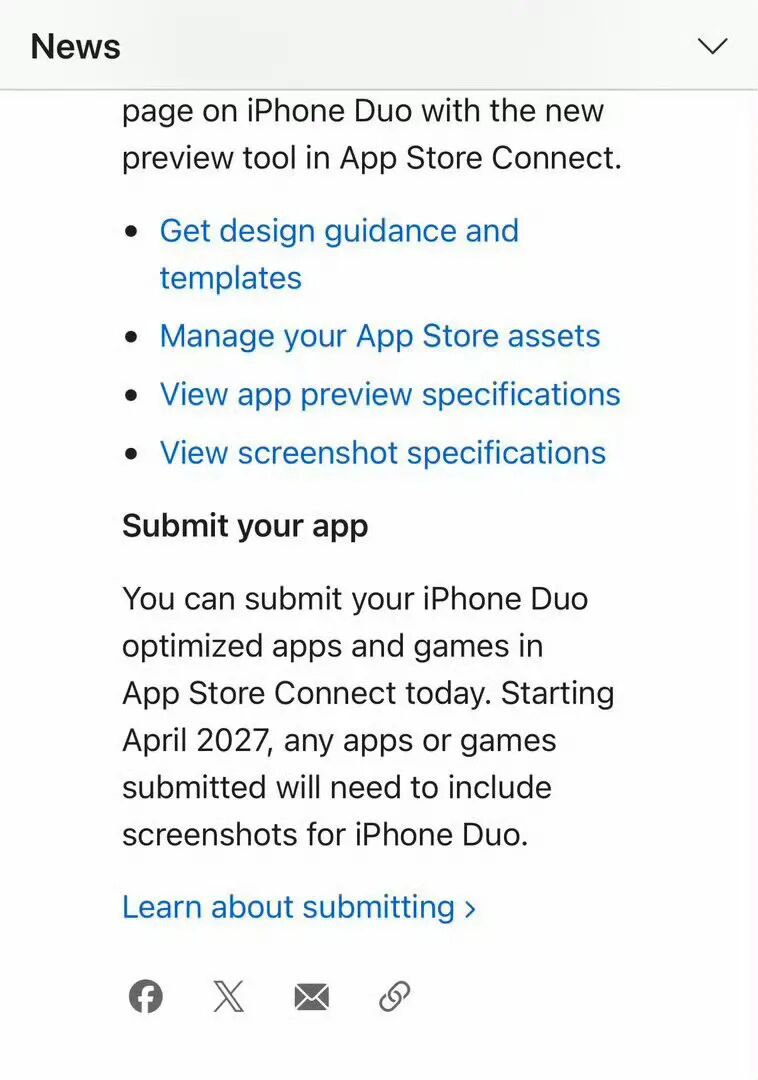
Industry analysts suggest that this move highlights Apple's strategic advantage in the foldable screen market. While the iPhone Duo may not excel in hardware specifications, Apple's software ecosystem is poised to become even more formidable in the foldable screen arena.
Indeed, Apple has acknowledged that the foldable screen technology is not an original innovation but rather draws inspiration from products and concepts introduced by manufacturers such as Huawei.
Some observers argue that Apple is fully embracing ecological dominance through this policy.
Tech blogger Shushu commented that while Android foldable screens had to persuade developers to adapt, Apple has simply issued an ultimatum: starting April 2027, failure to provide iPhone Duo screenshots will lead to rejection. This approach, according to Shushu, is not merely about adaptation but rather leveraging the App Store review authority to impose a form of 'toll' on developers.
This stringent stance mirrors that of uncompromising regulators. Despite grumblings about the associated costs, developers ultimately comply—after all, recompiling with Xcode grants them an 'adapted' badge, a far simpler requirement compared to navigating Android's fragmented screen ratios.
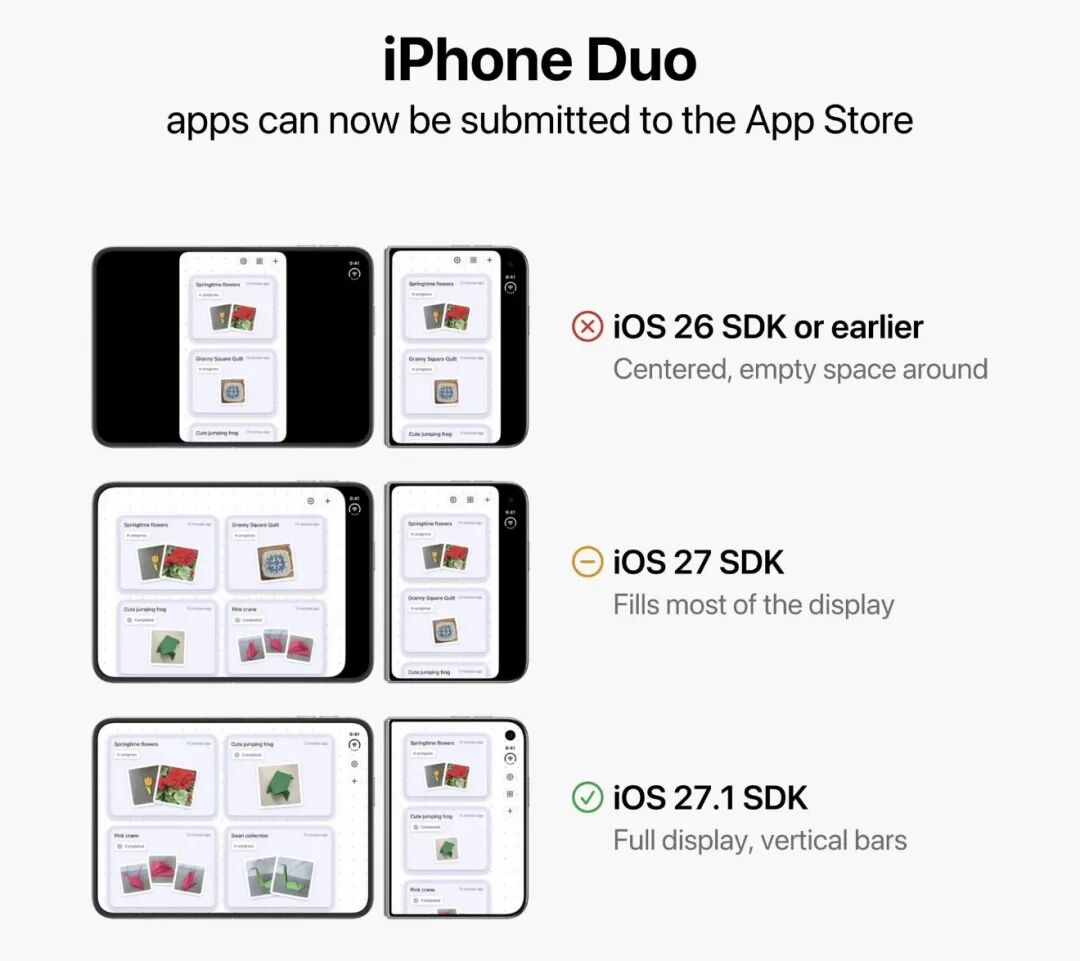
In practice, utilizing the App Store review authority to enforce unified standards directly addresses the challenges of inconsistent screen specifications and low developer adaptation willingness prevalent in the Android foldable market.
By making foldable screen adaptation a prerequisite rather than an optional feature, Apple ensures that early adopters enjoy a seamless and comprehensive software ecosystem experience.
What are your thoughts on this matter?
We welcome you to follow the Bianews WeChat public account for more insights and discussions:
-
Moonshot AI Launches Pre-IPO Funding Round, Eyes HKEX Listing in Q1 2027
-
Leapmotor's World Model Hasn't Yet Broken Free from Dahua's Shadow
-
![]()
Data Centers Can No Longer Keep Up with AI’s Ambitions
-
Vanishing 340 Billion! MiniMax’s Market Value Plummets by 80%, Signaling End of Capital Splurge in Large Model Sector
-
What Exactly is Holding Back the 'Last Mile' of Enterprise AI Implementation?
-
![]()
When World Models Become the 'Intermediary'
-
![]()
Is Apple Exerting Ecological Dominance? Forcing Developers to Comply with iPhone Duo Standards
-
![]()
Which Competitor's Market Share Does the Yijing X9 Target with Its Full-Huawei-Tech Stack at the 300,000 Yuan Price Point?