Amid Business Reorganization, Xiaomi Sets Sights on AI for Future Growth
 10/21 2026
 494
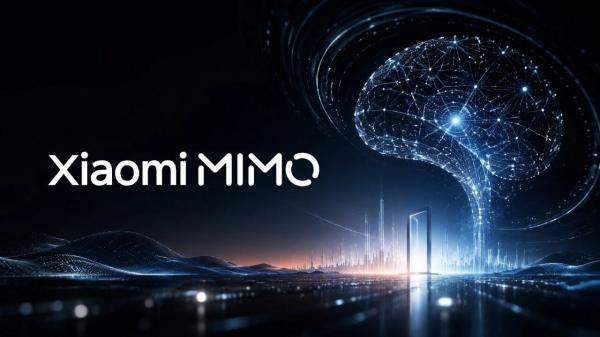

Automotive sales now contribute 20% of revenue, and MiMo, with 10.5 trillion Tokens, begins to generate revenue.
On August 18, Xiaomi unveiled its latest financial results. Revenue for the second quarter of 2026 stood at 108.92 billion yuan, down 6.1% year-on-year; gross profit was 21.61 billion yuan, a 17.2% decrease from the previous year; and adjusted net profit reached 6.22 billion yuan, marking a 42.6% year-on-year decline. The primary performance pressures stemmed from Xiaomi's traditional revenue pillars, including smartphones, IoT, and internet services. The 'Smartphone × AIoT' segment generated 84 billion yuan in revenue, an 11.3% decrease year-on-year. Meanwhile, revenue from smart electric vehicles, AI, and other innovative businesses surged to 24.9 billion yuan, up 17.1% year-on-year, and now accounts for approximately 23% of the group's total revenue.
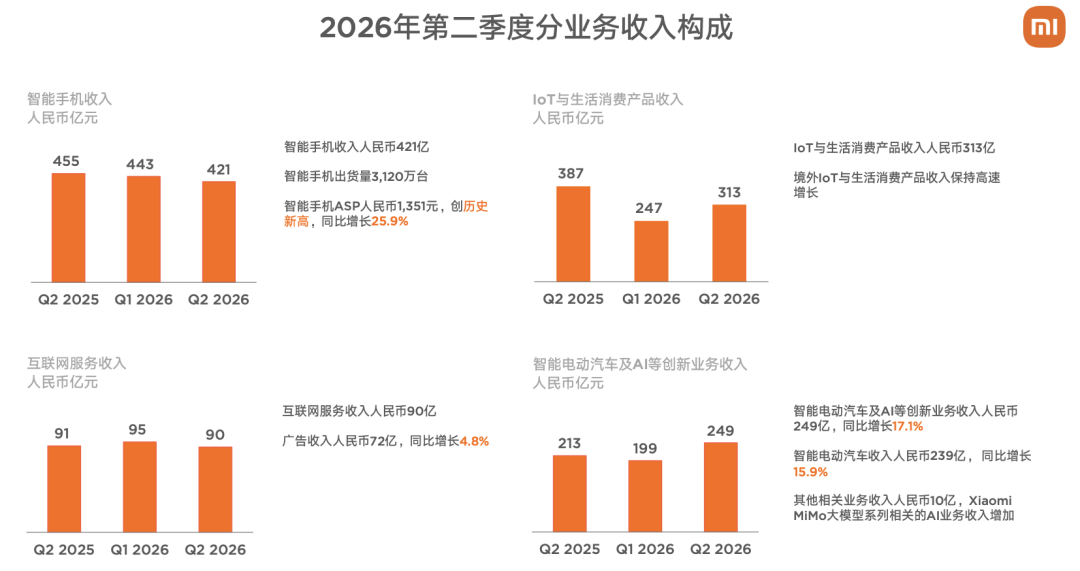
Image source: Xiaomi official website
Currently, revenue from innovative businesses is predominantly driven by automotive sales, with automotive revenue reaching 23.9 billion yuan in the second quarter. This quarter also marked the first explicit inclusion of MiMo-related AI businesses as a revenue source: among the approximately 1 billion yuan in other related business revenue, Xiaomi highlighted AI businesses tied to the Xiaomi MiMo large model series as a key growth driver. During the earnings call, Lin Shiwei, Xiaomi's Vice President and Chief Financial Officer, further disclosed that MiMo's API calls and Token Plan have commenced generating revenue.
Investment continues to surge. The second-quarter financial report revealed that Xiaomi's R&D expenses hit 9.2 billion yuan, up 18.9% year-on-year, with cumulative expenses for the first half of the year totaling 18.2 billion yuan. Lin Shiwei noted during the earnings call that nearly 30% of this investment was allocated to AI. Previously, Xiaomi announced its expectation to exceed 60 billion yuan in AI investment over the next three years.
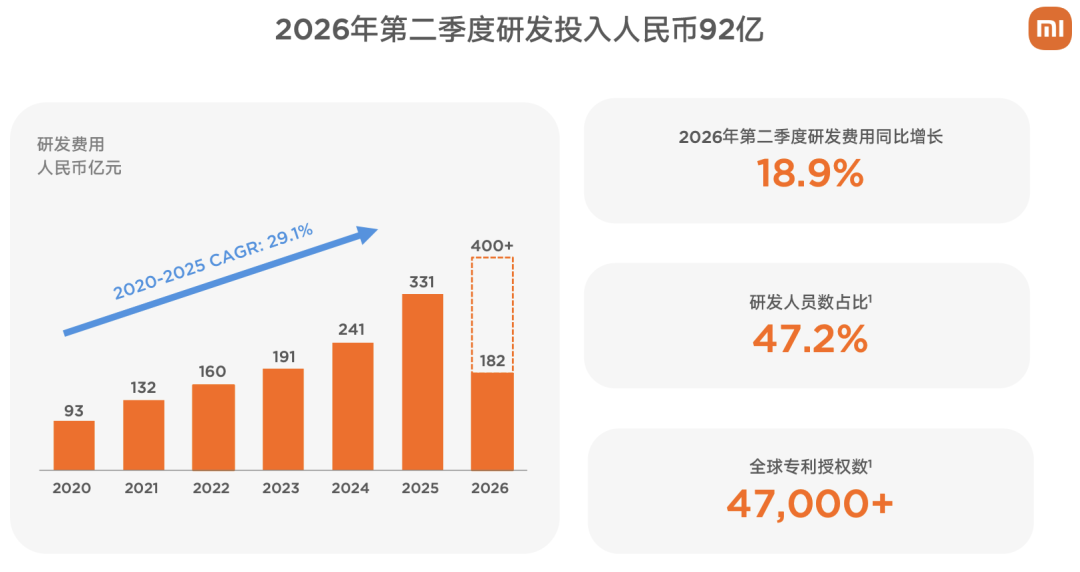
Image source: Xiaomi official website
On one hand, revenue from the 'Smartphone × AIoT' segment is declining, while on the other, automotive sales are scaling up, and MiMo is beginning to contribute revenue. Xiaomi's new growth structure is now extending beyond automobiles to encompass AI.
01 Core Business Faces Pressure, Automobiles Drive Initial Growth
Smartphones remain Xiaomi's largest revenue generator.
The financial report revealed that Xiaomi's smartphone revenue in the second quarter was 42.1 billion yuan, down 7.5% year-on-year; global shipments reached 31.2 million units, a 26.5% decrease from the previous year. Following a product mix adjustment, the average selling price of smartphones rose by 25.9% year-on-year to 1,351 yuan, a record high.
This adjustment is not unique to Xiaomi. IDC data shows that smartphone shipments in China declined by 4.3% year-on-year, marking the fifth consecutive quarter of contraction. Most Android manufacturers have begun raising prices or reducing the supply of low-end models. Omdia data indicates that Xiaomi's shipments fell by 26% in the second quarter of 2026, with over half of the shipments priced below $200. Low-priced models offer thinner profit margins, and users are more sensitive to price hikes. Consequently, Omdia believes that Xiaomi is the most significantly impacted among the top five global manufacturers due to rising storage costs. In the second quarter, Xiaomi's smartphone gross margin dropped from 11.5% to 8.5%, with escalating prices of core components such as storage cited as a primary factor.
IoT and lifestyle consumer performance also declined due to reduced domestic subsidies. This business segment primarily includes smart home appliances, TVs, tablets, wearables, and other IoT hardware. Revenue in the second quarter fell from 38.7 billion yuan in the same period last year to 31.3 billion yuan, a 19.2% year-on-year decrease. Internet services remained relatively stable, with revenue of approximately 9 billion yuan, roughly unchanged year-on-year, and the gross margin increased from 75.4% to 76.8%.
After combining the three businesses, revenue from 'Smartphone × AIoT' decreased from 94.7 billion yuan in the same period last year to 84 billion yuan.
While the core business faces pressure, automobiles are starting to drive incremental growth. In the second quarter, Xiaomi delivered 104,200 vehicles, up 28.2% year-on-year; automotive sales revenue was 23.9 billion yuan, a 15.9% increase from the previous year, accounting for over 20% of the group's quarterly revenue. Moreover, automobiles continue to scale up. Xiaomi has set a delivery target of 550,000 vehicles for the year. Based on the first- and second-quarter financial reports, approximately 185,000 vehicles were delivered in the first half of the year. This quarter's financial report also disclosed that the first extended-range SUV, the 'Pengcheng' series, will be launched in September, further expanding the existing product lineup.
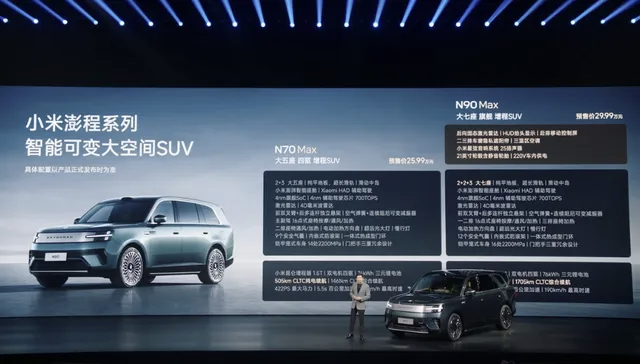
Image source: Jiemian News | Screenshot from Xiaomi's product launch live stream
However, the revenue growth rate of automobiles did not keep pace with the delivery growth rate. The financial report showed that the average revenue per vehicle in the second quarter decreased from 253,700 yuan to 229,300 yuan, which Xiaomi primarily attributed to the decrease in the proportion of SU7 Ultra deliveries. The gross margin of smart electric vehicles, AI, and other innovative businesses also declined from 26.4% to 19.2%, operating expenses increased from 5.9 billion yuan to 7.4 billion yuan, and operating losses expanded to 2.6 billion yuan.
Automobiles have bolstered quarterly revenue in the hundreds of billions of yuan, but they are still in the investment and profit adjustment phase.
02 Xiaomi's AI Strategy Converges on MiMo
Nearly 30% of Xiaomi's R&D investment in the first half of the year was directed toward AI, and MiMo made its debut in the financial report revenue for the first time. AI-related investments did not commence this year.
Following the release of HyperOS in 2023, Xiaomi began integrating large model capabilities into its smartphone system and introduced HyperMind for smart homes. Subsequently, Xiaomi gradually applied AI to intelligent driving, smart cockpits, and home device coordination. In 2024, Xiaomi increased its investment in AI infrastructure and advanced the development of base large models and multimodal technologies. By 2025, the first MiMo open-source model, MiMo 7B, was released, followed by continued expansion of multimodal, voice, and Agent capabilities.
This year, these changes are further reflected in the organizational structure. In July 2026, reports indicated that Xiaomi reorganized the AI technical division behind its AI assistant 'Xiao Ai.' The base model capabilities are now managed by the MiMo team, the cloud team handles model engineering, and the OS teams for smartphones and other businesses are responsible for on-device implementation. This division of labor aligns with Xiaomi's positioning of MiMo during this quarter's earnings call. Management stated that MiMo serves as the base model layer of the company's AI system and will continue to integrate with businesses such as smartphone operating systems, home, intelligent driving, and robots.
Xiaomi's AI capabilities, previously deployed across different businesses, are now beginning to coalesce around MiMo into a common underlying model.
03 Two Pathways for MiMo's Expansion
After establishing itself as a base model, MiMo first accelerated its outreach to external developers.
Externally, Xiaomi initiated its efforts with developers. In April of this year, MiMo V2.5 entered public beta, and Xiaomi subsequently launched the MiMo Orbit plan, collaborating with multiple Agent frameworks. In May, the API prices for the MiMo V2.5 series continued to decrease, while the available quantity of the Token Plan increased simultaneously. In June, the AI programming tool MiMo Code was introduced.
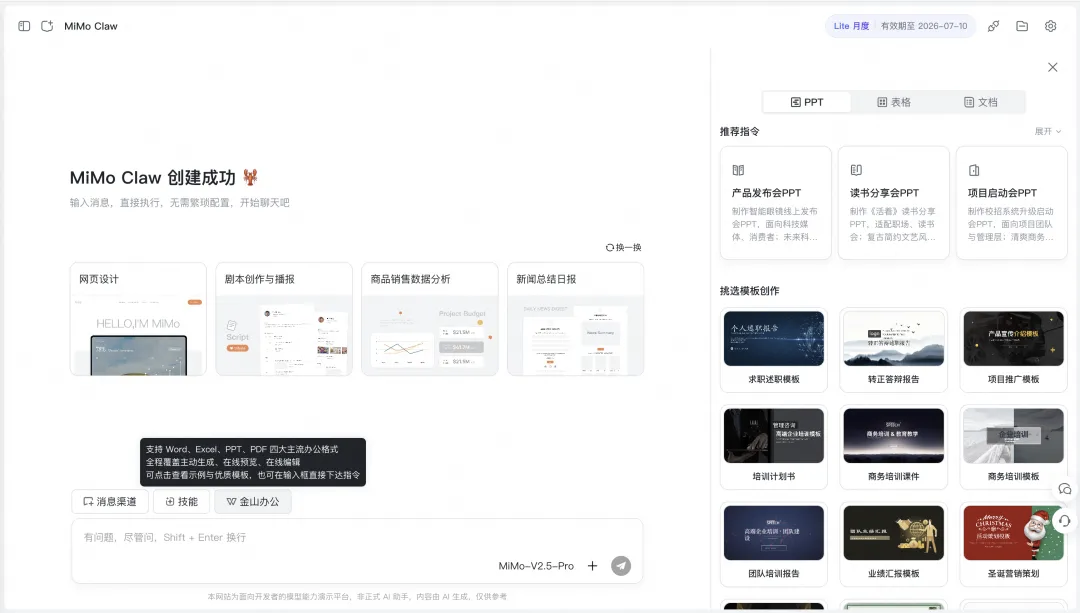
Image source: Official Xiaomi MiMo account
The call volume quickly surged. In this quarter's financial report, Xiaomi cited OpenRouter data, stating that from July 20 to 26, the Token usage of MiMo V2.5 reached 10.5 trillion, ranking first on the platform for that week. Management attributes the call growth primarily to the model's performance in perception, Agent, and code capabilities, as well as its low call prices and open-source strategy. Beyond call volume, the financial report provided a more direct signal of commercialization. Revenue of approximately 1 billion yuan from other related businesses in the second quarter increased by 56.5% year-on-year, with growth sources including MiMo-related AI businesses. Lin Shiwei revealed during the conference call that the current focus remains on expanding the user base and continuing to iterate the base model.
MiMo's other pathway leads into Xiaomi's own product ecosystem. This quarter's financial report disclosed that Miloco 2.0 is centered around MiMo, and the new generation AI assistant, Super Xiao Ai 2.0, in HyperOS 4 Beta, is also connected to MiMo, adding cross-application and cross-device task processing capabilities. Intelligent driving for automobiles and robots were highlighted by management as directions for continued integration in the future.
This pathway aligns with Xiaomi's established 'Human-Car-Home' ecosystem. The financial report showed that as of the end of June, the number of connected devices on Xiaomi's AIoT platform reached 1.161 billion, a 17.4% year-on-year increase; the monthly active users of the Mi Home App reached 124 million, and the monthly active users of Xiao Ai reached 175 million. In terms of automobiles, 104,200 vehicles were delivered in the second quarter, with sales revenue of 23.9 billion yuan.
Thus, Xiaomi's AI strategy has crystallized into two distinct pathways: externally, MiMo enters the developer ecosystem through APIs, Token Plans, and Agent tools; internally, it integrates into the 'Human-Car-Home' ecosystem.
However, scale does not equate to revenue. MiMo has commenced contributing revenue, but it is still in the early stages of commercialization. The second-quarter financial report showed that smart electric vehicles, AI, and other innovative businesses incurred an operating loss of 2.6 billion yuan for the quarter, and AI-related costs were also a contributing factor to the decline in the gross margin of the innovative business segment.
Looking ahead, whether MiMo can transform call volume and the scale of the 'Human-Car-Home' ecosystem into stable profit contributions in the financial report will determine whether AI can truly become a new growth engine for Xiaomi.
(The images and public data materials in this article are sourced from the internet and public industry platforms. If there is any infringement, please contact us for timely modification.)
-
New Chips Frequently Emerge, RISC-V Fuels the AI Era
-
Raccoon Carries SenseTime to the Top of the AI Wave
-
Huaqiangbei-Based Company Replicates Huawei’s Popular Wide Straight Slab Phone
-
![]()
Optical Manufacturing Drives Life and Health Forward! Goertek Optics and Nearview Technology Forge Strategic Alliance
-
RMB 37.49 Billion Long-Term Contract: What Is Xiechuang Data Wagering On?
-
![]()
Why, After 34 Years, Has the Former Color TV Leader Reached the Point of Delisting? "Konka, Delisting, Color TV, Price War, China Resources"
-
![]()
Xiaomi Restructures Business, Eyes AI as Next Growth Engine
-
![]()
Amid Business Reorganization, Xiaomi Sets Sights on AI for Future Growth