Nut Pandownload Ownership Change: The Logic of Large-Screen Projectors Replacing TVs Is Failing
 11/04 2026
 401
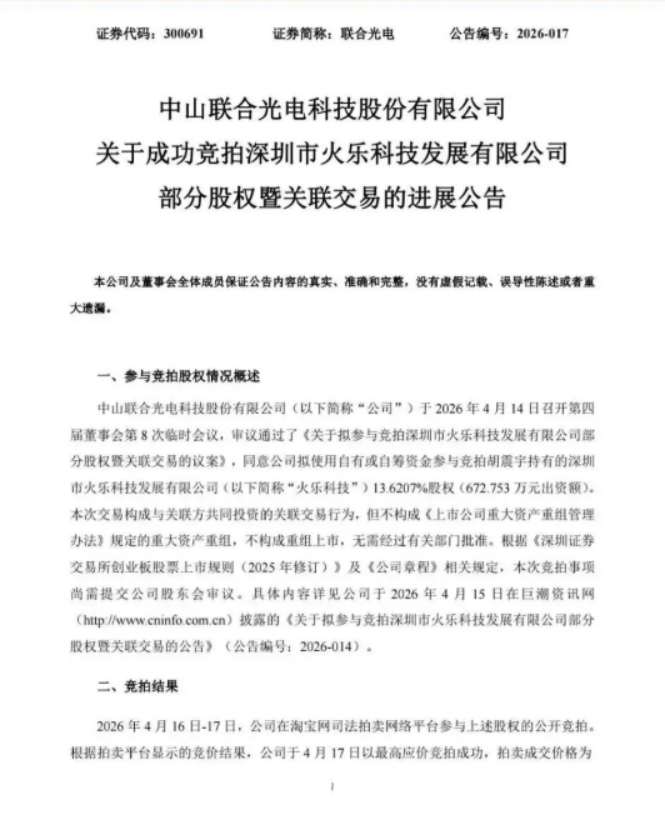
In April 2026, a judicial auction announcement brought the long-dormant Nut Projector back into the public eye. The 13.6207% equity stake in Huole Technology held by founder Hu Zhenyu was forcibly auctioned by the Shenzhen Nanshan District People's Court, and Zhongshan United Photonics won with the highest bid of 180 million yuan. Combined with approximately 2.65% equity previously held through a participating fund, United Photonics now holds a total of about 16.27%, becoming the largest shareholder of this former unicorn once valued at ten billion yuan.
The founder was forced out through judicial enforcement, and the acquirer is his own core supplier. This has no precedent in China's smart projector industry, and it also gives Nut Projector's control transfer industry analysis value beyond the fate of a single company.
 Nut Projector bursts onto the scene
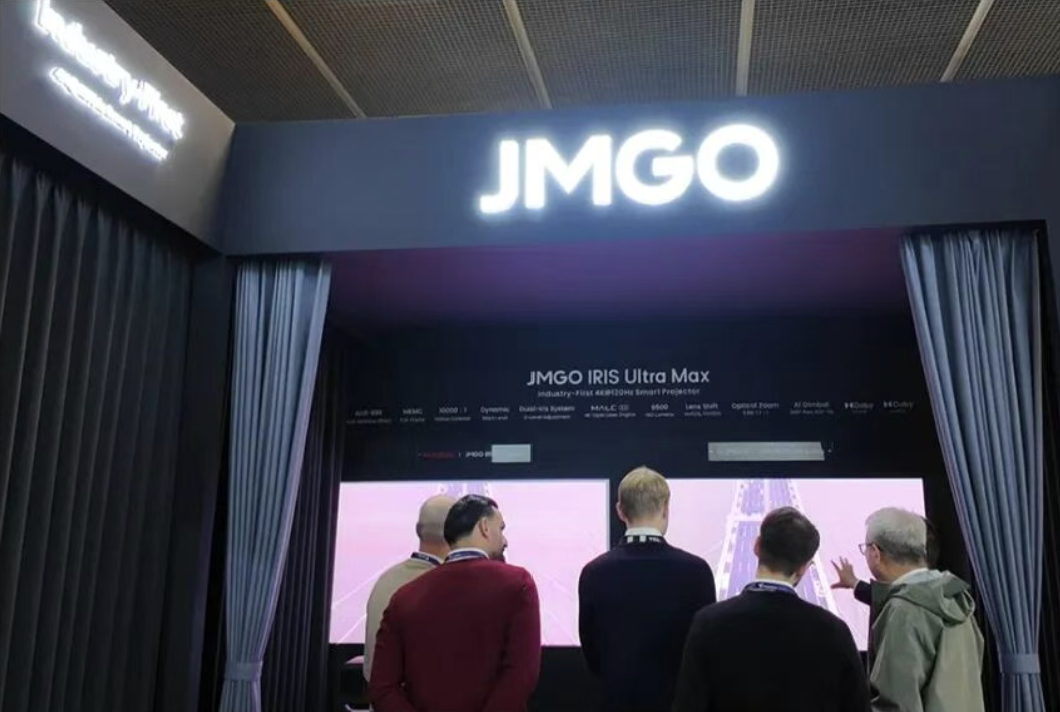
Nut Projector's starting point was no different from that of most hardware startups. In 2011, Huole Technology was founded in Shenzhen and launched the industry's first round smart projector, Nut G1, officially entering the home consumer market. It was the first to integrate an Android smart system, built-in HiFi speakers, electric focus, and voice control, redefining the projector from a "display tool" to a "home smart cinema terminal" and directly establishing the product standards for subsequent home smart projectors. In 2024, Nut ranked first globally in sales in the home laser projector mid-to-long throw market. For an unlisted brand, it demonstrated considerable technical and market acumen at the time.
Source: Nut Projector
Capital also priced it accordingly. In 2014, the Series A round received 60 million yuan from IDG Capital, Fortune Capital, and StarVC; in March 2022, it completed a 1 billion yuan Pre-IPO round, with OPPO, IDG Capital, and others participating, pushing the valuation to around ten billion yuan. The presence of IDG, Alibaba, and OPPO on the shareholder register once led the outside world to expect that Nut would replicate the path of XGIMI Technology and become the second projector brand to list on the public capital market.
The company had not yet gone public, and the core reason was not Nut's own operational problems, but that the time window for its IPO push happened to coincide with the cyclical turning point of industry growth.
The smart projector industry experienced explosive growth from 2018 to 2022. As the industry leader, XGIMI Technology seized the peak of the industry boom and listed on the STAR Market in 2021, with its market value once exceeding 40 billion yuan, becoming the only terminal brand in the industry to complete an IPO.
However, growth peaked in 2022 and then turned sharply downward. According to data from RUNTO Technology's "2025 China Smart Projector Market Annual Report," in 2025 China's smart projector market (excluding laser TVs) recorded full-channel sales of 5.203 million units, down 13.9% year-on-year; sales revenue was 8.36 billion yuan, down 16.5% year-on-year. This was the third consecutive year of negative growth after 2023.
Even the listed industry leader could not maintain its valuation in the public market. XGIMI Technology's stock price plunged nearly 90% from its peak, leaving its valuation at only about 7 billion yuan. The IPO window for the unlisted second-place player was effectively closed. Pre-IPO investors who entered in 2022 at a ten billion yuan valuation faced a deadlock of negative industry growth, narrowing exit paths, and dimming listing prospects for the target.
Xinliu believes that the IPO window in the consumer tech sector is highly cyclical and often exists only in the latter half of rapid industry growth — when performance growth is sufficient to support the valuation narrative and secondary-market investors are willing to pay for growth premiums. Once industry growth turns negative and the valuation logic switches, the window can close quickly within one to two quarters.

Behind the auction
The direct trigger for Hu Zhenyu losing control of Nut lay outside Nut. Around 2022, he set up a VR headset project in Shanghai called "Jinglan Technology," with an entity separate from Huole Technology, but the project's operation relied heavily on Hu Zhenyu's personal Nut equity for financing or credit support. The product stalled due to poor management before it was even launched.
In August 2023, the Shanghai Minhang District People's Court filed and enforced a labor arbitration case related to Jinglan Technology. Hu Zhenyu was placed on the list of dishonest judgment debtors and subject to consumption restrictions; the court's enforcement ruling showed that Jinglan Technology "had no property available for enforcement" and owed employees more than 6 million yuan in wages.
During the same period, the Nut board of directors agreed on August 28, 2023, to Hu Zhenyu's resignation as chairman "due to health reasons," with IDG Capital partner Lian Meng serving as interim chairman, while Hu Zhenyu retained only a board seat. Hu Zhenyu himself claimed he was "kicked out of the company by the board." The founder withdrew from the decision-making layer, but the risks at the equity level were not cleared, and they exploded through judicial auction in April 2026.
The acquirer United Photonics' identity as an upstream supplier pushed the nature of this auction beyond a simple equity change. United Photonics is one of China's leading high-end optical lens companies, and its new display products have been used in laser TVs and projector products from brands such as Nut, Hisense, and LG, with Nut long being its core customer.
United Photonics had already held shares indirectly through a participating fund as early as 2019, with a total of about 2.65% before the auction. The auction price of 180 million yuan for 13.6207% equity implied an overall valuation of Huole Technology of about 1.32 billion yuan, more than 85% lower than the ten billion yuan valuation in 2022. In its announcement, United Photonics described the purpose of the transaction as "extending and strengthening the company's smart display industry ecosystem" and "enhancing the company's industrial chain influence and voice, achieving good manufacturing + brand industrial synergy."
From an industrial logic perspective, this is a vertical integration by an upstream supplier during a trough in the brand's valuation. For United Photonics, acquiring equity in a core customer for less than 200 million yuan both consolidates its shipment channel for optical components and gains entry to terminal brands and channels.
United Photonics stated clearly on its investor interaction platform that the 13.6207% stake "does not meet the conditions for 'control' under the Accounting Standards for Business Enterprises, and Huole Technology is not a subsidiary within the scope of the company's consolidated financial statements." If operations improve later, it can further increase its stake to achieve control; if performance falls short of expectations, it can also flexibly advance or retreat as a financial investment. This is an industrial positioning structure with clear risk boundaries and ample flexibility.
Source: Zhongshan United Photonics
The choices of early financial investors are equally noteworthy. IDG, Alibaba, OPPO, and others did not step in to contest control in this auction, but accepted a situation in which industrial capital entered to provide support. United Photonics is not without risk. If subsequent operations fall short of expectations, the company's approximately 16% controlling stake will make it difficult both to unilaterally push deep integration and to quickly find an acquirer for exit — primary-market equity liquidity for unlisted companies is extremely poor, and it can easily end up trapped in a deadlock of "unable to manage, unable to exit."

Industry background: market falls for nine consecutive quarters, DMD chips constrained
The change in control at Nut Projector occurred against the backdrop of deep adjustment in the smart projector industry. RUNTO Technology data shows that in the first half of 2026, China's smart projector market (excluding laser TVs) recorded full-channel sales of 2.056 million units, down 26.0% year-on-year, and sales revenue of 3.34 billion yuan, down 27.0% year-on-year. Since the second quarter of 2024, the market has contracted year-on-year for nine consecutive quarters. In the second quarter of 2026, quarterly sales fell below 1 million units, the first time sales dropped below 1 million units since 2022.
Demand-side pressure comes from three factors: earlier home appliance subsidies pulled forward replacement demand, residents' willingness to consume is relatively weak, and discretionary consumption bears the brunt; in 2026, the home appliance trade-in program did not cover the projector category, lacking policy support; and 75-inch Mini LED TVs, after subsidies, saw prices drop below 3,000 yuan, directly breaking the traditional price anchor of projectors as "low-price large screens."
The supply side shows a pattern of squeeze from both ends. In the low-end market, Haqu Q1 entered the top three in LCD projectors in February 2025 at the 700-yuan price point, forming a leading camp together with Xiaoming and Dajiangcheng, further compressing the entry-level space for small and medium-sized brands. In the mid-to-high-end market, Hisense's Vidda accounted for 38% of sales in the high-end projector market above 8,000 yuan, steadily ranking first in the industry. While the price war tightens from both ends, costs have continued to rise. Terminal price cuts and cost increases occur simultaneously, squeezing manufacturers' profit margins from both directions.
A more fundamental constraint than cost comes from upstream chips. The DMD chip, the core component of the DLP technology route, has long been monopolized globally by Texas Instruments, with no large-scale domestic mass-production substitute. Most brands can only optimize appearance and systems, lacking core bargaining power and finding it difficult to achieve structural cost reduction.
Even Nut cannot bypass the upstream barrier of DMD chips. In a track where demand has contracted for nine consecutive quarters, substitute prices continue to fall, and core components are controlled by a single overseas supplier, it is very difficult for a single brand to rewrite its finances and fate through product-level efforts alone.

Lessons for other entrepreneurs
The Nut Projector case offers lessons at two levels, both corresponding to issues in startup governance that are easily obscured by growth narratives.
First, a founder's cross-sector ventures must have hard isolation of assets and credit.
Second, the window of technological leadership is easier to overestimate than the technology itself. Nut's accumulation in tri-color lasers and self-developed optical engines is real, and its 2024 global first place in mid-to-long throw laser projector sales is also real. But the competitive dimension of the projector industry has shifted from single technical parameters to supply chain efficiency, channel coverage, and cost control, while the contraction of the overall industry makes single-point technological leadership dilute faster, and the advantage of any generation of products is unlikely to constitute a sustained barrier.
The change in control at Nut Projector is essentially a typical clearing and restructuring during the downturn phase of a mature consumer electronics track. When the industry moves from an incremental to a stock cycle, companies without core competitiveness face greater operational pressure, and if founders fail to isolate personal debt from the company, corporate control will be shaken.
What United Photonics bought for 180 million yuan was not just discounted equity, but also an industrial takeover of a downstream brand by upstream industrial capital. When the founder becomes a risk burden, promptly divesting that node and bringing in industrial capital to fill the gap can enable the company to complete risk clearing and continue operations. This provides startups in a downturn cycle with a third survival path beyond bankruptcy liquidation and peer mergers and acquisitions.
*Header image generated by AI
- XINLIU -
-
![]()
Metal Film vs. Dielectric Film: The Selection Logic for AR Waveguide Reflective Coatings
-
![]()
Apple 'Wins Without Trying' Against NVIDIA
-
![]()
Nut Pandownload Ownership Change: The Logic of Large-Screen Projectors Replacing TVs Is Failing
-
Thanks to Chinese Support, Apple's China Revenue Surges 21%, with Revenue and Profit Hitting New Highs Again
-
![]()
Two-Trillion Sprint Tier: Benchmarking Analysis of Industries in Nanjing, Ningbo, Tianjin, and Qingdao
-
![]()
Cloud Computing in the AI Era: Prosperity for the Few | Juchao
-
![]()
Smartphone Specs Slashed Across the Board: Hardware Downgrades Leave Users in a Bind
-
![]()
Apple "Wins by Default" Against Nvidia