Gree Electric's Performance Weighed Down by Soaring Copper Prices: Will Dong Mingzhu Unveil a "Big Move" by Year-End?
 11/12 2026
 413
Produced by Radar Finance | Text by Zhou Hui | Edited by Meng Shuai
"Gree Electric would rather sacrifice several billion yuan in profit this year than compromise on product quality." Dong Mingzhu, Chairwoman of Gree Electric, made this remark during a recent appearance on Tmall's Double 11 "Life Proposal Bureau" program.
According to the latest financial report released by Gree Electric, the company posted total operating revenue of 126.544 billion yuan in the first three quarters of this year, down 8.07% year-on-year, and net profit attributable to shareholders of 17.274 billion yuan, a year-on-year decline of 19.51%. Its single-quarter net profit attributable to shareholders in the third quarter alone fell by more than 40%.
Regarding Gree Electric's lackluster performance during the year, Dong Mingzhu attributed part of the blame to rising copper prices. "Copper costs five to six times as much as aluminum. If we want to protect the brand, we must give up some benefits, so Gree Electric insists on using copper to ensure quality."
In fact, as one of the "three giants of white goods," Gree Electric's declining performance also mirrors the harsh reality of widespread pressure across the home appliance industry. Amid increasingly fierce stock competition in the sector, Gree has chosen to ramp up its layout in the liquid cooling track.
The semi-annual report shows that, leveraging its technical accumulation in the commercial air conditioning field, the company has independently achieved full coverage of three major technical routes—fluorine systems, water systems, and liquid cooling systems—which can serve edge computer rooms, traditional IDCs, high-density AIDCs, and all supercomputing scenarios.
At the same time, Gree's core air conditioning business is being empowered by AI. In the aforementioned program, Dong Mingzhu also revealed that Gree will launch a product by year-end that can redefine home appliances, "perhaps this air conditioner can still be sold at its original price after 10 years of use."
Third-Quarter Net Profit Fell by More than 40%; Dong Mingzhu Responds to Performance Decline
On October 26, Gree Electric disclosed its 2026 third-quarter report. In the first three quarters of this year, Gree Electric achieved total operating revenue of 126.544 billion yuan, down 8.07% year-on-year, and recorded net profit attributable to shareholders of 17.274 billion yuan, a year-on-year decrease of 19.51%.
In the third quarter alone, Gree Electric's single-quarter total operating revenue was 36.871 billion yuan, down 7.9% year-on-year; net profit attributable to shareholders was 3.996 billion yuan, a year-on-year decline of more than 40%.
In the first three quarters of this year, Gree Electric's sales gross margin was 27.03%, down about 1.41 percentage points from 28.44% in the same period last year.
Regarding this less-than-stellar financial report, Dong Mingzhu said during a recent appearance on Tmall's Double 11 "Life Proposal Bureau" that the company's performance decline this year was due to rising copper prices.
According to Caizhongshe, since the second half of 2025, copper prices have generally shown a volatile upward trend, affected by multiple factors including Federal Reserve rate cut expectations, the suspension of production at Indonesia's Grasberg copper mine, and demand from AI and power grids.
Dong Mingzhu said that copper costs five to six times as much as aluminum. If we want to protect the brand, we must give up some benefits, so Gree Electric insists on using copper to ensure quality. "Aluminum can certainly be used, but its stability, reliability, and durability all need to be questioned, and then consumers become the victims."
Regarding the issue of "replacing copper with aluminum," Gree Electric has in fact said "no" many times.
In December last year, when Xiaomi, Midea, Haier, and other air conditioning giants all joined the "Air Conditioning Aluminum Enhanced Application Research Working Group Self-Discipline Convention," Dong Mingzhu stated that she still insisted on not using "aluminum to replace copper," because it has not reached the same technical conditions and guarantees as copper.
In January this year, Gree Electric issued the "Explanation on Recent Market Concerns," promising that Gree household air conditioners would not increase prices and that there were currently no plans related to "replacing copper with aluminum."
In the "Life Proposal Bureau" program, Dong Mingzhu further emphasized that Gree Electric would rather lose several billion yuan in profit this year than lower product quality. What Gree Electric wants to do is be a long-termist and build a world-class brand.
However, this does not mean that Gree Electric ignores "aluminum replacing copper" technology. Dong Mingzhu previously emphasized, "We have not said we won't research it. We will certainly research it, until aluminum can completely replace copper; I will certainly use aluminum."
In the "Explanation on Recent Market Concerns" issued in January, Gree Electric also stated that if related research in the future can fully meet Gree's quality and technical standard requirements and be officially applied, it will be clearly labeled to fully protect consumers' right to know and right to choose.
In addition to rising copper prices, weakening demand on the consumer side has also had a certain impact on Gree Electric's performance. Gree Electric pointed out in its third-quarter report that the year-on-year decline in the company's consumer appliance business affected the company's performance.
According to Industry Online data, in the first three quarters of 2026, total sales in China's household air conditioning industry were 150 million units, a year-on-year decrease of 8.4%. By quarter, the decline widened quarter by quarter: a year-on-year decrease of 2.8% in the first quarter, 9.3% in the second quarter, and 15.1% in the third quarter.
Gree Electric admitted in its third-quarter report that the home appliance industry as a whole is under pressure, downward pressure continues to mount, and industry competition has further intensified.
Industry Online data shows that in the third quarter of 2026, Gree Electric's domestic sales and export shipments of household air conditioners fell by 13.8% and 34.0% year-on-year, respectively.
Facing challenges, the company has adopted a differentiated competition strategy, focusing on the mid-to-high-end market with technological and quality advantages, resulting in a decline in revenue scale; at the same time, in the face of high raw material prices, the company adheres to the business philosophy of "competing on quality, not price," and product selling prices remain relatively stable, which has had a certain impact on the company's profits.
Home Appliance Industry Under Widespread Pressure; Gree Steps Up Layout in Liquid Cooling Track
In fact, Gree Electric's performance decline is also a microcosm of the current overall downturn in the home appliance industry.
AVC summary data shows that from January to September this year, China's overall home appliance market (excluding 3C) retail sales amounted to 604.1 billion yuan, a year-on-year decrease of 10%. By quarter, the first, second, and third quarters decreased by 6.0%, 12.4%, and 10.1%, respectively.
By category, from January to September this year, retail sales in the air conditioning category fell by 15.9% year-on-year, the steepest decline.
During the same period, kitchen and bathroom major appliances, color TVs, laundry care, refrigeration, small kitchen appliances, and cleaning appliances also fell by 10.3%, 9.0%, 7.1%, 5.8%, 5.2%, and 2.3% year-on-year, respectively.
Affected by this, home appliance companies are generally under pressure in their performance. Not long ago, Haier Smart Home, another of the "three giants of white goods," also delivered a third-quarter report with declines in both revenue and net profit.
In the first three quarters of this year, Haier Smart Home achieved total operating revenue of 221.819 billion yuan, a year-on-year decrease of 5.23%; and recorded net profit attributable to shareholders of 14.999 billion yuan, a year-on-year decrease of 13.67%.
During the same period, Midea Group's total operating revenue was 369.087 billion yuan, a slight year-on-year increase of 1.2%; net profit attributable to shareholders was 41.393 billion yuan, a year-on-year increase of 9.27%, making it the only one among the "three giants" to maintain both revenue and net profit growth. However, compared with the same period last year, its revenue and net profit growth rates have both slowed significantly.
According to a Nomura Orient International Securities research report, in the first three quarters of this year, Midea Group's C-end smart home business group revenue was under pressure due to weak domestic sales and the company's cancellation of the new cooling year opening, but the growth of its overseas OBM business revenue remained impressive.
As the home appliance industry enters an increasingly fierce stage of stock competition, the liquid cooling track continues to heat up with the support of AI.
CCID Consulting data shows that in 2025, the overall market size of China's liquid cooling data centers reached 15.98 billion yuan, a year-on-year increase of 45.2%, and is expected to reach 23.25 billion yuan in 2026 and exceed 47 billion yuan in 2028.
CICC predicts that in 2026, the global intelligent computing center liquid cooling market size is expected to exceed 114.7 billion yuan, a year-on-year increase of 273%.
Relying on the cooling source technology and manufacturing capabilities accumulated over decades in the HVAC business, home appliance giants including Gree, Midea, and Haier have all rushed into this track.
Gree Electric mentioned in its semi-annual report that in the first half of the year, the company's data center business continued to make breakthroughs and successively won annual centralized procurement projects for national computer room air conditioning from leading telecommunications operators and benchmark projects such as internet liquid cooling computing centers.
On November 7, Gree Electric also announced that the company had recently successfully won the centralized procurement projects for temperature control equipment from China Mobile and China Tower, with an order scale exceeding 300 million yuan.
According to Gree Electric, the winning products cover air-cooled fluorine pump computer room dedicated air conditioners, chilled water column air conditioners, dry-wet composite computer room air conditioners, and base station dedicated air conditioners, providing safe, reliable, energy-saving, and efficient integrated temperature control solutions for data rooms and communication base stations nationwide.
According to Securities Daily, a relevant person in charge of Gree Electric stated that the compressor, heat exchange, and system control technologies accumulated by Gree Electric in the commercial air conditioning field provide a foundation for expanding the data center liquid cooling business. At present, Gree Electric has formed a product layout covering fluorine systems, water systems, and liquid cooling systems.
The person in charge also revealed that Gree will subsequently continue research around key technologies such as natural cooling source utilization, magnetic levitation compressors, and intelligent control, strengthen coordination with its controlled subsidiary Zhejiang Dun'an Artificial Environment Co., Ltd., improve the supporting facilities from core components to system integration, and deepen cooperation with telecommunications operators, cloud vendors, and computing hubs.
It is worth mentioning that in February this year, Gree Electric also jointly invested with leading domestic IDC service provider Beijing Sinnet Technology to establish Ge'an Data Information Technology (Kunshan) Co., Ltd. (referred to as "Ge'an Data").
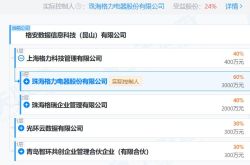
Tianyancha information shows that Gree Electric, through its 60%-owned Shanghai Gree Technology Management Co., Ltd., holds a 40% stake in Ge'an Data and is its actual controller.
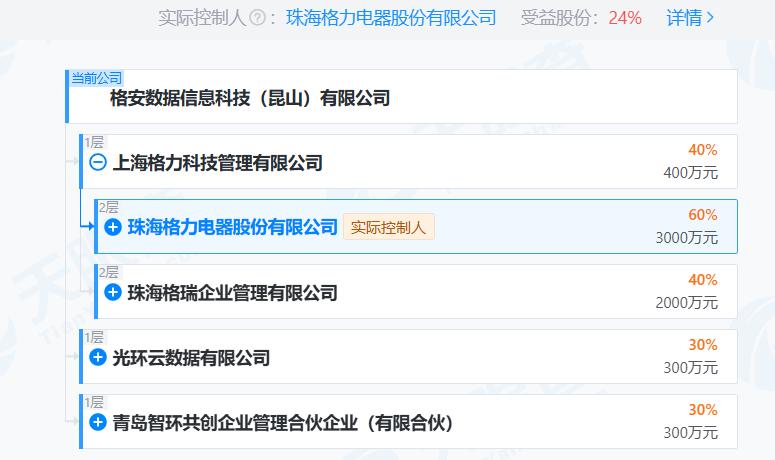
According to the Kunshan Converged Media Center, Ge'an Data will focus on cutting-edge fields such as the latest liquid cooling technology, data processing, cloud computing equipment, computer room refrigeration equipment, and IoT device sales.
AI Empowers Core Home Appliance Business; Dong Mingzhu Teases Year-End "Ace" New Product
While the new track provides performance growth for the company, Gree Electric's core home appliance business is being empowered by AI.
In the "Life Proposal Bureau" program, when talking about AI home appliances, Dong Mingzhu said that for companies without strength, AI is just a conceptual game; for companies with strength, it is real technological upgrading.
Dong Mingzhu believes that true AI intelligence is not superficial voice interaction, but achieving device-to-device connectivity and high-level control between people and devices.
Dong Mingzhu also gave Gree AI air conditioners as an example, saying that they can identify the number of people in a room, sense changes in ambient temperature and humidity, and automatically adjust energy output. When there are many people, the power is increased to ensure comfort; when no one is in the room, the frequency is automatically reduced to save energy, without requiring users to operate manually.
Radar Finance found through review that in recent years, Gree Electric has launched multiple AI products. In the mid-to-high-end market, Gree Electric has launched products such as "AI Cool King," "AI Moon Goddess," and "AI Calm King."
Among them, the "AI Cool King" wall-mounted unit, equipped with AI dynamic energy-saving 2.0 technology, can increase the power-saving rate from 13.6% to 23%; the "AI Moon Goddess," equipped with single cross-flow reversible upward and downward air outlet technology, creates a zero-temperature-difference sleep space.
As a veteran IP born in 1995, the "Calm King" has also been given new vitality by AI. It is reported that the "AI Calm King," which won the AWE2026 Eplun Gold Award, is not only an air conditioner but also the "central brain" of whole-house intelligence.
By integrating multimodal perception and AI decision-making technology, this product features local computing and storage capabilities, enabling deep coordination and management of whole-house appliances. It continues to operate stably even when disconnected from the network and supports intelligent linkage of up to 50 terminals.
According to Gree Electric's semi-annual report, sales of the "Calm King" series nationwide exceeded 5 billion yuan in the first half of this year.
Gree Electric stated that it will focus on product features that are "colder, quieter, and more energy-efficient," incorporate its "wind that does not blow on people" technology, continue to enhance the market reputation of the "Calm King" brand, and build it into a blockbuster product with ten-billion-level sales.
In addition, in March this year, Gree Electric held a strategic cooperation press conference with JD.com titled "Building a New Home with True Love." At the event, the two sides formally signed an agreement, setting the core goal of selling 10 million units of AI series air conditioners over three years.
Notably, in the "Life Proposal Bureau" program, Dong Mingzhu also teased that Gree Electric will launch a product by the end of the year that could redefine the ideal state of home appliances. Positioned at the luxury goods level, she said, "perhaps this air conditioner can still be sold at its original price after 10 years of use."
Radar Finance will continue to follow Gree Electric's subsequent developments.
-
![]()
What Is Astigmatism, Really? Why Tangential and Sagittal Foci "Go Their Separate Ways"
-
![]()
Gree Electric's Performance Weighed Down by Soaring Copper Prices: Will Dong Mingzhu Unveil a "Big Move" by Year-End?
-
![]()
AI R&D Doubles in Speed as Anthropic Redacts Most of a 100-Page Report
-
![]()
Crown New Materials to Inject RMB 228 Million into Zhejiang Optical Film Project
-
![]()
Gaize Technology Officially Announces Takeover of Entire Japanese Optical Powerhouse Plant: Can It Translate Into Production Capacity?
-
![]()
Baidu Begins Building Factories
-
Hong Kong Listed Company Huaxia Culture Technology Enters AI Sector with Mid-Term Profit Alert Exceeding HKD 900 Million
-
![]()
NXP Earnings: Net Income Hits $884 Million as Automotive Chip Growth Lags at 13%