NXP Earnings: Net Income Hits $884 Million as Automotive Chip Growth Lags at 13%
 11/12 2026
 530
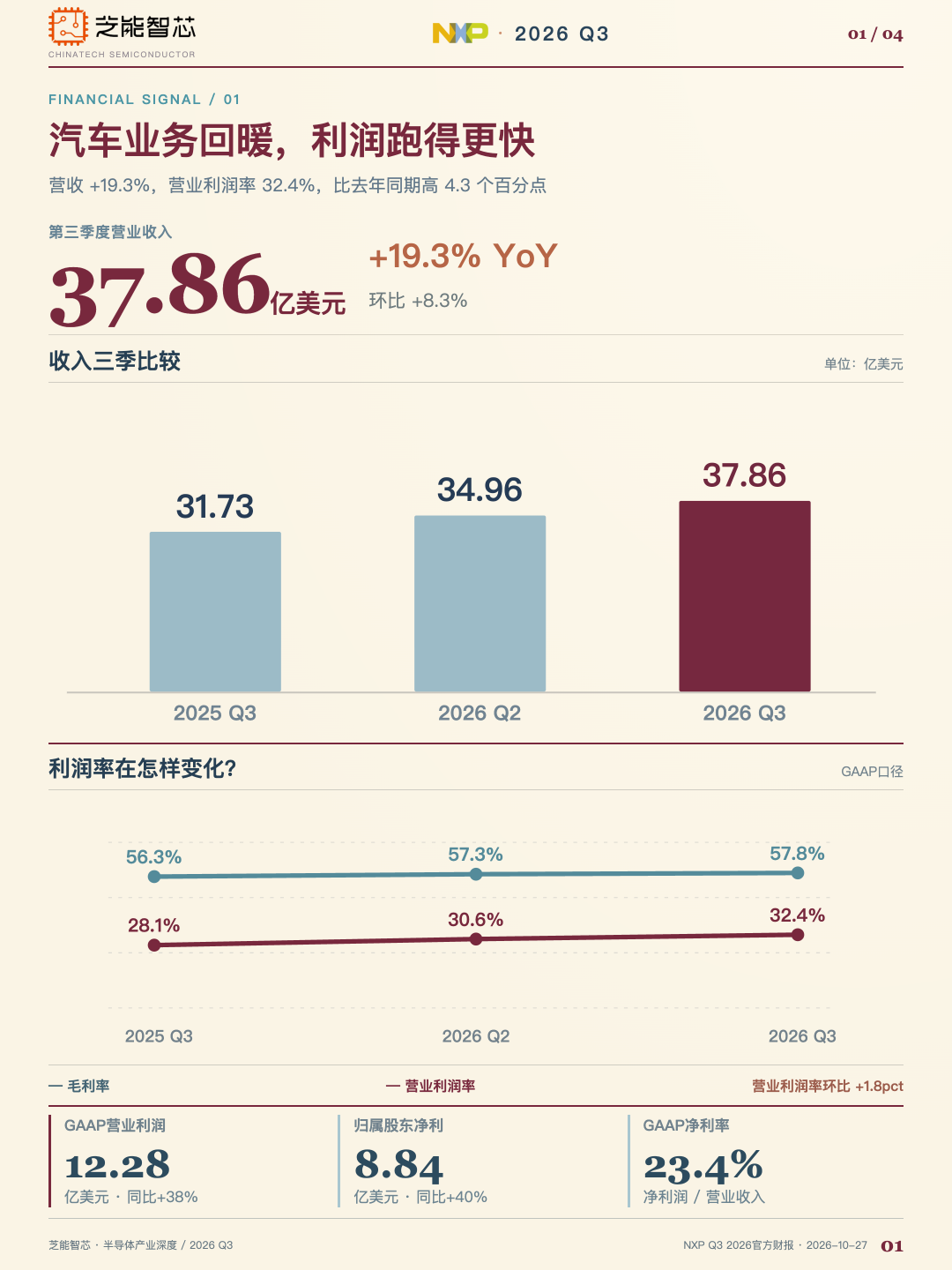
NXP reported Q3 2026 revenue of $3.786 billion, up 19.3% year-over-year, with net income attributable to shareholders of $884 million, a 40% year-over-year increase.
The incremental growth came primarily from outside automotive: although automotive accounts for more than half of group revenue, it was the slowest-growing of the four segments.
For an automotive chip company, growth this quarter was driven first by industrial and communications.
On October 26, the Volkswagen Group announced it would integrate NXP's S32K5 series MCUs into its future zone control architecture, with the first models built on the new architecture launching in 2027. One day later, NXP released its third-quarter earnings report.
Price competition in traditional MCUs continues, and automakers are already working with chip companies well ahead of time to define next-generation electrical/electronic architectures.
Part 1: Operating Cash Flow of $1.256 Billion; Buyback Authorization Increased by Another $5 Billion
Q3 2026 earnings highlights:
◎ Revenue up 8.3% quarter-over-quarter; GAAP gross margin 57.8%, up 1.5 percentage points from a year earlier;
◎ GAAP operating profit of $1.228 billion, up about 38% year-over-year;
◎ Adjusted non-GAAP operating profit of $1.406 billion, operating margin 37.1%. Profit growth outpaced revenue growth.
◎ Cash generation was stronger than profit. Operating cash flow for the quarter was $1.256 billion; after deducting about $50 million in net capital expenditure, non-GAAP free cash flow was $1.206 billion, equivalent to 31.9% of revenue.
In addition to the remaining balance under its existing repurchase authorization, the company added a new $5 billion buyback authorization, expanding manufacturing and R&D capabilities while continuing to return cash to shareholders.
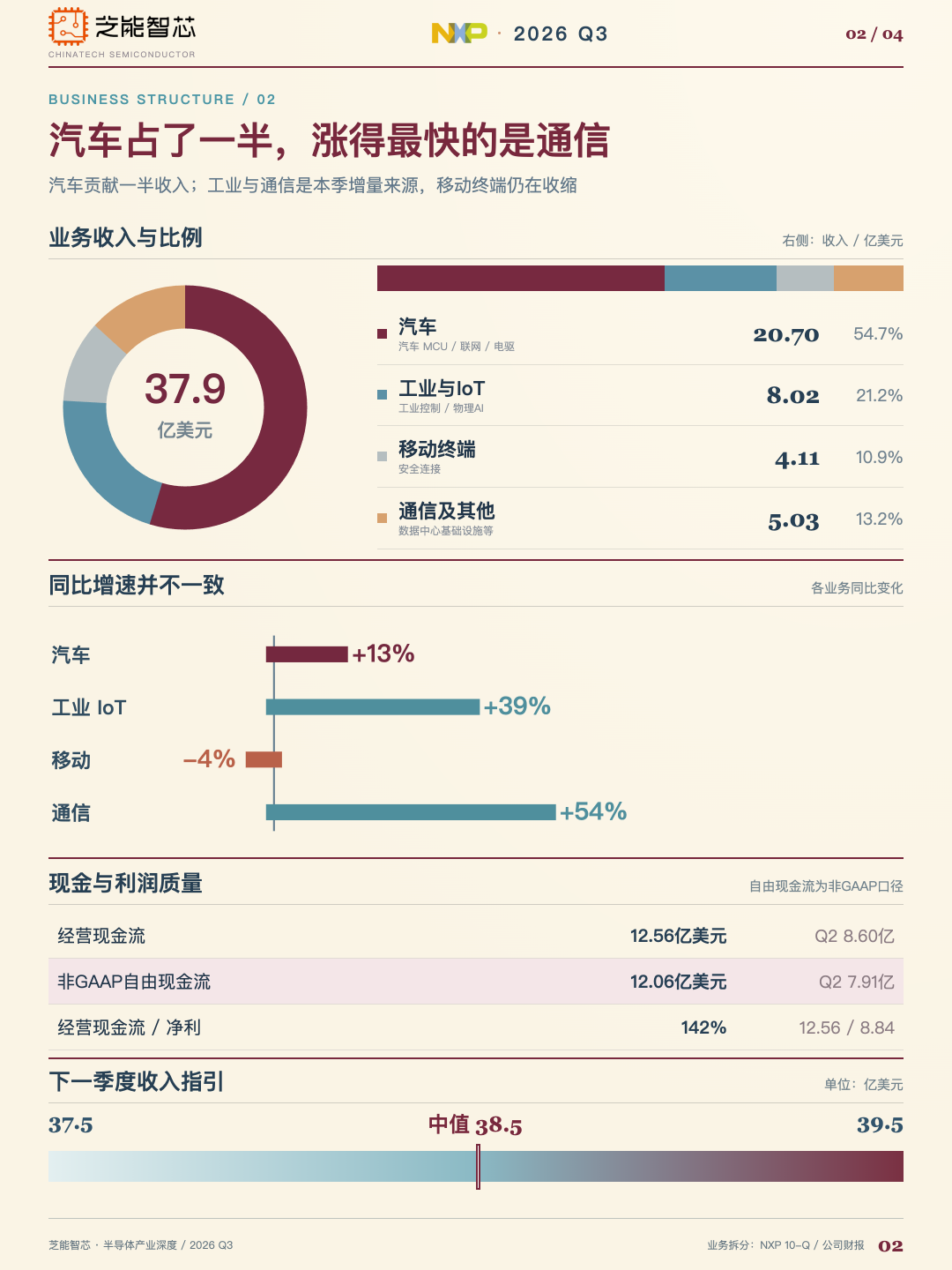
The four segments posted sharply divergent growth rates.
◎ Automotive end-market revenue was $2.070 billion, up 13% year-over-year, accounting for 54.7% of total group revenue;
◎ Industrial and IoT was $802 million, up 39% year-over-year;
◎ Communications infrastructure and other was $503 million, up 54% year-over-year, still less than a quarter of the size of the automotive business;
◎ Mobile end-market was $411 million, down 4% year-over-year.
Part of the incremental growth came from industrial equipment, trusted physical AI, and data center infrastructure.
On the earnings call following the report, CEO Rafael Sotomayor said the company had not seen broad-based inventory replenishment among automotive customers. Demand visibility has improved, and automakers are engaging more directly than before in chip demand planning.
The growth drivers lie in electrification, software-defined vehicles, and ramping production of specific product design wins.
◎ Full-year 2026 product pricing was originally expected to decline slightly; CFO Bill Betz said it is now closer to roughly flat;
◎ In 2027, the company will pass increased upstream input costs on to customers to protect gross margin.
New solutions for software-defined vehicles can command higher average selling prices. Input costs, product generations, and system value have together reshaped the bargaining relationship.
Fourth-quarter revenue guidance is $3.75 billion to $3.95 billion, with a midpoint of $3.85 billion, roughly 2% growth from the third quarter.
Part 2: S32K5 Enters Volkswagen's 2027 Architecture — and Chips Follow the Platform
In the past, a vehicle's body, lighting, air conditioning, chassis, and comfort systems each had their own control units. With multiple ECUs stacked together, wiring harnesses, chip variety, software maintenance, and validation workload all increased.
Zone control architecture consolidates control tasks in nearby locations into a small number of controllers, while a central computing platform handles high-level decisions.
RV Tech, the joint venture between Volkswagen and Rivian, has designated NXP's S32K5 MCU as a common technology module for the zone control architecture, with the solution used across different brands and models.
One MCU corresponds to a platform shared by multiple brands and models. Develop once, expand the range of applicable models, and the project cycle is longer while the volume base is more stable.
Central computing requires high-performance processors, zone controllers require safe and reliable real-time execution, and motor and power systems still contain a large number of analog and power devices.
What S32K5 has to prove is networking capability, functional safety, OTA updates, software toolchains, and long-term supply.
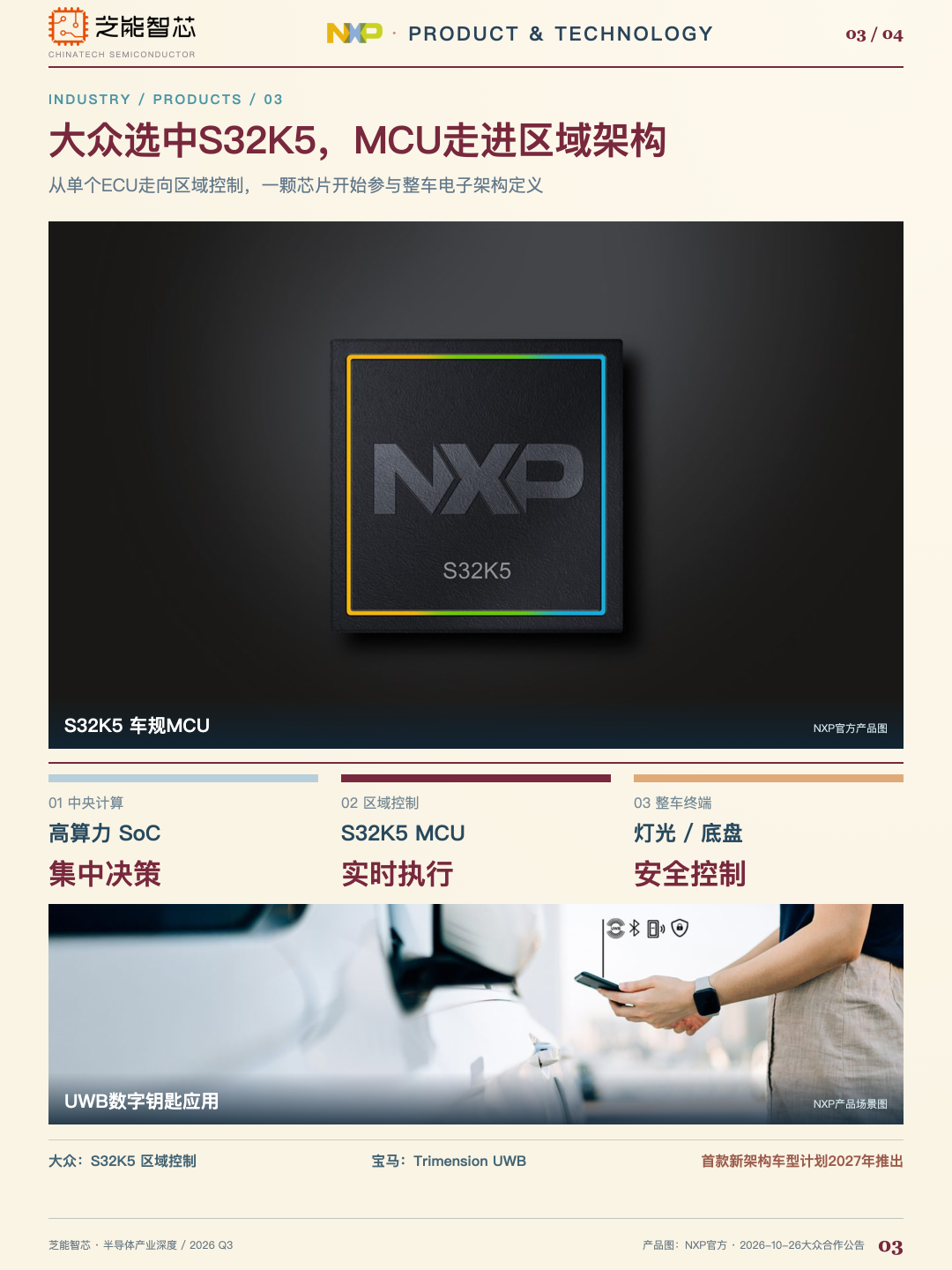
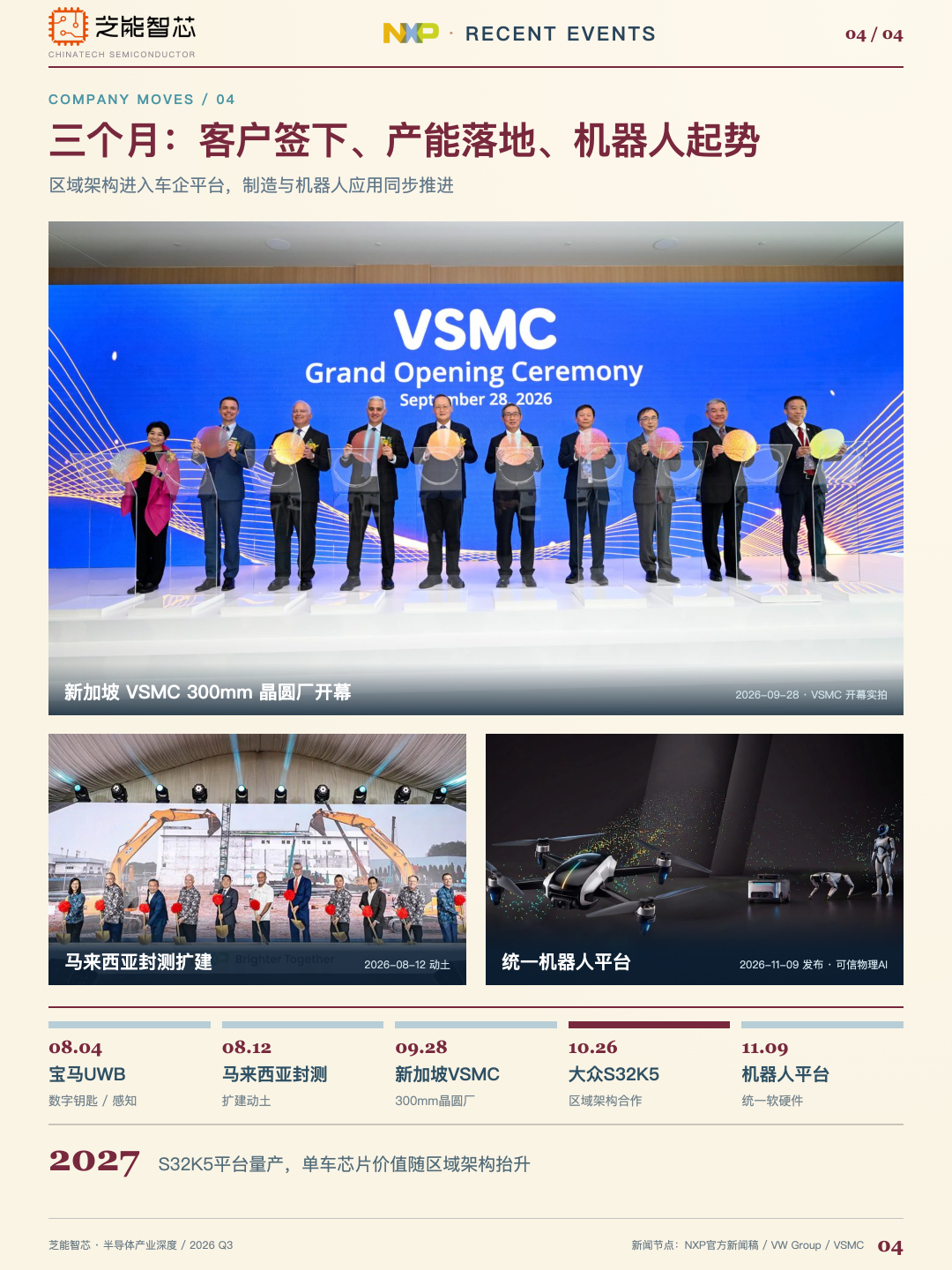
On August 4, NXP announced that BMW would adopt the Trimension ultra-wideband (UWB) solution in selected 2026 model programs for digital keys and proximity sensing.
UWB handles the user's actions every time they approach and enter the vehicle. Ranging, resistance to relay attacks, system integration, and ecosystem compatibility are its competitive strengths.
On August 12, NXP began expansion of its packaging and testing facility in Malaysia; on September 28, VSMC, its first 300mm wafer fab in Singapore in partnership with VIS, held its opening event. The former adds back-end packaging and testing capacity, while the latter adds front-end wafer supply.
China's automotive supply chain continues to pursue localized substitution of MCUs, power devices, and vehicle controllers, and mature-process products face price competition.
Automakers' requirements for zone control and functional safety are rising at the same time, and new MCU platforms create barriers in ecosystem and validation. Defending the traditional automotive market depends on manufacturing cost control, while raising per-vehicle value in zone control architectures depends on system-level R&D.
On November 9, NXP released a unified robotics platform, emphasizing trusted physical AI deployment. Industrial equipment, data center power supplies, and such robotics scenarios all require control, safety, and connectivity products.
What robots and vehicles both need is a combination of real-time control, connectivity, sensing, and security. Whether the system can act as expected in real environments matters more than the computing power of a single chip.
Summary
Competition in automotive chips has shifted from the price of individual part numbers to the right to participate in architectures spanning models and systems. NXP remains keenly aware of this shift.
-
![]()
What Is Astigmatism, Really? Why Tangential and Sagittal Foci "Go Their Separate Ways"
-
![]()
Gree Electric's Performance Weighed Down by Soaring Copper Prices: Will Dong Mingzhu Unveil a "Big Move" by Year-End?
-
![]()
AI R&D Doubles in Speed as Anthropic Redacts Most of a 100-Page Report
-
![]()
Crown New Materials to Inject RMB 228 Million into Zhejiang Optical Film Project
-
![]()
Gaize Technology Officially Announces Takeover of Entire Japanese Optical Powerhouse Plant: Can It Translate Into Production Capacity?
-
![]()
Baidu Begins Building Factories
-
Hong Kong Listed Company Huaxia Culture Technology Enters AI Sector with Mid-Term Profit Alert Exceeding HKD 900 Million
-
![]()
NXP Earnings: Net Income Hits $884 Million as Automotive Chip Growth Lags at 13%