Global Smartphone Shipments to Decline for Second Consecutive Year, Yet Apple's iPhone Defies the Trend with Year-over-Year Growth: Consumers Increasingly Favor Huawei and Apple
 11/18 2026
 549
Fast Technology News, November 18 — The global smartphone market is currently being squeezed simultaneously by a deteriorating macroeconomic environment and continuously rising prices of core components such as memory and flash storage, with industry-wide shipments expected to decline for two consecutive years.
Amid the continued cooling of the overall market, Apple's performance stands in extremely sharp contrast to the industry-wide downturn. The iPhone's market performance has been exceptionally steady—not only has it avoided declining along with the broader market, but its overall shipment volume has actually achieved counter-trend growth.
Morgan Stanley predicts in its latest industry research report that Apple's full-year iPhone shipments in 2027 will reach approximately 270 million units, achieving positive year-over-year growth of 7%, while overall global smartphone market shipments during the same period are expected to still decline by 5% year-over-year.
The report's estimates show that total global smartphone shipments in 2027 will drop to approximately 1.04 billion units.
Previously, the institution had originally predicted that the global market would achieve positive growth of 3.6% in 2027, but has now sharply revised down its growth forecast, while also predicting that full-year global smartphone shipments in 2026 have already contracted by 13.8% year-over-year.
The continuous rise in core component costs is one of the primary triggers for the deterioration of the entire market outlook.
DRAM memory and NAND flash prices have been rising for multiple consecutive quarters, continuously squeezing the profit margins of all phone manufacturers.
For Android phone makers focused on the mid-to-low-end market, the pressure from this round of cost increases is particularly difficult to absorb. Their product pricing is generally low, brand premium space is extremely limited, and there is almost no room to pass on cost pressure to ordinary consumers by raising end-product prices.
Many small and medium-sized manufacturers have already fallen into the awkward situation of losing money on every unit sold. Even Apple had previously publicly warned that memory chip-related costs are rising rapidly.
Even in such an environment, Apple still demonstrated market resilience that is in a league of its own across the industry. In the second quarter of 2026, total global smartphone market shipments declined by 11% year-over-year, but iPhone shipments during the same period still recorded positive growth of 3%, moving completely independently of the broader market.
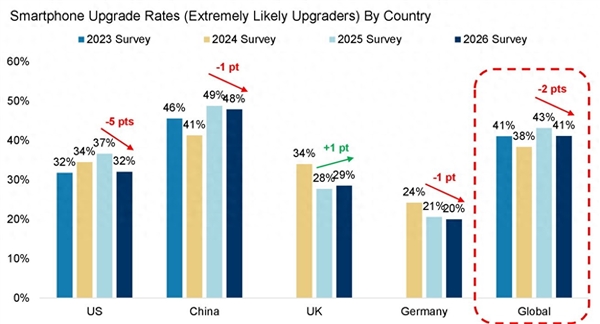
Apple's user retention rate also set a new all-time record during the same period. The latest consumer survey data shows that Apple's user retention rate rose 3 percentage points year-over-year, reaching a historic high of 93%.
Apple's net switching rate metric—used to measure the difference between consumers' willingness to switch into and out of a brand—also directly rose to a high of 12%.
Among all mainstream leading phone manufacturers, Huawei is the other brand besides Apple with a positive net switching rate and continuously improving data.
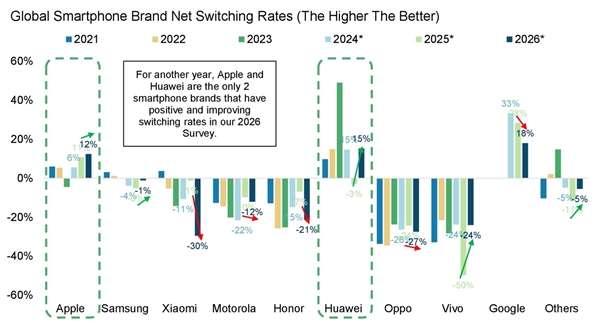
Samsung and Google's net user switching rates are relatively neutral, while Xiaomi, Motorola, Honor, OPPO, and vivo—all mainstream players in the Android camp—have negative net user switching rates, all being in a state of net user outflow overall.
Apple's upcoming first foldable phone, the iPhone Duo, is regarded by Morgan Stanley's analyst team as Apple's most important opportunity to attract existing Android users going forward.
Relevant user survey results show that among respondents currently using non-iPhone phones, 22% explicitly expressed interest in directly purchasing the iPhone Duo when they switch phones. Among them, China has the highest potential interest at 34%, the US market at 17%, the UK at 9%, and Germany at 7%.
The battle for existing users in the entire global smartphone market has entered an unprecedentedly brutal phase. Leading brands are relying on high user loyalty and premium pricing power to withstand cost pressure, while the survival space for mid- and tail-end manufacturers will only be further squeezed. The pace of industry reshuffling will far exceed everyone's previous expectations.
-
![]()
1.881 billion! Another central enterprise wins the bid for a big data center project
-
Will the Fangchengbao Titan 9 Go on Sale Tomorrow? Is the Predicted Official Price Range of 300,000–380,000 Yuan Accurate?
-
Top 10 Fastest-Growing and Most Profitable Companies in the Token Export Sector
-
![]()
JieJie Microelectronics Bets Another 1.5 Billion Yuan on High-Voltage Chips: The Ambition Behind the Layout
-
![]()
Phone Prices Are Rising Across the Board—So Why Is Apple the Only One Selling More?
-
Forecasting the Official Launch Price Range of the iCAR V25 from V23 and V27 Sales Trends
-
![]()
In the AI Era, Tokens Are This Small Chinese City's "New Local Specialty"
-
![]()
Global Smartphone Shipments to Decline for Second Consecutive Year, Yet Apple's iPhone Defies the Trend with Year-over-Year Growth: Consumers Increasingly Favor Huawei and Apple