Beauty Joins In, ByteDance Ramps Up Investment Game
 09/17 2026
 447
447
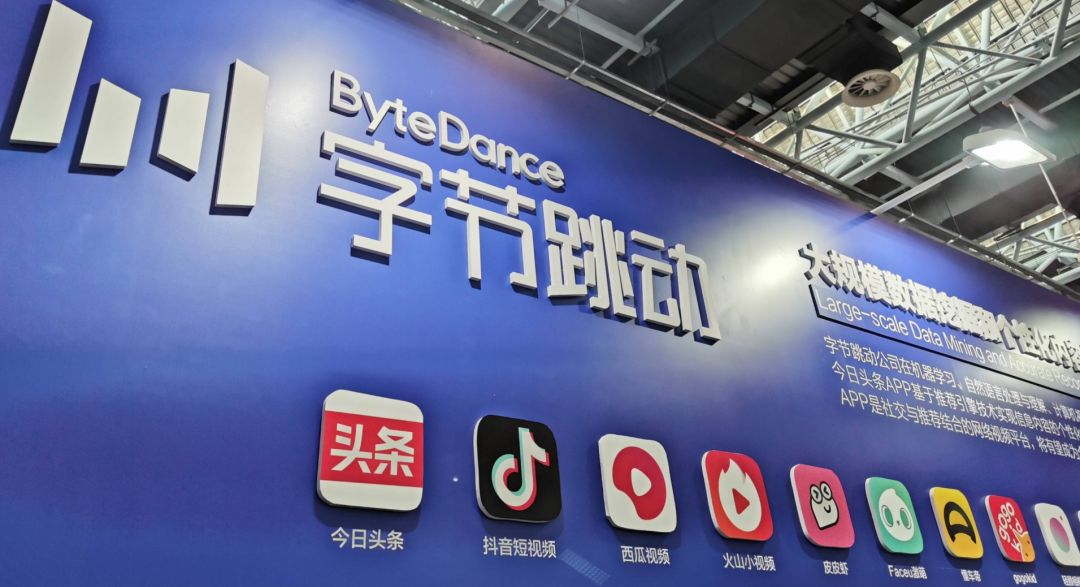
A company that once revolutionized the content industry with its algorithms is now embarking on a new learning journey: mastering the art of investing for the future.
Since September, the tech world has been abuzz with a significant personnel shift.
Multiple media sources, citing insiders, have reported that Jiang Kai, a former partner at Coatue, has joined ByteDance to spearhead its financial investment team in Hong Kong, directly reporting to ByteDance's CFO, the renowned beauty in tech circles, Julie Gao.

Julie Gao
Public records reveal that Jiang Kai has a long-standing expertise in investing in Asian technology and consumer sectors, with notable participations in projects like Zuoyebang, Kuaikan Manhua, CertiK, and Yunquna.
Two crucial points emerge from this.
Firstly, the Hong Kong base signifies a natural inclination towards global technology projects.
Secondly, the focus on financial investment underscores a shift from past strategic investments tied to business expansion, emphasizing professional judgment, return on investment, and investment discipline.
It's worth noting that media reports have not divulged details on team size, capital pool, or specific investment amounts. Hence, labeling this as a "ByteDance重启大规模战略投资" (ByteDance restarting large-scale strategic investments) would be premature. Nonetheless, ample evidence suggests ByteDance is indeed bolstering its investment prowess.


ByteDance's Investment Journey: Present but Scattered
The most pivotal investment in ByteDance's history might not be a minority stake in a domestic startup but its 2017 acquisition of Musical.ly.
Subsequently, Musical.ly was merged with TikTok, becoming one of ByteDance's most successful global product assets. In 2021, ByteDance acquired Moonton Technology to bolster its gaming business.
These deals collectively highlight that ByteDance's early investments were an extension of product management, focusing on users, content, product capabilities, and global traffic, with investment serving as a means to acquire these capabilities.
Its strength lay in its swift response, seamlessly integrating the technology, teams, and products of invested companies into its main business.
However, its weakness was also apparent: investment boundaries tended to expand alongside business boundaries, making it challenging for outsiders to discern which investments were strategically synergistic and which were purely financially motivated.
Around 2022, as the internet industry entered a contraction phase, ByteDance restructured its organizational and business frameworks, leading to changes in its strategic investment department.
Since then, ByteDance hasn't completely halted external investments, but market perception has significantly diminished, with its public investment pace and visibility falling short of Tencent and Alibaba.
This perception that "ByteDance has lagged in the investment arena" stems not from a lack of cash or technological understanding but from its recent focus on internal products, global operations, and AI self-research, missing out on some opportunities to secure positions through capital in advance.
Why the renewed investment focus now?
Because AI is reshaping the investment timeline.
In the past, a company could develop a product and then decide on upstream or downstream investments.
Now, large models, computing power, data, robotics, and applications are rapidly converging. By the time a direction is validated by the market, the best projects have often completed multiple funding rounds and are no longer cheap.
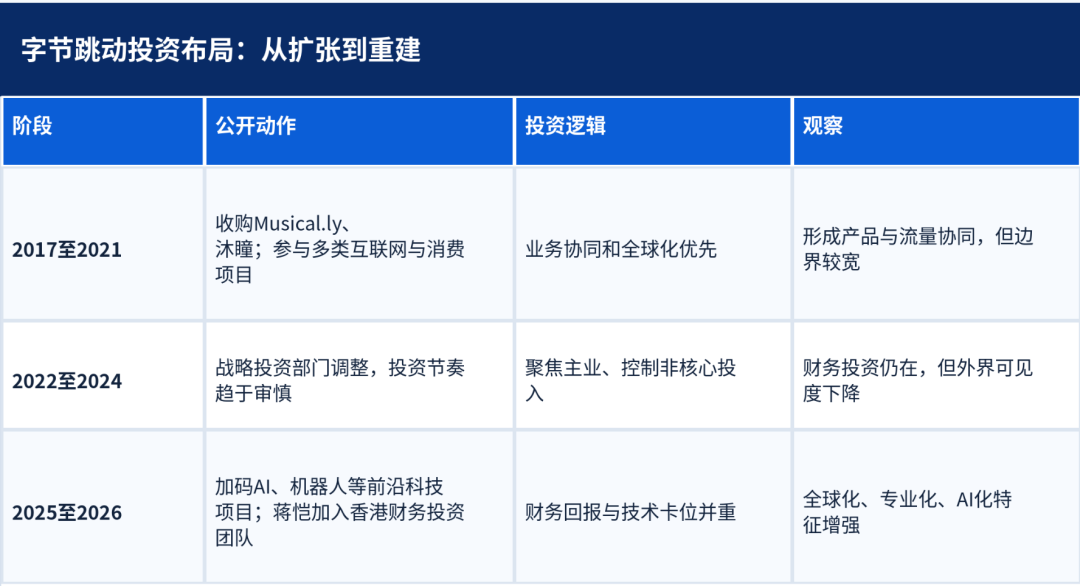
ByteDance's current investment direction showcases three key shifts.
Firstly, it's investing in harder technologies. Public reports mention ByteDance's participation in AI and embodied intelligence projects like Shengshu Technology, Yingmou Technology, and Independent Variable Robotics.
Independent Variable Robotics secured approximately RMB 1 billion in Series A++ funding in 2026, with ByteDance participating. The company had previously received investments from Alibaba and Meituan.
This case is highly symbolic, indicating that internet giants are shifting from competing for traffic entry points to competing for intelligent entry points in the physical world.
Secondly, it's investing more globally. The Hong Kong team represents more than just a change in office location; it suggests that project sourcing, investment currencies, legal structures, and exit markets may become more internationalized.
ByteDance leverages both TikTok's globalization experience and a history of collaborating with institutions like Coatue. Jiang Kai's addition fills gaps in professional investment networks and long-term project screening capabilities.
Thirdly, it's enforcing stronger financial discipline. The question ByteDance now faces is not "Can this project collaborate with Douyin?" but rather "Is it still worth investing in even without business synergy?" This marks a shift from a business unit mindset to an investment institution mindset.
Four Tech Giants, Four Investment Styles
Tencent stands out as the most typical long-term investor, boasting a strong ecological connectivity and relatively mature exit awareness.
Projects like JD.com, Meituan, Pinduoduo, and Bilibili have enabled Tencent to form extensive connections across the internet industry chain.
According to its 2025 annual report, as of the end of 2025, Tencent held equity in listed investment companies with a fair value of approximately RMB 672.7 billion. While this figure represents book value and not realized profits, it underscores investment's importance on Tencent's balance sheet.
Tencent's strength lies in leveraging social, gaming, payment, and cloud services to support the growth of invested companies. Its weakness is its vast investment portfolio, where market fluctuations can impact profits through fair value adjustments, and exit timings can be influenced by industrial relations and regulatory environments.
Alibaba's investment logic has evolved from e-commerce ecosystem expansion to a renewed focus on cloud and AI. It once widely deployed capital in retail, logistics, consumption, and local services but has recently increased its emphasis on AI, chips, and infrastructure.
When disposing of Sun Art Retail in 2025, Alibaba anticipated a shareholder loss of approximately RMB 13.177 billion from the transaction, reminding the market that not every past strategic investment can exit at ideal prices.
Alibaba's strength lies in its deep industrial resources, with cloud and e-commerce providing real-world scenarios. Its weakness is its large asset base and historical burdens, with investment portfolio optimizations often accompanied by significant accounting fluctuations.
Baidu resembles a technology-focused investor. "Early to bed, late to rise" is a common online evaluation. Its investments typically revolve around AI foundations, intelligent cloud, autonomous driving, and applications, with long project growth cycles and returns not always immediate. However, Baidu's strategy warrants reconsideration by capital.
Baidu's 2025 annual report shows general business revenue of approximately RMB 102.5 billion, down 2% year-on-year, with online marketing under pressure partially offset by cloud service growth.
For Baidu, investment and self-research are not separate systems but rather compete for time around AI commercialization.
Meituan's investments are closer to operational realities and have been highly successful. It focuses on whether dining, retail, delivery, merchant services, and robotics can enter real-world scenarios.
Independent Variable Robotics, which has received investments from Meituan, Alibaba, and ByteDance, serves as an excellent observation window. Meituan's capital moves do not necessarily pursue the hottest valuations but rather prioritize improvements in supply-side and fulfillment efficiency.
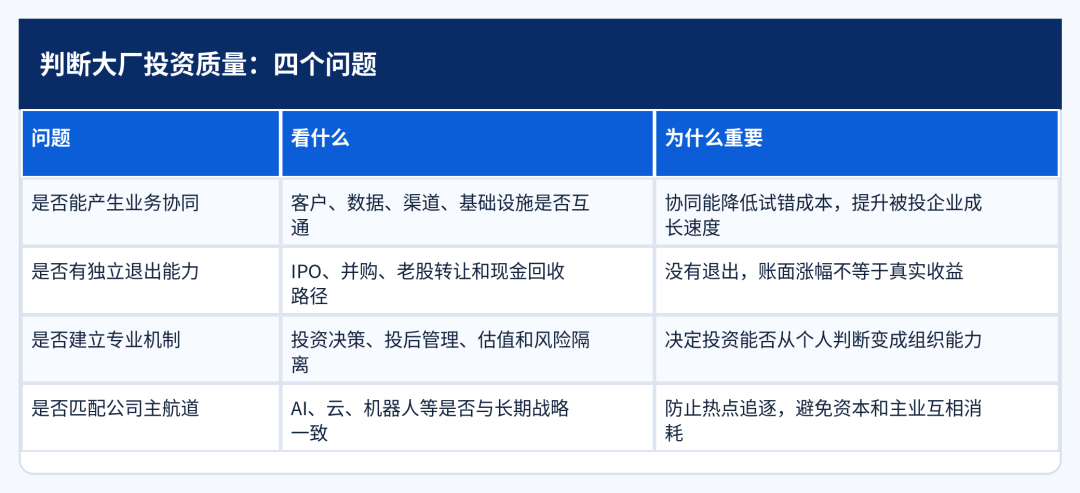
None of these four companies is inherently superior. Tencent excels in portfolio and connectivity, Alibaba in industry and infrastructure, Baidu in technological direction, and Meituan in scenario implementation.
ByteDance's past strengths lay in products and growth, while the professionalization, globalization, and exit management of its investment system are precisely the areas it needs to strengthen.
What Will ByteDance Invest in Next?
I believe ByteDance will not revert to its past scattergun investment approach but will instead advance along three lines.
The first line is AI infrastructure, including computing power, chips, data tools, and model services. ByteDance has already established self-research capabilities through Seed, Doubao, and directions like video and 3D generation. External investments can complement technical areas not easily covered by internal R&D.
The second line is AI applications, particularly products that can integrate with content production, advertising, e-commerce, and enterprise collaboration.
ByteDance's most valuable resources are not singular traffic but content distribution, user feedback, and commercialization systems. Truly worthwhile investment projects should be verifiable in these scenarios, not just remaining at the demonstration level.
The third line is embodied intelligence and robotics. This direction has not yet formed a stable business model, making it a stage where tech giants can place early bets.
However, robots are not internet products; costs, supply chains, safety responsibilities, and delivery cycles will prolong return timelines. If ByteDance enters this space, it must accept that it will not be the next short-video phenomenon and cannot demand immediate monetization from all projects at internet speed.
Final Commentary
The statement "ByteDance has fallen behind in the investment arena and is now stepping up efforts" is half fact, half emotion.
The fact is that Tencent and Alibaba have continuously increased their stakes in AI and hard tech in recent years, with Tencent holding a listed investment portfolio worth hundreds of billions of yuan. ByteDance's external investments have been more low-key and cautious, missing some market windows. The emotion stems from the tendency to equate investment volume with capability and hot project lists with performance.
True investment capability lies not in backing a single company but in consistently discovering, pricing, enabling post-investment growth, and exiting with returns.
The significance of Jiang Kai's addition may not lie in the size of the next investment but in whether ByteDance begins to establish a replicable mechanism.
ByteDance is not short of cash, technology, or global scenarios. What it lacks is the organizational capability to translate these resources into capital judgment. Competition in the AI era is no longer just about model parameters or product experiences.
Whoever can see changes earlier, buy into them more accurately, and exit after they materialize will truly possess the ability to navigate cycles.
If ByteDance once captured user interests through algorithms, it now needs to capture industrial directions through investment.
This time, the market will judge not by whether it makes a move but by whether it can turn each move into a long-term capability.
-
Huawei Relinquishes AITO, Seres Assumes Control
-
Entering a New Phase of Auto Exports: BYD and Chery Pursue 'Vehicle Parity Growth'
-
Seres’ Ascendancy in AITO: A Journey Built Over Time
-
![]()
An Apple Product Seven Years Late Enters a Market Where It Can't Set Prices
-
![]()
2026 China Automotive Net Promoter Score (NPS) Index Research: Product Experience Fuels Word-of-Mouth, Brand Marketing Holds the Key to Breakthroughs
-
![]()
Beauty Joins In, ByteDance Ramps Up Investment Game
-
![]()
Jensen Huang Hits Back at Ray Dalio: Is AI the Next Big Financial Bubble?
-
![]()
Battle for the Gateway to the World Model: ByteDance Leans Left, JD.com Leans Right