Has Qualcomm Begun Paying Royalties to Huawei?
 10/13 2026
 585
585
Original content from the editorial team of Caigou Business Review
Author | Xuan Niao
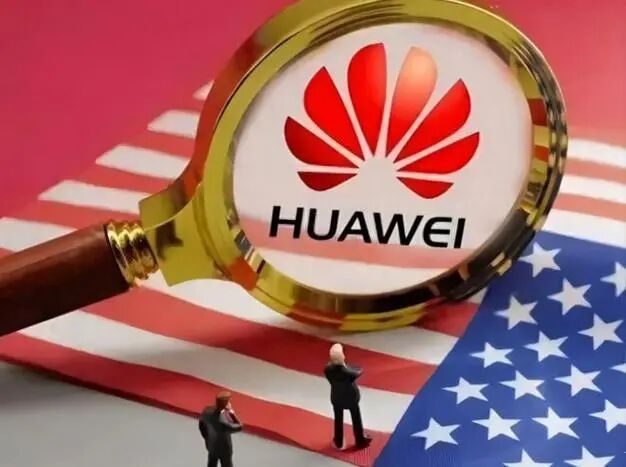
On the afternoon of October 5, 2026, Huawei's official website and its overseas social media accounts simultaneously released an announcement: Qualcomm has declared its intention to pay Huawei for patent licensing. This news immediately propelled the Weibo hashtag #QualcommObtainsHuaweiLogicFoldingLicense# to the forefront of trending topics. Many people's initial reaction was, "Did I misread that?" However, upon comparing the original announcement with reports from foreign media, it became evident that this was no misperception.
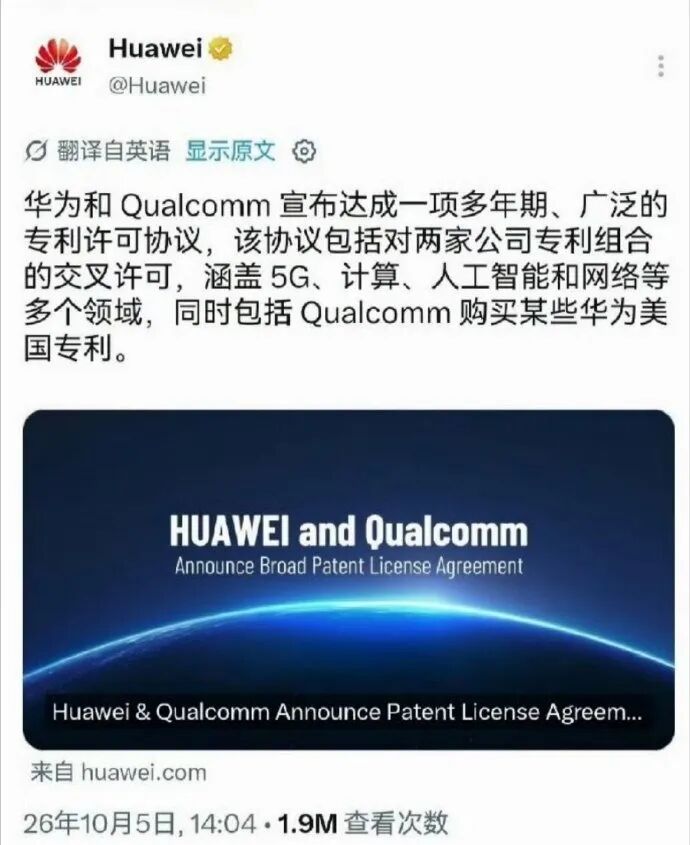
Huawei's official Weibo announcement was measured and succinct: Huawei and Qualcomm have forged a multi-year, comprehensive patent licensing agreement, encompassing cross-licensing of each other's patent portfolios in 5G, computing, artificial intelligence, networking, and other domains. Concurrently, Qualcomm will acquire a selection of Huawei's U.S. patents. The overseas version of the announcement added an additional layer of detail: The transaction will be finalized after securing the requisite regulatory approvals, adhering to the principles of fair, reasonable, and non-discriminatory (FRAND) licensing. Neither party disclosed specific financial figures.
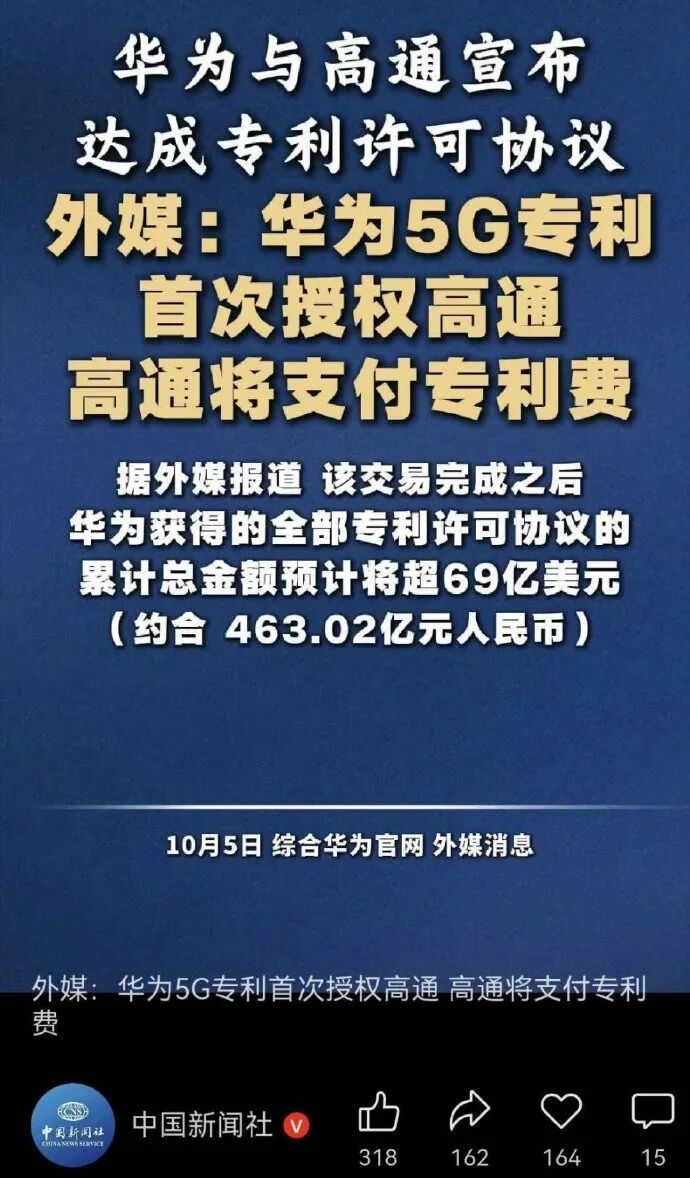
According to Reuters, this agreement marks the inaugural patent licensing pact between Huawei and Qualcomm covering 5G technology and represents Huawei's first accord to yield "positive revenue" from Qualcomm. Historically, Huawei has consistently been the entity paying royalties. China News Service reported that following this transaction, the cumulative total of all patent licensing agreements is projected to surpass $6.9 billion (approximately 46.3 billion RMB).
While the official announcement merely disclosed the overarching framework, Bloomberg, citing insider sources, reported that the agreement also encompasses licensing of Huawei's LogicFolding (logical folding) chip technology patents. Logic Folding constitutes a pivotal technology within Huawei's "Tao's Law": Rather than obsessively pursuing transistor miniaturization, it vertically stacks chips through 3D wafer-level hybrid bonding, compresses signal transmission time, and approximates advanced process performance using mature fabrication techniques. This methodology was initially unveiled by Huawei Semiconductor's head, He Tingbo, in May of this year, with its inaugural commercial application in the Kirin 9050 Pro, utilized in the Mate 90 series. Given Qualcomm's inability to procure EUV lithography machines, its acquisition of this license effectively validates Huawei's chip design approach.

Flashback to 2019, when the U.S. placed Huawei on the Entity List in May, Ren Zhengfei stated in an interview with CCTV's "Face to Face": "We never entertained the notion of our demise. We had already commissioned the production of 20,000 gold medals inscribed with 'Huawei Never Dies.'" He also underscored that Huawei procured 50 million chipsets annually from Qualcomm, "never excluding or resisting" them. Seven years on, the erstwhile chip purchaser now collects royalties from its former supplier—a testament to his assertion, "They underestimated our strength."
Online commentary surged ahead of news coverage. Tech blogger Jia Jinghua hailed it as a watershed moment: "Huawei has risen to prominence. Qualcomm is paying for the first time and securing Logic Folding licensing."
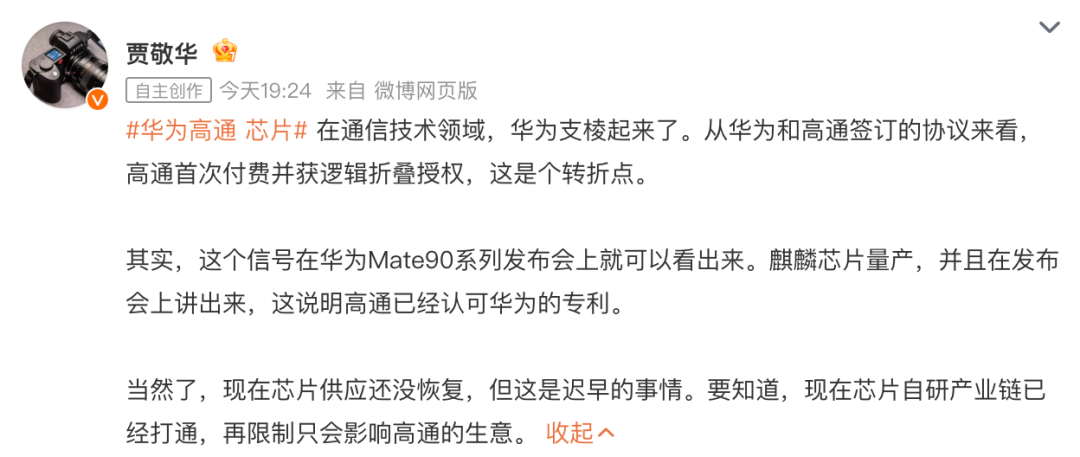
One netizen remarked: "Selling patents is unequivocally more lucrative than selling phones. Only truly exceptional manufacturers like Huawei would have Qualcomm seek patents from them."

The most widely circulated comment stemmed from @XiaoQiFlag's calculation: "In the future, Xiaomi pays Qualcomm royalties, and Qualcomm pays Huawei royalties. For each chip, Huawei collects 5 RMB from Qualcomm, while Qualcomm might collect 10 RMB from Xiaomi." While the arithmetic may not be precise, it underscores the mechanism of royalty escalation along the supply chain.

Two clarifications are in order: Firstly, the $6.9 billion figure represents the cumulative projected revenue from all Huawei licensing agreements, not the transaction price for this specific deal. Secondly, the transaction necessitates regulatory approval, and the "Logic Folding license" is derived from Bloomberg's insider sources—the official announcement did not explicitly name it, rendering the hashtag's claim more advanced than official disclosures.
From surviving on backup plans in 2019 to compelling rivals to pay by the rules through polar codes and Logic Folding in 2026—for a company once severed from its supply chains, the most compelling evidence is not rhetoric but having former adversaries open their wallets.
Disclaimer: This article is crafted based on publicly available information or details provided by interviewees. However, Caigou Business Review and the author do not vouch for the completeness or accuracy of the information or associated materials mentioned or displayed herein, nor do they represent any institutional stance. In the event of infringement, please contact us for removal. Under no circumstances shall the information or opinions expressed herein constitute investment advice to any individual.
▼
-END-
-
![]()
Who is Taking Away the Profits of Car Companies: Battery or Intelligent Driving?
-
![]()
Tencent Successively Discontinues Two AI Agents
-
![]()
Has the Brake Pedal of JAC Motors Really Broken? The Market Will Teach Every Automaker with 'Fatal Flaws' a Lesson
-
![]()
Changsha’s Emerging Powerhouse in Computing: Cancels RMB 3 Billion Contract!
-
![]()
Production Capacity Can’t Keep Up with Orders! This Optical Enterprise Soars 449% on Debut
-
![]()
Q3 Report | Yuanjie Technology's Net Profit Expected to Surge Fivefold, Transitioning from 'Shortage Dividends' to 'Delivery Challenges'
-
![]()
The Computing Power Price War Hits Silicon Valley
-
![]()
The AI Office Sector is Forming a 'Three-Pillar' Landscape