BAIC's August Sales Report Omits Joint Venture Data
 09/14 2026
 456
456
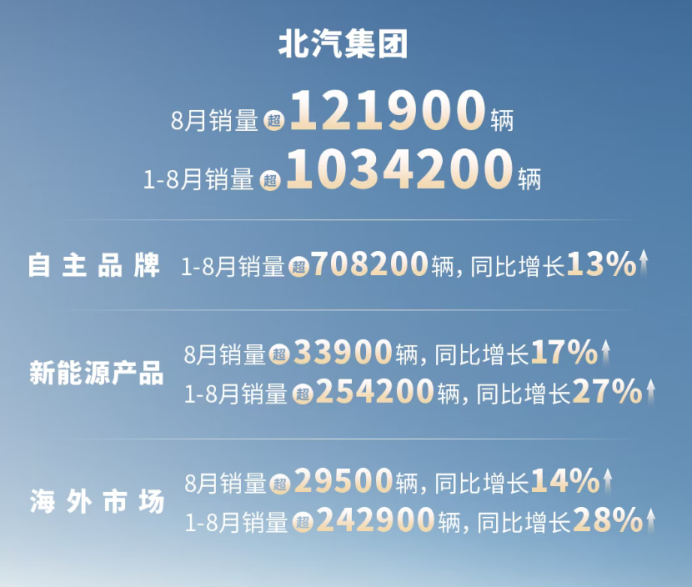
Recently, BAIC Group unveiled a sales report for the January-August period that has sparked considerable discussion. According to the data, the group's total vehicle sales in August this year exceeded 121,900 units, with cumulative sales from January to August surpassing 1.034 million. Among these, independent brands recorded a cumulative sales volume of 708,200 vehicles from January to August, marking a 13% year-on-year increase. New energy vehicles (NEVs) achieved cumulative sales of 254,200 units during the same period, up 27% year-on-year. Overseas exports also showed robust growth, reaching a cumulative total of 242,900 vehicles from January to August, a 28% year-on-year increase. The three major business segments—independent brands, NEVs, and overseas exports—all demonstrated positive growth simultaneously, indicating a relatively strong overall performance. However, notably absent from the entire announcement was any data pertaining to joint venture brands.
This selective disclosure of information often reveals more than just the numbers. For a considerable period, joint venture segments such as Beijing Benz and Beijing Hyundai have been pivotal contributors to BAIC Group's sales and profits. Today, these two joint ventures are no longer separately highlighted in official reports, indirectly suggesting their diminished role and influence within the group.
A closer examination of BAIC Group's business segments reveals an even more pronounced trend of divergence.
Data indicates that independent brands sold over 708,200 vehicles from January to August this year, up 13% year-on-year, serving as the largest contributor to the group's sales volume. The NEV segment acts as a growth catalyst for the group, with August sales exceeding 33,900 units, a 17% year-on-year increase. The overseas market also made a significant impact, with August export sales surpassing 29,500 units, up 14% year-on-year, thereby opening up new avenues for growth.
Each of these three segments contributed distinct growth drivers. However, conspicuously absent from this announcement was any mention of joint venture brands. The reasons for this omission become apparent when considering the market performance of these joint ventures.
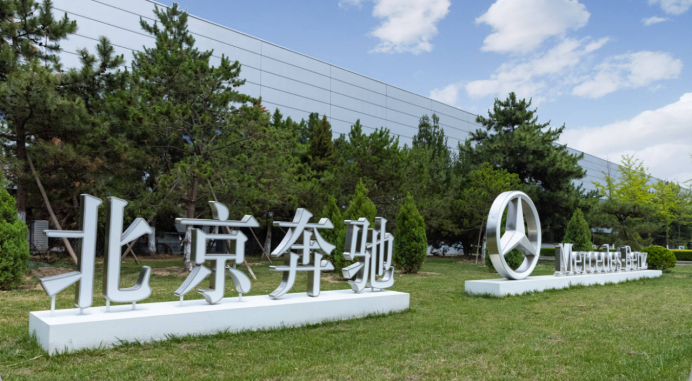
Take Beijing Benz, for instance. It had long held sway in the luxury brand market with several key models in its early years. In 2023, Beijing Benz sold 586,626 vehicles. However, as competition intensified in the domestic luxury fuel vehicle market in recent years and local high-end NEV models continued to erode profit margins, Beijing Benz faced mounting pressure. In 2024, its annual sales dipped slightly to 563,053 units, a roughly 4% decline. The downward trend accelerated in 2025, with annual sales falling to 451,666 units, a nearly 20% drop.
In 2026, Beijing Benz's situation continued to worsen, with domestic market sales remaining under pressure. Sales of its key fuel vehicle models contracted, while market acceptance of its pure electric products remained limited. From January to August, cumulative sales reached only 214,220 units, with all its key models under pressure. Sales of the Mercedes-Benz C-Class dropped 37.9% year-on-year in the first five months, the GLC fell 23%, and the E-Class also saw a slight decline.
Its NEV products, the EQB, EQA, and EQE, received a lukewarm response, struggling to compensate for the decline in fuel vehicle sales. Nevertheless, Beijing Benz has not abandoned its electrification efforts. This year, it launched new domestically produced models such as the all-electric GLC and CLA, leveraging the new MB.EA pure electric platform to bolster its product lineup and enhance its relatively weak pure electric offerings. Whether these newly launched models can offset the decline in fuel vehicle sales remains to be seen in the market.
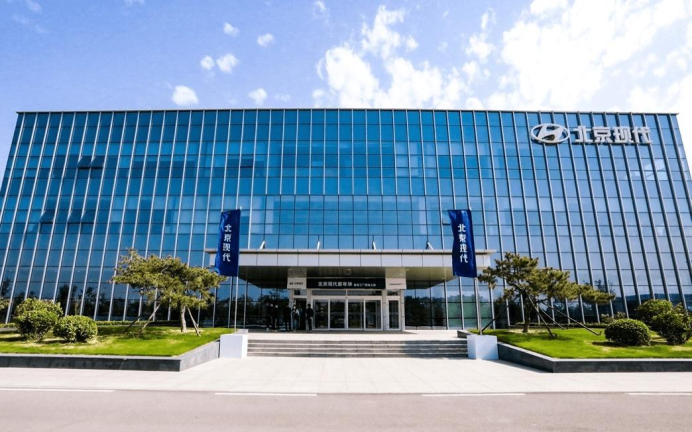
Beijing Hyundai's downward trajectory began even earlier. At its peak, Beijing Hyundai sold over 1.14 million vehicles annually, ranking among China's mainstream joint venture passenger vehicle brands. However, its sales have declined for several consecutive years since 2017. In 2023, Beijing Hyundai's annual sales reached approximately 270,000 units, dropping to about 203,000 units in 2024, a roughly 25% decline. In 2025, its annual sales further contracted to about 180,000 units, and in the first half of 2026, cumulative sales stood at 94,697 units, down about 5% year-on-year, with retail sales in August this year reaching only 4,830 units. Compared to its peak annual sales of over 1 million units, Beijing Hyundai's current sales volume has shrunk to less than one-fifth. The Elantra remains its sales mainstay, while models like the Tucson L and Kustos have seen localized growth, though their overall impact remains limited. In response to market changes, Beijing Hyundai is also advancing its NEV transformation, launching the all-electric Ioniq V model this year and planning to continuously expand its NEV product lineup in an attempt to re-enter the domestic NEV market.
It is clear that the position of the joint venture segment within BAIC Group's business landscape has undergone a dramatic transformation from its former status. This shift is not unique to BAIC when viewed in the broader context of the entire Chinese auto market. According to data from the China Passenger Car Association, in August this year, the NEV penetration rate in the domestic passenger vehicle market surpassed 65% for the first time, up 10 percentage points year-on-year. The NEV penetration rate among independent brands reached 83.9%, indicating a clear shift in market dominance.
Local automakers such as BYD, Geely, and Chery continue to expand their NEV product offerings, covering multiple segments from affordable daily drivers to high-end markets. NEV brands like Leapmotor and Li Auto have also maintained stable deliveries, further squeezing the market space for traditional joint venture fuel vehicles. The markets for family cars and luxury fuel vehicles, once dominated by joint venture brands, are now facing increasing pressure from local NEV models.
In Conclusion:
From the current vantage point, BAIC Group's selective disclosure reflects a typical microcosm of the transformation underway in China's automotive industry. Independent brands, NEVs, and overseas markets are emerging as the core drivers for automakers' upward development, while the joint venture segment, which once held a significant market share, now stands at a crossroads of transformation and adjustment.
For BAIC, the impressive data from its independent brand segment is commendable. While the current transformation efforts in its joint venture segment are clearly visible, whether these adjustments can translate into actual market growth and fill the gaps in its current sales structure remains to be seen over a longer period.
(Images sourced from the internet; removal upon infringement notice)
-
![]()
Rescuing Neta Auto: Even Taiyi Zhenren Steps In, and Associated Company’s Value Soars by 2.5 Billion Yuan
-
Why Does 'Taiyi Shenglian' Step In to Save Neta?
-
![]()
Registered Capital Sees Slight Reduction to 110.7291 Million Yuan! Yongxin Optics Finalizes Industrial and Commercial Registration Amendments
-
![]()
Renaming Marks the Start: Conant Optics’ Smart Glasses Business Gets a Full-Throttle Boost
-
Amazon’s Shift to Passkey Compels Home Furnishing Brands to Overhaul Backend Access Controls
-
![]()
Doubao Mobile Phones: Opting for the Path of Maximum Public Discourse
-
![]()
OpenAI Hits Pause on the AI Race: The Hype Around Large Models Cools Down, and Enterprise AI Enters the Era of Results-Based Adoption
-
![]()
Li Feifei's Atlas Opens the Door to a New World for Embodied AI