Why Do More Camera Sales Lead to Less Profit? The Dilemma of Perception Hardware Provider Haoen Automotive Electronics
 09/14 2026
 578
578
Produced by Zhineng Zhixin
Haoen Automotive Electronics' H1 2026 Financial Report:
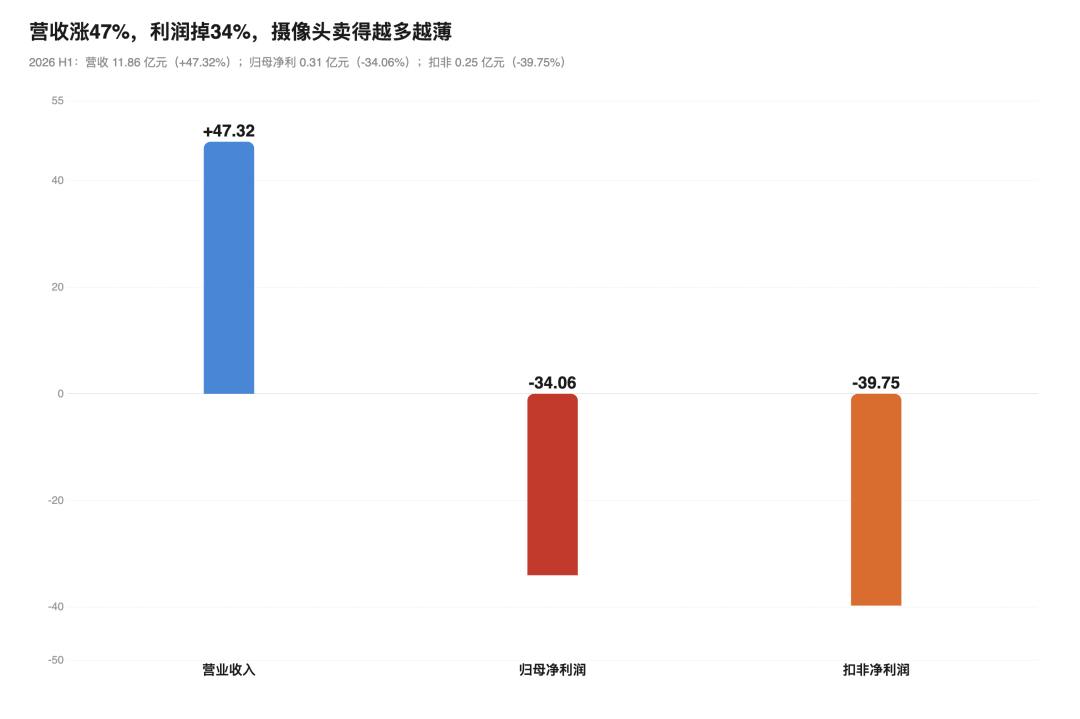
◎ Revenue: RMB 1.186 billion, a 47.32% YoY increase;
◎ Net profit attributable to shareholders: RMB 30.9 million, a 34.06% decrease;
◎ Net profit after non-recurring gains and losses: RMB 24.88 million, a 39.75% decrease.
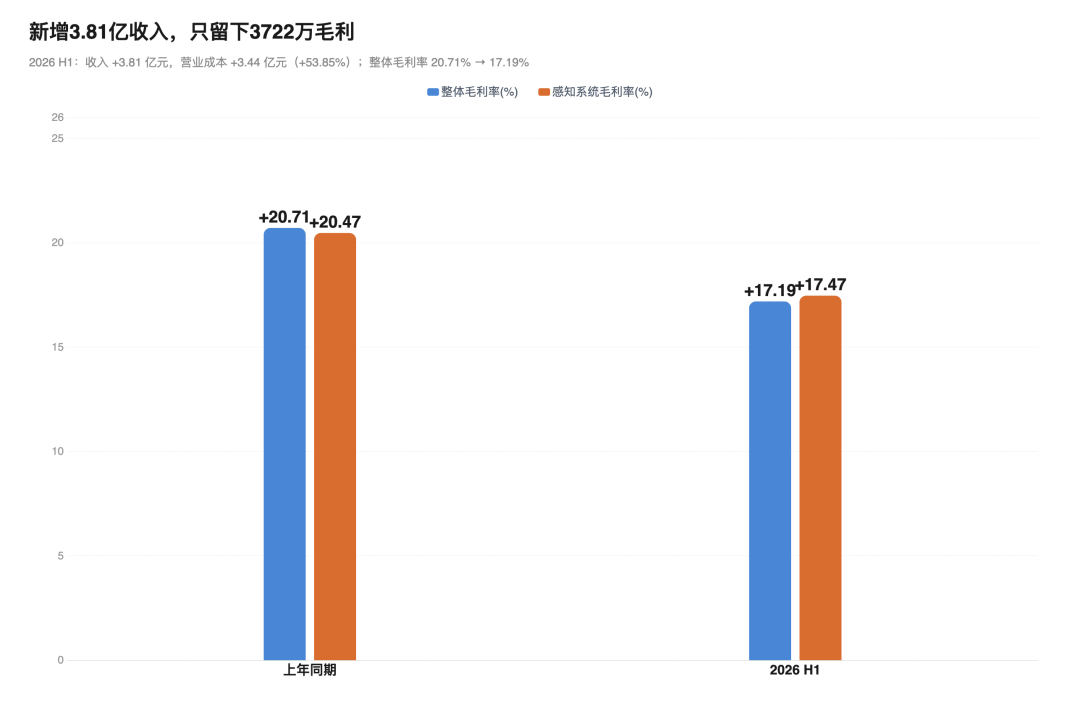
◎ Revenue from automotive intelligent driving perception systems: RMB 1.114 billion, a 39.24% increase, accounting for nearly 94% of total revenue. Gross margin declined from 20.47% to 17.47%.
Cameras, ultrasonic radars, and perception systems are selling in greater quantities, yet profits are shrinking.
The shift towards more affordable models has boosted sales volumes, but gross margins have not kept pace. The company attributes the margin decline mainly to rising raw material costs, with significant increases in the prices of PCBs and memory chips. Annual price reductions and sensor standardization are expected to persist long-term.
Part 1: Why Did Revenue Nearly Double While Profits Declined?
Haoen's order growth accelerated in the first half of the year.
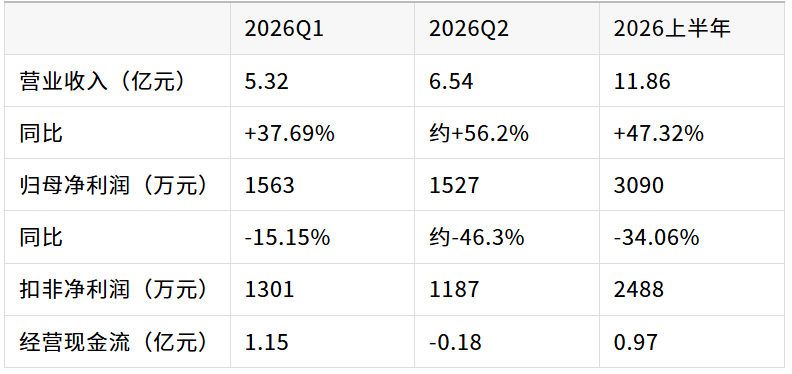
◎ Q1 revenue: RMB 532 million, a 37.69% YoY increase;
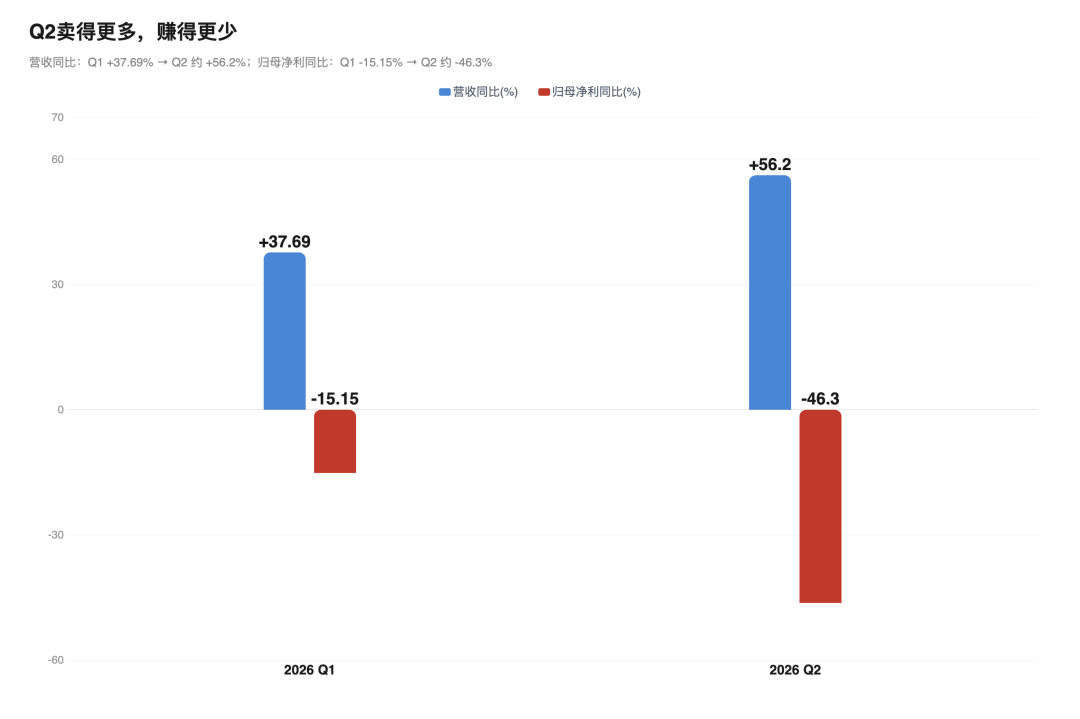
◎ Q2 revenue: RMB 654 million, a ~56.2% YoY increase and a 22.8% QoQ increase. However, Q2 net profit attributable to shareholders was only RMB 15.27 million, a ~46.3% YoY decrease and slightly lower than Q1.
◎ H1 revenue increased by RMB 381 million, while operating costs rose by RMB 344 million, a 53.85% cost increase, 6.5 percentage points higher than revenue growth.
◎ Overall gross margin declined from ~20.71% to 17.19%, a 3.52 percentage point drop. The 17.47% margin for the perception systems segment differs due to other businesses like intelligent computing systems.
◎ Despite a RMB 381 million revenue increase, gross profit only rose by ~RMB 37.22 million. Haoen achieved significant sales growth but retained less than 10% of the additional revenue at the gross profit level.
◎ R&D expenses: RMB 118 million, an increase of ~RMB 24.99 million;
◎ Selling and administrative expenses increased by ~RMB 7.3 million combined.
◎ Credit impairment losses shifted from a RMB 1.43 million reversal last year to a RMB 4.4 million loss; asset impairment losses expanded from RMB 5.74 million to RMB 20.45 million. Together, these impairments dragged pre-tax profit down by ~RMB 20.54 million YoY.
Although R&D expenses grew by 26.9%, this was significantly lower than the 47.3% revenue growth, indicating a decline in the R&D expense ratio.
The profit deterioration resulted from three combined forces: declining product gross margins, increased absolute R&D investment, and rising inventory and receivables impairments. While R&D represents proactive investment, gross margins and impairments reflect pressures on operational quality.
Why Hasn't the Democratization of Intelligent Driving Brought High Profits for Perception Hardware?
Haoen's core products include in-vehicle cameras, ultrasonic radars, millimeter-wave radars, dashcams, parking controllers, and integrated driving-parking domain controllers—the "eyes and ears" of vehicles.
◎ Cameras and ultrasonic radars: Fastest growth in volume and easiest to standardize.
As intelligent driving features trickle down from models priced above RMB 200,000 to those around RMB 100,000, the number of cameras and radars per vehicle has increased, benefiting Haoen. However, the costs of sensor hardware components like chips, lenses, PCBs, and structural parts are transparent, with a growing number of alternative suppliers. Automakers can easily split orders among multiple vendors for price comparisons.
After automakers secure control over algorithms, data, and electronic-electrical architectures, they specify sensor parameters, chip platforms, and interfaces, then outsource hardware manufacturing and calibration to suppliers.
Haoen still holds value in automotive-grade certification, optical design, algorithm adaptation, and mass production yield rates—capabilities that serve as entry tickets to the supply chain.
◎ Millimeter-wave radars and integrated driving-parking systems: Elevate value but intensify competition.
Haoen's existing millimeter-wave radars already supply Seres and Geely, while its domain controllers serve customers like Dongfeng, Geely, and Great Wall Motors.
The company is advancing a 5R5V12U integrated driving-parking solution, integrating five millimeter-wave radars, five cameras, and twelve ultrasonic radars into a single domain controller, with mass production expected in Q4 2026.
Transitioning from individual sensors to domain controllers raises per-vehicle value, enabling Haoen to shift from "selling hardware by unit" to system integration. However, the domain controller market now faces not just camera and radar peers but also competitors like Desay SV, Huawei, DJI, and automakers' in-house teams.
Haoen's strengths lie in a comprehensive perception hardware portfolio, low costs, and extensive parking system mass production experience. Its weaknesses include algorithm capabilities, chip ecosystems, and influence over high-level intelligent driving platforms. It is better suited for mid-to-low computing power, cost-effective integrated driving-parking solutions rather than competing with leading players for system definition rights in advanced urban NOA.
◎ Pure vision route: A technological risk Haoen's business model cannot ignore.
Haoen bets on a multi-sensor fusion route combining cameras, ultrasonic, and millimeter-wave radars. If automakers shift toward a more thorough (thorough) pure vision approach or leverage occupancy networks and end-to-end algorithms to reduce ultrasonic and millimeter-wave radar counts, the per-vehicle sensor value could decline. The company also lists technological path changes as a risk in its private placement materials.
Part 2: Are RMB 20.9 Billion in Designated Projects and Massive Capacity Expansion Opportunities or Pressures?
Haoen disclosed designated project letters with an estimated lifecycle value of ~RMB 20.9 billion, including RMB 14.4 billion for vision perception systems, RMB 4.1 billion for radar perception systems, and RMB 2.4 billion for domain controllers.
Based on historical experience, the company states that ~60-70% of designated projects convert to revenue, though it used a more conservative 50% estimate in its fundraising projections.
◎ Designated projects ≠ firm orders; model launches may be delayed, sales volumes may underperform, and automakers may adjust configurations.
While Haoen has entered customers' development systems, the final revenue realization depends on model sales volumes, supply shares, and lifecycle price reductions.
Through a private placement, the company raised ~RMB 1.033 billion, with net cash inflows from financing activities reaching RMB 1.031 billion. Ending cash balances surged from RMB 767 million at year-start to RMB 1.734 billion, primarily driven by the private placement. After excluding financing inflows, the company did not achieve equivalent autonomous cash growth in H1.
◎ Operating cash flow turned positive at RMB 97 million, up from -RMB 58 million YoY, but Q1 alone contributed RMB 115 million, implying Q2 cash flow was -RMB 18 million. While the H1 turnaround is positive, it does not confirm a complete cash flow improvement.
◎ Inventories rose from RMB 590 million to RMB 772 million, a 30.9% increase; accounts receivable increased from RMB 439 million to RMB 513 million, a 16.7% rise.
Over the same period, notes payable and accounts payable combined increased by ~RMB 207 million, indicating suppliers' payment terms absorbed part of the working capital needed for expansion. Inventory write-downs reached RMB 20.45 million, underscoring the costs of rapid expansion.
Haoen's current fundraising plan aims to add 64.3 million units of intelligent driving perception system capacity, equivalent to 153.1% of existing capacity.
If designated projects convert as planned, the expansion will resolve delivery bottlenecks. However, if industry prices continue to decline, technological routes shift, or model sales underperform, additional depreciation and idle capacity will further compress profits.
Robotics and the low-altitude economy offer new application scenarios.
◎ Robotics perception products have entered mass production, and the company has completed robotics decision-making product development, with partners including Shanghai Zhiyuan Robotics, Zhejiang Humanoid Robotics Innovation Center, Shanghai Huazhijian Robotics, and Shanghai Ant Lingbo Technology.
◎ Robotics domain controllers currently use NVIDIA Jetson Thor chip solutions, with discussions underway for domestic alternatives.
Low-altitude aircraft have secured designated projects from XPENG, GAC Group, and others, with mass production planned from late 2026. However, these revenues remain minimal, serving primarily to validate technological transfer rather than explain profitability.
In June 2026, Haoen established a new subsidiary, Haoen Xinchen Intelligent Computing, to develop AI computing cards and servers. H1 revenue from intelligent computing systems reached RMB 66.5487 million, accounting for 5.61% of total revenue.
This represents an independent growth area beyond automotive perception, sharing power supply and computing technologies with robotics and AIDC but involving entirely different customers, certifications, and competitors. Its scalability remains to be seen over several quarters.
Summary
Haoen's H1 growth is genuine, with expanding customer bases, designated projects, and production capacity. The challenge lies in the perception hardware industry's simultaneous experience of rising penetration rates, declining unit prices, and strengthening automaker control over definitions. As cameras and radars sell in greater volumes, the hope is that profits will follow suit.
-
![]()
Rescuing Neta Auto: Even Taiyi Zhenren Steps In, and Associated Company’s Value Soars by 2.5 Billion Yuan
-
Why Does 'Taiyi Shenglian' Step In to Save Neta?
-
![]()
Registered Capital Sees Slight Reduction to 110.7291 Million Yuan! Yongxin Optics Finalizes Industrial and Commercial Registration Amendments
-
![]()
Renaming Marks the Start: Conant Optics’ Smart Glasses Business Gets a Full-Throttle Boost
-
Amazon’s Shift to Passkey Compels Home Furnishing Brands to Overhaul Backend Access Controls
-
![]()
Doubao Mobile Phones: Opting for the Path of Maximum Public Discourse
-
![]()
OpenAI Hits Pause on the AI Race: The Hype Around Large Models Cools Down, and Enterprise AI Enters the Era of Results-Based Adoption
-
![]()
Li Feifei's Atlas Opens the Door to a New World for Embodied AI