For Seres, Enduring Short-Term Pain Is Preferable to Long-Term Misery
 09/21 2026
 392
392
This may well be the trajectory that other vehicles bearing the 'Jie' (boundaries or realms) brand will follow in the future.
Author: Zhang Wen
Editor: He Jian
Cover Design: Party A and Party B
AITO, Huawei's most successful venture into the automotive industry under its 'Jie' brand, is currently in turmoil.
On September 15, the Harmony Intelligent Mobility Alliance announced a restructuring of its cooperation model with AITO, with Huawei stepping back from a leading role. According to the announcement, Seres will now take the helm in product definition, design, brand marketing, channel retail, and service systems, while Huawei Terminal will adopt a 'participatory empowerment' role. This change does not affect the Zunjie, Xiangjie, Zhijie, and Shangjie brands, which will continue under Huawei's full leadership.
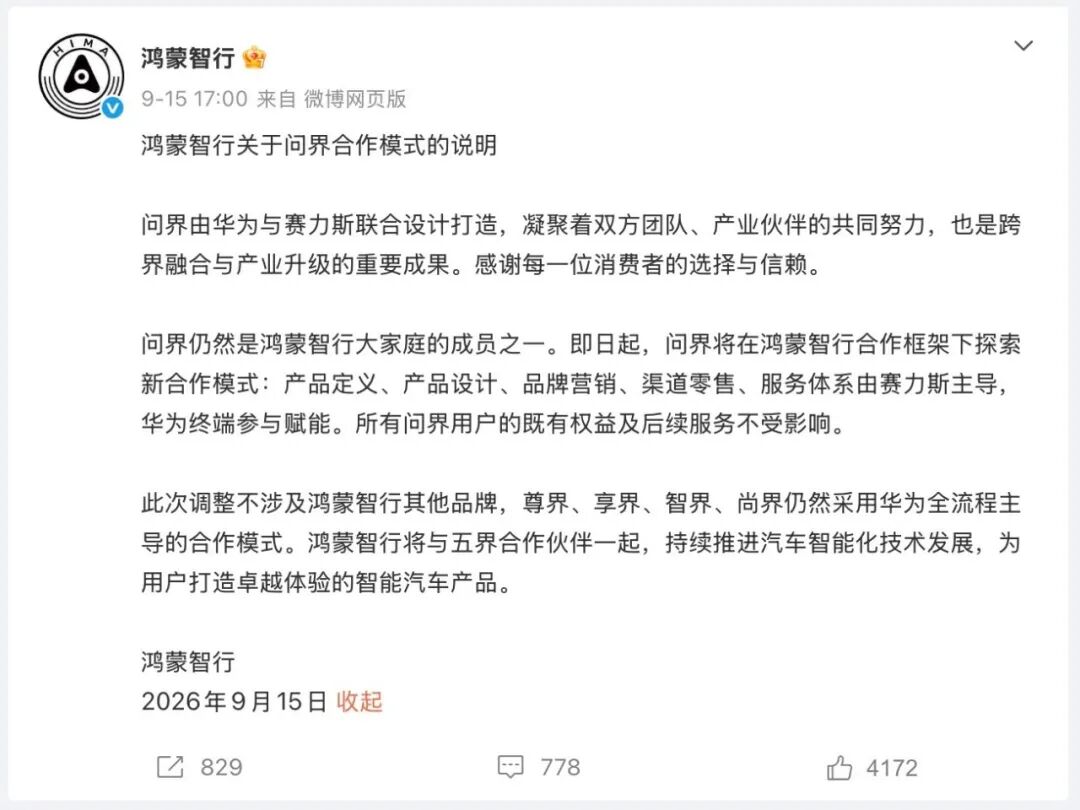
Announcement from the Harmony Intelligent Mobility Alliance
Over the past week, rumors have swirled regarding the cooperation between Seres and Huawei, with market concerns focusing on Seres' ability to sustain AITO's growth without the Huawei brand's influence.
On the day of the announcement, Seres' A-shares and Hong Kong stocks both plummeted, with A-shares dropping by 5.09% and Hong Kong stocks by 6.12%. On social media, some AITO consumers, who had placed value on Huawei's backing, expressed their dissatisfaction by canceling orders, likening the situation to 'a prince dethroned in a succession struggle'.
AITO is pivotal for both Huawei and Seres. For Seres, despite the expansion of the Harmony Intelligent Mobility Alliance to five 'Jie' brands, AITO remains the cornerstone of sales. From January to August this year, the Alliance delivered approximately 328,100 vehicles, with AITO accounting for over 60%.
Kang Bo, Vice President of Seres, assured in an exclusive media interview that the cooperation model adjustment would not diminish the 'Huawei content' in AITO, and that AITO remains part of the Harmony Intelligent Mobility Alliance. Xu Qinsong, President of Huawei Terminal China Region, also stated in an internal meeting that AITO would not completely sever ties with the Alliance's channel system.
However, these assurances seem insufficient to quell external doubts. Some observers suggest that this adjustment equates to AITO reverting from the Smart Selection vehicle model to the HI model, with automakers leading product development and Huawei acting as a supplier, similar to the cooperation seen with Avatar and many 'Jing' branded vehicles. Despite Seres acquiring a stake in AYO, concerns persist. On the evening of September 20, AYO issued a statement emphasizing Seres' strategic partnership and shareholder status, vowing to continue supplying solutions like Qiankun Intelligent Driving and Harmony Cockpit, as well as technical support, to 'support AITO's development as always'.
This adjustment has far-reaching implications for AITO. Beyond internal changes in product development, sales channels, and brand marketing, the brand's halo effect may also be impacted. Compared to other 'Jie' branded vehicles, AITO enjoys a deeper brand association and closer ties with Huawei in consumers' eyes, a key factor in its early success.
However, under the new cooperation model, whether Seres can uphold AITO's premium image remains uncertain.
The Inevitable Moment of Separation
In a sense, AITO's success has led to the demise of the original Smart Selection vehicle model between Seres and Huawei.
When Seres (then known as Sokon) and Huawei initiated their cooperation in 2021, both sides had limited options. Seres had struggled in the automotive industry for years without significant breakthroughs and was at a critical juncture in the new energy transformation.
For Huawei, this was a last-ditch effort. At the time, traditional automakers were wary of Huawei, with the 'Soul Theory' proposed by Chen Hong, former Chairman of SAIC Motor, gaining traction. Huawei's Automotive BU faced the dilemma of years of investment failing to yield results. Yu Chengdong urgently needed to forge cooperation with automakers but encountered repeated rejections. Seres was the only automaker at that time willing to fully cooperate with Huawei.
The AITO brand was officially launched at the end of 2021. Unlike previous cooperation models, AITO focused on the Smart Selection vehicle model, with Huawei deeply involved in every aspect, from product definition and channel sales to brand marketing.
In AITO's early days, this cooperation model proved highly efficient. Seres gained access to Huawei's brand, technology, and nationwide sales network, while Huawei could bypass the capital-intensive vehicle manufacturing business and leverage its product definition, marketing, and retail expertise from over a decade in the smartphone industry.
In the year following its launch, AITO sold over 75,000 vehicles, nearly 100,000 in 2023, over 380,000 in 2024, and reached 420,000 in 2025. In the luxury market, AITO holds a dominant position, with the AITO M9 delivering over 300,000 units to date and being the sales champion in its segment for 21 consecutive months.
With AITO's success, Seres has emerged as one of China's most successful automotive manufacturers in transition. In 2024, Seres' annual revenue surged by 305% year-on-year, turning a profit for the first time, and maintained a net profit attributable to the parent company of 5.96 billion yuan in 2025.
However, as AITO grew, the drawbacks of the Smart Selection vehicle model became increasingly apparent. Besides purchasing intelligent driving, cockpit, and other hardware and software from Huawei, Seres also had to pay technology licensing and channel marketing fees, making it difficult to enjoy cost reductions from economies of scale.
Multiple media outlets have reported that under the original model, these fees accounted for approximately 10% of the vehicle's selling price, with about 8% for channel marketing and 2% for technology licensing.
According to Seres' Hong Kong stock prospectus, from 2022 to 2024, the company's purchases from its largest supplier increased from 5.8 billion yuan to 42 billion yuan, with the proportion of total purchases rising from 14.5% to 30.2%. By 2025, this figure further expanded to 56 billion yuan, accounting for 33.8% of total purchases, equivalent to about one-third of the annual revenue.
Seres' sales expense ratio has also been on the rise, maintaining a high level of nearly 15% over the past two years. In the first half of 2026, despite a 7.9% year-on-year decrease in revenue, Seres' sales expenses still reached 8.47 billion yuan, with the sales expense ratio hovering around 14.7%.
Over the past two years, although the gross profit margin of Seres' new energy vehicle business has consistently remained above 26%, the overall net profit margin is only around 4%. In the first half of this year, Seres swung from profit to loss, with the net profit margin further dropping to about -3.81%.
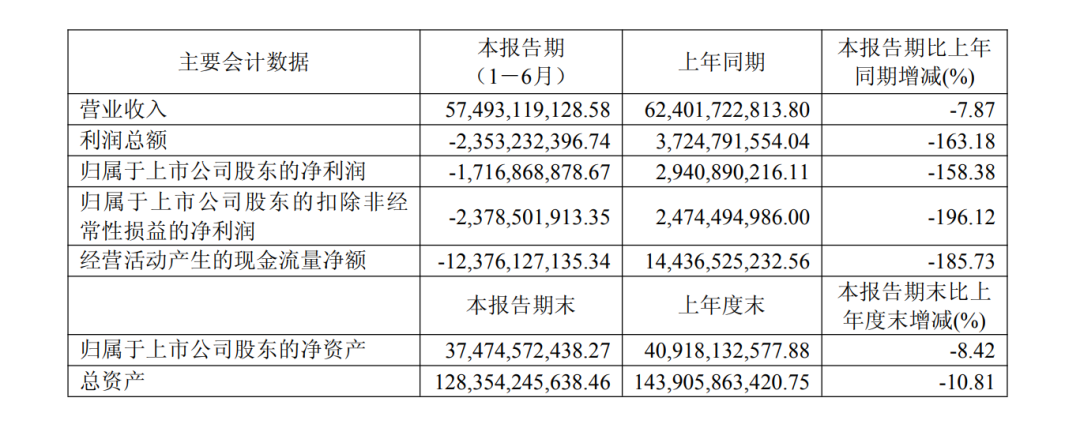
Seres' financial report
At the same time, maintaining the original cooperation model has become increasingly challenging for Huawei. When AITO was launched in 2021, Seres was the only brand under Huawei's Smart Selection vehicle model. But now, the Harmony Intelligent Mobility Alliance encompasses five 'Jie' brands, with models spanning a price range from over 100,000 yuan to over 1 million yuan. Even if Huawei's product development capabilities can keep pace, its stores may struggle to accommodate so many vehicles.
Huawei now needs to focus more on managing the Harmony Intelligent Mobility Alliance as a whole, rather than just AITO. Compared to AITO's success, the other four 'Jie' brands are still in the early stages, with a consistently low sales share. In August this year, under pressure from declining AITO sales, the Alliance's monthly sales decreased by 6.5% month-on-month.
According to a previous report by Yijian Auto, Xu Qinsong, President of Huawei Terminal China Region, urged the team internally to build brand awareness for the Harmony Intelligent Mobility Alliance and promote the development of the other 'four Jie' brands. The dominance of these four automakers will be further consolidated within the Alliance system.
Under the Smart Selection vehicle model, product development and definition for 'Jie' branded vehicles were led by Huawei, with clear boundaries between them. Even though AITO had stronger appeal, it was confined to the SUV segment. For Seres, which has seen a decline in both revenue and sales this year, the constraints of the Smart Selection vehicle model have become increasingly evident.
Shortly after the new model's announcement, Kang Bo, Vice President of Seres, clearly stated that AITO will enter the sedan, MPV, and other competitive product markets at an appropriate time while consolidating its position in the high-end SUV market.
Over the past few years, both sides have been preparing for this adjustment. In 2024, Seres spent 2.5 billion yuan to acquire relevant trademarks and design patents of AITO from Huawei. Subsequently, Seres acquired a 10% stake in AYO for 11.5 billion yuan, deepening its supplier cooperation relationship with Huawei into an equity binding.
At the same time, Seres has been continuously expanding its own sales and service network outside of Huawei's system. Kang Bo stated that AITO now has over 400 user centers, covering more than 200 cities across the country.
How Much Huawei Halo Will AITO Retain?
After the cooperation model change, the first challenge Seres faces is convincing consumers that the 'Huawei content' in AITO has not diminished.
When Kang Bo, Vice President of Seres, accepted a media interview a few days ago, he spent nearly half of the time addressing this issue. He emphasized that AITO remains a core member of the Harmony Intelligent Mobility Alliance, and Huawei Terminal will continue to participate in empowering it.
Kang Bo said that since Seres still holds a 10% stake in AYO, AITO will still have access to Huawei's 'latest, best, and most practical technologies, products, and supply guarantees', and the OTA upgrades and other rights of the existing 1.2 million AITO users will not be affected.
From a technical standpoint, the relationship between AITO and Huawei has not fundamentally changed. Huawei's Qiankun Intelligent Driving, Harmony Cockpit, and even electric drives will continue to feature in AITO models. The newly launched AITO M9, for example, is the first to be equipped with Huawei ADS 5 and Huawei's Zhiqing full 800V platform.
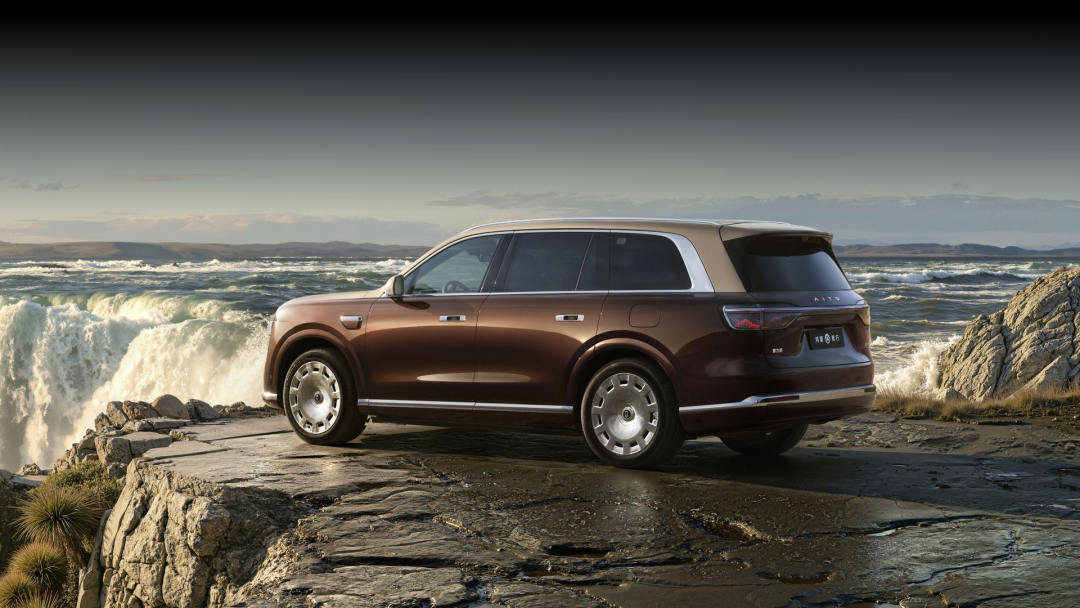
AITO M9
What consumers may be more concerned about is not these technical collaborations. In previous media interviews, Kang Bo always emphasized that AITO is jointly built by Huawei and Seres, but more consumers may recognize Huawei's support.
Over the past five years, AITO has never been seen as just another automotive brand purchasing Huawei's technology. As the first cooperation brand under Huawei's Smart Selection vehicle model, AITO's association with Huawei runs far deeper than other products. In the early days, some stores even used the banner of 'HUAWEI AITO', and even though it was later discontinued, consumers still largely identified AITO with Huawei.
AITO's ability to enter the market priced at 300,000 to 500,000 yuan or even 500,000 to 600,000 yuan in such a short time from almost no brand foundation is inseparable from this special identity.
Even now, with Huawei's cooperation with automakers increasing and expanding to five 'Jie' and three 'Jing' brands, AITO remains the most prominent representative of the 'Huawei car' in consumers' eyes.
According to the '2026 Mid-Year New Energy Vehicle Brand Health Study' released by Jielan Road, AITO is still the new energy vehicle brand that consumers most easily associate with 'Huawei' when mentioned. In the survey, AITO's overall mention rate reached 66.8%, with a primary mention rate of 58.4%. In contrast, the mention rates of Xiangjie, Zhijie, and Zunjie are only around 20%, and the 'Jing' branded vehicles are less than 1%.
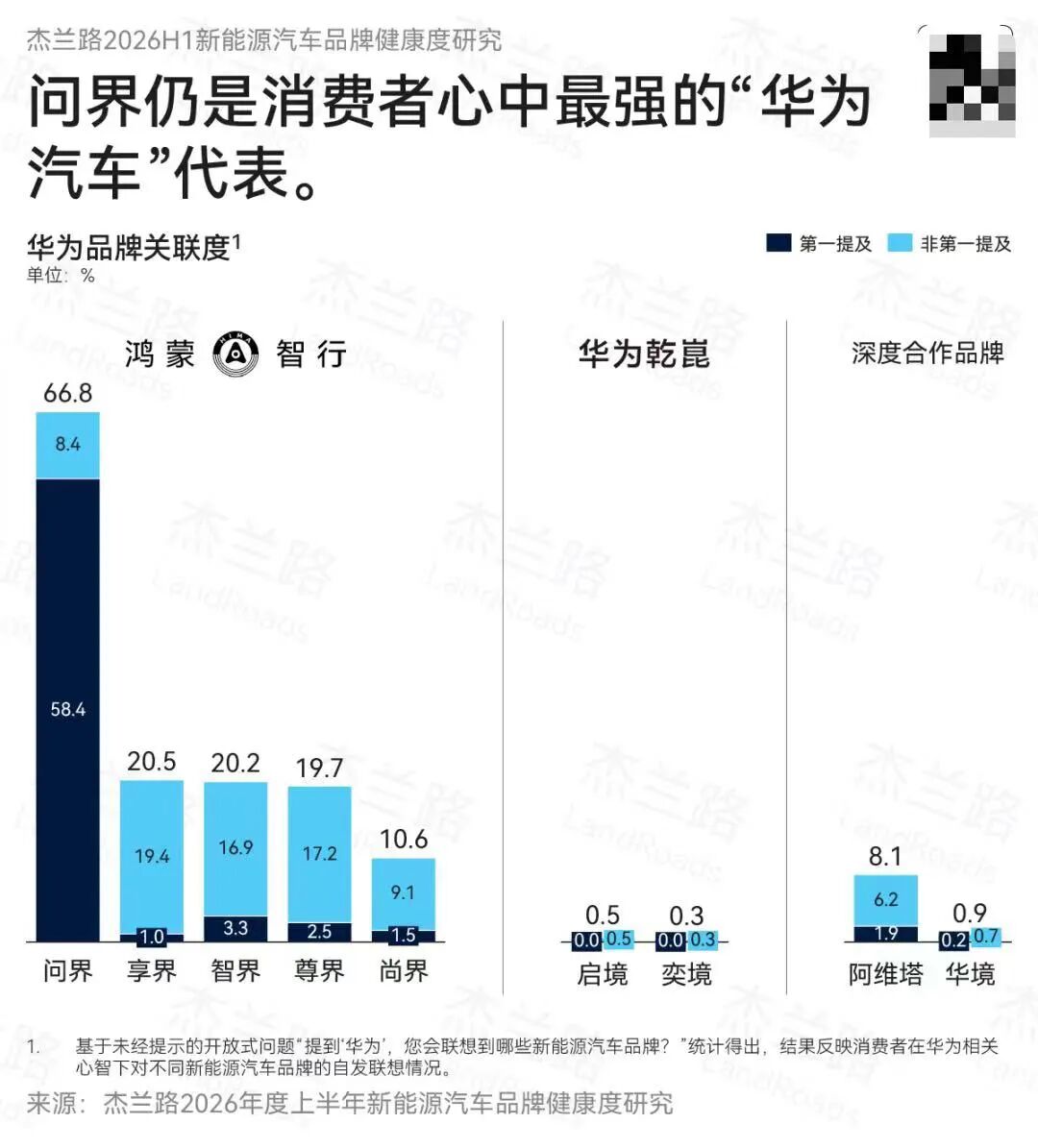
In the past, the strong association with Huawei was the foundation of AITO's success. However, with the adjustment of the cooperation model between Seres and Huawei, this strong brand association has become one of the biggest concerns for AITO's future development.
No matter how much Seres emphasizes to the outside world that AITO still belongs to the Harmony Intelligent Mobility Alliance system, the product definition, development, and even marketing of AITO will no longer be led by Huawei. Huawei's technology can still be equipped in AITO models, but 'being personally defined and managed by Huawei' has become a unique label for the other four 'Jie' brands.
Particularly in the current landscape, where Huawei is relentlessly forging new automotive alliances, the mere integration of Huawei's automotive technology no longer serves as a distinct competitive edge. Beyond the five 'Jie' and three 'Jing' brands, even traditional fuel-powered vehicles like the Nissan Teana are now flaunting a fully-fledged Harmony Cockpit. Consequently, the allure of the Huawei brand for AITO may not endure indefinitely.
Looking ahead, AITO vehicles will become an increasingly rare sight in Huawei stores. With the restructuring of the cooperation model, AITO is set to adopt an 'exclusive franchise' approach. Earlier media reports indicate that, starting January 1, 2027, Huawei franchise stores will be officially bifurcated into two categories: one exclusively dedicated to AITO, and the other to Zunjie, Xiangjie, Zhijie, and Shangjie. Dealers will be compelled to choose between aligning with Huawei or Seres. Should they opt for exclusive AITO sales, the contracting entity will shift to Seres.
As previously disclosed by Yijian Auto, this strategic move is designed to convey to the external world that AITO and the Harmony Intelligent Mobility Alliance have not 'completely severed ties' and continue to maintain a system-level connection.
Given the current complexity of the models within the Harmony Intelligent Mobility Alliance, with brands and models spanning various price points coexisting in the same stores, this adjustment holds certain advantages for AITO. By establishing an exclusive network, AITO will at least no longer have to vie with the other four 'Jie' brands for scarce store space and sales resources. Nevertheless, this also implies that the brand association between AITO and Huawei is progressively diminishing, and AITO is no longer synonymous with a 'Huawei car'.
This trajectory may also be the path that other 'Jie' brands will embark upon in the future.
All rights reserved by Shanshang. Reproduction without permission is strictly prohibited.
-
![]()
RoboX’s Breakthrough Year: From Hype to Reality
-
![]()
Nitto Denko Pours $160 Million into New Factory to Bolster Global Polarizer Strategy
-
![]()
Collaborating with XIOPM: Unveiling Huawei's Ambitious Optics Strategy
-
![]()
Monthly Report | Online Market Analysis of Dash Cams in July: Hikvision Maintains Leadership, DDPai Stands Out Against the Trend, and Panoramic Security Features Reshape the Market
-
![]()
Six Dishes and One Soup: The Launch of AITO Grand Hotel, How Seres Takes Over AITO Starting from a Meal
-
![]()
"China Speed" from an Overseas Perspective: The Coordination Revolution of Manufacturers and Suppliers
-
![]()
Founders Fund Allocates SpaceX Shares to Investors: Commercial Space Industry Hits Trillion-Dollar Valuation, Unlocks Liquidity Avenue
-
![]()
Revealed: Tesla’s Robot Team Conducts Factory Inspections, with Top Group, Sanhua Intelligent Controls, and Others Securing Major Orders!