Lei Jun’s 200 Billion: Why Does He Always Make Bold Moves After Trends Emerge, Rather Than Before?
 09/21 2026
 460
460
Baker Street Detective

Is making bold moves after a trend emerges Lei Jun’s strength, or the biggest risk for Xiaomi’s future?
At the recently concluded Xiaomi Autumn Launch Event, founder Lei Jun announced that the latest Xiaomi smartphone would start at a five-digit price. While the public was astounded by the high price, Lei Jun stated in a personal interview that Xiaomi would invest 200 billion yuan in R&D over the next five years. The market widely interpreted this as Lei Jun’s intention to make significant strides in the storage sector and lead the team to "drive down" chip prices.
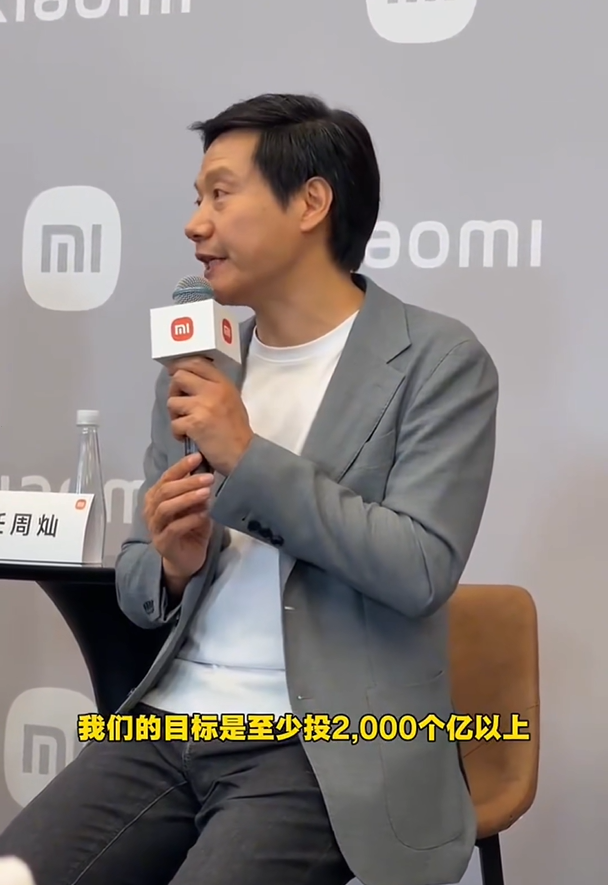
Considering Lei Jun’s timing when entering the new energy vehicle industry, his current move to invest 200 billion yuan in chip R&D may not be mere talk. This raises the question: Why does Lei Jun always choose to make bold moves only after an industry has shifted from 'possibility' to 'certainty'?
01 Lei Jun Never Pursues First-Mover Advantage
In 2021, when Xiaomi announced its foray into electric vehicles, the new energy vehicle industry had already entered a stage of accelerated industrialization. However, Lei Jun did not enter during the earlier embryonic stage. Instead, he made the decision after 75 days, 85 industry visits, discussions with over 200 automotive professionals, four management team discussions, and two board discussions. He announced an estimated investment of 10 billion USD over ten years.
By 2026, Lei Jun announced that Xiaomi plans to invest 200 billion yuan in R&D over the next five years, focusing on core underlying technologies such as chips, AI, and operating systems. Over the past five years, Xiaomi has already invested approximately 105 billion yuan in core technology R&D. Observing the timeline, it is evident that Lei Jun does not like to be the 'first to bet on the future.' However, from another perspective, this may precisely be Lei Jun’s most noteworthy strategic foresight.
What he truly assesses is not just whether an industry has a future, but when that future has become worth betting on with Xiaomi’s organizational capabilities and cash flow.
These two perspectives are fundamentally different. When an industry is in its embryonic stage, the most visible aspect to entrepreneurs is the imaginative potential. However, when the industry is on the verge of explosion, what truly needs to be assessed is whether the technological roadmap is clear, whether the business model has been validated, whether the supply chain is mature, whether consumer demand has formed, and whether the company itself has the capability to enter this battlefield.
Lei Jun seems to be waiting for these conditions to be 'fully prepared.' While others were still debating whether 'new energy vehicles are the future,' he did not rush to prove his foresight. However, once new energy vehicles transformed from a concept into an industrial trend, and Xiaomi possessed sufficient cash, an R&D team, a mobile phone business, an IoT ecosystem, and supply chain capabilities, Lei Jun directly made a bold move in the new energy vehicle industry.
This reflects a typical steady development strategy for a company—not rushing to predict all futures but striving to identify which futures have begun to shift from probability to trend, and then concentrating resources on directions that truly have the potential to alter the company’s long-term destiny.
This is why the statement 'Lei Jun always makes bold moves after a trend emerges' is unfair if interpreted merely as 'chasing trends.' True trend-chasing means entering a market only after seeing others profit. Strategic late-mover advantage, however, involves assessing whether one has the capability to scale a trend after it has been validated and then actively bearing the catch-up costs as a late entrant.
What Lei Jun truly excels at is not proving his predictive judgments but focusing on whether he has the capability to convert certain opportunities into book profits, becoming the company’s working capital.
This is also Xiaomi’s most successful commercial DNA in the past. From smartphones to IoT, Xiaomi was not the first inventor of every technological innovation, but it excelled at reorganizing technologies, products, and supply chains already validated by the market and then pushing them into larger markets through scale, efficiency, channels, and ecosystems.
In other words, what Lei Jun has truly excelled at in the past is not 'creating a market that no one believes in' but 'scaling a market once it begins to form,' achieving economies of scale and rapidly profiting from them. This is a completely different strategic foresight. It does not pursue being the first to bet on every opportunity but attempts to ensure that once a decision to bet is made, there is the capability to complete the most critical implementation process afterward and later surpass competitors.
This also explains why today’s '200 billion yuan' is more noteworthy than the mere number. Lei Jun needs to explain to the public whether the late-mover advantage of the internet era can still hold true in the era of hard technology.
02 How Latecomers Can Surpass
In the smartphone era, Xiaomi could rapidly catch up by relying on mature supply chains, technology diffusion, and economies of scale. This is because smartphones are essentially a highly mature, globally diversified industry. Many capabilities can be acquired through mergers and acquisitions, many components can be procured, and many technologies can be quickly transformed into products through engineering integration.
However, industries like automotive, chips, AI, and operating systems operate differently. These fields share a common characteristic: time itself is a technological asset.
Chips cannot be developed overnight with money; operating systems cannot form an ecosystem immediately after a team is assembled; AI does not instantly gain long-term advantages with computing power and models; automotive manufacturing cannot replicate a decade-long quality system by simply building a factory.
Lei Jun put it bluntly: 'Chip R&D is not for short-term cost reduction. Achieving economies of scale will take at least a decade.' This means that Lei Jun’s past approach of 'making bold moves after a trend is confirmed' has also undergone an upgrade. Previously, he traded lateness for certainty; now, he must compensate for the time lag caused by late entry through long-term investment. This is precisely the true significance of the 200 billion yuan.
This 200 billion yuan investment does not mean Xiaomi has more money and can do everything. Instead, Xiaomi has gradually realized that if it is to transition from a smartphone and consumer electronics company to a true technology platform enterprise, relying solely on supply chain integration capabilities is insufficient.
Automobiles require their own intelligent technologies and manufacturing capabilities, smartphones need their own chips, AI requires underlying computing power and algorithms, ecosystems need operating systems, and the integration of people, vehicles, and homes requires these technologies to interconnect. Against this backdrop, Xiaomi under Lei Jun’s leadership in recent years has increasingly shifted its strategic focus away from the 'extreme cost-effectiveness' of the past and toward building a complete technological foundation.
Xiaomi’s new 200 billion yuan R&D plan in 2026 explicitly focuses on core underlying technologies such as chips, AI, and operating systems. Lei Jun also emphasized that AI, robotics, automotive, and intelligent manufacturing will converge. This indicates that the 200 billion yuan is not simply about adding a few R&D projects but redefining Xiaomi’s capability boundaries.
Xiaomi’s previous challenge was 'how to turn mature technologies into good products'; now, the challenge has become 'how to make key technologies themselves the company’s core assets.'
If corporate strategy is viewed as a long-distance race, the earliest starters do not necessarily run the farthest. The key lies in who can sustain sufficient investment for a long enough time after the true racecourse is determined.
Currently, Lei Jun clearly prefers to reserve resources for tracks with higher certainty and then use massive investments to bridge the gap in entry timing. The essence of this approach is not conservatism but selective risk-taking. Yes, Lei Jun never refuses to take risks.
When venturing into car manufacturing in 2021, he even called it the last major entrepreneurial endeavor of his life and was willing to bet his entire reputation. However, he wants risks to be based on thorough research rather than personal judgments like 'I believe the future will be this way.'
In a sense, this reflects the strategic resolve of a mature entrepreneur. Not all trends need to be chased, and first-mover advantage is unnecessary for every opportunity. The key is to assess industrial certainty and make bold moves only when it is high enough to mobilize the company’s resources.
Therefore, if Lei Jun’s strategy must be summarized, Baker Street would not define it as 'chasing trends' but rather as 'making bold moves as a latecomer with a long-term perspective.' This is the side that most people do not see.
03 Lei Jun’s Strategic Foresight
Lei Jun’s strategic foresight does not involve early布局 (layout) in all potential trends. Knowing when to shift from observer to participant and when to transition from participant to long-term builder is what makes him worthy of study for future entrepreneurs.
The transition between these three roles is more challenging than simply entering an industry five years earlier. The new energy vehicle case illustrates that when the industry’s direction becomes increasingly clear, Xiaomi dares to enter a completely unfamiliar, capital-intensive industry over a ten-year cycle. The bold move on chips demonstrates that once Xiaomi realizes that underlying technologies will determine the future ecosystem, it is willing to bear the costs of a decade upfront, even knowing that chips will take ten years to scale.
Looking back, Lei Jun’s perceived 'lateness' in the past actually encompasses two different aspects: one is the unnecessary early payment of costs for uncertainty; the other is the need to change pace for technological windows that, once missed, are difficult to recover. This may precisely be Xiaomi’s most critical strategic transformation today.
Early Xiaomi relied on speed, efficiency, and scale, making 'lateness' an advantage. Today, as Xiaomi enters fields like chips, AI, operating systems, automotive, and intelligent manufacturing, speed alone is insufficient. It must begin accumulating capabilities that cannot be directly acquired through procurement.
Thus, what Lei Jun truly needs to prove is no longer 'whether I can see the trend' but 'whether, once the trend becomes an industry, I can use ten years to transform a latecomer into a true technological participant.' This is the true wager behind the 200 billion yuan.
While 200 billion yuan can buy equipment, talent, and R&D conditions, it cannot buy a decade of engineering experience. However, if a company is willing to sustainably invest 200 billion yuan and ten years into underlying capabilities like chips, AI, operating systems, and intelligent manufacturing after a trend is confirmed, what it ultimately gains is not just the competitiveness of a single product but potentially an entire platform capability.
Lei Jun’s true brilli mayance lie in his redefinition of the 'latecomer' identity—not necessarily seizing the earliest position but possessing the strongest resource concentration capability once a major trend forms; not necessarily creating all trends but being able to solidify industrial capabilities into long-term barriers after a trend becomes an industry.
This is a strategic logic entirely different from 'betting on the future.' It does not bet on a single product but on the company’s own continuous evolutionary capability. For Xiaomi today, the core issue that the 200 billion yuan investment aims to resolve is simple: Can such a massive investment transform Xiaomi’s past strength in 'scaled catch-up' into future strength in 'underlying technology accumulation?'
If so, then Lei Jun’s seemingly 'slow' choices in the past may precisely represent a conscious strategic restraint—letting the industry prove its direction first, then letting Xiaomi prove itself, waiting for a higher-certainty possibility, and then concentrating all resources. Once the decision to make a bold move is made, it is not about a one- or two-year product cycle but a decade-long construction.
This, perhaps, is Lei Jun’s most noteworthy strategic foresight: not needing to be the first to see the future forever but only needing to be the one capable of turning the future into reality after it truly arrives.
Conclusion
There is an old Chinese saying, 'A noble person speaks slowly,' which also applies in business competition. What Lei Jun truly excels at may never be seeing trends earlier than others but being willing to wait when no one else has a clear view, daring to make bold moves once a trend truly forms, and, once the decision to make a bold move is made, daring to spend ten or even more years to deliver.
Over the past 26 years since the 21st century began, trends (opportunities) have never been scarce; what is scarce is strategic resolve. Today, everyone talks about AI, automotive, and chips, and tomorrow there will be new trends. However, what truly determines how far a company can go is not how many trends it has chased but whether it has the capability to resist short-term temptations, endure long-term solitude, and turn a single bold move into a decade-long construction after committing to a direction.
Therefore, what is truly expensive about the 200 billion yuan is not the money but the time. What Lei Jun is truly betting on is not just a product but Xiaomi’s next decade and even whether Xiaomi can become a centennial enterprise. He does not strive to be first in every trend, nor does he need to prove that he always sees the future earlier than others. He only needs to identify an era and then bet all his patience, capital, and organizational capabilities on it.
Authentic successors don't blindly follow every passing trend. However, when they do choose to embrace a particular trend, they do so with a tenacity that spans a decade or even with an all-encompassing commitment. This approach is far from mere trend-following; rather, it embodies strategic determination—a trait that distinguishes true strategists.
THE END
All the information and materials presented herein are sourced from official public records.
Please note that this article does not offer any form of investment advice.
This article is an original work by Baker Street Detective and reproduction without explicit permission is strictly prohibited.
The images used in this article are obtained from public sources. Should there be any concerns regarding copyright infringement, please reach out to us for prompt removal.
-
![]()
RoboX’s Breakthrough Year: From Hype to Reality
-
![]()
Nitto Denko Pours $160 Million into New Factory to Bolster Global Polarizer Strategy
-
![]()
Collaborating with XIOPM: Unveiling Huawei's Ambitious Optics Strategy
-
![]()
Monthly Report | Online Market Analysis of Dash Cams in July: Hikvision Maintains Leadership, DDPai Stands Out Against the Trend, and Panoramic Security Features Reshape the Market
-
![]()
Six Dishes and One Soup: The Launch of AITO Grand Hotel, How Seres Takes Over AITO Starting from a Meal
-
![]()
"China Speed" from an Overseas Perspective: The Coordination Revolution of Manufacturers and Suppliers
-
![]()
Founders Fund Allocates SpaceX Shares to Investors: Commercial Space Industry Hits Trillion-Dollar Valuation, Unlocks Liquidity Avenue
-
![]()
Revealed: Tesla’s Robot Team Conducts Factory Inspections, with Top Group, Sanhua Intelligent Controls, and Others Securing Major Orders!