UK Mulls Imposing EU-Style Tariffs on Chinese Electric Vehicles
 10/08 2026
 384
384
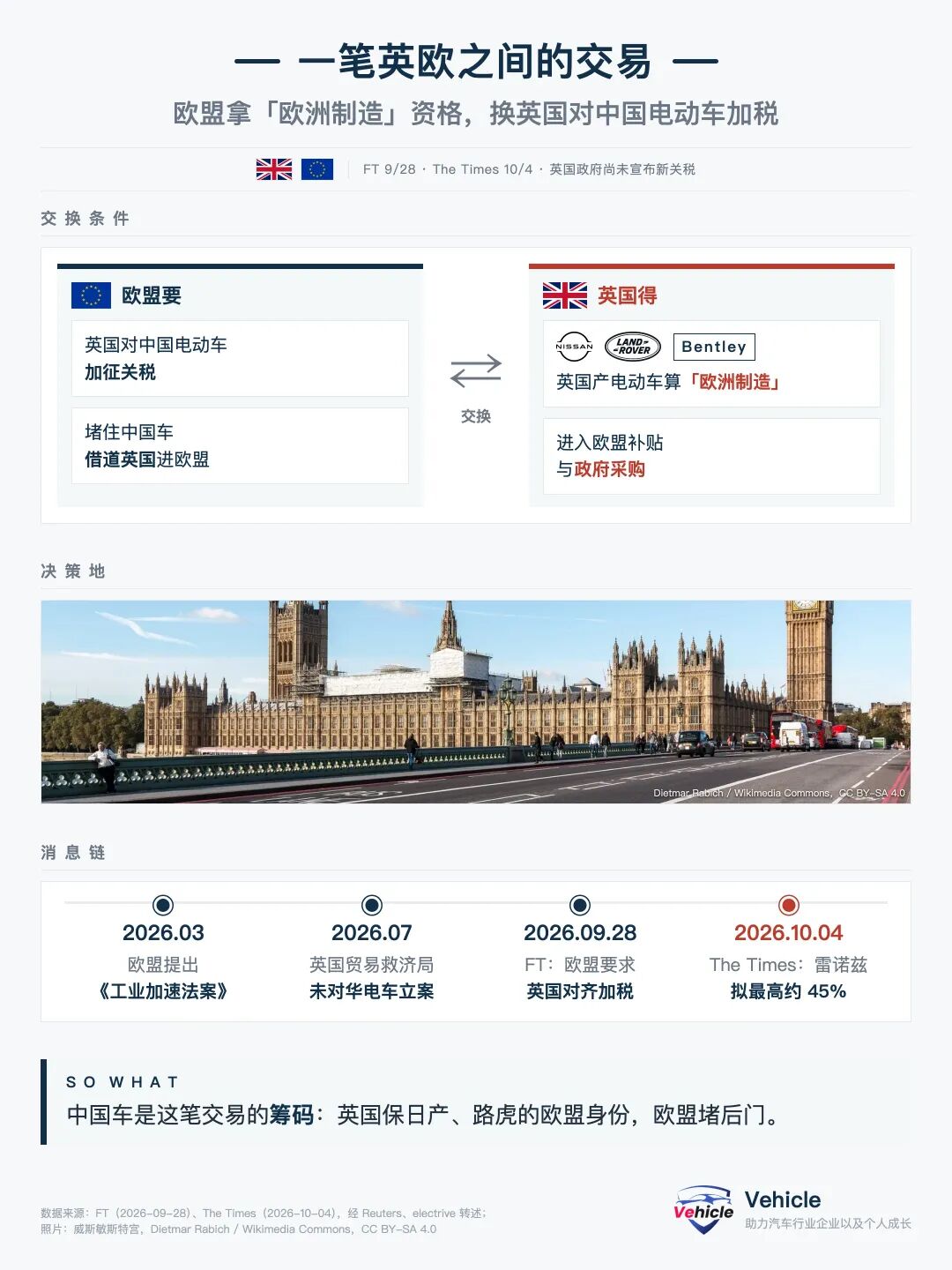
On the eve of National Day, reports surfaced indicating that the EU had signaled to London: If the UK wishes for its factories to be included in the EU's "Made in Europe" legislative framework, its trade policies must harmonize with those of the EU, including imposing tariffs on Chinese electric vehicles. In return, the EU is prepared to recognize electric vehicles produced by Nissan, Land Rover, and Bentley in the UK as "Made in Europe."
On October 4, the UK's "The Times" cited senior government sources stating that Business Secretary Jonathan Reynolds is formulating a tariff plan for Chinese imported vehicles. According to reports, ministers are considering aligning tax rates with those of the EU, potentially reaching up to 45%. While this information remains unconfirmed, the UK government has affirmed its commitment to ongoing dialogue with the industry to ensure that practices align with both industry and national interests. To date, the UK has not announced any new tariffs, and Chinese cars entering the UK are still subject to a standard 10% import tax.
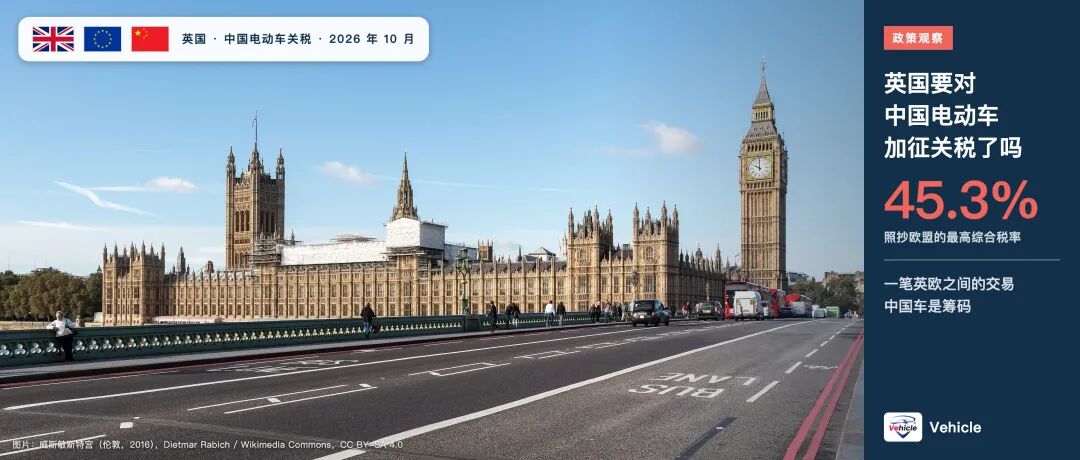
Vehicle's assessment suggests that while the UK is likely to take some action, implementing a comprehensive set of anti-subsidy tariffs akin to the EU's, which vary by company and reach up to 45.3%, will not occur swiftly and may not be the final outcome.
This article delves into the UK's consideration of imposing EU-level tariffs on Chinese electric vehicles from multiple angles: the motivations behind the UK's temptation, the potential magnitude and methodology of tariffs, the likelihood and timing of implementation, and the implications for Chinese automobile exports. We aim to provide valuable information and insights.
Why the UK is Contemplating Tariff Hikes
To understand this, we must examine the current automotive industry landscape and geopolitical context.
Firstly, the EU's leverage: Earlier this year, the EU proposed the Industrial Accelerator Act (for a detailed analysis, refer to our previous article, "In-Depth Analysis of the EU's Industrial Accelerator Act: Rewriting the 'Rules of the Game' for China's Automobile Industry Going Global"). According to the draft, electric vehicles benefiting from public subsidies and entering government procurement must be fully assembled in the EU, with at least 70% of their components (excluding batteries) sourced from within the EU. If the UK is not deemed a 'trusted partner,' vehicles manufactured by factories like Nissan Sunderland and Jaguar Land Rover will be ineligible for subsidies or government procurement in the EU. The UK's Society of Motor Manufacturers and Traders (SMMT) estimates that UK automobile production drives approximately €24 billion in economic activity and supports 250,000 jobs in the EU annually. Its CEO, Mike Hawes, stated that excluding the UK would be a self-defeating move. Brussels is concerned that low UK tariffs could facilitate Chinese vehicles entering the EU via the UK, thus demanding that the UK tighten its borders first.
Secondly, the market share of Chinese brands in the UK: As highlighted in our previous article, "8 Charts to Understand the UK Automobile Market in August 2026," Chinese brands accounted for 21% of new car sales. Additionally, September marks the UK's license plate change month, with 350,536 new cars registered. Chinese brands totaled 81,776 units, representing 23.3% of the market, up from 12.4% in the same month last year; from January to September, they accounted for 17.5%. BYD sold 20,140 units in a single month, a 78.7% year-on-year increase, ranking second only to Volkswagen; Chery's four brands—Chery, Jaecoo, Omoda, and Lepas—sold a combined 32,830 units, surpassing the Volkswagen brand, with the Jaecoo 7 topping the single-model list with 10,800 units. With market share doubling in a year, pressure on domestic manufacturing has intensified.
Finally, the political climate: The Burnham government expressed its intention in September to be recognized as a trusted partner under the EU's new regulations, having already aligned steel tariffs with the EU in July. Electric vehicles are the next category subject to such "alignment" tests.
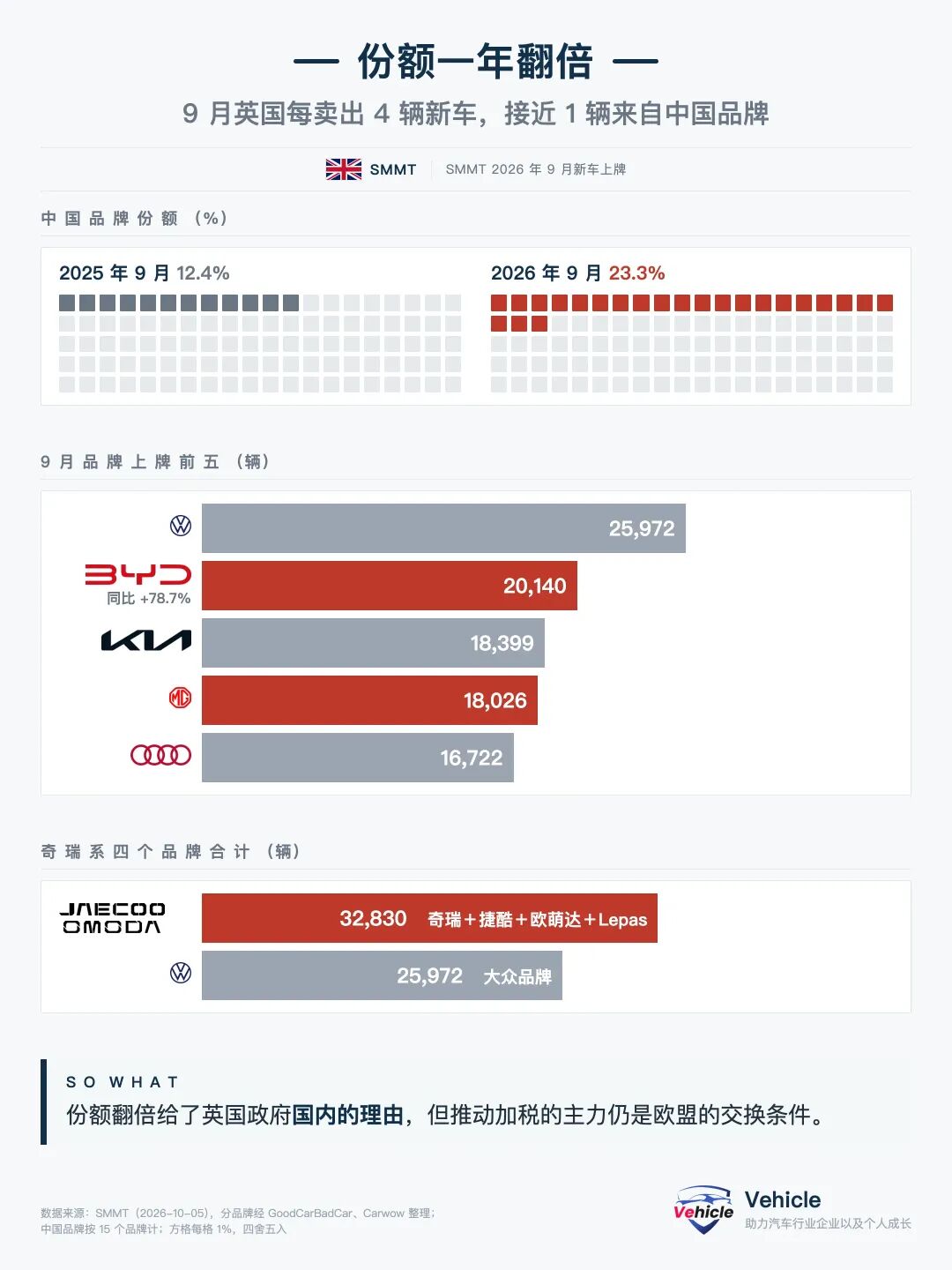
Data from SMMT, organized by brand by Vehicle
However, there is also significant countervailing pressure: China is a vital market for Jaguar Land Rover, and Reynolds himself has mentioned the risk of retaliation; the UK's Zero Emission Vehicle (ZEV) mandate requires automakers to sell 33% pure electric vehicles by 2026, and Chinese electric vehicles offer the most cost-effective means to meet this target; in June, Nissan signed a non-binding memorandum with Chery to manufacture Chery vehicles at its Sunderland plant starting in the 2027 fiscal year.
In summary, the primary reasons driving the UK to consider imposing tariffs on Chinese electric vehicles are the EU's offer of "Made in Europe" status in exchange and the rapid doubling of Chinese vehicles' market share, providing a domestic rationale for the UK.
Potential Magnitude and Methodology of Tariffs
The "45%" figure represents an upper limit. The EU's anti-subsidy tariffs implemented in October 2024 vary by company: Tesla at 7.8%, BYD at 17.0%, Geely at 18.8%, other cooperating companies at 20.7%, and SAIC and non-cooperating companies at 35.3%. These rates are in addition to the 10% standard tariff, making the maximum 45.3%. If the UK follows suit, BYD's comprehensive tariff would be 27%, and SAIC MG's would be 45.3%.
A rough calculation based on a Chinese car's landed cost of £20,000: BYD would incur an additional £3,400 in tariffs, resulting in an approximately £4,080 increase at the terminal after adding 20% VAT; MG would incur an additional £7,060, resulting in an approximately £8,470 increase. For a car priced around £30,000, this would be sufficient to erode the current price advantage of Chinese brands, though it may not eliminate their technological advantages in new energy smart connected vehicles.
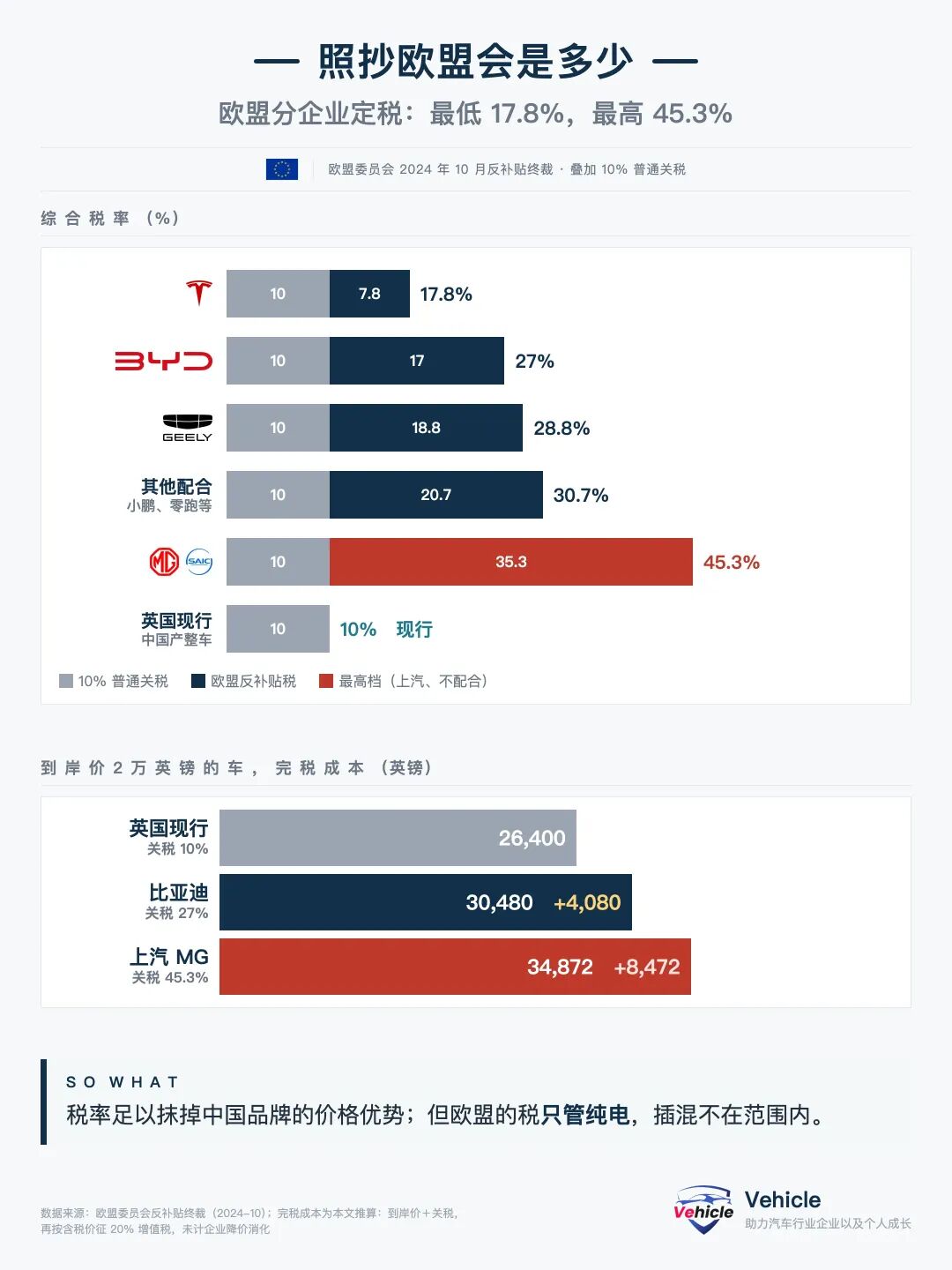
Tariff rates from the European Commission's final ruling in October 2024; duty-paid costs are estimated in this article
How might the tariffs be imposed? Jack believes there are three potential paths, each with its costs:
Anti-subsidy investigations: Initiated by the Trade Remedies Authority (TRA), these can set company-specific tariff rates like the EU's, complying with WTO rules but taking time. The EU took about 13 months from initiating the investigation in October 2023 to the final ruling. The TRA confirmed in July this year that it had not initiated an investigation into Chinese electric vehicles, making it difficult to reach a final ruling within a year from scratch.
Raising ordinary tariffs: Directly increasing the Most-Favored-Nation (MFN) tariff rate for pure electric vehicles in the UK Global Tariff schedule. This would treat all non-free-trade partners equally, while vehicles from the EU, Japan, South Korea, and Turkey would enter zero-tariff under free trade agreements, primarily affecting Chinese-made vehicles. This path is quick and could be included in the budget bill, making it the likely option inferred in this article, though not mentioned in reports.
Rules of origin: The electric vehicle and battery origin thresholds in the UK-EU Trade and Cooperation Agreement will tighten on January 1, 2027. Vehicles using many Chinese batteries will not qualify for zero tariffs, complementing tariff increases by tightening restrictions at the component level.
An easily overlooked detail: The EU's anti-subsidy tariffs only target pure electric vehicles. As Chinese brands shift towards plug-in hybrids in Europe, sales of such models have surged; the best-selling Jaecoo 7 in the UK in September was primarily available as a plug-in hybrid and fuel-powered version (internal combustion engine version). If the UK only targets pure electric vehicles, fewer cars will be blocked than imagined.
For the tariff amounts, the UK could follow the EU's lead, with BYD at 27% and MG at 45.3%; however, a bigger variable is whether the UK will also include plug-in hybrids.
Likelihood and Timing
Given the importance of the EU's exchange conditions for UK automakers and the UK's precedent with steel, it seems inevitable that the UK will introduce some measures targeting Chinese vehicles. However, the probability of immediately imposing the full 45.3% tariff is lower, as the government must also consider ZEV targets, living costs, and relations with China. A more likely combination is initiating a TRA investigation or slightly raising tariffs on pure electric vehicles as bargaining chips with the EU, using time to secure "trusted partner" status.
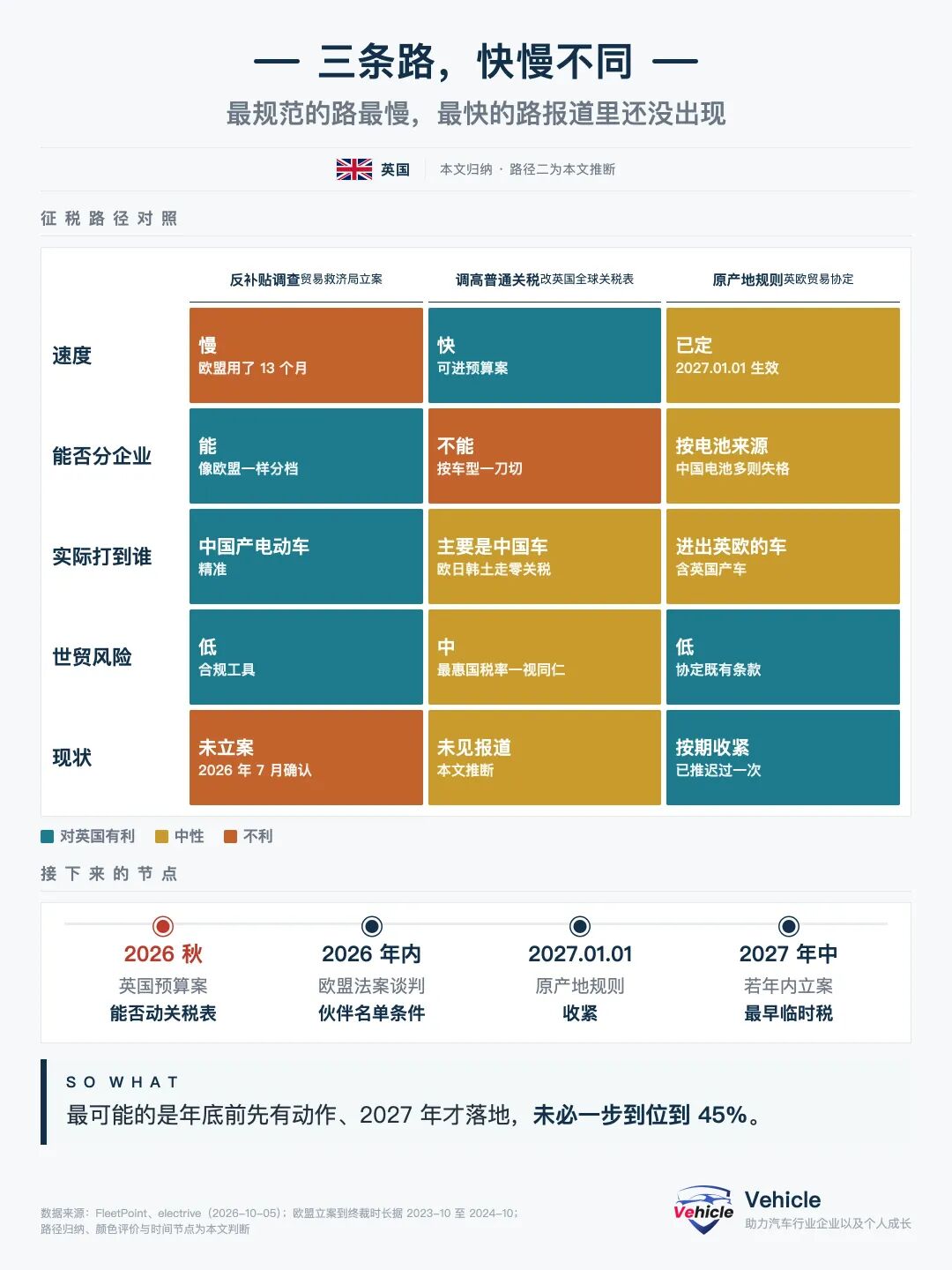
Summarized for this article; Path 2 and timeline are inferred in this article
Key timelines to watch: The progress of trilateral negotiations on the EU's Industrial Accelerator Act will determine when the UK must present its bargaining chips; the UK's autumn budget bill is the quickest window for adjusting tariff schedules; the tightening of rules of origin on January 1, 2027; if the TRA initiates an investigation this year, following the EU's pace, provisional tariffs could start around mid-2027, with a final ruling by the end of 2027.
The most likely scenario is action before the end of the year, with implementation in 2027, and not necessarily the full 45% at once.
Impact on Chinese Automobile Exports
The UK is crucial for Chinese automakers. According to data from the China Passenger Car Association, the UK was the fourth-largest destination for Chinese automobile exports in 2025, with a total of 335,551 units; new energy vehicle exports reached 231,181 units, ranking second only to Belgium. However, Belgium mainly serves as a transshipment port, while the UK is effectively the largest single terminal market for Chinese new energy vehicles in Europe. After the EU imposed tariffs in 2024, the UK absorbed a significant volume of Chinese vehicles diverted from the EU. If this outlet narrows, the impact on Chinese automobile exports will be substantial.
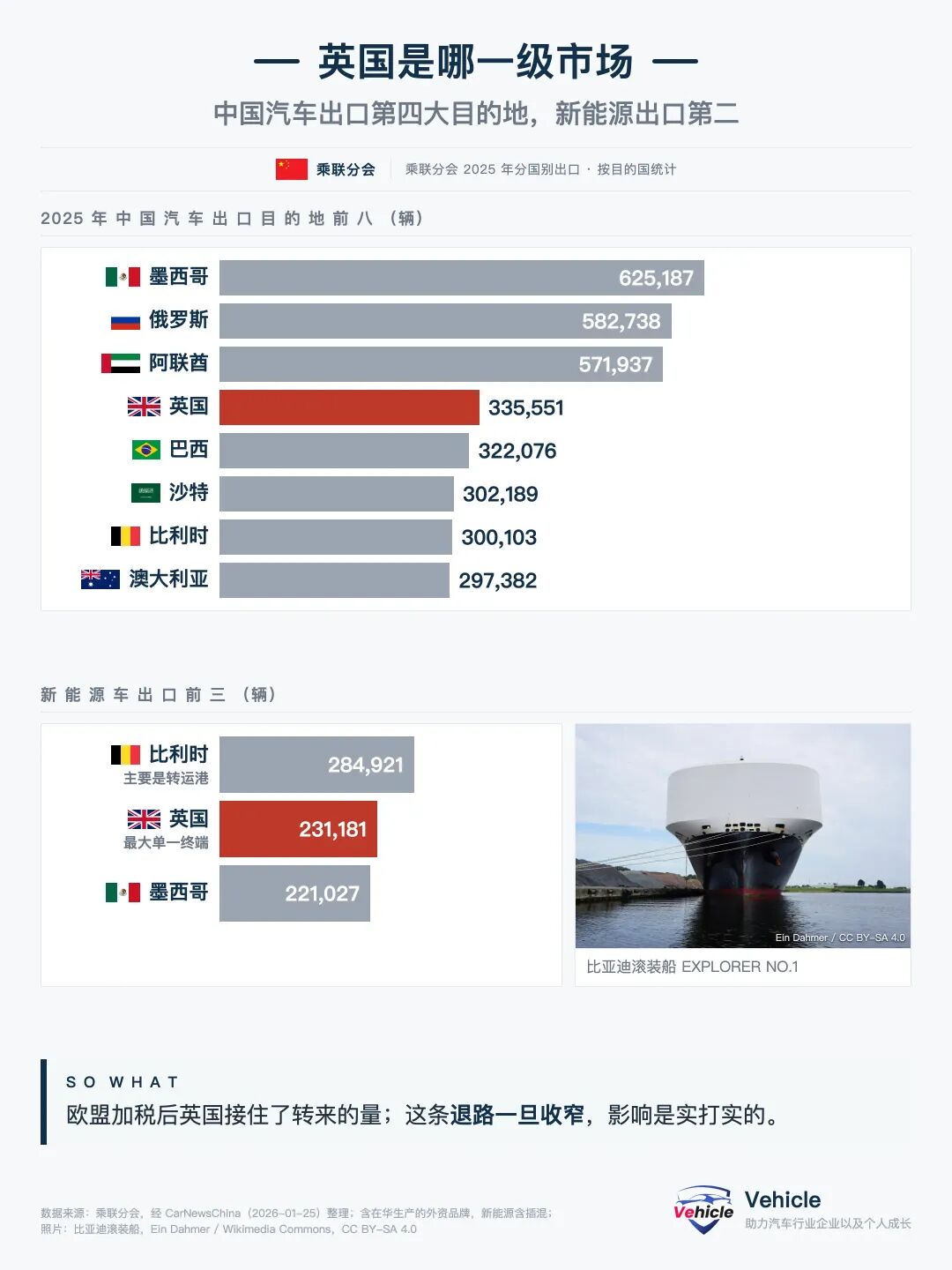
Data from the China Passenger Car Association, organized by Vehicle
SAIC MG is the most exposed. Following the EU's model, it would face a 45.3% tariff; MG sold 18,026 units in the UK in September, with its main models imported from China and no production plants in Europe.
BYD faces a moderate tariff rate and has some buffer: Its plant in Szeged, Hungary, is scheduled to start assembly in the fourth quarter of this year, with the first model being the Dolphin Surf; plug-in hybrids account for a significant portion of its product line. However, Szeged's production will be far below full capacity for at least two years, unable to fully meet UK demand.
Chery's brands have the highest sales volume and are least affected: Jaecoo and Omoda mainly offer plug-in hybrids and internal combustion engine vehicles, with a joint venture plant in Barcelona and potential Sunderland contract manufacturing, which could grant them local status in the UK.
Foreign brands producing in China, such as Tesla, BMW MINI, Volvo, and Polestar, which manufacture in China and export to the UK, are also included in export statistics and would be affected by tariffs, which is one reason for the UK government's hesitation.
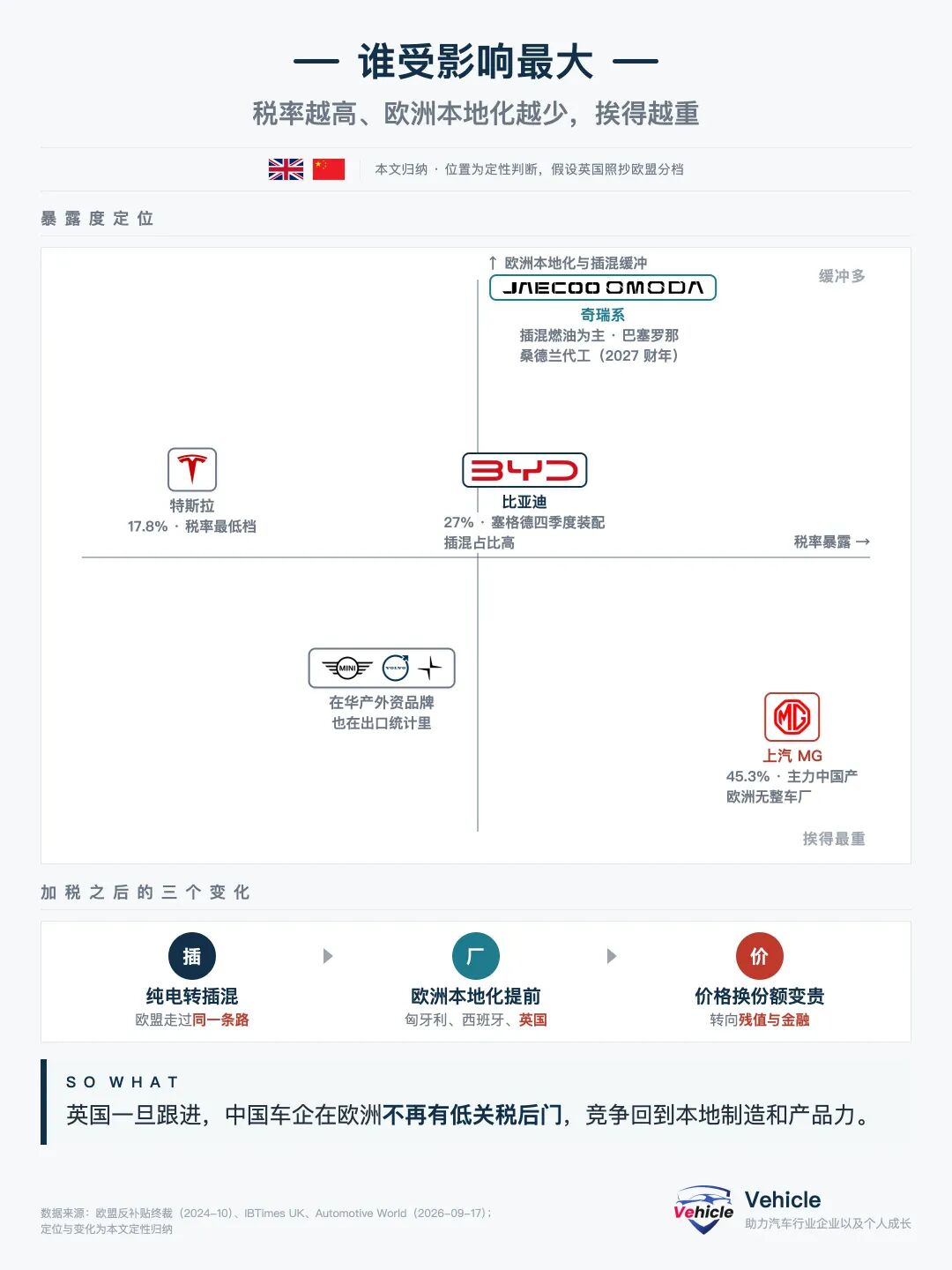
Positions are qualitatively summarized in this article, assuming the UK follows the EU's tiered approach
Overall, tariff increases will likely bring three changes: a shift in pure electric vehicle exports towards plug-in hybrids, similar to the EU's path; accelerated timelines for local production in Europe; and increased costs for Chinese brands relying on price-based market share gains in the UK, shifting competition more towards residual value, financing options, and distribution channels.
Final Thoughts
If the UK follows suit in imposing additional tariffs on Chinese new energy vehicles, Chinese automakers will no longer have a low-tariff backdoor in Europe, and competition in Chinese automobile exports will fully return to local manufacturing and product strength.
*Unauthorized reproduction or excerpting is strictly prohibited-
-
![]()
UK Mulls Imposing EU-Style Tariffs on Chinese Electric Vehicles
-
AI Embarks on a New Phase Amidst Unabated Capital Fervor
-
![]()
Is Fan the Only Option for Laptop Cooling Systems?
-
![]()
What is the role of language in autonomous driving VLA?
-
![]()
Why Does Apple’s Foldable Screen Feel So Uninspired, Even as a Late Entrant?
-
![]()
How Did the iPhone 18 Pro Conceal Face ID Beneath the Screen?
-
![]()
Qualcomm and Huawei Are Becoming Inseparable Partners
-
![]()
Why Are Automakers Embarking on Realignment: Insights from Geely-NIO to FAW-GAC Collaborations?