SERES and Huawei Make a Dramatic Shift! AITO Launches Ultimate Evolution Strategy
 10/08 2026
 383
383
Written by | Guanchejun
New developments have emerged in the collaborative efforts between SERES and Huawei!
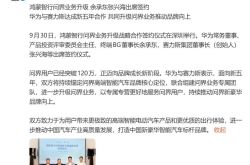
On October 1st, HiMo Intelligent Travel officially declared that Huawei and SERES had signed an upgraded strategic cooperation agreement for the AITO business in Shenzhen on September 30th. The signing ceremony was graced by the presence of Yu Chengdong, Chairman of Huawei's Terminal BG, and Zhang Xinghai, Founder of SERES Group, who jointly cemented a new five-year deep-binding cooperation framework.
From Guanchejun's perspective, this development is far from trivial. It potentially signifies the culmination of Huawei's Smart Selection model after years of trial and error, establishing a new, actionable benchmark for collaborative car manufacturing ventures between domestic tech firms and automakers. It also charts the clearest long-term growth trajectory for AITO since its inception.
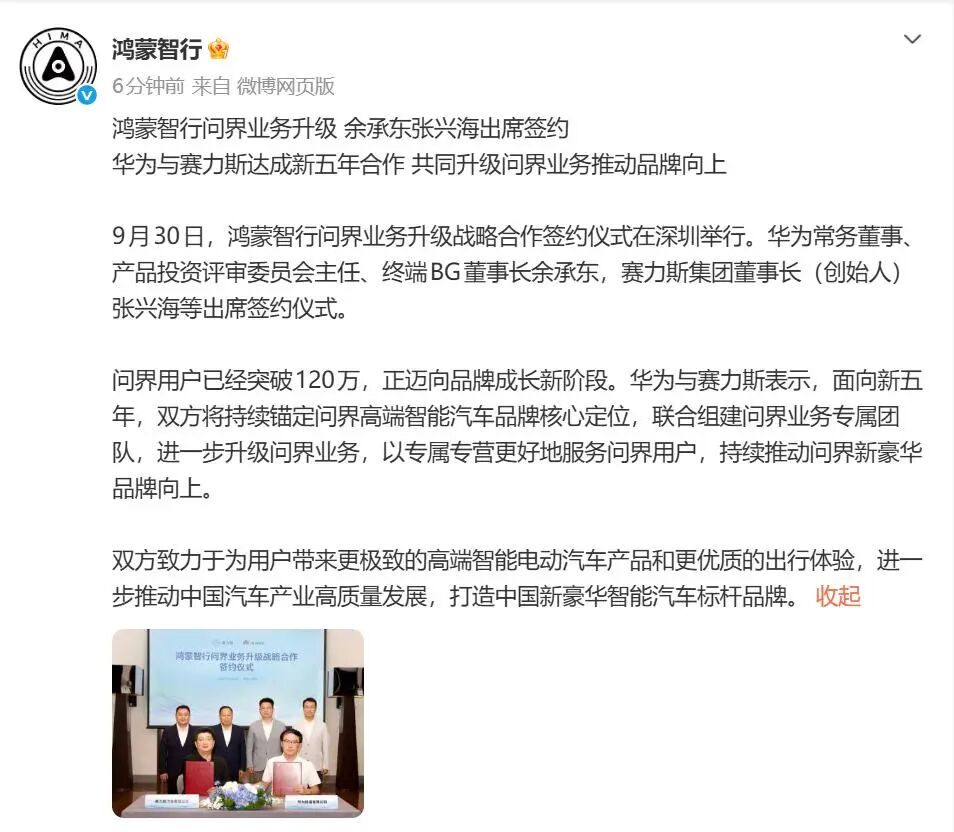
Publicly available information indicates that the core adjustments outlined in this agreement hinge on two pivotal aspects.
Firstly, both entities have established a dedicated business unit for AITO, ensuring full-chain exclusive operations and transitioning away from the previous model of shared resources and fragmented efforts.
Secondly, a formal division of labor system has been instituted, with SERES taking the helm in operations and Huawei providing exclusive technological enhancements. This approach upholds AITO's premium and luxury brand image, emphasizing scalable, high-quality growth.
Following the execution of this five-year cooperation pact, SERES will assume comprehensive responsibility for all facets of the AITO business, encompassing research, production, supply, sales, and services. It will lead in product definition, vehicle refinement, supply chain management, brand marketing, and terminal services.
Conversely, Huawei will concentrate on core sectors, dedicating its resources to the in-depth development of full-stack smart technologies, including the HarmonyOS cockpit, Qiankun Intelligent Driving, and automotive chips, offering exclusive high-end technological iteration support to AITO.
In Guanchejun's estimation, the true catalyst for this upgrade lies in the formation of the dedicated business unit.
As is widely acknowledged, Huawei's prior multi-brand car manufacturing strategy diluted resources. Now, with an independent, dedicated team overseeing product updates, user operations, and market promotion, coupled with Huawei's exclusive terminal store network, AITO enjoys a complete and independent operational ecosystem.
These transformations are underpinned by a bidirectional strategic decision.
Presently, HiMo Intelligent Travel's five-brand portfolio spans all price segments. While initial multi-line expansion facilitated rapid market penetration, in an era of inventory competition, overexpansion merely scatters resources, energy, and technology.
This time, Huawei ensures comprehensive market coverage while preserving AITO's premium benchmark status through tiered empowerment and differentiated competition, maximizing the commercial value of its technology.
For SERES, the five-year long-term agreement, coupled with operational autonomy, grants it core decision-making authority over products, marketing, and the market, paving the way for AITO's premium and sustained brand development.
Delving deeper, in today's new energy vehicle market, full-chain systemic capabilities represent the core barrier to brand establishment.
Most cross-industry collaborations between automakers and tech companies in the sector have consistently struggled to gain momentum. Avitar serves as a prime example, despite having the backing of three industry giants—Changan, Huawei, and CATL—it missed market opportunities and suffered from sluggish sales due to various factors.
This underscores that amassing top-tier resources is far less dependable than having a clear and stable cooperation mechanism in place.
Thus, Huawei and SERES's exploration of a cooperation model carries significant societal value. If successful, it will serve as a replicable and enduring industry model.
In essence, the upgraded cooperation between Huawei and SERES signifies the official transition of domestic smart car cross-industry collaborations from extensive development to a refined and systematic mature phase.
The windfall gains of the new energy industry have fully dissipated, and the era of winning by chance or single-point advantages has concluded.
In the latter half of the race, what truly matters are stable business models, efficient collaborative systems, continuous product iteration, and genuine user reputation.
The charts in this article, unless otherwise specified, are publicly disclosed through various channels. This is hereby stated and acknowledged with appreciation! The views expressed herein are for reference only and do not constitute investment advice.
This article is original to Leverage Car Observation and is prohibited from being reproduced without authorization! For reproduction, please obtain authorization. Additionally, when authorized for reproduction, please also indicate the source and author at the beginning of the article. Thank you!
-
![]()
After Testing ChatGPT dot, I Understand Why Big Companies Must Develop Personal Agents
-
![]()
SAIC Surpasses BYD! Automakers' 2026 Yearly Goals Prove to Be a Daunting Task
-
![]()
Leapmotor Surges Ahead! Li Auto and HiMo Harmony Intelligent Travel See Declines, September’s New Energy Vehicle Market a Blend of Triumph and Challenge
-
![]()
SERES and Huawei Make a Dramatic Shift! AITO Launches Ultimate Evolution Strategy
-
![]()
Changan Automobile Takes Action: What Lies Ahead for Deepal and Avatr?
-
![]()
World Model Track: Who's Consolidating, Who's Breaking Through?
-
![]()
AI Self-Generation: The Dawn of a New Era
-
![]()
Musk Changed the Name Again, But This Time It's No Simple Matter