So, Is It All Due to Incorrect Braking by Some?
 10/13 2026
 473
473
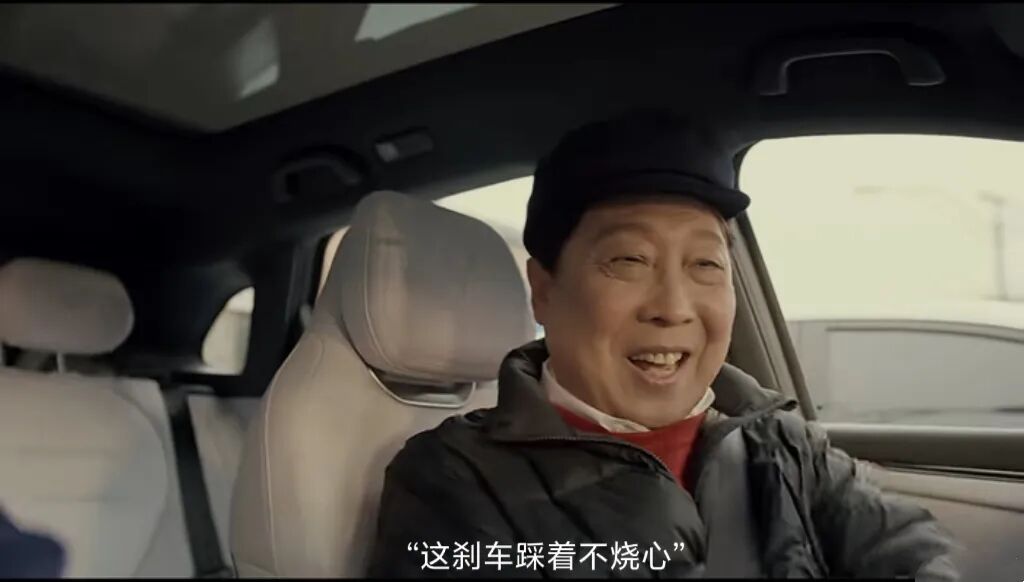
As the renowned legal drama series "Red Fruit Short Drama" aptly puts it: "Establish the rules first, and the path will only broaden. Only then will braking feel less distressing."

By She Zongming
01 /
He Yong once sang in "The Bell and Drum Tower": "Who set such a difficult question? The correct answers are everywhere."
Now, this line seems apt for the recent controversy.
The correct answers are everywhere: admit fault, apologize, and recall.
Tesla could have simply replicated its response from eight years ago when addressing Consumer Reports' allegations of "brake failure" in the Model 3.
However, some involved parties seem to revel in complicating matters.
They do this by "never admitting fault," thereby fueling online public opinion and providing fodder for internet memes.
Even when the People's Daily stated, "Although the incident awaits authoritative investigation conclusions, one thing is undeniable: a car's brake pedal should never break during driving!"
Even when they declared in their own announcement, "We will further optimize the design of this component."
They still refuse to admit fault or bow their heads.
This inevitably reminds people of a scene from the "Yanxi Palace" spin-off "Golden Branch and Jade Leaf"—
After the female lead is framed, she is asked to admit fault. But she would rather kneel outside the hall than admit wrongdoing.
Bystander: "Just admit fault, and everything will calm down. Why won't you admit it?"
Female lead: "I didn't do anything wrong."
Bystander: "Even if you think you're not wrong, why not temporarily admit fault to preserve the bigger picture?"
Female lead: "You want me to kneel and admit fault to ××? Only if my bones break."
"I didn't do anything wrong, so why should I admit fault?" If this line came from Emperor Jiajing being questioned in "The Ming Dynasty 1566," I could understand. If it came from Tang Zhou being punished by the sect leader in "Immortal Scent," I could also understand. But when an automaker takes this stance, I can only interpret it as:
Have they been listening too much to GAI's "My fate is too hard to learn to bow"?
02 /
The reason the automaker involved refuses to admit fault is that after causing a huge uproar, they released third-party test results.
The essence is: Compliance with industry standards, with stricter tests conducted, and no cracks or damage found.
When I opened the test results, I saw no indication of the testing agency, and on every crooked and slanted page, the words "compliant with standards" were written.
I couldn't sleep, and after careful examination, I realized the entire document was screaming three words—"I didn't do anything wrong."
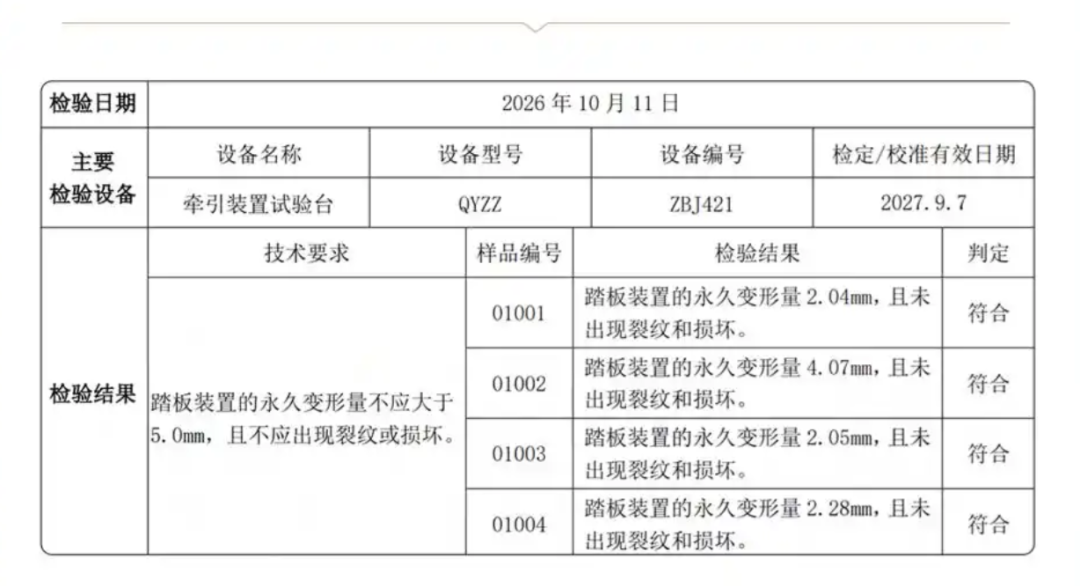
From my limited understanding, this is a reemphasis of the initial response that it "exceeds national and industry standards."
Sure enough, the "blame others rather than reflect on oneself" approach works wonders.
Placed in the context of the binary opposition proposition that "the × community and × expert must cool down one," the implication is clear:
If it's not my fault, then it must be someone else's.
No wonder some netizens joke: "So, is it all because this generation of drivers (testers) didn't brake correctly?"
Others satirize: "In the future, 'malicious braking' should be banned."
These aren't statements from the automaker involved, but the conclusions that can be inferred from their "I didn't do anything wrong" stance are plentiful—netizens' "creative urges" never miss a potential punchline.
In my view, if handling public opinion is like braking, then the automaker's response in this crisis is nothing short of another "brake pedal breaking."
Although "this generation of netizens is no good," some aren't foolish.
To determine if the brake pedal is faulty, there's no need to delve into knowledge about weld lines, single-layer vertical plate long force arms, or PP modified plastics. Just look at two points:
1. Whether the DCD tester is employed by the state.
2. Whether the automaker still plans to offer "free upgrades" to car owners.
These two points are straightforward: If the testing is problematic, then the legal department shouldn't stand idly by.
If the brake pedal is fine, why the need for an upgrade?
03 /
Putting facts aside, the test results released by the automaker involved can't really be considered "wrong."
Not only are they not wrong, but they're also impeccable, showcasing a mastery of language arts.
"Brake pedal longitudinal force 1500±20, clutch pedal 800±10" "Further increase longitudinal force to 3000N, loading speed 20mm/min, maintain for 5s, then release longitudinal force" "Compliant with industry standard QC/T 788-2018's 1500N test, with an average displacement of 2.61mm and a maximum permanent deformation of 4.07mm"... Sounds professional, doesn't it?
I'd say this is a distant... nod to Mr. Lei's art of expression.
There's a saying: "Figures don’t lie, but liars figure."
Translated, it means: "Numbers don't lie, but some people manipulate numbers."
In this case, whether anyone manipulated numbers, I'm not sure.
But I find the backlash quite intriguing—
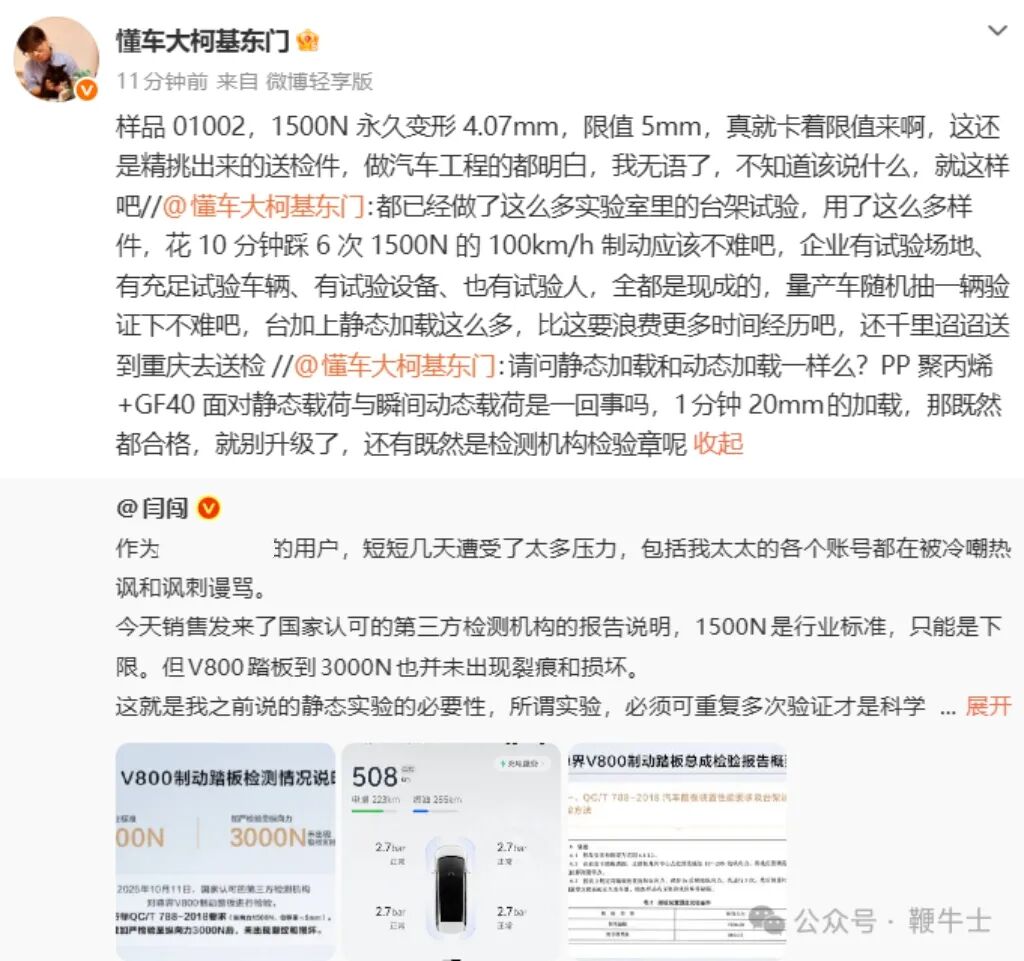
After the third-party test results were released, the tester involved from DCD, "DCD Big Corgi Dongmen," posted multiple responses and raised questions:
"Are static and dynamic loading the same? Is PP polypropylene + GF40 facing static loads the same as instantaneous dynamic loads? If the loading is 20mm per minute and it all passes, then why the upgrade? And where's the testing agency's seal?"
"Sample 01002, 1500N permanent deformation 4.07mm, limit 5mm. Really pushing the limit, huh? And this is a carefully selected sample for testing. Anyone in automotive engineering understands. I'm speechless, not sure what to say. So be it."
And experts have also pointed out the "subtleties":
"Slowly increasing to 2000N in one or two seconds is different from suddenly applying 2000N in a fraction of a second during an emergency. These are two different experiments, and the force the brake pedal needs to withstand varies."
"Whether the vehicle is static or dynamic, the force on the brake pedal differs. The speed at which force is applied is also crucial."
It's not hard to judge who's right or wrong here.
My judgment is: Maybe we should remove emergency braking from driving guides in the future. Delete it like × company (suspected deletion).
That way, if issues arise, automakers can shift the blame: "Who told you to brake without applying force gradually?"
04 /
As the renowned legal drama series "Red Fruit Short Drama" aptly puts it: "Establish the rules first, and the path will only broaden."
Only then will braking feel less distressing.
After saying all this, let me clarify—I mean: I firmly support the automaker's two responses and wholeheartedly believe in the test conclusions from the third-party China Automotive Engineering Research Institute (CAERI).
After all, the automaker's confidence far exceeds that of Chery, which recently apologized for issues like rear axle longitudinal arm tears and rear wheels detaching from the body.
After all, it's rare to find testing agencies with such a sense of entertainment—typified by contributing new "hand-tearing ghost" moments like "verifying the safety of the Ideal i8 by crashing it with a Chenlong truck."
These are all novelties in the world.
Watch and cherish them while you can.
-
![]()
Who is Taking Away the Profits of Car Companies: Battery or Intelligent Driving?
-
![]()
Tencent Successively Discontinues Two AI Agents
-
![]()
Has the Brake Pedal of JAC Motors Really Broken? The Market Will Teach Every Automaker with 'Fatal Flaws' a Lesson
-
![]()
Changsha’s Emerging Powerhouse in Computing: Cancels RMB 3 Billion Contract!
-
![]()
Production Capacity Can’t Keep Up with Orders! This Optical Enterprise Soars 449% on Debut
-
![]()
Q3 Report | Yuanjie Technology's Net Profit Expected to Surge Fivefold, Transitioning from 'Shortage Dividends' to 'Delivery Challenges'
-
![]()
The Computing Power Price War Hits Silicon Valley
-
![]()
The AI Office Sector is Forming a 'Three-Pillar' Landscape