How Does China's Intelligent Driving Elite View the 'Second Half of Global Autonomous Driving' at WICV 2026?
 10/22 2026
 392
This year's WICV 2026 World Intelligent Connected Vehicles Conference featured a special roundtable.
It gathered China's intelligent driving elite: NIO's Li Bin, XPeng's He Xiaopeng, BYD's Yang Dongsheng, Huawei's Jin Yuzhi (Yinwang), Horizon Robotics' Yu Kai, and Momenta's Cao Xudong. The moderator was Zhao Fuquan from Tsinghua University.
These six companies represent a panoramic view of China's intelligent driving landscape: three OEMs, one full-stack solution provider, one chipmaker, and one algorithm company.
The roundtable primarily discussed 'How global autonomous driving enters the 'second half'.'
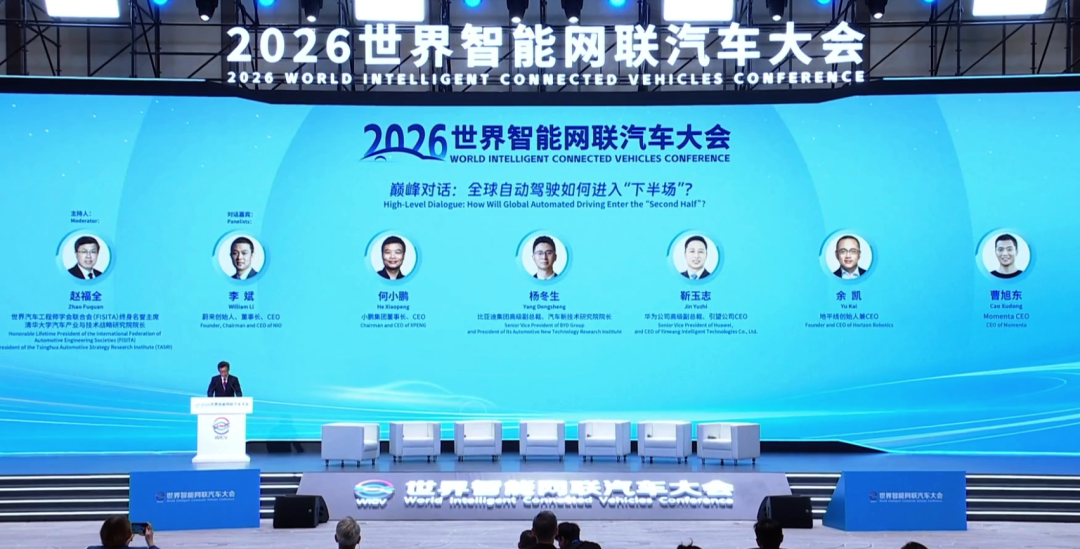
So how does this elite group view the current development of autonomous driving? What key product technologies remain for the industry in the second half? When will L3/L4 arrive, according to their predictions? How will companies survive? What challenges does intelligent driving face in going global?
I reviewed the entire conversation, aligned responses by question and speaker, and verified mentioned standards, regulations, and partnerships against public reports.
This analysis summarizes the key issues, shares which game rules have changed in the second half, and what these changes mean for product developers, technologists, and strategists.
01 The Second Half Starts with a New Scoreboard
Shifting from 'Can it drive?' to 'Will people pay? Do they dare trust it?'
Zhao Fuquuan set the tone for 2026 at the outset.
He rejected calling it a 'banner year' (implying next year would be weak) or a 'first year' (suggesting just beginning). Instead, he called it a tipping point: the first half relied on technological breakthroughs, while the second half must reach consumers, generate profits, and ensure safety and convenience.
His first question gave each panelist two minutes to answer: How do you understand the second half? How will the underlying business logic change? Where will competitive moats lie?
Comparing their responses revealed surprisingly consistent metrics.
01 Li Bin: Two Metrics
He said NIO's nine-year-old value proposition—'freeing mental energy, reducing accidents'—boils down to two numbers in the second half.
One is how many users are willing to pay. 'If users won't pay, no matter how good you claim it is, you haven't created real user value.'
The other is quantifiable safety, ideally reflected through insurance companies using accident probability and severity data for feedback.
02 He Xiaopeng: Three New Metrics
He highlighted three numbers absent in the first half: safety collision mileage, full-scenario coverage, and user payment rates.
He illustrated the second metric vividly: 'If you drive 10,000 km, can 9,999 km be autonomous?'
03 Yang Dongsheng: Usable, Dare to Use, Daily Use
BYD's approach focused more on user psychology. First, it must be usable (affordable); second, users must dare to use it (safety as a mission, not just a tech metric); finally, daily use.
He also introduced 'mutual trust' and 'stickiness' between technology and users, arguing technology must feel less cold.
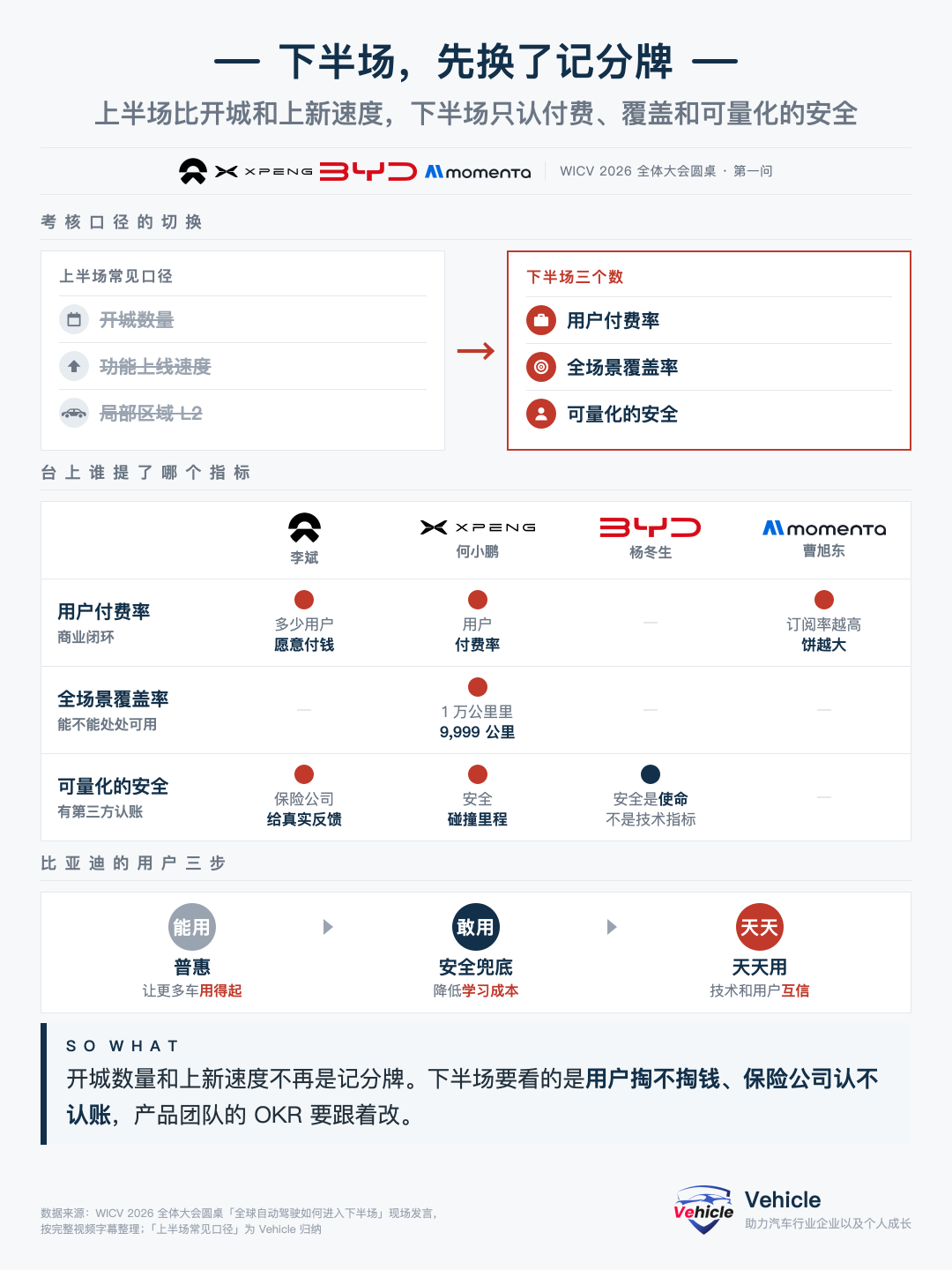
Combining these perspectives clarifies the second half's scoreboard: payment rates, coverage, and quantifiable safety. The first half's focus on 'city launch counts' and 'feature rollout speed' now shifts.
This directly impacts product teams.
Past intelligent driving OKRs focused on feature launches, city expansions, and disengagement mileage. Continuing this in the second half would misalign with what bosses and users care about.
The new scoreboard only recognizes user payments and insurance validation.
02 When Will L3 Arrive?
Four answers, one consensus in architecture
The moderator pressed hardest on this question, asking nearly every OEM about mass production timelines.
Their responses:
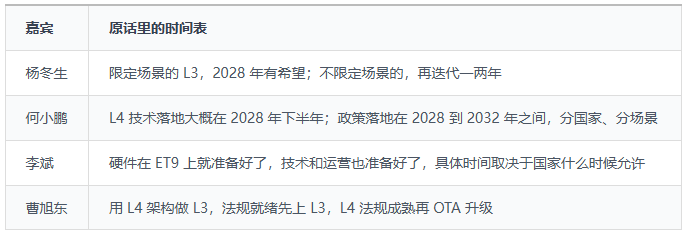
Despite four different statements, disagreements were minor.
01 XPeng: L3 Just Shifts Liability
He Xiaopeng's view defied consensus. He considered L2 and L4 together, believing L3 would be skipped.
He cited a European L3 test in a German car with narrow activation ranges, lasting only minutes daily, with poor experience. His conclusion: L3 merely shifts liability without improving experience or, crucially, safety.
He also argued true L4 companies must start with Robotaxi, which demands 100x safety margins.
02 Momenta: L4 Architecture, L3 License
Cao Xudong shared a client case he considered the most actionable.
A European automaker in China initially followed European L3 approaches. When Chinese markets and policies clarified, both sides judged the L3 transition would be short, so they redesigned sensors, domain controllers, and actuators using L4 architecture.
When L3 regulations permit, they launch with L3 licenses but L4 experience; after L4 regulations mature, they upgrade via software.
The benefit is clear: instead of two architectures for L3 and L4, one architecture covers both phases, slashing costs.
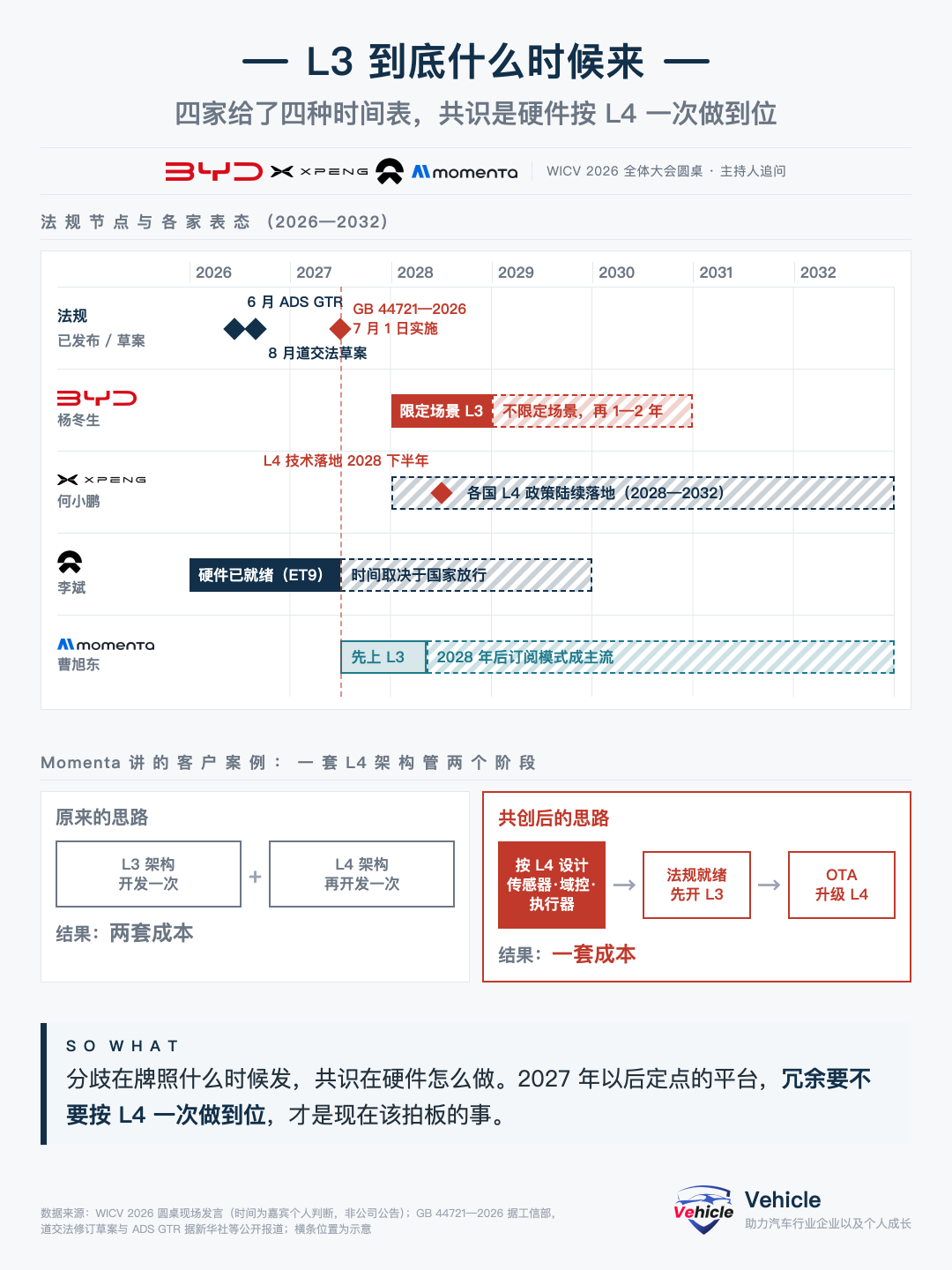
Thus, the real consensus on stage: build hardware to L4 standards upfront, obtain licenses incrementally per regulations.
Regulatory milestones are already clear.
GB 44721—2026 'Safety Requirements for Autonomous Driving Systems in Intelligent Connected Vehicles' was released, taking effect July 1, 2027, governing L3 and L4. Li Bin specifically mentioned it: 'If you claim capabilities, you must follow this regulation.'
For planners, my advice: stop debating 'whether to do L3.'
The real decision: for platforms awarded after 2027, should hardware redundancy meet L4 standards upfront?
03 Liability Shift Alters Cost Structures
After L3, automakers sell a comprehensive safety net
Jin Yuzhi highlighted a crucial point: in L2, drivers remain liable for accidents.
Once L3 deploy, this changes. Draft road traffic law discussions now focus on who handles violations during activation.
Li Bin explained L3 readiness in three layers: regulatory understanding, product preparation, technological maturity, and finally, an operational system.
He calculated pragmatically:
'If you sell millions of vehicles annually, you need an operational system supporting millions of L3 cars. This isn't about dozens or hundreds of robotaxis.'
— Li Bin, NIO Founder
He emphasized: manufacturer liability ≠ zero accidents, which is impossible. What's needed are response mechanisms and safety accountability systems.
NIO shared its data for reference:
950,000 vehicles on roads with 7x 8MP cameras, lidar, and 1,000+ TOPS computing power
9.14 billion km and 112 million hours of assisted driving, preventing/mitigating over 9.07 million accidents
Internal data: co-driving safety mileage 8x higher than human-only driving
Four insurers certified >30% reduction in major accidents
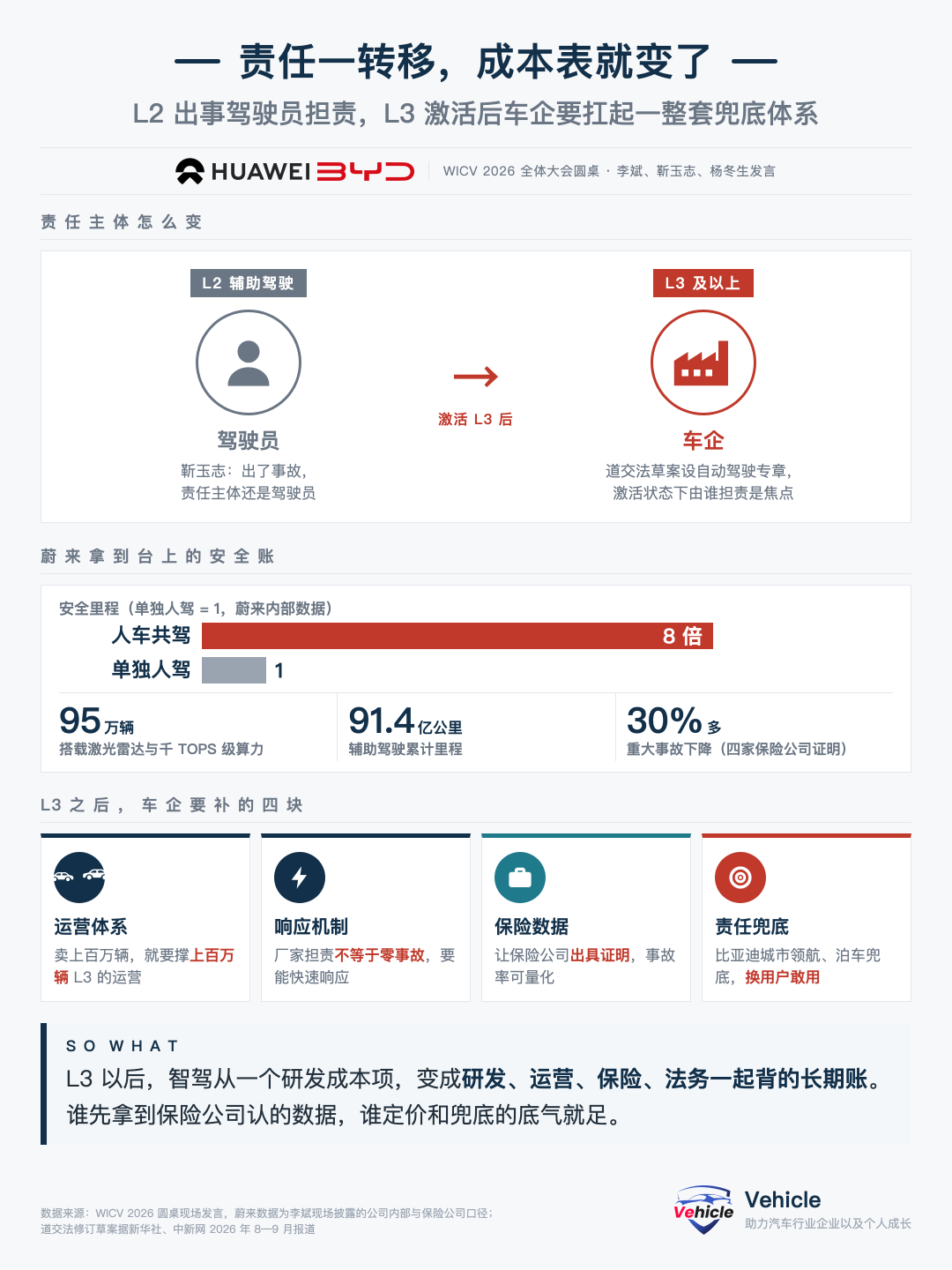
BYD took another approach: using liability guarantees to build user trust.
Yang Dongsheng said users face learning curves initially; guarantees not only show corporate responsibility but also encourage trials, generating real data and forcing R&D to study every failure scenario. They implemented urban navigation and parking guarantees, acquiring much real-world data.
This chapter impacts management most.
Post-L3, intelligent driving transforms from an R&D cost center into a long-term liability shared by R&D, operations, insurance, and legal teams.
Companies first securing insurer data gain pricing and guarantee confidence. NIO highlighted 'four insurer certifications' for this reason.
04 Technology Converges, Moats Shift
After algorithmic homogenization, competition focuses on vehicles, data, and computing power
Li Bin addressed technology routes directly.
He said the industry largely agrees: world models plus closed-loop reinforcement learning demonstrate scaling laws in intelligent driving. L2-L5 technologies converge from the same source.
Differences lie in engineering: stronger redundancy improves safety; greater computing power enables larger models; higher memory bandwidth and more sensors boost reliability.
He Xiaopeng framed it differently. He said the second half brings two changes:
1. Software becomes AI models plus data
2. Local hardware evolves into full-capability software-hardware coupling across chips, chassis, motion control, cockpits, self-driving, and vehicles—'very similar to robots'
He gave a sober assessment: fully integrating chassis motion control with autonomous driving for snow, swamp, or grass driving won't happen in 1-2 years.
Yang Dongsheng, representing BYD, was more specific.
Post-electrification, braking, steering, and suspension are all electronically controlled, with fast motor responses. 'With so many eyes and legs,' vehicles naturally exceed human driving capabilities. Thus, automakers must achieve full-stack autonomy, connecting electronic architectures, vehicle execution, and data pathways.
01 All Say: Data Remains Insufficient
This point impressed me deeply. Even companies with the most data admitted shortages on stage.
Yang Dongsheng: BYD has 4 million vehicles generating 200-300 million data points daily—still insufficient, with too few extreme scenarios encountered, necessitating simulations.
Li Bin: Over 125 million valuable anonymized video clips collected in four years, comparable to Tesla, but computing power remains inadequate, requiring further investment.
Zhao Fuquan summarized: 'No single enterprise's data suffices to make models competitive.'
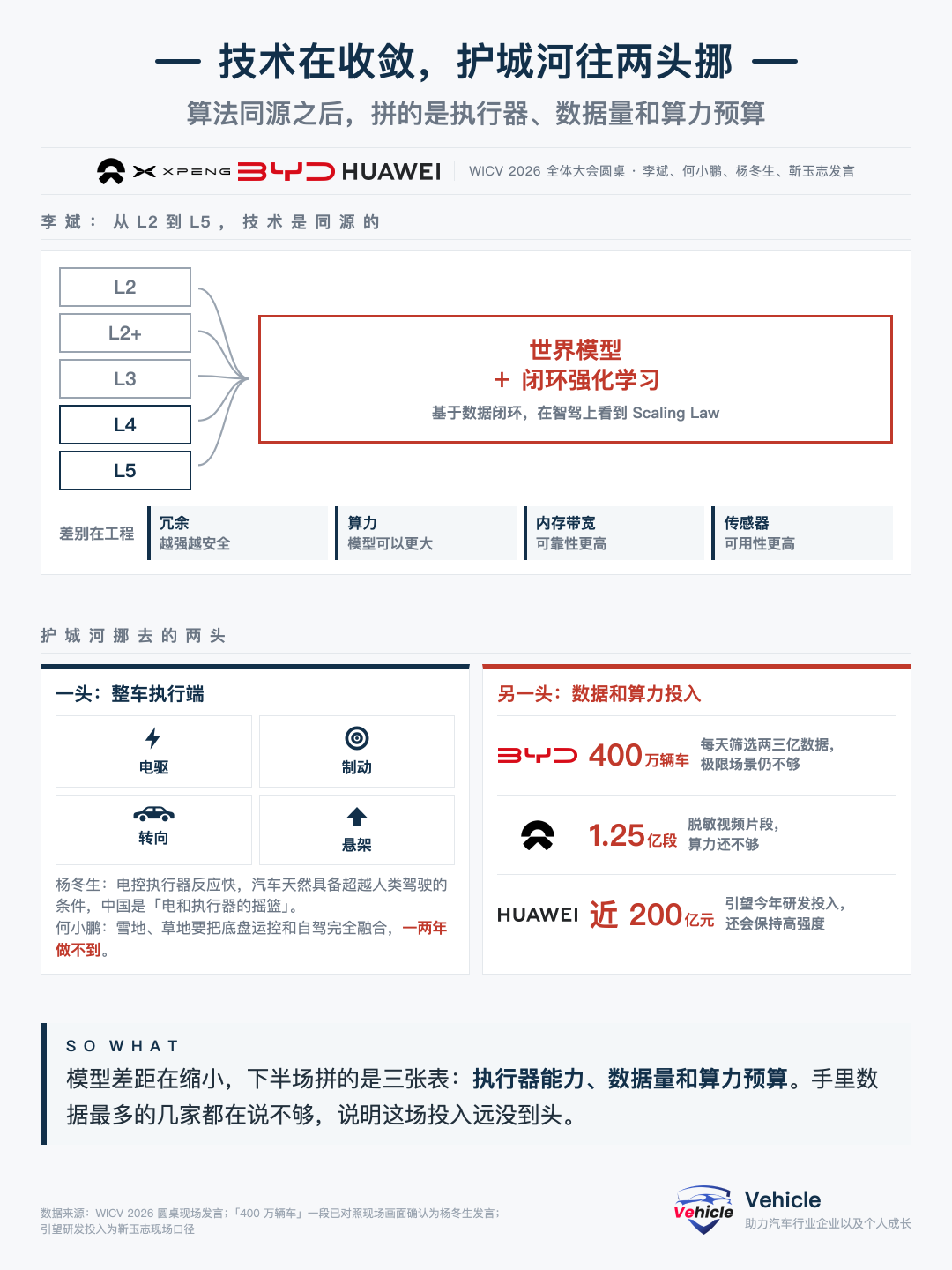
Combining these perspectives, my understanding is: algorithms are becoming commoditized, so moats shift to two areas.
One is vehicle execution: electric drivetrains, wire control, and chassis—China's traditional strength, as Yang Dongsheng called China 'the cradle of electrification and actuators.'
The other is data plus computing investment intensity. Huawei Yinwang's nearly 20 billion RMB R&D investment this year, NIO's computing power expansion plans, and BYD's data hunger all signal the same direction.
As model gaps shrink, the second half hinges on execution capabilities, data volume, and computing budgets.
05 Three Supplier Business Models
Screwdriver, Tier 2, co-creation with revenue sharing
The moderator shifted questions to the three tech companies later, posing increasingly pointed ones.
The toughest went to Cao Xudong: 'Many intelligent driving companies founded five years ago have vanished as automakers absorbed capabilities. How long can you survive?'
Their answers revealed three distinct business models.
01 Huawei Yinwang: Unchanged Role, Expanded Ecosystem
Jin Yuzhi said Yinwang has always done one thing: supply intelligent components for the smart networking era, likening itself to an 'electronic screwdriver' that helps automakers build and sell better cars without competing with them.
What changes is the ecosystem. On October 19, Yinwang partnered with CATL and Times Electric Service: vehicles equipped with Qiankun Intelligent Driving can autonomously locate, enter, swap batteries in 99 seconds, and exit stations.
This matters because Yinwang unifies energy replenishment ecosystems, sparing automakers from individual integrations. His National Day data was striking: Qiankun users drove 560 million km with assisted driving in seven days, 60% under assistance.
02 Horizon Robotics: Computing Only, 95% via Partners
Yu Kai began with 'We don't build cars.' The moderator interjected: 'When you say that, everyone looks at Huawei.'
He drew clear boundaries: Horizon develops computing chips and basic software but not domain controller hardware or operations. 95% of vehicle projects deliver through partners, typical Tier 2.
His rationale: innovation emerges from collaboration, not central planning. 'Dominating every link in such a long chain with excellence has low probability.'
03 Momenta: From Supply to Co-Creation
Cao Xudong replied: 'The first half was supply; the second half is co-creation plus supply.'
Beyond the earlier 'one L4 architecture for L3/L4' case, he predicted subscription models would dominate post-2028. Then, parties would co-create not just products but operations, with higher subscription rates expanding the pie and revenue shares.
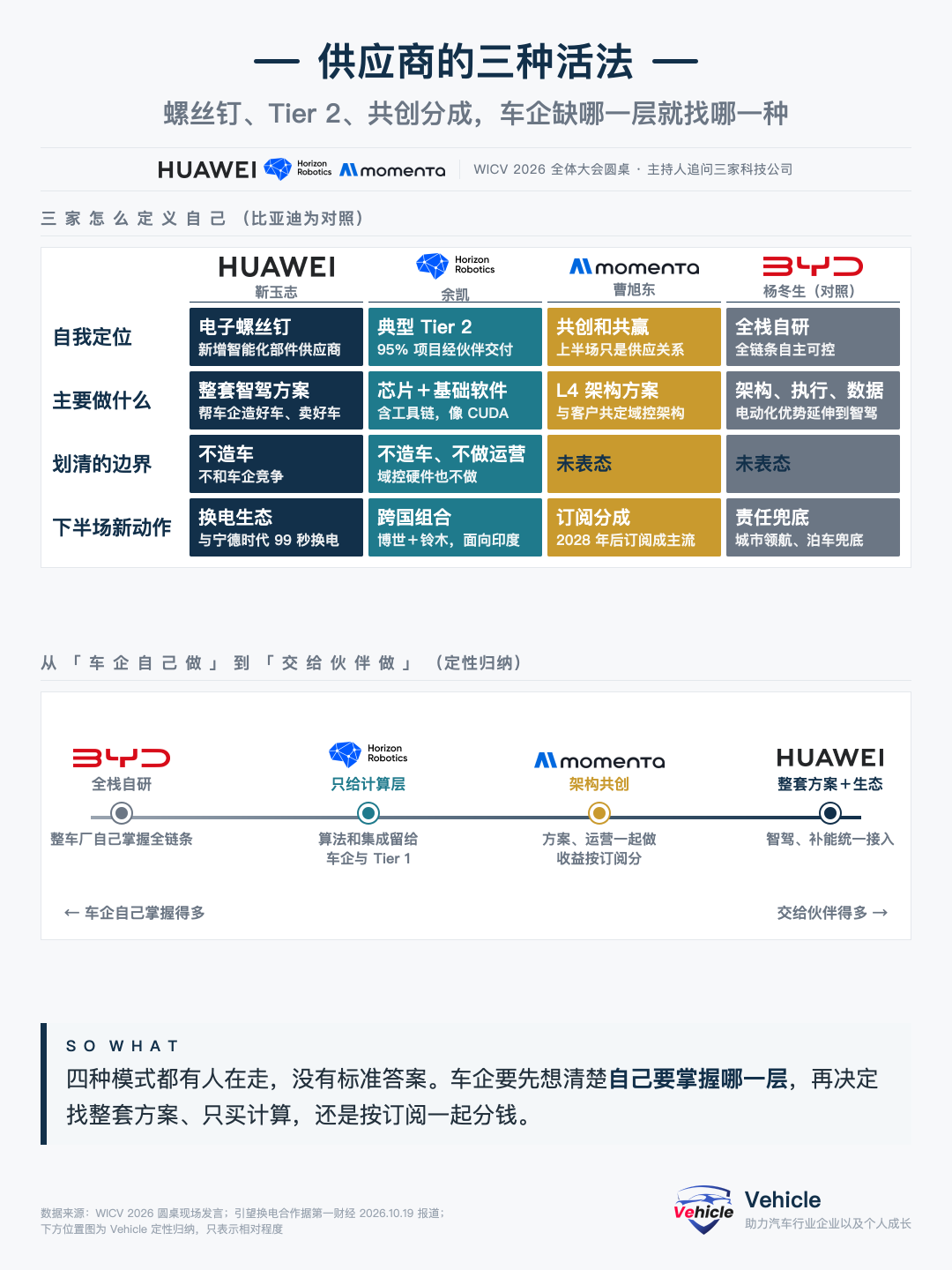
For automakers, this framework helps identify partnership needs:
Seeking full-stack solutions and ecosystem access requires one approach; developing algorithms in-house while needing chips and toolchains needs another; wanting to amortize L3/L4 costs via subscriptions demands a third.
BYD represents a fourth path: full-stack self-development with self-guarantees. All four approaches exist without standard answers.
06 Going Global Gets Tougher
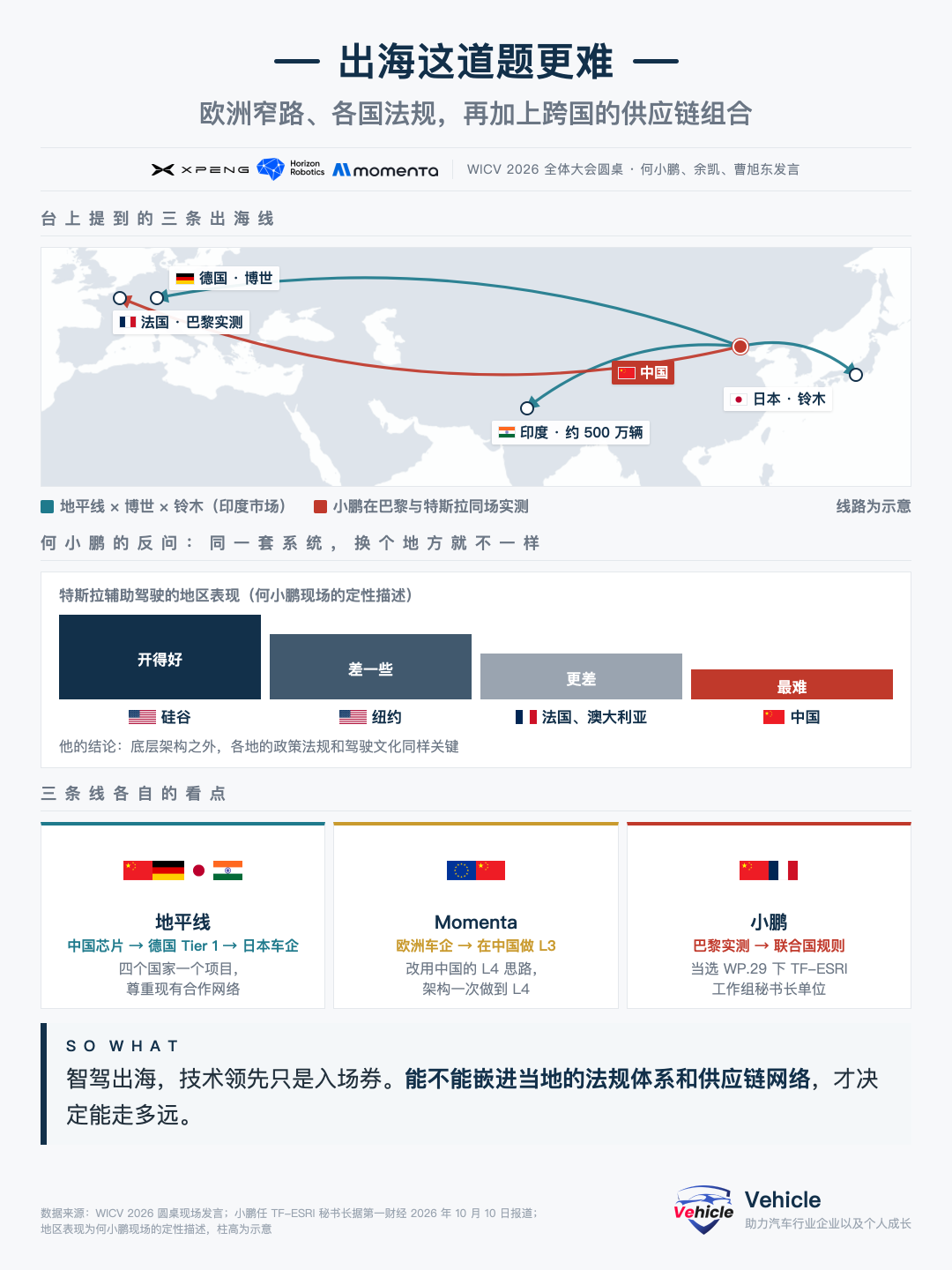
Europe's narrow roads and varying national regulations pose a greater challenge than China's road conditions.
The host asked He Xiaopeng: During the Paris Motor Show, a senior media person tested both Tesla and XPeng. Initially, it was expected that Tesla would perform better, but the results showed that the two were very close. Why is that?
The answer given here is the most interesting. Looking back, when domestic companies claimed that China's autonomous driving was the most challenging due to the large number of people and electric vehicles.
Now, for example, XPeng has shifted its narrative, stating that upon arriving in Europe, they discovered many narrow one-way streets and the need to consider how to politely pass other vehicles. He encountered a six-lane roundabout in Paris with no markings on the ground, where vehicles were weaving in and out.
To simultaneously comply with local regulations, ensure safety, and align with local driving culture, he said, 'This is a very difficult thing.'
The overseas expansion cases discussed by the other two tech companies followed completely different approaches.
Horizon Robotics: Collaborated with Germany's Bosch to secure a project with Japan's Suzuki, targeting auxiliary driving for approximately 5 million vehicles in the Indian market. A Chinese tech company, a German parts supplier, a Japanese automaker, and the Indian market—four countries involved in a single project.
Momenta: A European automaker client is developing L3 in China and modified its architecture based on China's L4 approach.
Yu Kai made a statement here that truly reflects a big-brother mentality, and I believe all Chinese automotive companies going overseas should remember it:
'We are not appearing as disruptors. We respect the existing cooperation networks and ecosystems, and we aim to be creators of value, not disruptors of the system.'
— Yu Kai, Founder of Horizon Robotics
My judgment is that the overseas expansion of intelligent driving is just beginning. It will revisit the path taken in China over the past few years, but with even more new stories.
What truly determines success or failure is whether you can integrate into the local regulatory systems and supply chain networks, coexisting harmoniously.
07 Written at the End
Alone, we go fast; together, we go far.
This roundtable discussion ran ten minutes overtime. Zhao Fuquan joked that it wasn't his fault but rather the organizer's greed for inviting so many people.
One part of his summary stood out to me as particularly valuable for management to consider:
'Regarding autonomous driving, having the technology doesn't guarantee implementation, nor does having regulations. Issues like responsibility allocation and insurance coverage remain unresolved.'
'Consumers have been spoiled by free upgrades, but subscriptions reflect research and development costs and profit margins. The entire industry needs to educate users together.'
'No single automaker can dominate the market, nor can any single parts supplier be truly unique.'
Looking back at the entire conversation, the six participants had different perspectives but were all answering the same question: What is still missing for autonomous driving to transition from a technology to a business?
The missing elements were clearly listed on stage: payment rates, quantifiable safety, responsibility and insurance mechanisms, subscription models, and localization for overseas expansion.
No single company can fill all these gaps alone. The judgments and choices must ultimately be made by each company individually.
The second half of the intelligent driving story continues.
That's all for today's sharing. If you found it useful, please help by liking, sharing, and clicking 'In Sight.' Feel free to leave your thoughts in the comments section.
*Reproduction or excerpting without permission is strictly prohibited.-
-
![]()
Post-85s AI Meteorology Entrepreneur from Changzhou, Jiangsu: Secures Multi-Million Funding
-
![]()
Why Is Light Able to Pass Through Holes Smaller Than Its Wavelength?—Exploring the Extraordinary Optical Transmission of Metasurface Infrared Filters
-
![]()
Film and Television Hurricane Delivers a Rigorous Review of the iPhone Duo! Withstands 10,000 Folds, Yet Falls Short in Software
-
![]()
Is the XPENG MONA L05’s Pre-sale Price 40,000 Yuan Steeper Than Its Rivals’?
-
![]()
Historic Windfall in Layoffs: BMW's Up to €650,000 Compensation Sparks Employee Exodus, Overwhelms System
-
![]()
Has Geely’s Debut Boxy SUV Shaken Up Off-Road Pricing?
-
![]()
GM China Reports $210 Million Net Profit in Q3: Two Consecutive Years of Profitability, Though CEO Warns of Tougher Market Conditions
-
![]()
BMW Layoffs: Employees Compete to Leave!