Xiaopeng 'Soars' into the European Market
 10/22 2026
 562
Tesla may 'soar,' but hasn't Xiaopeng been capable of 'soaring' for quite some time?
In reality, the ability to 'soar' isn't all that intriguing. If Tesla were solely capable of 'soaring,' it would still face significant criticism. Conversely, an inability to 'soar' doesn't impede its sales either. These factors are interconnected. In today's automotive landscape, a company must possess both the capability to innovate ('soar') and to remain firmly grounded.
Recently, Xiaopeng has made remarkable strides. The company announced its representation of the International Organization of Motor Vehicle Manufacturers (OICA) and its role as the joint secretary of the newly established Working Group on Autonomous Driving Scenario Information Exchange under the United Nations vehicle regulatory framework. Against the backdrop of China and the EU concluding a fresh round of automotive trade consultations, this move holds particular significance: Chinese automakers are integrating their technological expertise into international industrial collaboration.
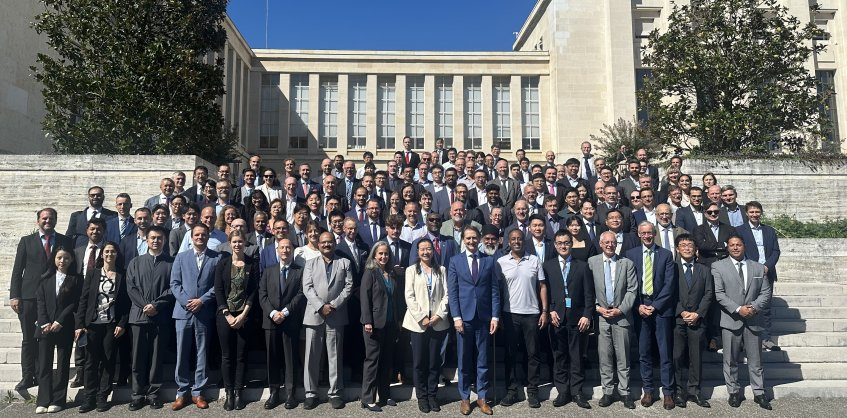
Delegates at the GRVA Plenary Session pose for a group photo in Geneva.
He Xiaopeng also recently unveiled new technology collaboration ventures in Paris. Discussions can encompass the entire vehicle platform or focus separately on intelligent driving, chips, and batteries, with collaboration partners including global automotive enterprises. Following Volkswagen, he hopes to attract more peers as Xiaopeng's clients.
The same company that finds automakers eager to purchase its R&D capabilities abroad still faces arduous efforts in domestic car sales. The product, pricing, and sales challenges that Wang Fengying must address have not become any simpler due to Xiaopeng's technological prowess.
The Chinese automotive market is creating this dichotomy. Peers are integrating intelligence into increasingly affordable models, while multinational automakers, to keep pace, are beginning to acquire R&D capabilities from Chinese companies. Xiaopeng has discovered new revenue streams from this trend but still bears the brunt of this competition.
01 Xiaopeng is Transforming Peers into Clients
The relationship between the European and Chinese automotive industries can no longer be simply characterized as competitive.
According to consultation results disclosed by the Ministry of Commerce in October, China and the EU continue to address issues such as hybrid vehicle trade and price commitments for pure electric vehicles, while identifying new energy, artificial intelligence, and two-way investment as areas for cooperation. Negotiations over market share persist, and companies are also evaluating the benefits of collaboration.
The scenario information exchange working group, for which Xiaopeng has assumed the joint secretary role, is co-chaired by China and France. The focus lies on exchanging experiences in diverse road environments, traffic behaviors, and autonomous driving operations. Xiaopeng, in collaboration with the Society of Automotive Engineers (SAE) International, supports the working group's operations, facilitating collective discussions among all parties.
Such endeavors may not be as captivating as new car launches, but they are directly linked to the global expansion of intelligent driving. Systems trained on Chinese roads must operate under different traffic regulations. Engineering teams must familiarize themselves with local testing methodologies, and regulatory agencies must also comprehend the system's performance in specific scenarios.
Chinese automakers are already actively participating. At the same session of the United Nations' Working Group on Autonomous and Connected Vehicles, the OICA delegation included technical experts from Chery, NIO, and BYD. What Xiaopeng has secured this time is a more defined organizational role.
Meanwhile, Xiaopeng has introduced its Navigation Guided Pilot (NGP) to the streets of Paris. The official intelligent driving experience program at the Paris Motor Show featured only Xiaopeng and Tesla, allowing attendees to experience it on real roads. Tesla's Full Self-Driving (FSD) has already been approved for open use in the Netherlands, while Xiaopeng aims to promote NGP to overseas customers by 2027. It is currently working on testing, certification, and product delivery schedules.
For Xiaopeng, entering these stages early is a preparation for future business endeavors.
Volkswagen's case has already illustrated why foreign automakers opt for Xiaopeng. The first model they collaborated on is targeted at the Chinese market, where Volkswagen needs to swiftly launch intelligent electric vehicles that cater to Chinese consumer demands. In March of this year, the jointly developed ZONY 08 commenced mass production in Hefei with a development cycle of 24 months.
The division of labor in the cooperation is also clear-cut. Volkswagen China Technology Company participates in development, responsible for product design definition, technical verification, quality standards, and driving tuning. Xiaopeng provides platform and intelligence capabilities, while Volkswagen retains control over its brand and vehicle requirements.
Volkswagen is buying time to catch up with the market. For Xiaopeng, R&D investment, which was primarily recouped through its own car sales in the past, now has alternative payers.
The scope of their cooperation is also expanding. In 2025, the jointly developed electronic and electrical architecture will be further extended to Volkswagen's internal combustion engine and plug-in hybrid platforms in China. As the technology is integrated into more models, the revenue Xiaopeng can strive for has the potential to surpass its own vehicle sales.
In Europe, local manufacturing fosters another type of collaboration. The Magna plant in Graz, Austria, is already producing the G6, G9, and P7+, with the G9L completing its first trial production in October. Xiaopeng gains local manufacturing capabilities, while Magna secures production orders. Both parties benefit from increased sales of Xiaopeng vehicles in Europe.
With these practices, He Xiaopeng's launch of XPENG AI ENGINEERING in Paris has a clearer business foundation. Clients can collaborate on developing entire vehicle platforms or purchase modules such as intelligent driving, chips, and batteries, even including tools for R&D, production, and after-sales.
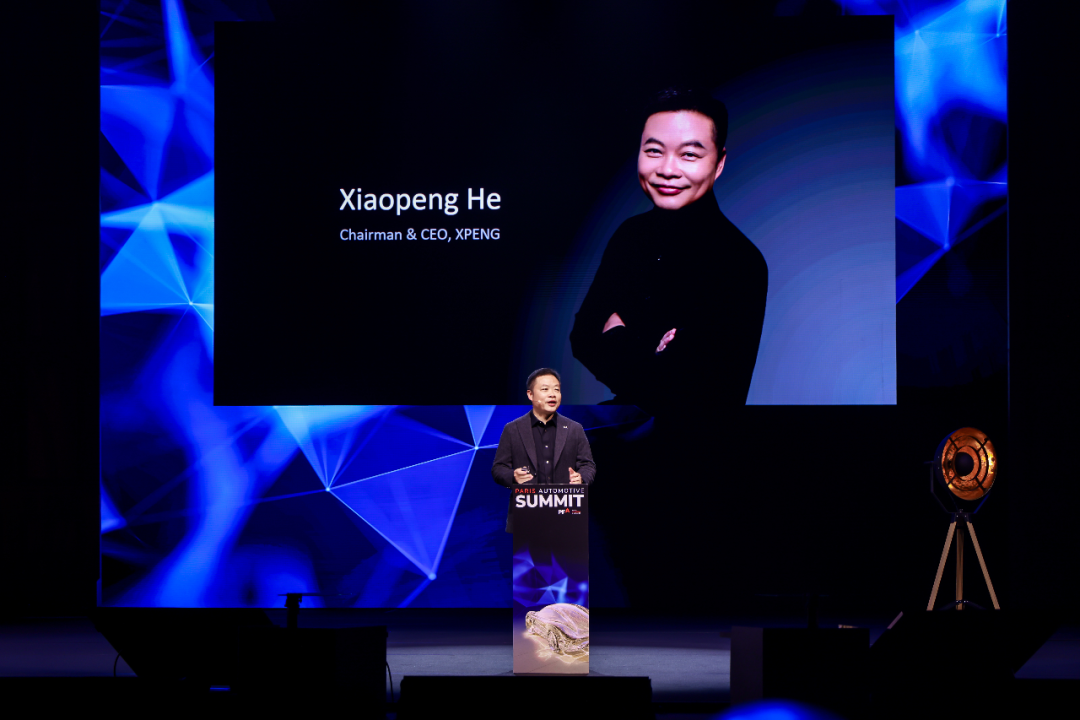
He Xiaopeng introduces intelligent automotive technology collaboration businesses at the Paris Automotive Summit.
Xiaopeng hopes more automakers will be willing to pay for ready-made engineering capabilities. Developing these from scratch would necessitate investing in R&D teams and bearing development time and trial-and-error costs. Xiaopeng aims to recoup returns by applying its existing R&D to more products.
This is also the practical significance of its participation in international technology collaboration. Technologies must adapt to local regulations and road environments for use in different markets; communication with regulatory agencies and industry partners is inevitably part of product development. Now, Xiaopeng's autonomous driving technology is highly likely to become a component of its technology sales.
02 Wang Fengying Faces Internalized Competition
While He Xiaopeng seeks more technology clients externally, Xiaopeng's own vehicles still need to secure orders domestically. Data from the China Passenger Car Association shows that in September, Xiaopeng exported approximately 10,100 vehicles, doubling year-on-year; domestic retail sales were about 30,600 vehicles, down approximately 16.3% year-on-year, a decline similar to that of the overall new energy retail market that month. In the same month, Leapmotor's domestic retail sales were about 78,200 vehicles, still experiencing growth.
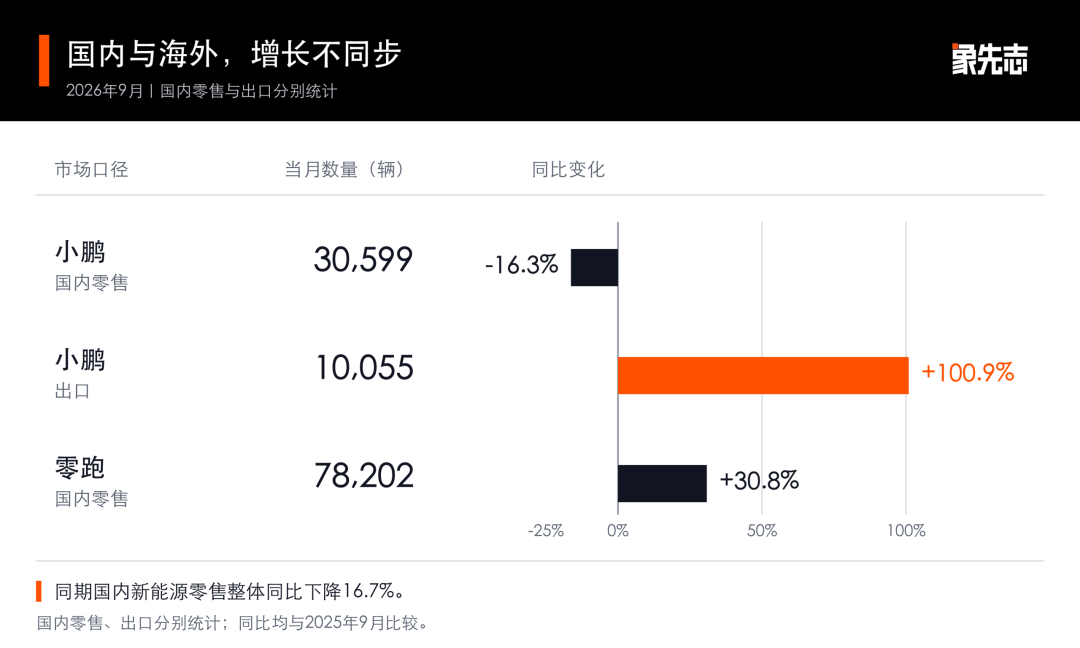
Xiaopeng's domestic retail and export sales exhibit different trends.
The product and pricing decisions involving Wang Fengying still confront considerable challenges. Consumers purchase an entire vehicle, so Xiaopeng's advantages in intelligent driving must be packaged with pricing, space, and charging experience to serve as compelling reasons to buy.
In February 2025, BYD released the Divine Eye C, initially covering 21 models, with prices ranging from the 70,000-yuan level to the 200,000-yuan level. Advanced driver-assistance systems are penetrating more affordable vehicles, augmenting the product options available to consumers and altering what Xiaopeng needs to elucidate: where its experience truly excels and how much that difference is worth.
As technology continues to advance, the scarcity of specific configurations is diminishing.
According to reports, as early as before the G6's launch in 2023, Wang Fengying led the product planning and sales teams through six or seven rounds of discussions on configurations and pricing. She advocated retaining configuration and software advantages while lowering prices, ultimately setting the starting price at 209,900 yuan.
Even the car's name underwent a change. It was originally called the G7, but with the P7's starting price at 249,900 yuan, a lower-priced SUV with a higher number could have confused the product lineup. Wang Fengying pushed for the name change to G6, aligning price, name, and positioning.
These matters may not be as attention-grabbing as developing chips, but they determine how consumers perceive a vehicle. Substantial investment has already been made in technology; which products it is integrated into and at what price they are sold affect how much of that investment is recovered.
After the G9L's release this year, He Xiaopeng mentioned another detail: Wang Fengying and Wu Anfei were more insistent than he was about integrating the new-generation intelligent driving system. According to his recollection, discussions also encompassed appearance, four-wheel-drive configurations, and pricing.
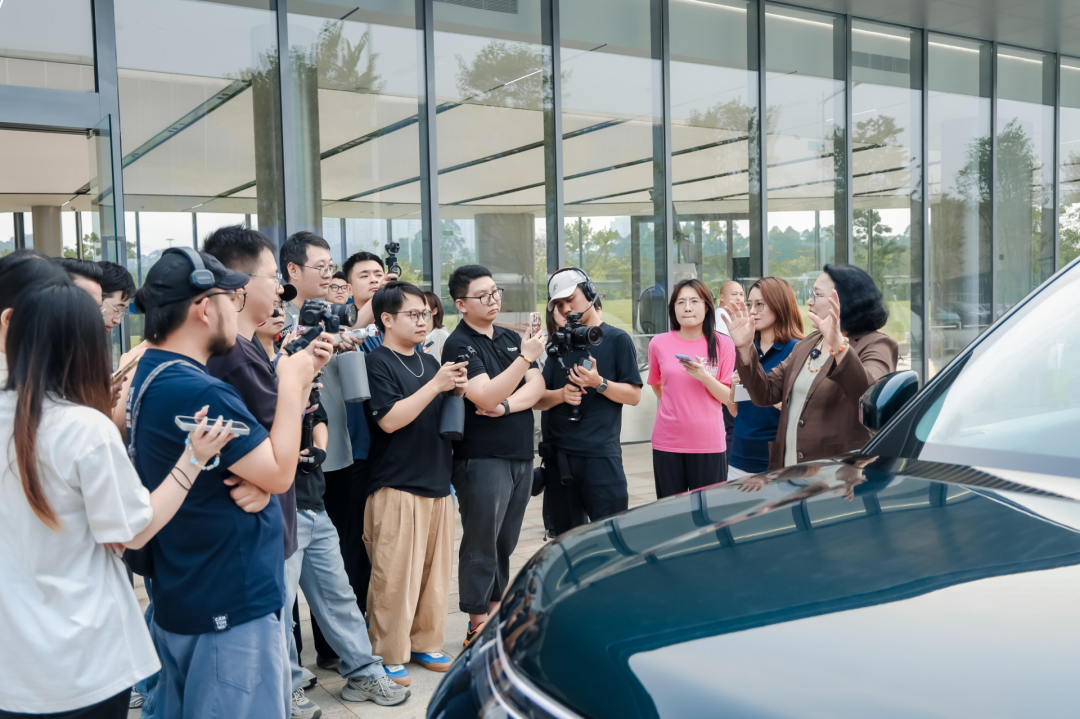
In September 2026, Wang Fengying exchanges views with the media at the first delivery ceremony of the Xiaopeng G9L.
From the G6 to the G9L, Wang Fengying has been defining which capabilities to retain and how to integrate them into products. She aims to lower the purchase threshold while making Xiaopeng's technological strengths sufficiently apparent. When it comes to insisting on integrating new systems, she remains unwavering.
While He Xiaopeng seeks technology clients externally, Wang Fengying incorporates R&D achievements into consumers' purchasing options. Their work is interconnected in this regard.
Xiaopeng has rebounded from adjustments. Global deliveries in 2025 were approximately 429,400 vehicles, up about 126% year-on-year. However, growth fluctuated this year. According to quarterly announcements, deliveries in the first three quarters were about 284,400 vehicles, down about 9.2% year-on-year; the third quarter witnessed a return to about 2% year-on-year growth.
Overseas orders are on the rise, and new domestic products provide support. The GX delivered 7,224 vehicles in September, exceeding 7,000 vehicles for three consecutive months, as Xiaopeng opens up new product space.
These changes offer opportunities for sustained growth but also clearly outline Wang Fengying's next task: maintaining sales volume across multiple models. While technology can be reused across different models, consumers must form new judgments about each one. After the initial excitement of a new model launch subsides, pricing appropriateness and whether dealerships can continue securing orders will influence the company's scale.
03 But Technology Business Also Depends on Sales Volume
Technology collaboration has already yielded substantial returns for Xiaopeng.
In the second quarter of this year, revenue from 'services and others' was approximately 2.7 billion yuan, with a gross margin of 75.1%. This business encompasses technology R&D services as well as parts and accessories sales. Calculated based on financial report data, it contributed nearly half of the company's gross profit.
During the same period, Xiaopeng's automotive gross margin declined from 14.3% year-on-year to 12.1%, which the company attributed to model transitions; R&D expenses were approximately 2.914 billion yuan, up 32.1% year-on-year. The automotive business is still undergoing adjustments, while R&D investment continues to escalate.
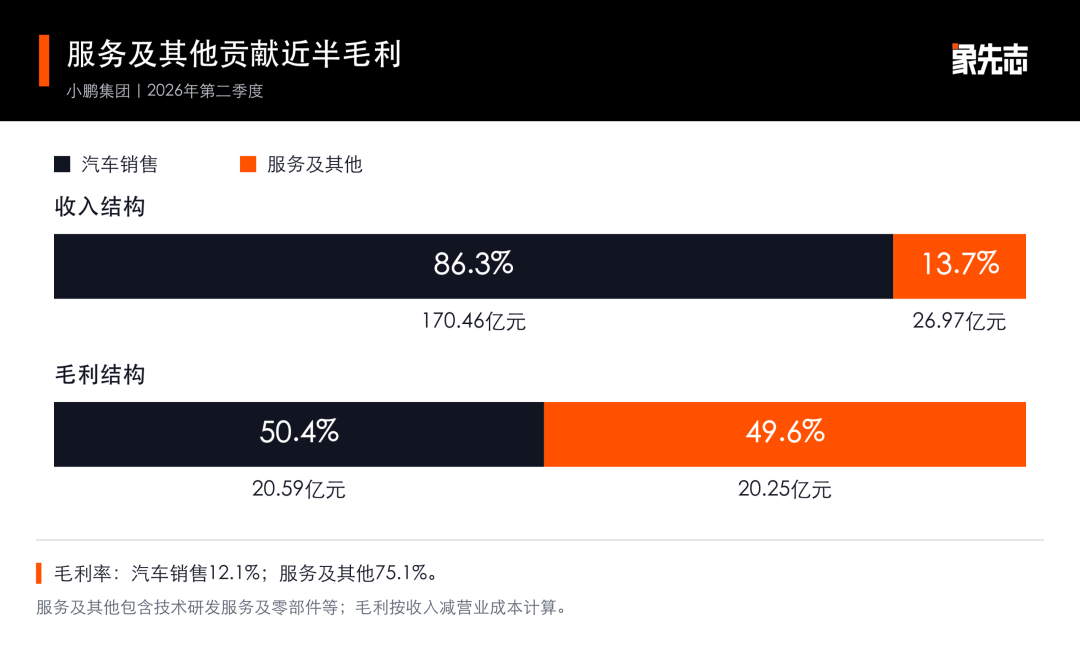
Services and others contributed nearly half of Xiaopeng's gross profit in the second quarter.
He Xiaopeng continues to expand his technology clientele for practical operational reasons. Developing new models and AI necessitates funding; each additional client adopting Xiaopeng's capabilities presents another opportunity to generate revenue.
However, this business is also intertwined with automotive sales.
Xiaopeng's 2025 annual report discloses that technology service revenue includes portions confirmed based on development milestones, while contracts with sales-based charging clauses confirm corresponding licensing revenue when the partner makes sales. Development projects bring phased income, and subsequent model sales influence another portion of returns.
On October 20, Reuters, citing data from automotive consultancy ThinkerCar, reported that the ZONY 08 averaged 267 monthly sales from its April launch to August. While Volkswagen acquired faster R&D capabilities, the new model still encountered product, pricing, and channel issues upon entering the market.
The report noted that the ZONY 08 is primarily sold through Volkswagen Anhui's newly established sales network, without fully leveraging Volkswagen's existing vast dealership system; Chinese models in the same price range continue to compete on configurations and charging capabilities. In response, Volkswagen emphasized that its collaboration with Xiaopeng has already introduced a new electronic and electrical architecture and enhanced development efficiency.
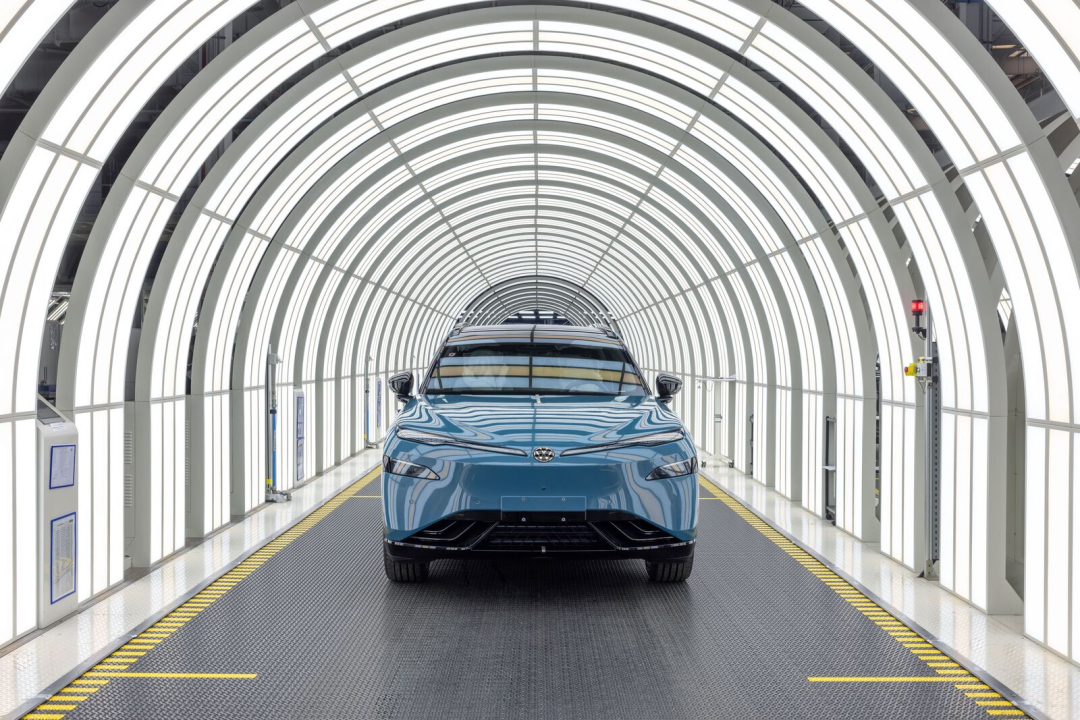
In March 2026, the ZONY 08 commenced mass production at the Volkswagen Anhui factory in Hefei.
The sales performance of the ZONY 08 serves as a litmus test for the market appeal of its collaborative model. To bolster technology exports, Xiaopeng must not only successfully deliver R&D projects but also convince partners of the enduring value of sustained procurement and the potential for additional projects. While R&D capabilities can be marketed independently, long-term revenue growth must still be sought within the automotive market landscape.
The upcoming round of competition in the whole-vehicle sector will also put automakers' control over battery costs to the test.
BYD has long been a player in cell manufacturing, and Leapmotor has followed suit by establishing cell production lines this year through joint ventures. In September, Leapmotor revealed that its production lines were already up and running, while maintaining external procurement channels to adapt to fluctuating demand. Peers are vying for greater cost control and supply chain autonomy; generally, the larger the production scale, the more feasible it becomes to reduce unit costs through upstream investments.
This dynamic will inevitably influence whole-vehicle competition. Cost savings can either be retained as profit margins or reinvested to lower prices and enhance vehicle configurations. While Xiaopeng aims to differentiate itself through its intelligent driving experience, it must also contend with competitors who are constantly tweaking their pricing and product offerings in other areas.
He Xiaopeng has drawn a clear line for Xiaopeng: developing battery systems in-house but steering clear of cell production. He elucidated this strategic choice in a September interview.
Venturing into cell manufacturing entails shouldering the pressures associated with factory operations, equipment maintenance, and capacity utilization. By opting to procure cells and then focusing on system design and vehicle integration, Xiaopeng can offload more upstream manufacturing tasks to suppliers. For Xiaopeng, determining the extent of its self-developed capabilities necessitates careful consideration of its scale, financial resources, and long-term investment commitments.
This also underscores why sales volume remains a pivotal factor. Fixed investments in R&D and manufacturing demand a larger business footprint to achieve cost amortization. Xiaopeng can monetize its technology by selling it to more automakers and boost revenue through increased vehicle orders, but success in both areas hinges on products that continue to resonate with the market.
Xiaopeng is already addressing immediate vehicle usage needs. In January of this year, deliveries of the P7+ and G7 extended-range models commenced, while the expansion of fast-charging infrastructure and networks continues apace. Extended-range models broaden the potential consumer base, and fast charging enhances the overall charging experience, thereby enticing consumers into dealerships.
Peers are pursuing similar strategies. Xiaopeng must excel not only in intelligent driving but also in delivering a holistic vehicle experience, all while maintaining sufficient profit margins to fuel the development of next-generation technologies.
Thus, for its own operational sustainability, Xiaopeng always seems to be 'gearing up for the future'. Competition in the Chinese automotive market has honed its R&D prowess, making it attractive for sale to peers, while simultaneously compressing the window of time during which a single technology can maintain a competitive edge. He Xiaopeng is therefore on the lookout for a broader clientele, while Wang Fengying must continually integrate technology, costs, and consumer demands into compelling product offerings.
Going forward, both securing new technology contracts and maintaining consistently popular vehicle models will be paramount. The former broadens the scope for R&D returns, while the latter enhances the scale and profitability of the core automotive business, enabling XPENG to invest more robustly in its future.
XPENG has already begun converting part of its future into tangible revenue. However, to sustain and grow this business, it must still prevail in today's fiercely competitive automotive market.
-
![]()
Post-85s AI Meteorology Entrepreneur from Changzhou, Jiangsu: Secures Multi-Million Funding
-
![]()
Why Is Light Able to Pass Through Holes Smaller Than Its Wavelength?—Exploring the Extraordinary Optical Transmission of Metasurface Infrared Filters
-
![]()
Film and Television Hurricane Delivers a Rigorous Review of the iPhone Duo! Withstands 10,000 Folds, Yet Falls Short in Software
-
![]()
Is the XPENG MONA L05’s Pre-sale Price 40,000 Yuan Steeper Than Its Rivals’?
-
![]()
Historic Windfall in Layoffs: BMW's Up to €650,000 Compensation Sparks Employee Exodus, Overwhelms System
-
![]()
Has Geely’s Debut Boxy SUV Shaken Up Off-Road Pricing?
-
![]()
GM China Reports $210 Million Net Profit in Q3: Two Consecutive Years of Profitability, Though CEO Warns of Tougher Market Conditions
-
![]()
BMW Layoffs: Employees Compete to Leave!