Avatr Cancels Launch Event: Carmakers Spend 8.12 Million Yuan on a Grand Show, Yet 87% of New Cars Peak in Their First Month
 10/30 2026
 548
Produced by Zhineng Technology
On the evening of October 28, Avatr announced the cancellation of the online launch event for the 07L Max pure electric version, originally scheduled for the following day, retaining only the price, configuration, and benefits announcement. How much does a launch event actually cost? And is it worth it?
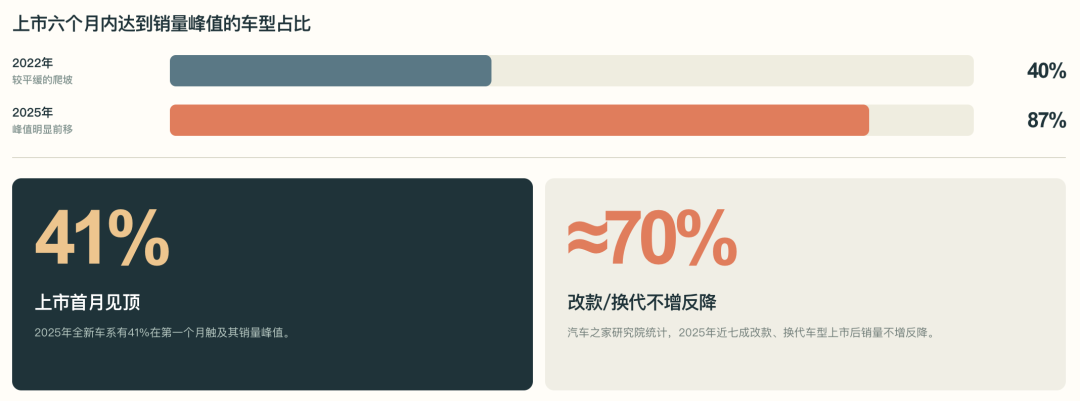
Several large-scale launch events disclosed on procurement platforms had winning bids ranging from 3.72 million to 8.13 million yuan. In 2025, 87% of all-new model lines reached their sales peak within six months of launch, with 41% peaking in the first month; nearly 70% of facelift and model-changeover models showed no sales growth after launch.
In 2026, automakers are still launching new models at high frequency, and 2027 will see a concentrated upgrade wave from traditional joint venture brands and new platforms.
There will continue to be more cars, but making money is getting harder and harder. Full-scale launch events will be increasingly reserved for entirely new brands, technology platforms, and flagship models.
01 More New Cars Than Ever, but Fewer Worth a One-Hour Presentation
According to the China Automobile Dealers Association's "model + powertrain combination" standard, there were 92 models from January to August 2024, 87 in the same period of 2025, and back to 92 in the same period of 2026—a year-on-year increase of 5.7%.
New products under the same standard have not seen a comprehensive sharp decline. The figure of "more than 600 new cars in the first half of 2026" includes annual facelifts, added-configuration versions, and limited editions.
Gasgoo's statistics for all-new and model-changeover models in the same period show 116 models, covering configuration updates, product iterations, and independent model lines.

The change is happening in structure.
◎ In 2025, new energy vehicles accounted for 55% of new model lines launched, and the share of all-new model lines within new energy began to decline, while the proportion of facelifts and model-changeover models rebounded;
◎ Investment in new fuel vehicle products continues to shrink.
In the first nine months of 2026, new energy vehicles accounted for 53.6% of total new car sales, and electrification has already surpassed half of the mainstream market. Powertrain form is increasingly difficult to serve as a standalone selling point for a launch event.

The problem is that the more new products there are, the easier launch events become repetitive.
Once 800V, urban assisted driving, and rear entertainment screens could fill half a PPT. By 2027, these configurations will need to be compared alongside competitors' actual experience, price, and energy consumption.
A car that adds two configurations and swaps a battery pack deserves a clear buying guide, but cannot sustain a 90-minute big show.
In 2022, 40% of all-new model lines reached their sales peak within six months of launch; by 2025, that rose to 87%; in 2025, 41% of all-new model lines peaked in the first month. For facelift and model-changeover models, nearly 70% saw sales decline rather than grow after launch in 2025.
A launch pulls attention to its highest point—and also exposes sales pressure for the following months in advance.
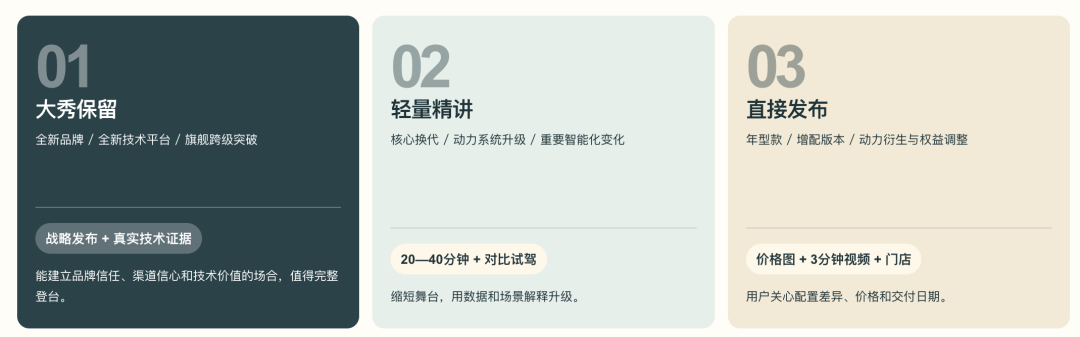
Entirely new brands, entirely new platforms, and flagships that rewrite a brand's price band need to align the public, dealers, suppliers, and investors around the same direction—and are worth investing in a large launch event.
For mid-sized model-changeover cars, users already know the old car, and a half-hour online explanation plus a credible set of technical validation is often more effective than a big stage.
For annual models, added configurations, and powertrain derivatives, a price and configuration table, a three-minute video, and an in-store test drive are enough.
02 A Launch That Can Sell for Four Months
This shift is first a matter of money.
◎ Dongfeng Motor's procurement platform shows specific contracts: a 2026 model launch event for Voyah, including design, construction, and operation, won a bid of 3.721 million yuan;
◎ Voyah's 2025 H53B corresponding project was 4.240 million yuan;
◎ The M-Hero M817 launch event creative and operations was 8.127 million yuan.
These are project winning bid amounts, excluding total advertising placement and media cooperation costs.

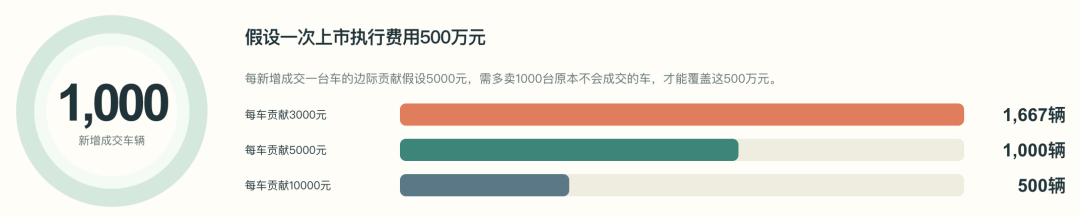
A complete launch event investing 5 million yuan, with each additional vehicle transaction contributing 5,000 yuan in marginal revenue, requires 1,000 additional sales that would not have occurred otherwise to break even.
The 1,000 units are incremental sales; customers already in the purchase pool and orders switched from other models of the same brand do not count.
In the past, people looked at livestream view counts, trending topic reads, and number of reports. In the future, they will look at how many high-quality test drives the launch event brings to stores, the efficiency of test drives converting to orders, order retention rate, and per-vehicle marketing cost 90 days after launch.
Trending on social media is easy to get excited about; still selling cars steadily three months later is what operational capability means.
The launch rhythm can be arranged into four consecutive nodes, forming a 120- to 180-day operating cycle.
◎ From 60 to 15 days before launch, identify the real reasons to buy: in what scenarios it is better than competitors, which features users are most willing to pay for, and at what price tier there is a reasonable transaction rate.
◎ From 14 days before launch to the release day, explain the answers clearly: energy consumption, charging, assisted driving, space, and price structure turned into comparison charts.
◎ From 1 to 30 days after launch, align test drives and orders with the content; stores have cars, test-drive vehicles, and unified talking points.
◎ From 31 to 120 days after launch, use delivery feedback to correct marketing, observing order cancellations, delivery waits, user complaints, and actual usage experience.
Launch event content will increasingly resemble a public product review.
◎ For battery fast charging, talk about measured 10% to 80% charging time, temperature, and power curves;
◎ For intelligent driving, talk about scenario boundaries, takeovers, and safety validation;
◎ For the cabin, talk about response speed during sustained use.
Relying solely on "only one in its class" and "industry-leading" cannot sustain momentum in 2027.
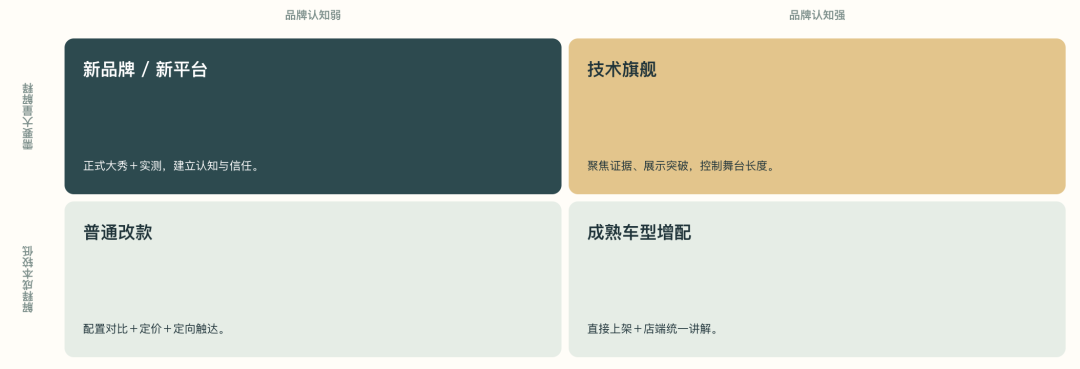
For event companies, PR firms, and automotive media, this will bring a new division of labor.
◎ Traditional stage construction, celebrity appearances, and single-day trending pushes will see greater business volatility;
◎ Teams that can connect technical testing, short videos, search, livestreaming, lead analysis, and sales feedback will enter automakers' more core budget pools.
The communication value of media simply rewriting launch event PPTs will continue to decline.
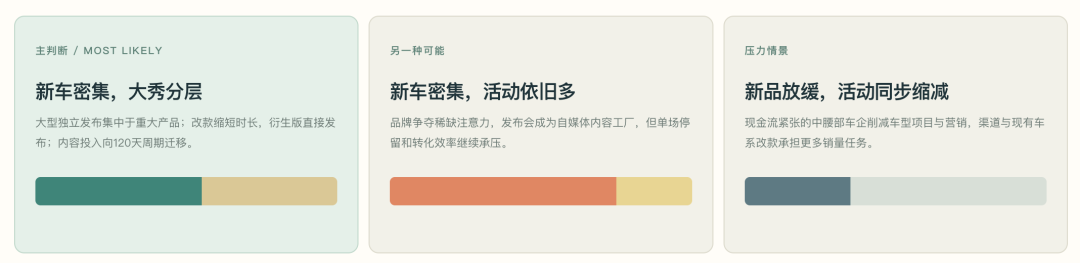
In 2027, three types of events will ultimately take shape: a small number of large brand or platform launch events, mid-sized real-vehicle technology and product briefings, and a large number of configuration versions launched quietly.
What automakers need to build is a unified product launch operating system, with R&D, pricing, communications, channels, and delivery jointly responsible—rather than handing communication volume to the marketing department and sales volume to the sales department, each submitting a separate report.

Summary
Automakers canceling launch events is the result of dense new car launches and shortening attention spans. In 2027, automakers will continue to release new cars, and launch event budgets and stages will be tiered by product value.
-
![]()
Phone Sales Hit a Ten-Year Low While Prices Keep Climbing—What's Going On?
-
![]()
Revenue of 94.14 Billion Yuan, Market Value of Only 89 Billion—Is Foxconn Industrial Internet Undervalued?
-
![]()
Microsoft Taps NVIDIA to Take On Apple Head-On: Redmond's High-End AI PC Gamble
-
![]()
DHS Leak Exposes 41,000 Employees: Undercover Agents and Grok Permission Groups Among the Casualties
-
![]()
Apple Actually Went Ahead and Made a Touchscreen MacBook, Exactly 16 Years After Steve Jobs Said It Wouldn't Work
-
![]()
Exclusive: The Two Turning Points That Sealed Xiaodu's Fate
-
![]()
Zhongji Innolight's Net Profit Triples: The Cash Flow Test Behind the AI Frenzy | Q3 Report
-
![]()
The $5 Billion Rumor and the $20 Million Floor Price: Character.AI's Death Ledger