Tesla's Latest Move: The "Price Cut" Is All About the Math
 11/02 2026
 350
Written by | Guancheshi
Tesla has made another big move.
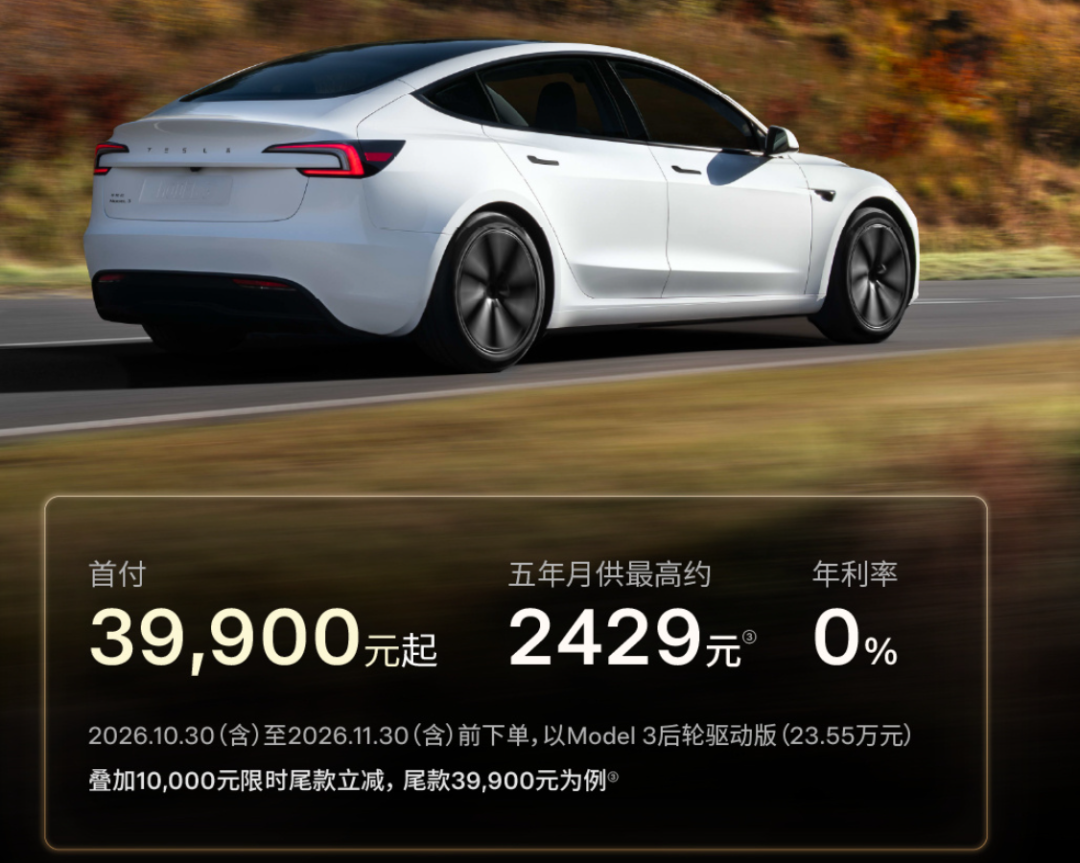
On October 30, Tesla China rolled out a new installment financing plan called "Te Congrong," running from October 30 to November 30.
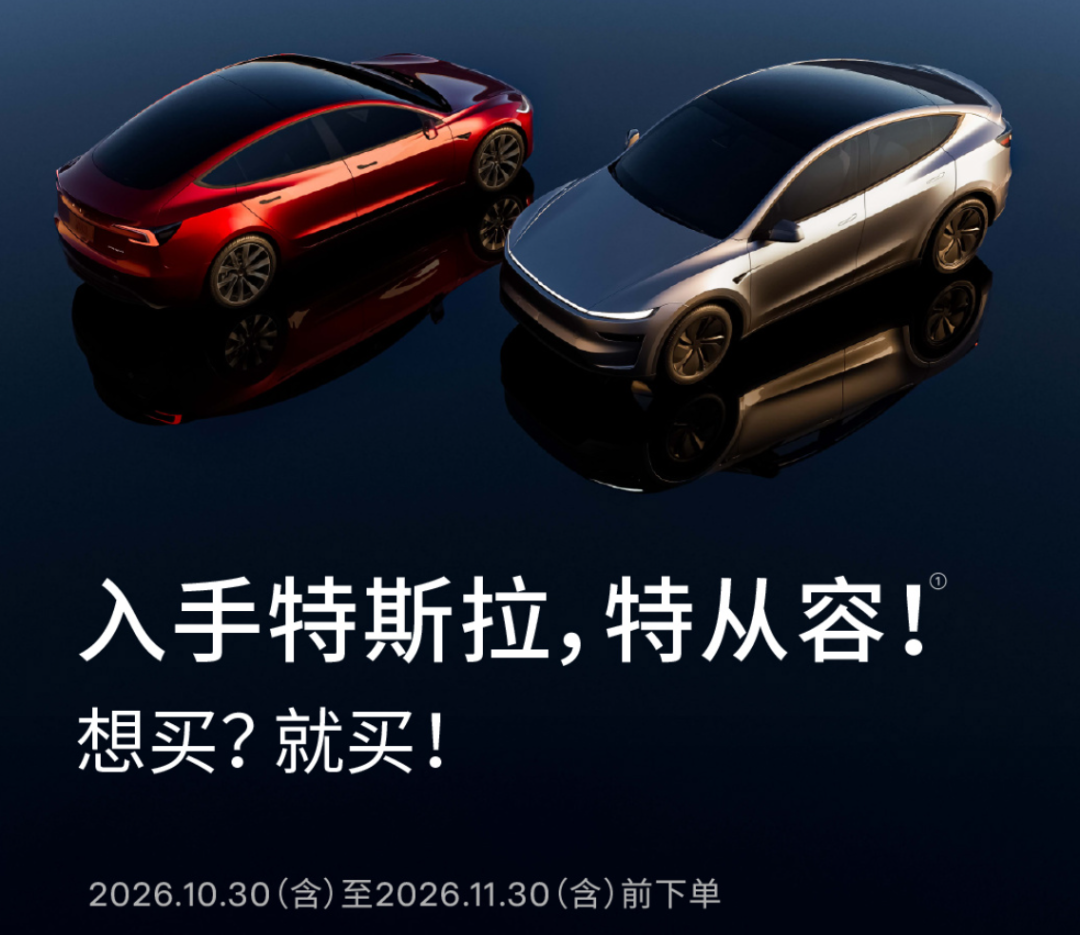
According to public reports cited by Guancheshi, this round of incentives is not a blanket increase. The final payment discount on the Model 3 rose from 5,000 yuan to 10,000 yuan, while the Model Y's was cut from 7,000 yuan to 4,000 yuan. The previous 8,000 yuan insurance subsidy for the Model 3 was not renewed after it expired on October 29.
By that math, Model 3 buyers who had previously enjoyed both the final payment discount and the insurance subsidy now actually receive 3,000 yuan less in direct cash savings under the new policy.
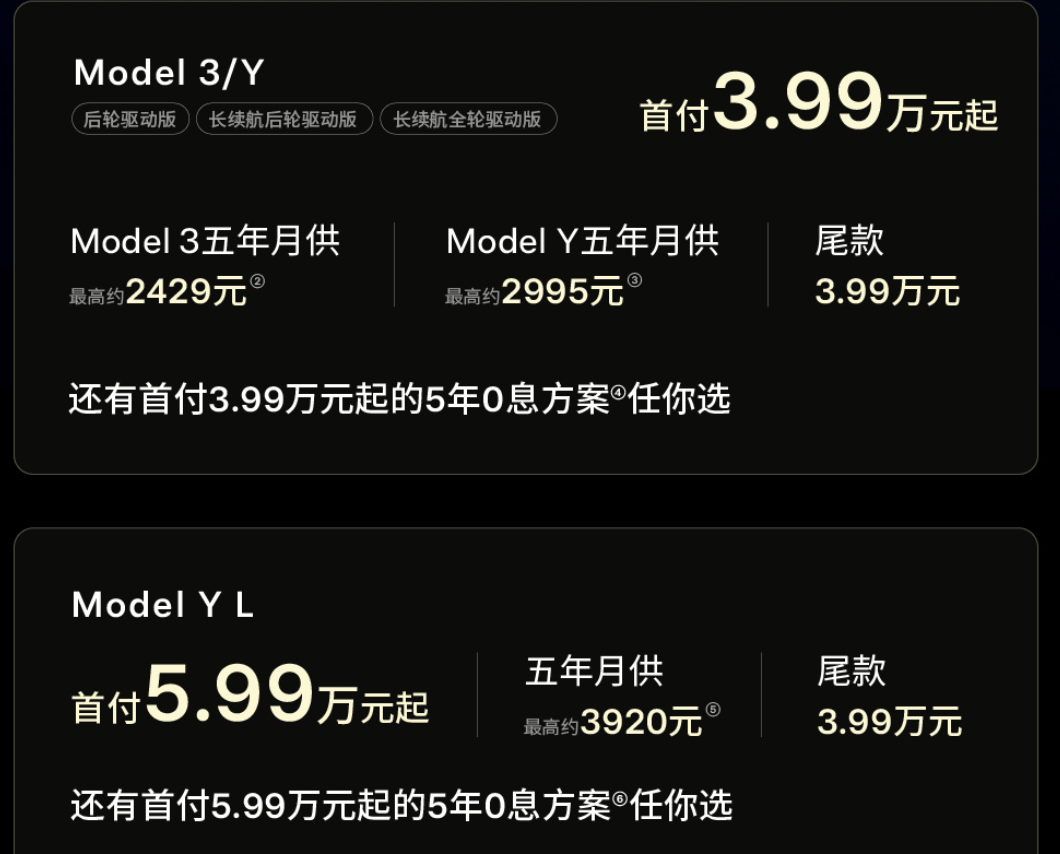
So the main thrust this time is replacing cash subsidies with financial leverage. Tesla also introduced a five-year zero-interest flexible loan plan, further lowering monthly payments while keeping the down payment low—at the cost of a one-time final payment of 39,900 yuan at the end of the loan term.
Cash subsidies appeal to price-conscious shoppers, while financing plans lower the barrier to entry. The latter does more to drive orders directly, but it also places a greater capital burden and risk exposure on the automaker.
In Guancheshi's view, Tesla's willingness to absorb that cost itself speaks to the urgency on the demand side.
Previously, data from the China Passenger Car Association showed that from January to September 2026, Tesla's cumulative retail sales in the Chinese market totaled 381,100 vehicles, down 11.9% year on year. September retail sales came in at 64,800 vehicles—up 29.55% month on month but down 9.35% year on year, marking the fourth consecutive month of year-on-year decline.
Globally, Tesla's performance was also underwhelming: third-quarter deliveries reached 486,500 vehicles, up about 1.3% quarter on quarter but down 2.13% year on year.
The previously disclosed third-quarter report showed that Tesla's revenue fell 0.17% year on year, GAAP operating profit plunged 56% year on year, and the operating margin dropped to 2.6%. In Guancheshi's memory, this is one of Tesla's ugliest income statements in recent years.
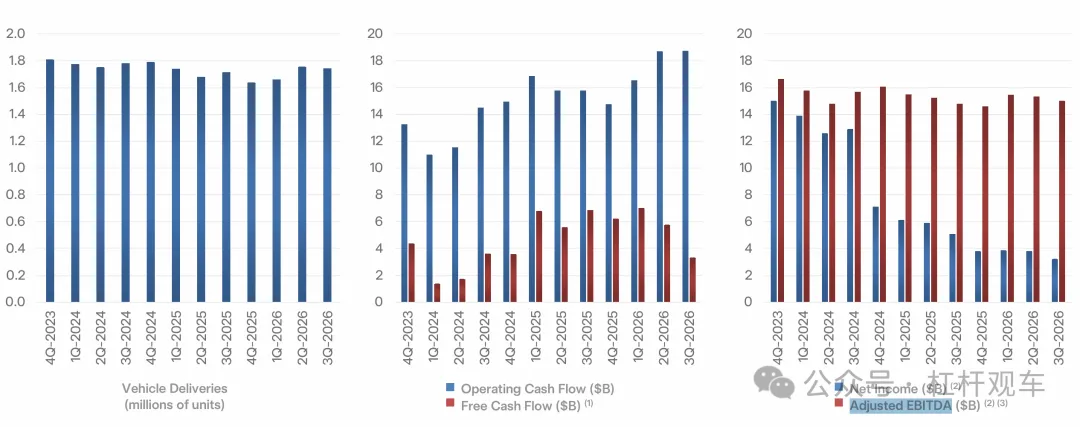
The financial report disclosed that Tesla's R&D expenses in the third quarter were $2.761 billion, a sharp increase of 69% year on year, almost all of which went into AI development, depreciation of newly added chips, and the production ramp-up of Optimus, Megapack 3, and Semi.
In addition, capital expenditure was $4.732 billion, a sharp increase of 110% year on year, and the full-year capital expenditure guidance was raised to about $20 billion—to build AI training computing power (with a year-end target of 400MW), battery materials production lines, and a wafer fab.
Musk also said on the conference call that this is what you call "betting on the come."
Selling cars is making real money, but laying the groundwork for the next generation of business requires heavy capital investment in the current period.

In Guancheshi's view, financial promotions solve sales for the next two to three months, while R&D investment is about where Tesla will be five years from now. Promotions are consumables; what truly determines victory or defeat has always been the product cycle and the R&D cycle.
For consumers, the low threshold does indeed reduce the current cost of buying a car, but don't forget that the other side of a five-year zero-interest loan is a longer debt cycle and a final payment of 39,900 yuan at the end of the term. The money saved by flexible monthly payments ultimately still has to be repaid.
Charts and tables in this article without indicated sources all come from public disclosures across various channels, and are hereby noted and acknowledged! The views in this article are for reference only and do not constitute investment advice.
This article is original by Leverage Guancheshi. Reproduction is prohibited without authorization! If reproduction is needed, please obtain authorization. In addition, when reproducing with authorization, please indicate the source and author at the beginning of the article. Thank you!
-
![]()
Computing Power Is No Longer the Ceiling for AI Agents—the Ecosystem Wall Is
-
![]()
BYD: Trading Price for Volume at Home, and Its Overseas "Savior" Is Starting to Falter Too?
-
![]()
The Vanished "Golden September and Silver October"
-
![]()
Tesla Changes Its Car-Buying Policies Nine Times a Year—Only "Honest People" Buy Teslas
-
![]()
Volkswagen: Would Rather "Court Death" Than "Wait for Death"
-
![]()
Is Honda Going to Reinvent the Assembly Line?
-
![]()
BMW Completes 1 Million Autonomous Vehicle Transfers Without Ever Touching a Public Road: Does This "Counterintuitive" Case Burst the Industry's Biggest Bubble?
-
October New EV Delivery Rankings: The End of the "Wei-Xiao-Li" Era as Leapmotor, Xpeng, and Xiaomi Take the Spotlight