BMW Completes 1 Million Autonomous Vehicle Transfers Without Ever Touching a Public Road: Does This "Counterintuitive" Case Burst the Industry's Biggest Bubble?
 11/02 2026
 338
Introduction
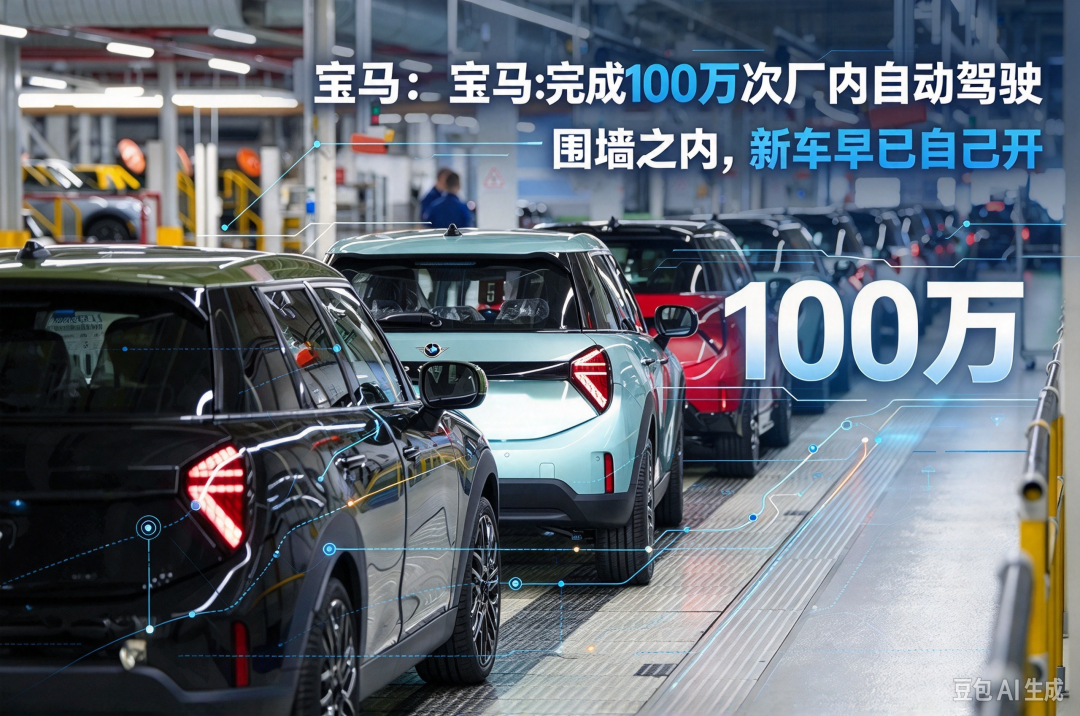
In October 2026, BMW announced a figure: its in-plant autonomous driving technology, AFW, had cumulatively completed 1 million driverless transfers of newly produced vehicles.
It sounds like a milestone breakthrough in autonomous driving.
But on closer inspection, all 1 million of these transfers took place within factory walls—not a single one ventured onto public roads.
Unmanned Vehicles Are Coming (WeChat official account: Unmanned Vehicles Are Coming) believes BMW seems to be telling us something: the first to bring autonomous driving to scaled, routine operation is not Robotaxi—it's the automobile factory.
(For related reading, please click: "BMW, Mercedes-Benz and Stellantis—Three Major Automakers Retreat Collectively! Is L3 Autonomous Driving About to Die?")
I. These 1 Million "Driverless" Transfers Are Not at All What You Think
BMW's system is called AFW (Automated Driving In-Plant). It is a technology system that enables newly produced vehicles to move autonomously without a driver within the factory—both in production areas and logistics areas.
A pilot was launched at the Dingolfing plant in 2022, and it has now been implemented at four plants: Dingolfing, Leipzig and Regensburg in Germany, and the MINI Oxford plant in the UK.
Across the group, about 3,500 driverless transfers are completed per day on average, and the Oxford plant alone completed more than 53,000 in the past year.
The Spartanburg plant will take over in 2027, becoming the fifth production site and the first in the United States to deploy AFW.
But it differs fundamentally from what we understand as "autonomous driving": the sensors are not on the vehicle—they're in the factory.
The Dingolfing plant has deployed Europe's largest lidar infrastructure along the routes. External sensors continuously capture the environment, while cloud architecture and motion planning software guide the vehicles.
This L4-level system comes from Swiss company Embotech, in which BMW took a stake through its venture capital arm in December 2024.
This means that no matter which model or configuration rolls off the line, it needs no additional perception hardware—the factory itself is "helping it see the road."
System availability exceeds 99.5% and can operate around the clock. Vehicles can dynamically avoid people, forklifts, other vehicles and temporary obstacles.
II. What's Being Calculated Is Not a "Technology Account" but a "Handling Labor-Hour Account"
Why does BMW put autonomous driving into factories first? Because the math inside a factory is far simpler than on public roads.
A newly produced vehicle needs to move from the assembly area to the testing area, from the testing area to the logistics area, and from the logistics area to the loading point.
These routes are fixed, speeds are controllable and the scenarios are closed—but the frequency is extremely high and the repetitiveness is extreme.
In the past, this relied on people driving each vehicle over and then walking back. Over a day, the handling labor hours add up to a real cost.
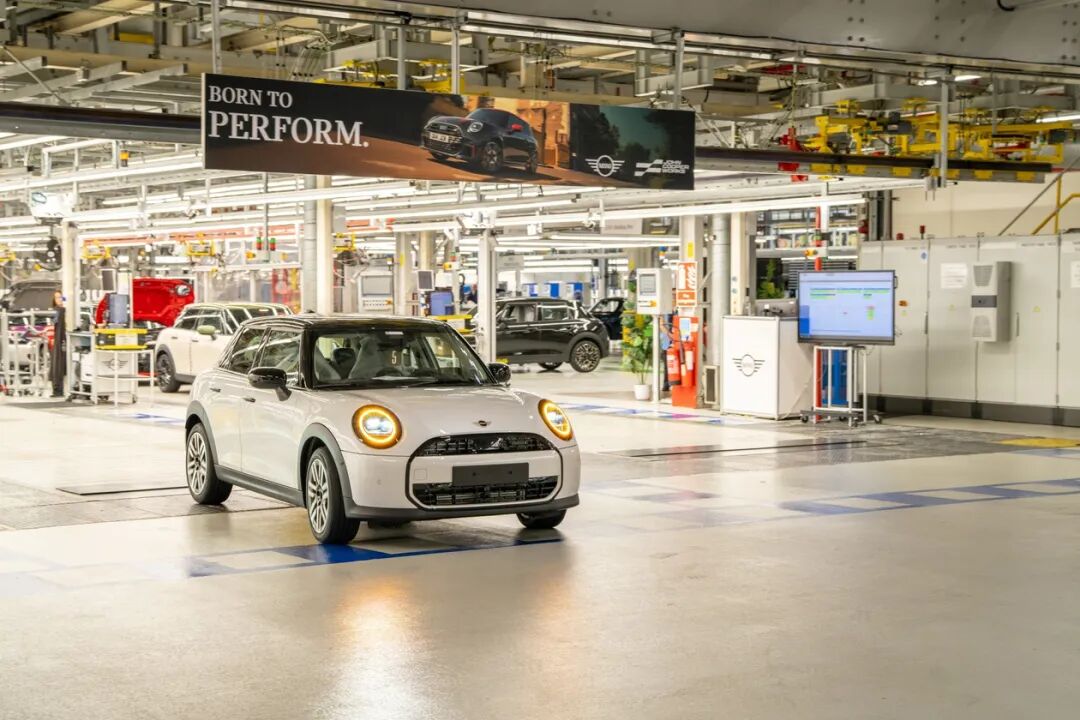 Image source: bitauto website
What AFW does is automate this "repetitive labor of a few hundred meters."
BMW Board Member for Production Wittmann put it precisely: AFW optimizes production processes and brings significant efficiency improvements to logistics.
The Oxford plant goes further by connecting the driverless transfer system directly to the control system of existing production equipment, so vehicles can stop precisely next to lifting equipment and complete automatic interaction.
This is not "showing that a car can move by itself"; it is welding driverless driving into the production rhythm.
A comparison with industry figures makes it even clearer.
After the "lights-out logistics" project of FAW-Volkswagen Tianjin Branch was implemented, regional logistics operating costs dropped by 47%, with annual optimized costs exceeding 4 million yuan.
NIO's unmanned shuttle system at its Hefei plant can complete the transfer of 60 newly produced vehicles per hour, saving an estimated 10 million minutes of time cost each year.
Driverless driving in factories does not convince people by being "cool"; it convinces people with one labor-hour sheet after another.
III. The Whole Industry Is Doing the Same Thing: First Let Vehicles Learn to "Work" Inside the Walls
BMW is not an isolated case. Autonomous driving in automobile factories has become a prairie fire.
Toyota's Motomachi plant has already put self-driving transport of finished vehicles into practical use, and Tesla allows vehicles to move autonomously within Gigafactory.
NIO has achieved fully unmanned transfer from the final assembly workshop to the road test area, and FAW-Volkswagen has built a "lights-out warehouse" with 153 AMR robots.
The Volkswagen Group is also testing automated movement and automatic loading of vehicles in logistics areas.
The common features of these projects are remarkably consistent: closed scenarios, fixed routes, low-speed operation and high-frequency repetition.
The global market size of autonomous driving in closed scenarios was about 5.946 billion yuan in 2025 and is expected to approach 48.56 billion yuan by 2032, with a compound annual growth rate of 36.2%.
This growth rate is not the most explosive in the overall autonomous driving market, but its certainty of implementation is the highest:
because every route in the factory can be planned in advance, every risk can be eliminated in advance, and every saving can be calculated in advance.
BMW itself puts it bluntly: in the next decade, within its production network alone, AFW will accumulate millions of kilometers of test mileage.
This mileage will not appear on the PPT of any Robotaxi launch event, but every day it generates real data, real efficiency and real cost savings.
The next time someone asks when autonomous driving will become widespread, perhaps we can ask in return:
Do you mean urban roads—or the places we usually never see at all?
In short, Unmanned Vehicles Are Coming (WeChat official account: Unmanned Vehicles Are Coming) believes:
BMW's 1 million transfers are worth exploring: for an automaker that cares most about driving pleasure, the first to bring "driverless driving" to scale is, unexpectedly, the newly produced vehicle in its own factory that needs no one to drive it.
Autonomous driving inside the walls has already run onto an assembly line;
Is autonomous driving outside the walls still waiting for the right moment?
Dear readers! What do you think?
References: media reports from bitauto website, BMW Car Owners, Yuanye Xinzhi Pai, etc.
#Unmanned Vehicles Are Coming #Driverless #Autonomous Driving #Unmanned Vehicles
-
![]()
Computing Power Is No Longer the Ceiling for AI Agents—the Ecosystem Wall Is
-
![]()
BYD: Trading Price for Volume at Home, and Its Overseas "Savior" Is Starting to Falter Too?
-
![]()
The Vanished "Golden September and Silver October"
-
![]()
Tesla Changes Its Car-Buying Policies Nine Times a Year—Only "Honest People" Buy Teslas
-
![]()
Volkswagen: Would Rather "Court Death" Than "Wait for Death"
-
![]()
Is Honda Going to Reinvent the Assembly Line?
-
![]()
BMW Completes 1 Million Autonomous Vehicle Transfers Without Ever Touching a Public Road: Does This "Counterintuitive" Case Burst the Industry's Biggest Bubble?
-
October New EV Delivery Rankings: The End of the "Wei-Xiao-Li" Era as Leapmotor, Xpeng, and Xiaomi Take the Spotlight