Great Wall Motor October Sales: Why Great Wall Has a Stronger Presence in the 200,000–300,000 Yuan Range Without Relying on 100,000-Yuan-Class Models
 11/12 2026
 445
Produced by Zhineng Technology
Great Wall Motor sold 120,374 vehicles in October, including 62,862 overseas. Domestic terminal retail sales were 51,924, with the largest sales segment falling in the 200,000–300,000-yuan range.
Models priced above 200,000 yuan together accounted for more than half, and the pricing center of gravity did not fall on the volume-driving position of 100,000-yuan-class sedans.
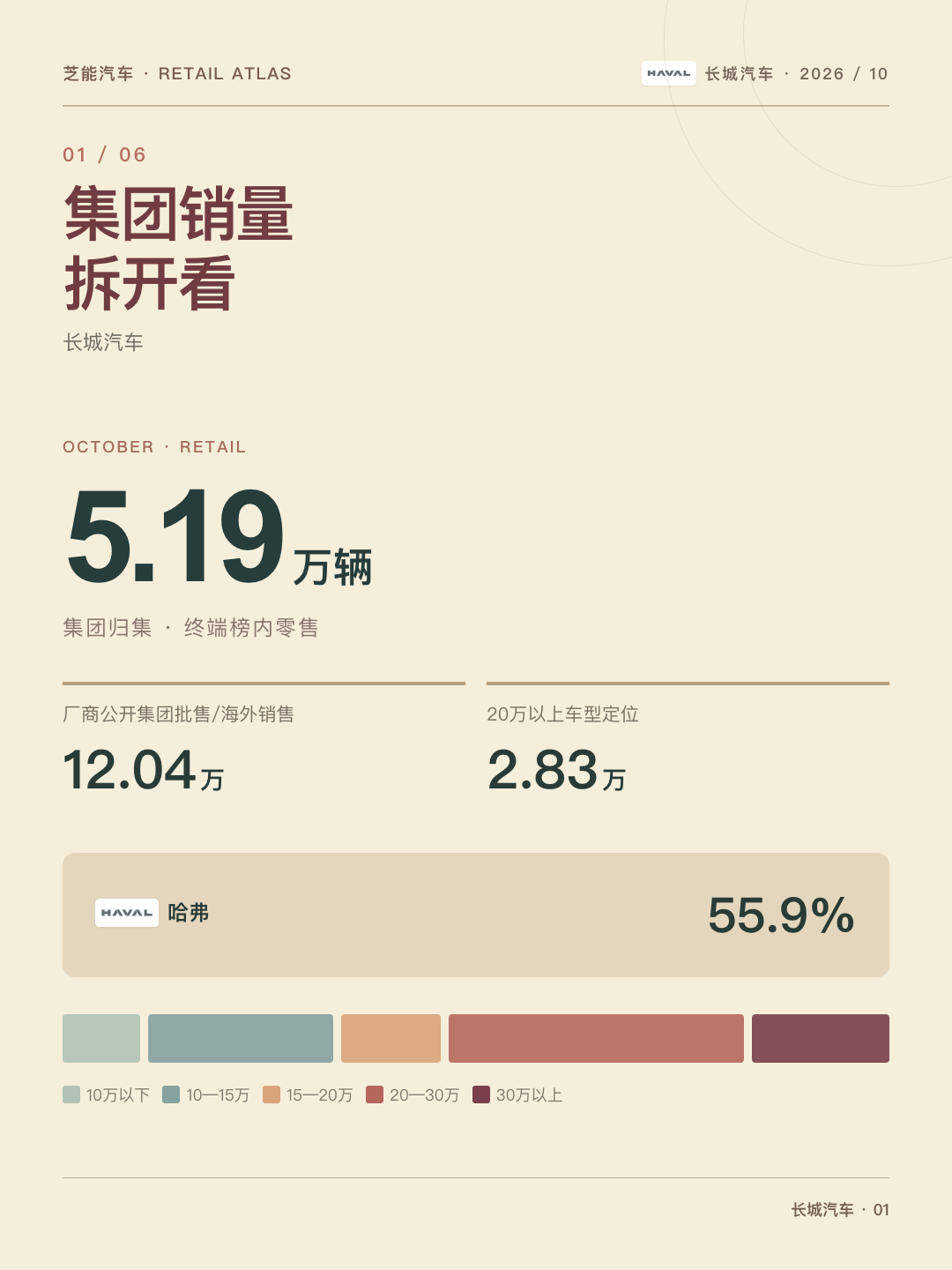
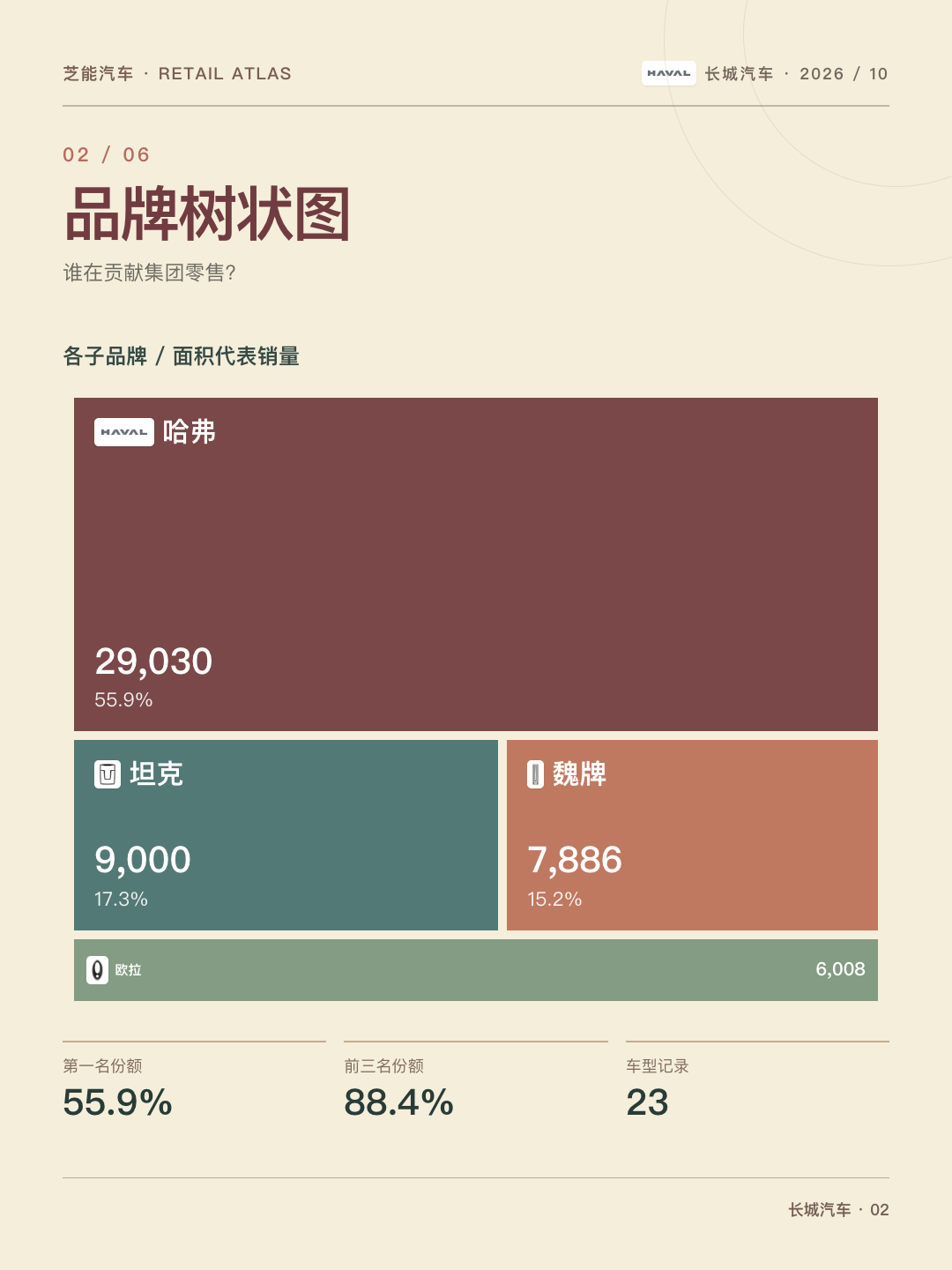
The 120,374 vehicles include wholesale and overseas sales, while the 51,924 in the ranking counts only terminal retail sales.
October sales fell year on year. Its overseas business makes it a highly internationalized automaker, and the domestic terminal ranking shows only part of its operations.
◎ Haval: 29,030 vehicles, 55.9%,
◎ Tank: 9,000 vehicles, 17.3%,
◎ WEY: 7,886 vehicles, 15.2%,
◎ ORA: 6,008 vehicles, 11.6%.
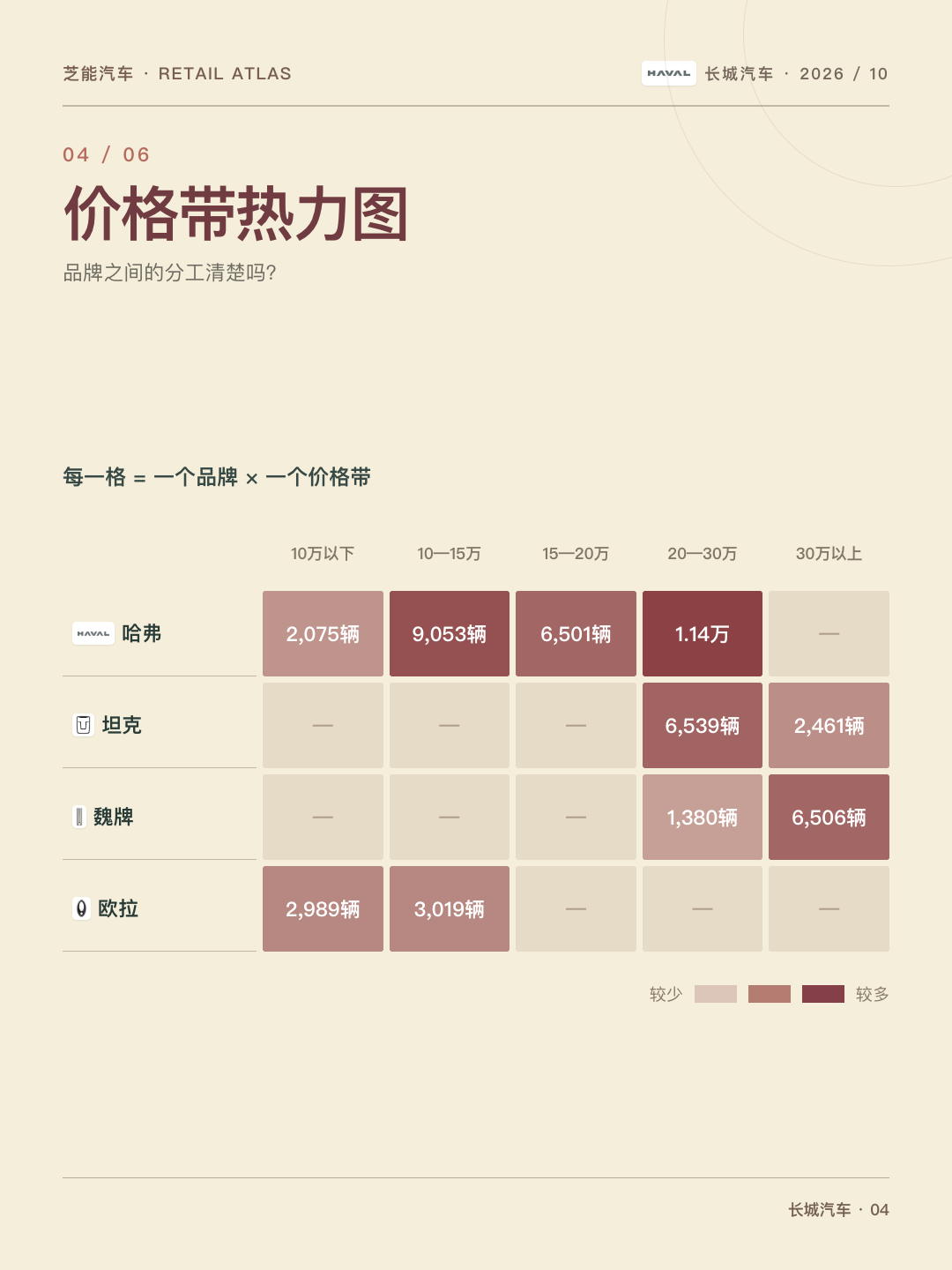
Haval serves the user base for family SUVs across a broader price range, Tank focuses on hardcore off-road and high-value SUVs, WEY uses products such as Gaoshan to enter higher-priced family travel scenarios, and ORA uses pure electric models to retain another group of customers.
Compared with competitors that rely on large numbers of 100,000-yuan-class sedans and small SUVs, Tank and WEY make the 200,000–300,000-yuan range the most substantial segment, reducing pressure from low-price competition, while performance, quality, and spatial experience still need to be continuously delivered through products.
Tank's curve follows purchase demand from a relatively concentrated base of off-road users, and the market capacity for hardcore off-road vehicles has no room for unlimited expansion.
Many buyers place orders quickly in the early stage of a product generation's launch, after which it enters a longer stable sales period; its rhythm should be read on a rolling three-month basis.
The top two brands together accounted for 73.2%, and Great Wall Motor's second brand was 20,030 vehicles fewer than its first brand. WEY and ORA have not yet formed their own scale, and Tank needs more price entry points to grow into volume.
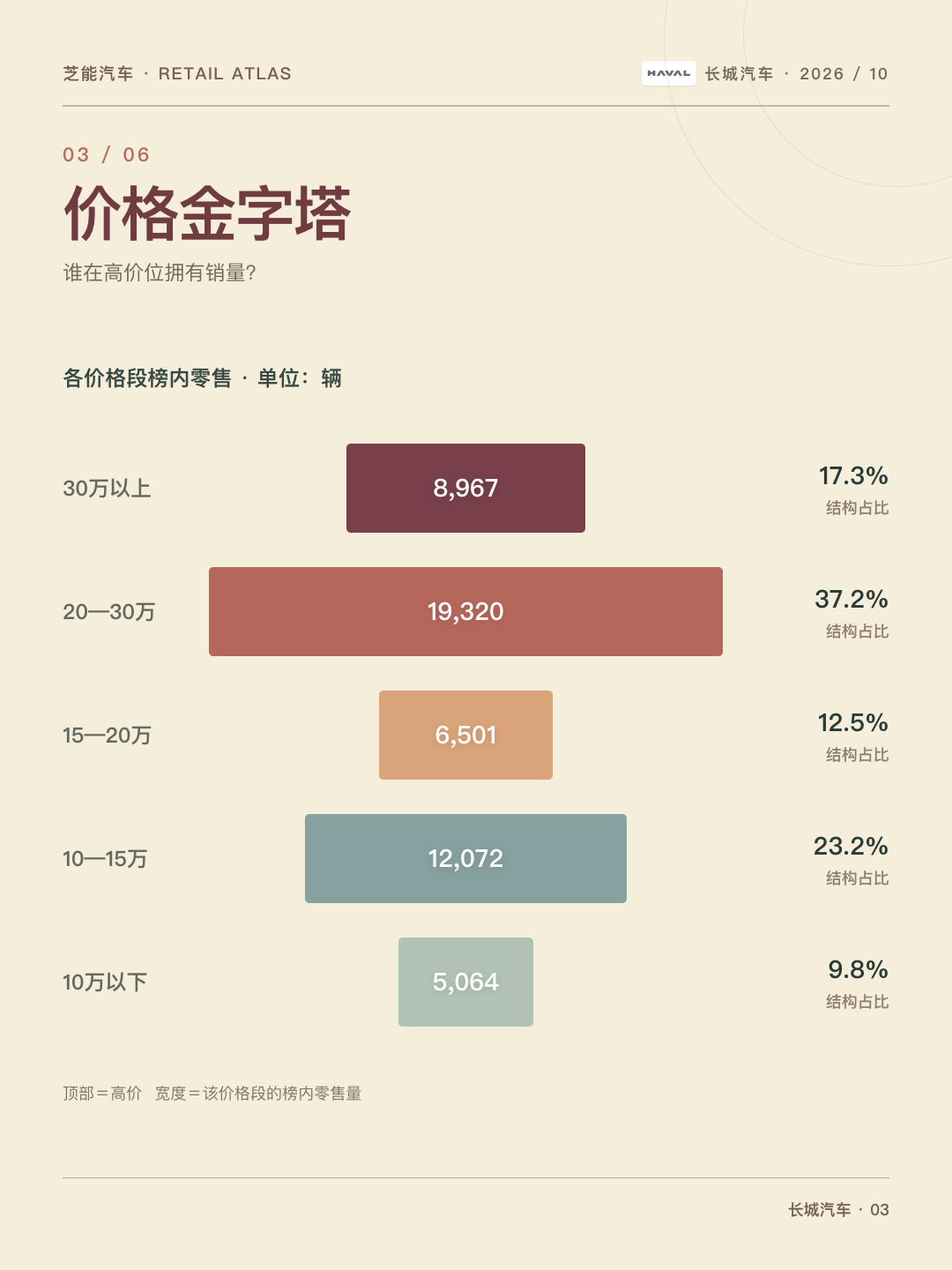
Models priced above 200,000 yuan totaled 28,287 vehicles, accounting for 54.5%. Great Wall did not spread out models in the low-price segment.
◎ Below 100,000 yuan: 5,064 vehicles, 9.8%,
◎ 100,000–150,000 yuan: 12,072 vehicles, 23.2%,
◎ 150,000–200,000 yuan: 6,501 vehicles, 12.5%,
◎ 200,000–300,000 yuan: 19,320 vehicles, 37.2%,
◎ Above 300,000 yuan: 8,967 vehicles, 17.3%.
WEY Gaoshan takes another path. Demand for high-end MPVs comes from both family and business use, with third-row space, ride comfort, handling safety, and service all included in the purchase decision; reputation, delivery quality, and actual experience determine repeat purchases and recommendations.
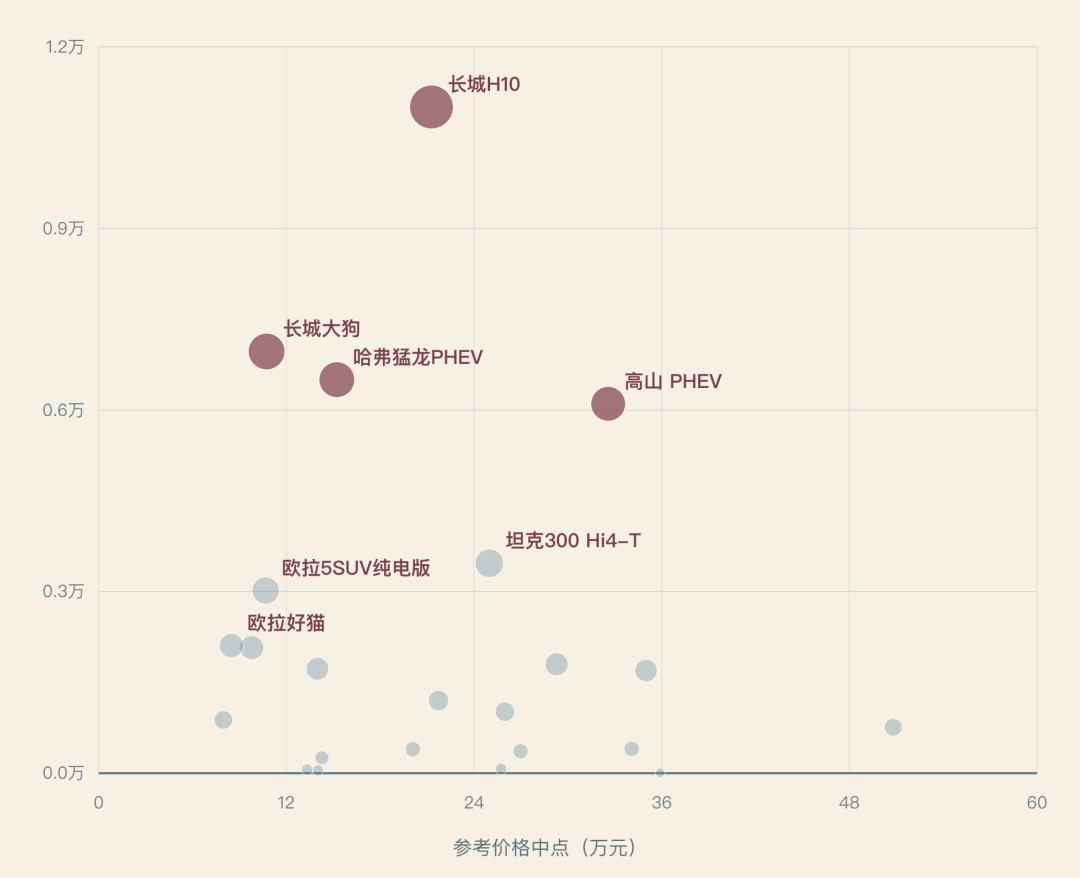
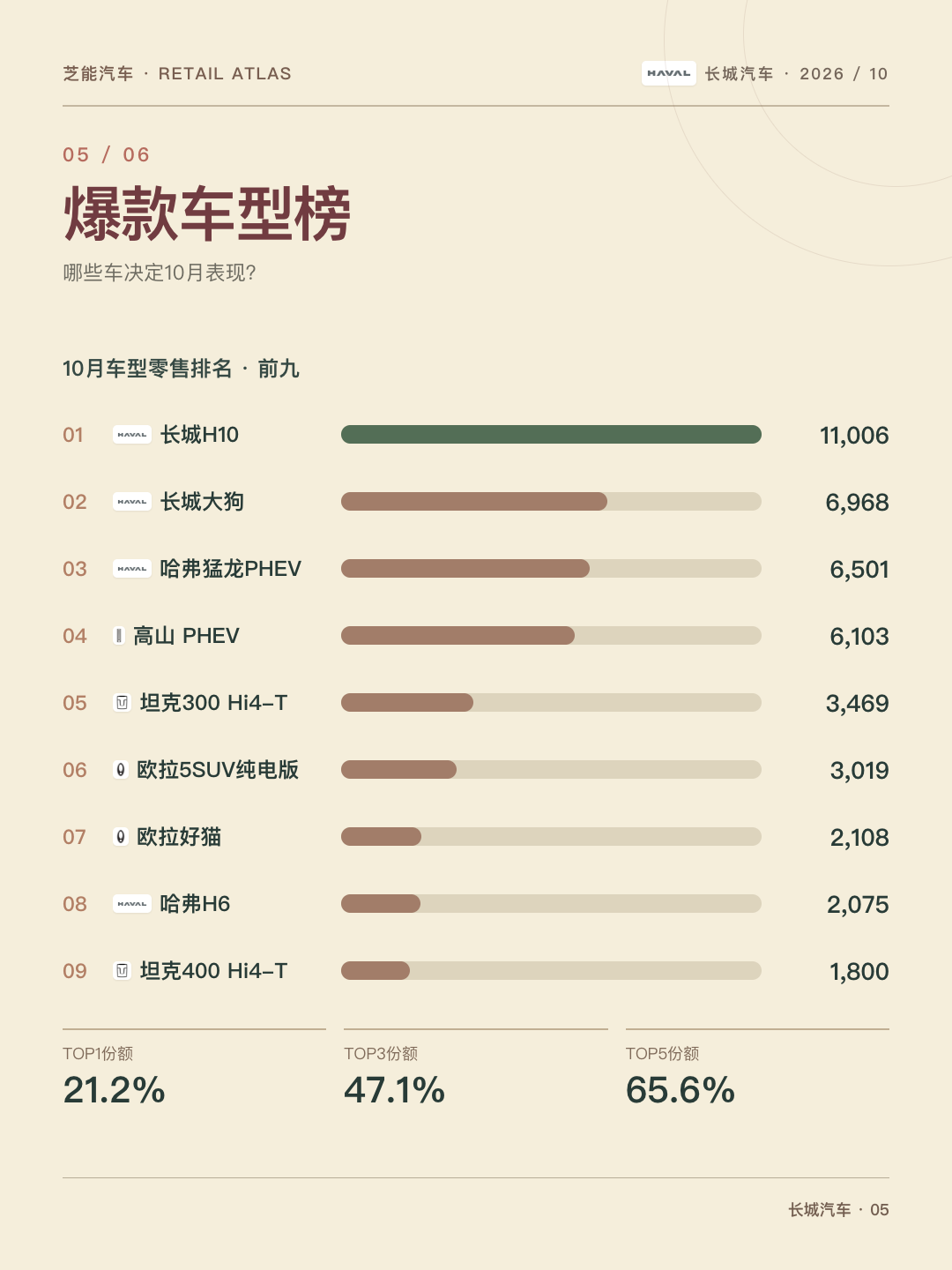
The top three models—Great Wall H10, Great Wall Big Dog, and Haval Menglong PHEV—totaled 24,475 vehicles, accounting for 47.1%; Great Wall H10 alone accounted for 21.2%, and its model-change rhythm directly affects monthly retail sales.
The remaining 34,047 vehicles were spread across a longer model list. Weaker models lack clear positioning, and inventory and marketing costs will likewise be pushed up.
Specifically by model:
◎ Great Wall H10: 11,006 vehicles, 201,800–223,800 yuan,
◎ Great Wall Big Dog: 6,968 vehicles, 90,900–123,900 yuan,
◎ Menglong PHEV: 6,501 vehicles, 130,800–173,800 yuan,
◎ WEY Gaoshan PHEV: 6,103 vehicles, 265,800–385,800 yuan,
◎ Tank 300 Hi4-T: 3,469 vehicles, 249,800–249,800 yuan,
◎ ORA 5 SUV pure electric version: 3,019 vehicles, 89,800–123,800 yuan,
◎ ORA Good Cat: 2,108 vehicles, 69,800–99,800 yuan,
◎ Haval H6: 2,075 vehicles, 81,900–113,900 yuan.
The peaks of Haval and Tank both fall in the 200,000–300,000-yuan range; one focuses on family SUVs and the other on hardcore off-road, separating the same price range through use scenarios. Another two vehicle series crossed the 200,000-yuan line, totaling 1,595 vehicles.
-
![]()
What Is Astigmatism, Really? Why Tangential and Sagittal Foci "Go Their Separate Ways"
-
![]()
Gree Electric's Performance Weighed Down by Soaring Copper Prices: Will Dong Mingzhu Unveil a "Big Move" by Year-End?
-
![]()
AI R&D Doubles in Speed as Anthropic Redacts Most of a 100-Page Report
-
![]()
Crown New Materials to Inject RMB 228 Million into Zhejiang Optical Film Project
-
![]()
Gaize Technology Officially Announces Takeover of Entire Japanese Optical Powerhouse Plant: Can It Translate Into Production Capacity?
-
![]()
Baidu Begins Building Factories
-
Hong Kong Listed Company Huaxia Culture Technology Enters AI Sector with Mid-Term Profit Alert Exceeding HKD 900 Million
-
![]()
NXP Earnings: Net Income Hits $884 Million as Automotive Chip Growth Lags at 13%