Ultrafast Nonlinear Optics Technology No. 106: Deep-Ultraviolet Ultra-Broadband Transient Absorption
 11/02 2026
 368
The deep-ultraviolet (DUV) region (200–300 nm) contains characteristic absorption features of nucleobases, amino acids, peptide bonds, and various organic ligands, making it an important window for observing molecular electronic states and structural changes. However, conventional femtosecond light sources are constrained by frequency-conversion bandwidth, material absorption, and dispersion, making it difficult to simultaneously achieve DUV coverage and measurement sensitivity. Recently, the Oppermann group at the University of Basel, in collaboration with the Travers and Brahms groups at Heriot-Watt University, reported a transient absorption (TA) system covering 200–800 nm [1]. By combining soliton dynamics in gas-filled hollow-core fibers (HCFs) with correlation-matrix reference correction, the study achieves measurements close to the detector noise limit at a 20 kHz repetition rate.
The system starts from a 1024 nm light source with a 270 fs pulse duration, generates 14.9 fs driving pulses through two-stage HCF post-compression, and then exploits soliton self-compression and resonant dispersive wave generation in a helium-filled HCF to produce a DUV supercontinuum. The DUV cutoff wavelength of the probe spectrum can be tuned via the gas pressure. Ultimately, the system measures the 200–400 nm and 400–800 nm spectral regions separately, yielding a complete ultra-broadband TA spectrum.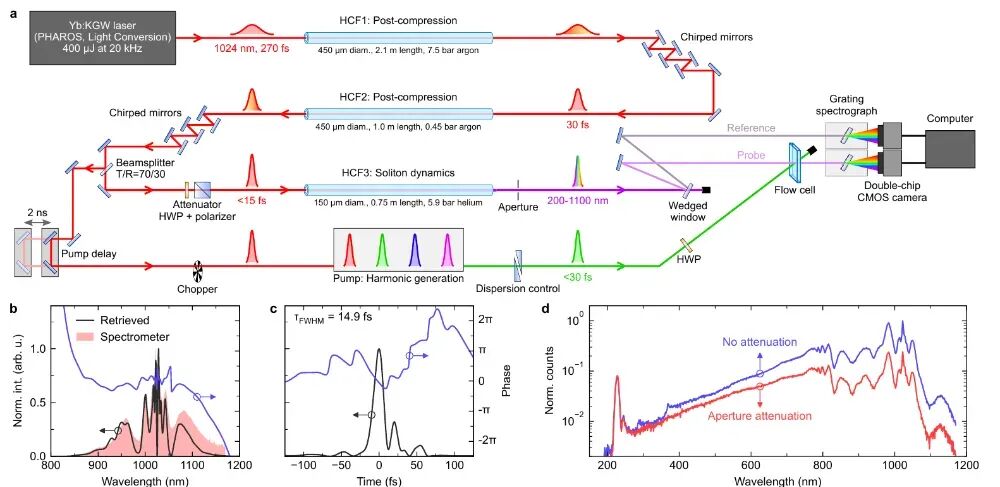 Figure 1: Ultra-broadband TA setup and light source characterization [1]
The authors statistically analyzed 30,000 consecutive supercontinuum pulses and found that intensity fluctuations in different spectral regions originate from different mechanisms. In the 480–800 nm region, the spectrum is generated mainly by self-phase modulation, with intensity fluctuations below 1%; in contrast, in the 230–480 nm region, third-harmonic generation from the self-compressed driving pulse interferes with the soliton supercontinuum, causing intensity fluctuations at some wavelengths to reach up to 5% of the mean intensity. Because the driving laser is not carrier-envelope-phase locked, pulse-to-pulse phase variations are converted into spectral intensity changes through this interference process. In addition, the 200–230 nm region is dominated by resonant dispersive waves, whose fluctuations are about 1.5% near the radiation peak and increase to about 4% at the 200 nm cutoff edge, mainly associated with shifts in the self-compression position induced by driving-pulse energy variations.
These fluctuations are not independent across different wavelengths. Using the spectral correlation matrix, the authors found that the third-harmonic-dominated region exhibits pronounced positive correlations and correlation modulation, whereas the resonant dispersive wave region shows sign changes in correlation. Consequently, noise not only increases the measurement uncertainty at individual wavelengths but also produces measurement artifacts with spectral structure. Without reference correction, the TA standard deviation can reach up to 30 mOD; even without pump excitation, the measured TA baseline still exhibits a spurious spectral structure with an amplitude of about 0.5 mOD, complicating the identification of weak absorption changes.
To address this issue, the authors adopted B-matrix reference correction. This method first uses a set of shot-by-shot synchronized recordings of sample-light and reference-light spectra to establish the spectral covariance relationship between them, and then calculates the optimal weights of reference pixels for each sample-light detection pixel. In this way, noise correction at each detection wavelength draws on information from the entire reference spectrum, enabling prediction and subtraction of intensity fluctuations with complex wavelength-dependent correlations. The TA standard deviation and baseline before and after correction are shown in Figure 2. After correction, the average TA standard deviation decreases to about 0.9 mOD, close to the detector noise floor of 0.8 mOD, and the spurious spectral structure in the baseline is effectively suppressed. At a 20 kHz repetition rate, after 1 second of acquisition and averaging, the measurement standard error reaches 9 μOD, enabling high-sensitivity TA measurements approaching the detector noise limit.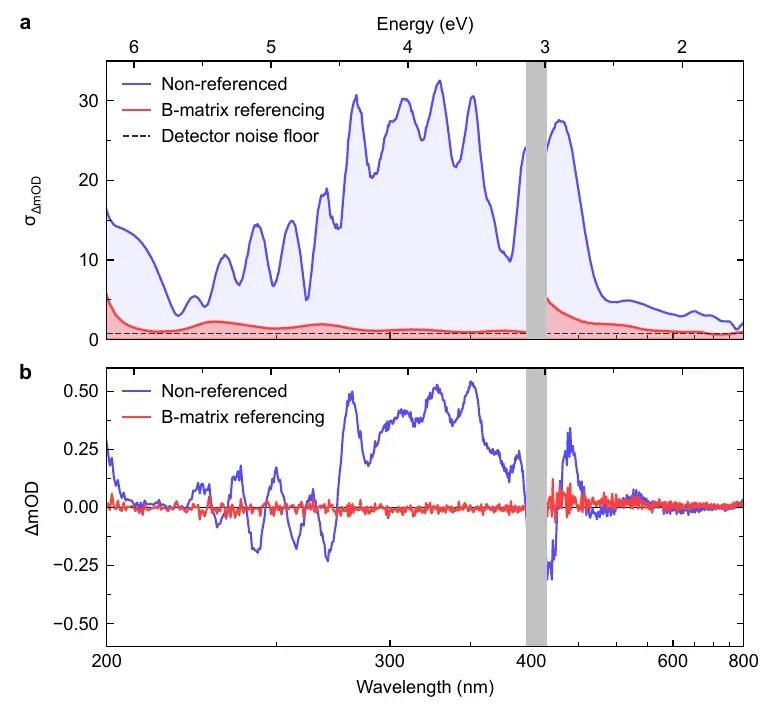 Figure 2: TA standard deviation and baseline before and after correction [1]
Subsequently, after verifying the spectral sensitivity and sample dynamics measurement capability using [Fe(bpy)3]Cl2 in aqueous solution, the authors further evaluated the temporal response of the system. Based on the two-photon absorption feature therein, the authors estimated that the upper limits of the effective response function at 200 nm and 210 nm are approximately 160 fs and 150 fs, respectively. Shortening the sample optical path, adopting a windowless liquid jet, and reducing probe-light dispersion can further improve the temporal resolution of DUV measurements.
The authors point out that previous soliton-driven TA studies covered only part of the DUV region, and light-source noise made it difficult for their sensitivity to reach the level of conventional bulk supercontinuum schemes. This work simultaneously achieves complete DUV coverage, 20 kHz shot-by-shot detection, and detector-noise-limited sensitivity, with a standard error of 9 μOD within 1 second, reaching the state of the art in current TA measurements.
In summary, this work combines an HCF broadband light source with correlation-based noise correction, improving TA sensitivity while extending DUV coverage, and providing a new experimental tool for studying photoinduced dynamics in nucleobases, peptide bonds, and wide-bandgap materials.
References
[1] P. J. Brongers et al. Ultra-broadband transient absorption down to 200 nm enabled by soliton dynamics in gas-filled hollow capillary fibers. arXiv:2608.26910v1 (2026).
-
![]()
Computing Power Is No Longer the Ceiling for AI Agents—the Ecosystem Wall Is
-
![]()
BYD: Trading Price for Volume at Home, and Its Overseas "Savior" Is Starting to Falter Too?
-
![]()
The Vanished "Golden September and Silver October"
-
![]()
Tesla Changes Its Car-Buying Policies Nine Times a Year—Only "Honest People" Buy Teslas
-
![]()
Volkswagen: Would Rather "Court Death" Than "Wait for Death"
-
![]()
Is Honda Going to Reinvent the Assembly Line?
-
![]()
BMW Completes 1 Million Autonomous Vehicle Transfers Without Ever Touching a Public Road: Does This "Counterintuitive" Case Burst the Industry's Biggest Bubble?
-
October New EV Delivery Rankings: The End of the "Wei-Xiao-Li" Era as Leapmotor, Xpeng, and Xiaomi Take the Spotlight