Who Is Squeezing Crystal Optech's Profits as Exclusive Supplier to a Major North American Customer?
 11/11 2026
 385
Crystal Optech closed at 24.35 yuan on November 11, down 1.54%, with a total market capitalization of 33.86 billion yuan and a dynamic price-to-earnings ratio of about 24.32 times.
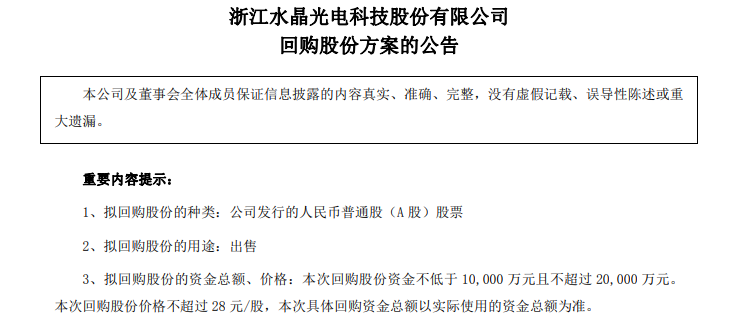
Against the year's highest closing price of 28 May 2026, the stock has retraced more than 40%. Faced with this low valuation, the company launched a 100–200 million yuan repurchase plan on 6 November 2026, with a price cap of 28 yuan per share; the repurchased shares are to be sold.
With the deep share-price correction compounded by the repurchase signal, what the market really needs to unpack is the intriguing growth gap in the 2026 third-quarter report.
In the first three quarters of 2026, Crystal Optech's revenue was 6.163 billion yuan, up 20.30% year on year; net profit including minority interests was 1.178 billion yuan, up 19.18%; but net profit attributable to the parent was 1.044 billion yuan, growing only 6.20%. The source of the discrepancy lies in minority interests, which surged from about 4.7 million yuan in the same period of 2025 to about 133 million yuan in the first three quarters of 2026.
This change is not a financial disturbance but an active shift in business structure: the new product for the major North American customer mass-produced this period was undertaken for development and mass production by the controlled subsidiary Jingchi Optech, which participated as exclusive supplier. Jingchi Optech is a joint venture between the company and Japan's Optorun, and under accounting standards part of its profit is classified as minority interests.
This is the first major North American customer project in Crystal Optech's history undertaken and mass-produced by a controlled subsidiary, meaning the company's role in the customer's supply chain is migrating from "manufacturing execution" to "joint technology development."
The costs and benefits are becoming explicit at the same time. In the single third quarter of 2026, gross margin rose to 39.78%, which the company called the highest single-quarter level in nearly a decade. A Guosheng Securities research report further breaks it down: the major North American customer project corresponds to high-technical-barrier variable aperture coating products, and the pricing and process premium brought by the exclusive supply position directly drove the structural rise in gross margin.
In other words, the "slowness" of attributable growth is exchanged for a product line with higher gross margin and deeper customer binding, as well as a long-term technology position that requires sharing profits with the joint-venture partner.
The repurchase plan needs to be understood in this industrial context. The repurchase size of 100–200 million yuan corresponds to only 0.26% to 0.51% of total share capital, so its signal value outweighs substantive support. But the intended use "for sale" is noteworthy: unlike conventional cancellation-style repurchases, it is closer to a treasury stock arrangement with a value judgment, indicating that management believes the current price near 24 yuan does not fully reflect the profitability of existing optical assets, while retaining room for flexible subsequent disposal.
What truly determines medium-term elasticity is whether the two new curves, AR and AI optics, can continue. In AR, the company signed a reflective optical waveguide manufacturing license with Lumus in September 2026, becoming the third company globally and the first in China to obtain this license after Quanta Computer and SCHOTT, and its technology position in the GWG full-color large-field-of-view solution is already clear;
in AI optics, the top two optical storage customers have obtained quasi-mass-production orders, but larger-scale shipments are expected only in the second half of 2027. Optical interconnect, affected by a lengthened verification cycle, has seen its mass-production pace delayed compared with initial planning, and its contribution to performance in the current period is limited.
Overall, Crystal Optech's 2026 third-quarter report should not be simply characterized as "slowing attributable growth." It reveals the phased cost for an optical component leader, when navigating the consumer electronics cycle, to actively use a joint-venture structure to undertake the most difficult projects and exchange short-term profit diversion for a leap in technology position.
The repurchase plan, meanwhile, provides a footnote anchoring value at a low valuation. Going forward, attention should also be paid to the sustainability of new product shipments to the major North American customer, changes in the proportion of Jingchi Optech's profit attributed to the listed company, and whether the timetable for optical storage to move from "quasi-mass production" to "scale mass production" can be fulfilled.
The "gap" in profit growth is a thing of the past; the slope of the new curves' ramp-up is the core of pricing.
-
XFusion Set for Listing Review: A Bet on Computing Power in the Agent Era and a Growth Model for Domestic Computing Power Breakthroughs
-
![]()
StepFun Refuses to Be Just a Cloud-Side Water Seller
-
![]()
Another Computing Power Company IPOs: 70% of Revenue from ByteDance, with Oracle Close Behind
-
![]()
Who Is Squeezing Crystal Optech's Profits as Exclusive Supplier to a Major North American Customer?
-
![]()
Zhongrun Optics Finalizes New Management Team with Completed Board Reshuffle
-
![]()
Between the Pupil Function and the MTF Lies a Fourier Transform
-
Apple, Huawei, and Xiaomi Sales Over the Past 8 Years: Who Really Took Away Huawei's Users?
-
![]()
Huawei Starlight Phone Faces Uncertainty Even Before Launch: Stores Say No Notice Yet, and It Won't Come Cheap