Billions of Dollars: Is Manus Truly Worth It?
 12/30 2025
 647
647
When we plot Meta's strategies from the past few years on a timeline, a distinct shift comes to the fore. In 2021, during discussions about the metaverse, Zuckerberg talked about future forms, platform migration, and how the entry points for a whole generation would be replaced. By 2025, Meta's approach to AI had shifted, focusing more on transforming reality rather than just discussing revolutionary paradigms. The acquisition of Manus, officially announced on December 30, took place against this backdrop. Although it was framed within the grand narrative of 'general AI agents,' the acquisition seems more like an attempt to address existing shortcomings. If we strip away the commercial flattery in the press release and focus solely on Meta's current situation, this deal appears to be driven by a sense of urgency.
As a result, once the news broke, the internet was abuzz with discussions about whether Manus was truly worth the hefty price tag.
It's difficult to say whether Manus is the only viable solution available in the market, but it's clear that Meta might be running out of time. 
Time is on the side of Meta's competitors. The real turning point in this round of AI competition has gone beyond model capabilities and entered the realm of product form positioning. After nearly three years of market education, AI has transitioned from being an 'optional tool' to almost a 'universal intermediary.' Users now increasingly turn to AI before conducting searches, starting work, creating content, or even handling daily tasks. This shift is reshaping the hierarchy among platforms.
Meta hasn't been absent from the model competition. The LLaMA series models have carved out a niche for themselves in terms of engineering capabilities and open-source influence. However, questions beyond the model itself remain unanswered: What role should AI play within Meta's ecosystem? Over the past two years, Meta has made numerous attempts to answer this. Chat scenarios have been continuously enhanced, content creation tools have been rolled out, and AI-generated capabilities have been integrated into advertising systems. Yet, these efforts have largely remained at the level of functional superposition, rarely fundamentally altering user behavior. AI exists within Meta's ecosystem, but no killer AI application has truly emerged beyond the existing product frameworks. 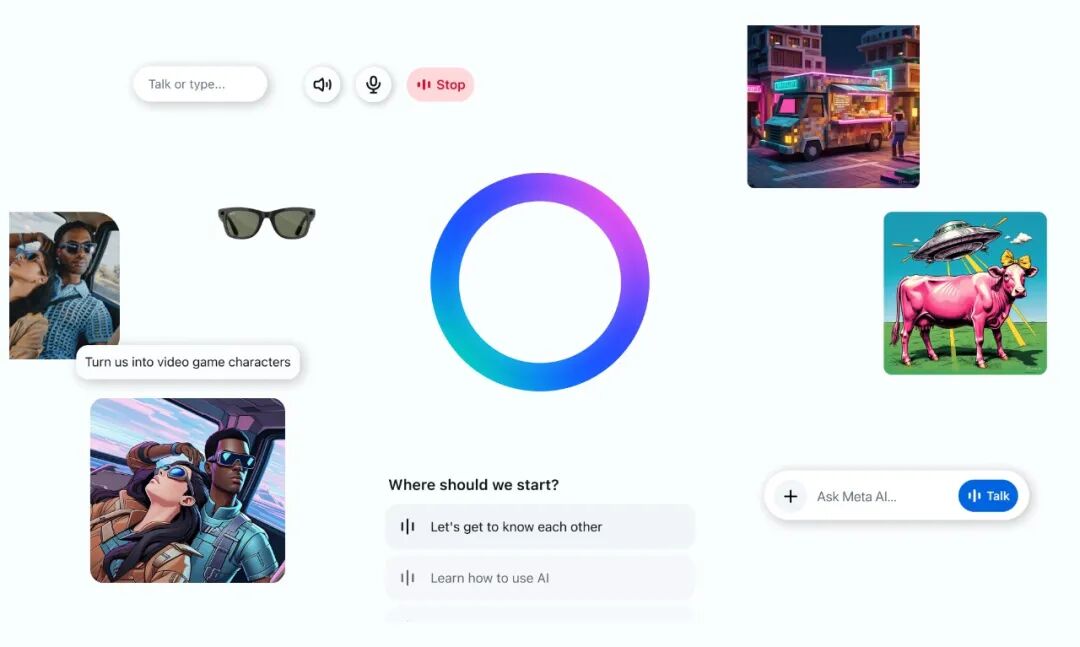
Meta AI App
The allure of Manus lies precisely in its successful completion of small-scale commercial validation.
From the beginning, Manus didn't try to cover all scenarios. Instead, it focused on handling specific tasks. Its greatest strength is its clear product definition and explicit value delivery, which allowed it to enter the paid phase earlier than many competitors.
In today's environment, such certainty has become a rare commodity. This explains why Meta decided to act at this particular juncture.
What has truly been amplified is not Manus's 'generality' but its established position in the 'AI agent' track. However, when a company of Meta's immense scale has to rely on acquisitions to validate a product form, it suggests, to some extent, a loss of patience in internal exploration. 
Manus is a product that's too skilled at storytelling. The underlying issues haven't disappeared. Whether a product that has achieved commercial logic closure on a small scale can be smoothly integrated into Meta's ecosystem remains highly uncertain. Manus has long been known for its 'narrative' prowess. It doesn't just deliver product progress; it also presents clear and consistent visions of the future. Keywords like 'general,' 'agent,' and 'next-generation work style' have permeated its entire growth journey. 
Manus celebrating $100 million in ARR, as shared on social media
At various stages, this narrative has outpaced actual validation.
Many may still recall the controversy surrounding invitation codes half a year ago and the subsequent disappointment when the actual experience fell short of the hype. Manus then 'self-exiled' from the domestic market, relocating entirely to Singapore to focus on international markets. Such situations are, of course, not uncommon in the tech industry.
In the AI startup wave, prioritizing narrative is indeed a common strategy. OpenAI remains the most adept storyteller among AI companies to this day. However, Manus's distinction lies in its consistent high exposure and skill in packaging incremental achievements as directional signals. This approach rapidly secured its position in capital and public opinion circles, paving the way for the eventual acquisition. From this perspective, being acquired may be a logical outcome for Manus. 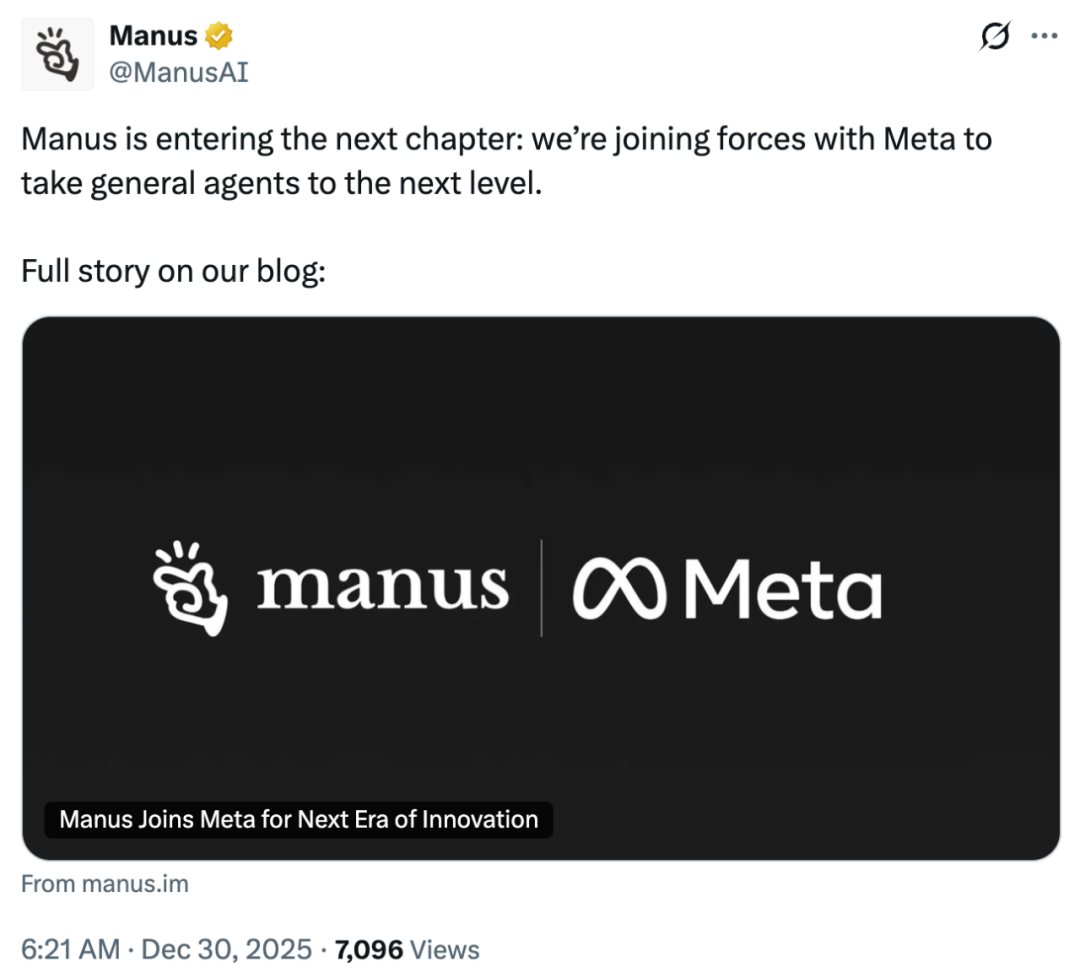
Image source: Internet
Within a larger ecosystem like Meta's, Manus no longer needs to constantly expand its narrative boundaries. After all, the billions of dollars Meta has invested already validate its worth—not necessarily representing the future of AI but at least serving Meta's current needs.
This outcome also signifies a change in strategy.
Manus's emphasis on efficiency and completion has thus far remained on a very limited scale, while Meta's core products still operate at scales of hundreds of millions or even billions.
These two logics don't naturally align. Once integrated into a platform-level structure, the product will either be reshaped to fit Meta's ecosystem or gradually marginalized. More critically, this acquisition doesn't answer Meta's fundamental question: Whom does AI serve within Meta's ecosystem—the efficiency needs of ordinary users, the production workflows of creators, or the revenue models of advertising systems? If this question remains unresolved, no amount of acquisitions will fundamentally alter the situation; they will merely result in continuous tool morphing. 
Image source: Internet
This isn't Zuckerberg's first aggressive choice under pressure. The difference lies in the fact that past bets on VR and the metaverse often pointed toward an unformed future, whereas this time, it resembles searching for a plug-and-play solution among existing options.
Manus may not be the worst choice, but it's unlikely to single-handedly address Meta's structural anxieties. For Zuckerberg, desperate for a solution, it may temporarily alleviate symptoms. Whether it can reshape the entire AI competition landscape next year remains uncertain. Of course, for Manus, none of this matters anymore. After all, they've achieved a status envied by many 'rising stars'—no longer needing to endure relentless competition in the startup world.
-
![]()
Nubia’s AI-Powered Smartphone Agent is on the Horizon: Can ZTE Make a Triumphant Return with Doubao?
-
China's Private Commercial Rockets: The Next Challenge Post-Long March 10B
-
![]()
New Energy Vehicle Owners: How Much More Will You Pay in Vehicle and Vessel Tax?
-
![]()
The next generation of robots may not necessarily resemble humans
-
Hikvision Makes Its Grand Debut at the World Artificial Intelligence Conference, Unveiling the All-Encompassing Guanlan Large Model Technology System
-
![]()
GPT-5.6 Deletes a Tech Mogul's Files: Before Granting AI "Full Access," Ensure You Have a Backup Plan
-
![]()
120,000 Layoffs in Silicon Valley Due to AI
-
![]()
Volkswagen Group to Slash Model Range by Half, Cut 1 Million Units of Production Capacity in China and Europe