Spring Festival Gala of the Horse Year: A Benchmark for Breakthroughs in Next-Generation 'Embodied AI'
 02/09 2026
 552
552

As the Spring Festival of the Horse Year approaches, the 2026 CCTV Spring Festival Gala, themed around the Bingwu Horse Year, has undoubtedly become a hot topic of national discussion.
According to reports, the 2026 CCTV Spring Festival Gala, themed 'Galloping Horses: Unstoppable Momentum,' will serve as a grand showcase for domestically produced embodied AI robots. From the 'Steel Galloping Horses' cluster performance at the Beijing main venue to the human-robot co-performance of traditional opera in Hefei, products from domestic robotics companies such as Magic Atom, Galaxy General, Unitree Technology, and iFLYTEK will make consecutive appearances with 'millimeter-level motion precision, multimodal interaction capabilities, and deep cultural integration,' marking a crucial leap from 'technical showcase' to 'practical application.'
This national-level technological exhibition will also outline the real path of China's embodied AI technology from laboratory research to commercialization: The awe-inspiring performances on stage represent intuitive visualizations of technological breakthroughs, while the challenges and pain points behind the scenes remain core issues for large-scale industrial deployment.
Collective Performance by the Embodied AI 'Dream Team'
Judging from the officially released program lineup and announcements from embodied AI robotics companies, the technological core of the 2026 Horse Year Spring Festival Gala will be fully constructed by embodied AI robots.
The CCTV main venue and sub-venues in Hefei and Shenyang will collaborate seamlessly, precisely targeting unique scenarios and forming a multidimensional performance matrix that integrates entertainment, interaction, and practical applications. This will create an exhibition lineup covering various robot forms, including humanoid, quadrupedal, bionic, and intelligent mobility robots. Data shows that the core technologies of the participating robots have achieved autonomous controllability, with a localization rate exceeding 85%, representing a concentrated inspection of China's embodied AI industrial ecosystem.
The Beijing main venue will feature a technology-culture fusion program themed around the 'Horse Year.' According to current rehearsal leaks,
Sixteen Unitree Technology G1/H1 humanoid robots will transform into 'Steel Galloping Horses' in the program 'New Postures of Galloping Horses,' using millisecond-level servo response systems to compress joint control errors to 0.01 millimeters, accomplishing difficult maneuvers such as in-place flips and bionic horse steps. Paired with AR virtual effects, digital silhouettes will appear behind the metallic steeds as they soar and tumble, instantly creating a strong Horse Year atmosphere through the fusion of virtual and real elements!
As the designated embodied AI model robot for the Spring Festival Gala, Galaxy General robots will participate in cluster dance performances while engaging in real-time interactions with hosts, cracking jokes and chatting. This robot can adjust its performance rhythm based on audience applause, plan autonomous paths, and assist with lighting tests, truly embodying the ability to 'work, perform, and interact!'
As a strategic partner of the CCTV Spring Festival Gala, Magic Atom will prominently feature its MagicBot Z1 mini-humanoid robot and Magic Dog quadrupedal robot dog—a dynamic 'human-dog duo.' The former boasts 50 degrees of freedom, effortlessly performing difficult maneuvers like continuous falls and standing up, and bending backward. The latter navigates multiple stage scenarios with ease, thanks to its wide-temperature operation and centimeter-level positioning capabilities.
Additionally, Songyan Dynamics, as a humanoid robot partner for the CCTV Spring Festival Gala, will showcase its N2 humanoid robot's explosive power with continuous flips, executing clean and sharp movements that demonstrate its hardcore technical prowess 'from arena glory to household companionship.'
The Hefei sub-venue will focus on the fusion of technology and tradition. The iFLYTEK bionic opera robot troupe will perform Peking Opera 'Trotting Horse' alongside human actors, replicating stylized movements with errors controlled within 0.1 millimeters, precisely restoring the posture and charm of the opera. Meanwhile, this robot troupe will collaborate with human musicians to perform the folk music 'Golden Snake Dances Wildly' using multimodal perception and fine control technologies.
The Shenyang sub-venue will highlight the hard power of industrial robots. The SIASUN Robot SR210A heavy-duty robotic arm will operate smoothly in low-temperature environments via 5G+edge computing, achieving zero-lag performance and stable completion of 3-ton 'Lion Dance' stage lifting, flipping, and lighting coordination with ±1 millimeter positioning accuracy.
However, to witness the scenario-based innovative applications of AGIBOT robots, you'll need to tune in to 'A Wonderful Night of Robots' by AGIBOT, airing on February 8 on Mango TV (simulcast on Mango TV, AGIBOT's official platform, and the 'Zhihui Jun' account).
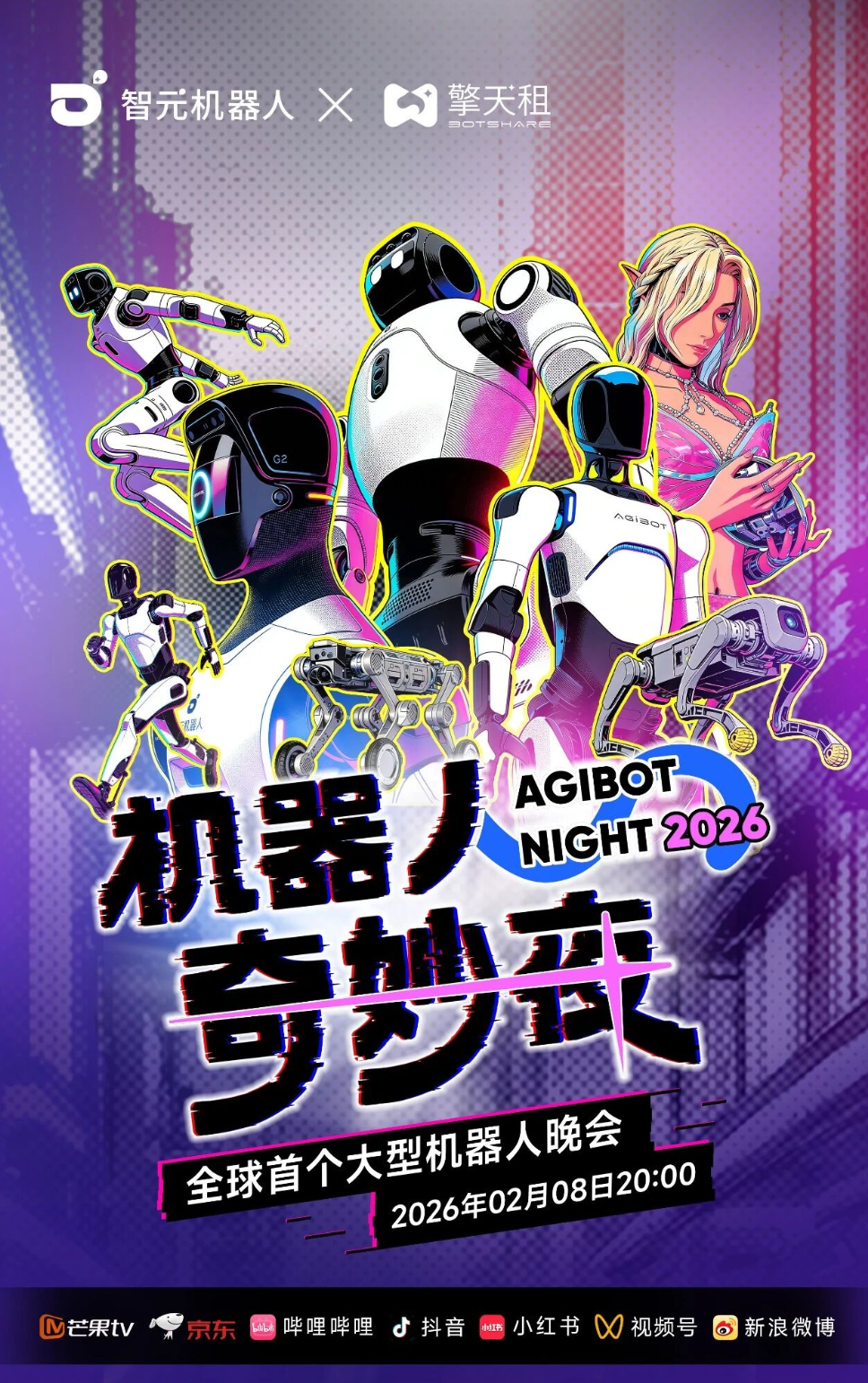
This marks the world's first large-scale gala entirely led by robots, with over 200 AGIBOT robots handling everything from hosting to performances (including singing, dancing, skits, magic, martial arts, and fashion shows) to interactions and coordination. Among them, the Yuanzheng A2 will serve as the host, the Yuanzheng A1 will lead the performances, the Qiyuan Q1 will showcase talents, and models like the Lingxi X2 will comprehensively demonstrate AGIBOT's end-to-end autonomous capabilities in motion control, dexterous manipulation, and multimodal interaction.
Compared to single-robot performances and interactions, staging over 200 cross-category robots simultaneously involves interactive intelligence, motion intelligence, operational intelligence, and multi-robot coordination, requiring solutions to challenges such as communication delays (sub-second response), motion synchronization (millimeter-level precision), and system stability, significantly increasing scale and technical difficulty.
This is not just a celebration of AGIBOT's full range of robots but also a 90-minute gala that will validate AGIBOT's 'One Body, Three Intelligences' architecture and GO-1 embodied foundation model, pushing the limits of multimodal large models driving natural interaction and scenario understanding through extreme pressure testing. It will also scale-test key capabilities such as multi-robot coordination, real-time interaction, and complex environment perception.
Current embodied AI robot performances have moved beyond single-motion displays, achieving a triple fusion of 'performance + interaction + practicality.' Motions pursue extreme precision, interactions achieve emotional resonance, and technologies target real-world applications, allowing audiences to intuitive visualize the potential of embodied AI in daily life. Behind this lies China's full-chain technological breakthroughs in embodied AI, from core components and control algorithms to embodied large models.
The Critical Leap from 'Precise Execution' to 'Autonomous Intelligence'
The embodied AI robot performances at the Horse Year Spring Festival Gala benefit from China's full-chain technological breakthroughs in embodied AI, from core components and control algorithms to embodied large models, serving as a practical test of core embodied AI technologies. Every technological highlight displayed by the embodied AI robots on stage corresponds to core industry R&D directions, marking China's critical leap from 'precise execution' to 'autonomous intelligence' in embodied AI technology.
Extreme motion control and collaborative capabilities form the technical foundation of the performances. Complex movements by humanoid robots and zero-error synchronization among cluster robots deeply rely on three technological breakthroughs: servo response, motion planning, and multi-robot coordination.
Unitree G1/H1's high-speed servo response system enables robots to quickly adjust limb postures for complex maneuvers. Galaxy General and Unitree's cluster robots rely on 5G and advanced algorithms to construct a real-time 'perception-decision-execution' closed loop, a technology directly applicable to industrial assembly line collaboration and warehouse cluster handling. Magic Atom's quadrupedal robot dog's centimeter-level positioning and wide-temperature operation capabilities also validate embodied robots' adaptability in complex environments, laying the foundation for outdoor special operations.
The deployment of embodied large models represents the biggest technological highlight of this Spring Festival Gala. Galaxy General has deeply integrated large language models with physical AI engines, constructing an autonomous agent architecture based on world models. This not only frees robots from their 'mechanical puppet' status of passively executing instructions but also enables them to autonomously plan actions and make decisions based on the environment and human needs. Its innovative virtual-real combined training technology has completed the construction of a 10-billion-scale robot operational dataset. Additionally, its embodied large model's end-to-end control latency has been reduced to 19ms, with dynamic environment perception accuracy exceeding 90%, reaching industrialization standards. Currently, this robot product has been deployed in over a dozen smart pharmacies in Beijing, enabling 24-hour unmanned medication picking and delivery.
Furthermore, multimodal perception and fine manipulation capabilities allow robots to 'blend into scenarios and empathize with humans.' The iFLYTEK bionic opera robot relies on the fusion of visual perception and fine force control technologies to precisely replicate opera movements. Magic Atom's MagicBot Z1 can identify human emotions and respond through voice and visual multimodal information collection, giving machines 'warmth,' a core requirement for family services, elderly care companionship, and other scenarios.
Notably, the robots performing on the Spring Festival Gala stage are not custom-made but have already achieved industrial deployment, covering multiple fields such as industry, logistics, retail, and elderly care. Moreover, the localization rate of core components for these robots exceeds 85%, breaking foreign technological monopolies in high-precision servo joints, motion control chips, and embodied large model training frameworks, laying the foundation for large-scale production.
Behind this lies policy support from multiple regions, including Beijing, Shanghai, and Shenzhen, as well as the fruits of industry-academia-research collaborative innovation—nearly 30 dedicated embodied AI testing fields have been put into use, and over 150 local enterprises are engaged in innovative exploration, forming a complete ecosystem from 'core technology R&D to component mass production to scenario applications.'
Industrial Realities and Development Challenges Behind the Stage Spotlight
However, it's important to note that the spotlight moments on the Spring Festival Gala stage represent the 'ideal state' of the embodied AI industry, not the 'realistic state' of large-scale industrial deployment. Currently, the global embodied AI industry still faces multiple pain points and challenges in technology, cost, data, and commercialization.
Technologically, insufficient generalization capabilities and the 'embodiment gap' remain core bottlenecks. Their root cause lies in the insufficient depth of multimodal information fusion (vision, touch, force) in embodied AI robots, making it difficult to form a comprehensive understanding of the physical world. This results in a significant decline in dynamic obstacle avoidance and fine control precision in unstructured environments. The Sim2Real (simulation-to-reality) deployment challenge remains unresolved, with substantial differences between simulations and real-world complex scenarios, making it difficult to directly transfer skills trained in simulation to robots. The 'black box' nature of large model decision-making processes also poses challenges for accountability in critical scenarios like healthcare and industry, restricting their application in high-sensitivity fields.
Data-wise, the massive shortage of high-quality physical interaction data and high collection and annotation costs form dual constraints. Embodied AI development requires vast amounts of physical interaction data, but currently, over 99% of the global demand remains unmet. Moreover, data collection requires integrating multidimensional information such as text, vision, joint trajectories, and physical interactions, with inconsistent annotation standards, making collection costs over 10 times higher than ordinary data. Additionally, physical environment data contains large amounts of sensitive information, with security risks in transmission and storage becoming a significant consideration for industrial development.
In terms of hardware and costs, core component dependencies and high costs restrict civilian adoption. Although the localization rate of core components for the Spring Festival Gala robots exceeds 85%, high-end GPUs, ultra-high-precision sensors, and precision reducers still rely on imports to some extent, constraining industrial development and driving up product costs. Simultaneously, low standardization of hardware interfaces and communication protocols leads to incompatibility among devices from different enterprises, increasing development costs by over 30% and restricting industrial ecosystem collaboration. Furthermore, the contradiction between energy consumption and battery life persists, with mainstream embodied robots offering only 7.5 hours of continuous operation, making it difficult to meet the 24-hour operational demands of industrial and logistics fields.
Commercially, difficulty in scenario adaptation and long ROI cycles hinder the deployment of embodied AI robots. The Spring Festival Gala stage represents a highly structured ideal scenario, while real-world application scenarios are complex, diverse, and unpredictable. Skills trained in robotics labs are difficult to quickly adapt, with long cycles for large task decomposition and validation and high operation and maintenance costs. This has prevented most applications from forming commercial closed loop s, trapping enterprises in a Circular dilemma of 'cost-scale-price': high costs drive up prices, restricting market demand; insufficient scale prevents economies of scale, keeping costs high. WhaleQi Comments
2025 marks the first year of embodied AI, and in this global competition, China has secured a place as a new player at the table. For the embodied AI industry, the 2026 Horse Year Spring Festival Gala stage is not an endpoint but a crucial opportunity for embodied AI robots to enter thousands of industries and daily life.
On the next journey of embodied AI, the global industry will exhibit four major trends: technological standardization, hardware modularization, scenario verticalization, and ecological collaboration. On the software and hardware fronts, world model-driven autonomous agents will become the mainstream paradigm, while modular design and core component localization will drive significant cost reductions. Deep cultivation of vertical application scenarios will become the core path for commercialization, while government-industry-academia-research-user collaboration will construct a complete industrial ecosystem. In the future, China will spur forward in the global technology competition with embodied AI as its core, transforming it into a driving force for social progress and a better life.
*Editor's Note: Original content is hard-earned; please respect the author. For reprints, please contact us.
-
![]()
Li Bin Claims, 'Denying the Pure EV Trend is Like Ostrichism.' What's Li Xiang's Take?
-
Lenovo: Liu Jun Turns Left, Yang Yuanqing Turns Right
-
Lenovo: Liu Jun Goes Left, Yang Yuanqing Goes Right
-
![]()
MiniMax Shares Unlock: Cornerstone Shareholders Show Long-Term Optimism, Yet Stock Plummets Nearly 30% in Two Days; Zhipu Also Sees Nearly 20% Drop Today
-
![]()
Single-Day Plunge of 40%: The 'First AGI Stock' Faces More Than Just Share Price Concerns
-
![]()
Ricoh and Fuji Hike Prices on Legacy Edge; Insta360 Poised to Disrupt Mirrorless Camera Market
-
![]()
Ricoh and Fujifilm Raise Prices in Tandem, Relying on Established Reputations; Insta360 Poised to Disrupt Mirrorless Camera Market
-
![]()
Strategic Shift in Photoelectric Sensing: Maxvision Secures Controlling Stake in CAS Optotech