Zhao Ming’s Move to Qianli Technology Sparks Transformation in AI Auto Industry
 02/14 2026
 639
639
Author / Xinyan
Produced by / Insight Auto
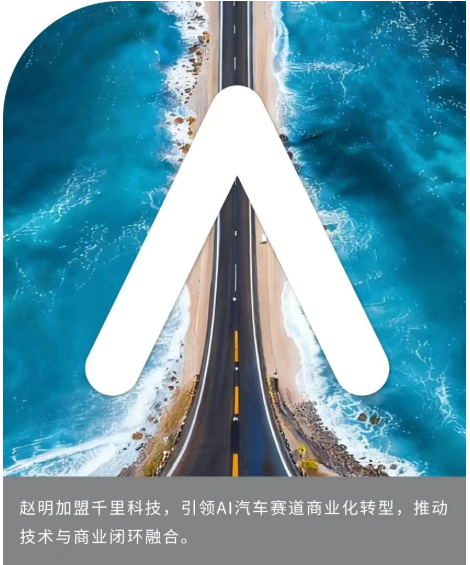
After a year-long hiatus, Zhao Ming, the former CEO of Honor, has swiftly made his comeback by joining Qianli Technology as co-chairman, sending ripples through the highly competitive AI automotive sector.
This seasoned Huawei executive, who boasts extensive experience in managing consumer electronics businesses worth hundreds of billions, has officially teamed up with his "old friend" Yin Qi to comprehensively lead the development of a closed-loop AI business model.
This formidable partnership directly tackles the challenges of shareholder integration and scalable profitability, aligning perfectly with the impending explosion of the AI autonomous driving market. By 2026, the global market is projected to surge to $939 million, growing at a compound annual rate of 55.2%.
Zhao Ming's foray into a new industry not only marks a fresh chapter in his career but also represents a significant milestone in the AI automotive industry's transition from technological R&D to commercialization. Competition in the sector has now escalated to a new level, characterized by a dual focus on "technological prowess" and "commercial closed-loop capabilities."

Technology Hits a Bottleneck, Commercial Strategy Becomes Key to Breakthrough
The collaboration between Zhao Ming and Yin Qi is essentially a strategic move at a pivotal stage in AI automotive development, with a core focus on enhancing commercialization capabilities following technological breakthroughs. Under Yin Qi's leadership, Qianli Technology has established a strong technological foundation, pioneering the "Model Inclusion" metric to quantify AI autonomous driving decision-making authority.
The G-ASD intelligent driving system, developed in partnership with Geely, offers comprehensive coverage from L2 to L4 scenarios, boasting 1400TOPS computing power and five LiDAR hardware configurations. It has already been deployed in 16 models, including Zeekr and Lynk & Co.
However, technological leadership alone has not translated into market dominance. Qianli Technology faces challenges such as a diverse shareholder base (including Geely, Mercedes-Benz, and Chongqing local state-owned assets), complex integration between Geely and Megvii teams, and insufficient commercialization efficiency of AI solutions. In 2024, the company achieved 7.035 billion yuan in revenue, marking a transformative breakthrough but still falling short of achieving scalable profitability.

Zhao Ming's key strength lies in bridging this commercial gap. During his decade-long tenure at Honor, he orchestrated a remarkable turnaround. When Honor became independent from Huawei in 2016, its online channel sales plummeted by 40%. Within two years, he led the team to achieve 49.68 million units in sales and 71.6 billion yuan in revenue, topping China's internet smartphone brand rankings. He also integrated AI strategy throughout the terminal layout, pioneering the "end-side AI + platform-level AI" development path.
The market has already responded positively to this partnership, with Qianli Technology's stock price surging to the daily limit on the day Zhao Ming's joining was announced, closing at 11.39 yuan and boasting a total market capitalization of 51.495 billion yuan, up 25.86% from a year ago.
The underlying rationale is clear: as AI technology enters a stage of homogeneous competition, Zhao Ming's expertise in user-centric thinking, channel expansion, and ecosystem integration will enable Qianli Technology to convert 70%-80% of its "Model Inclusion" technological advantages into tangible market share and profit growth, addressing the industry's common issue of "strong technology, weak commercialization."

Cross-Industry Players Enter, AI Automobile Sector Enters Restructuring Phase
Zhao Ming's entry is not merely a strategic reinforcement for Qianli Technology but also signals that the AI automotive sector has fully entered a restructuring phase dominated by cross-industry players.
Currently, the sector is dominated by three major forces. Yu Chengdong's Huawei Harmony Intelligent Driving is renowned for its aggressive technology, with cumulative assisted driving mileage exceeding 6.17 billion kilometers and urban navigation mileage reaching 180 million kilometers, capturing half of the luxury market above 350,000 yuan.
Behind this evolving competitive landscape lies a profound transformation in the underlying logic of the AI automotive industry, shifting from a pure technological race to a comprehensive competition in "technological implementation efficiency."
2026 will be a critical watershed, with domestic urban NOA penetration expected to soar to 22%, and consumer acceptance of intelligent driving systems transitioning from novelty to necessity.
Zhao Ming's experience in the consumer electronics industry precisely meets this industry upgrade demand. His approach to optimizing end-side AI can directly adapt to the cost-reduction needs of map-free intelligent driving, while his refined terminal market operation capabilities can address the conversion challenges of intelligent driving subscription services.
From an industry-wide perspective, Zhao Ming's cross-industry move is not an isolated event but a milestone in the deep integration of the consumer electronics and automotive industries.
As the AI autonomous driving market expands from $605 million in 2025 to $5.413 billion in 2030, more cross-industry talents with dual capabilities in "technological understanding + commercial operation" will accelerate their entry into the sector.
The underlying driver of this trend is that AI automobiles have evolved from "technological prototypes" to "mass-market commodities," urgently requiring the breaking down of capability boundaries between tech companies and automakers.
The partnership between Zhao Ming and Yin Qi will propel the AI automotive industry to accelerate beyond the research and development phase and enter a new era that values both technological and commercial merits.
END
-
![]()
Li Bin Claims, 'Denying the Pure EV Trend is Like Ostrichism.' What's Li Xiang's Take?
-
Lenovo: Liu Jun Turns Left, Yang Yuanqing Turns Right
-
Lenovo: Liu Jun Goes Left, Yang Yuanqing Goes Right
-
![]()
MiniMax Shares Unlock: Cornerstone Shareholders Show Long-Term Optimism, Yet Stock Plummets Nearly 30% in Two Days; Zhipu Also Sees Nearly 20% Drop Today
-
![]()
Single-Day Plunge of 40%: The 'First AGI Stock' Faces More Than Just Share Price Concerns
-
![]()
Ricoh and Fuji Hike Prices on Legacy Edge; Insta360 Poised to Disrupt Mirrorless Camera Market
-
![]()
Ricoh and Fujifilm Raise Prices in Tandem, Relying on Established Reputations; Insta360 Poised to Disrupt Mirrorless Camera Market
-
![]()
Strategic Shift in Photoelectric Sensing: Maxvision Secures Controlling Stake in CAS Optotech